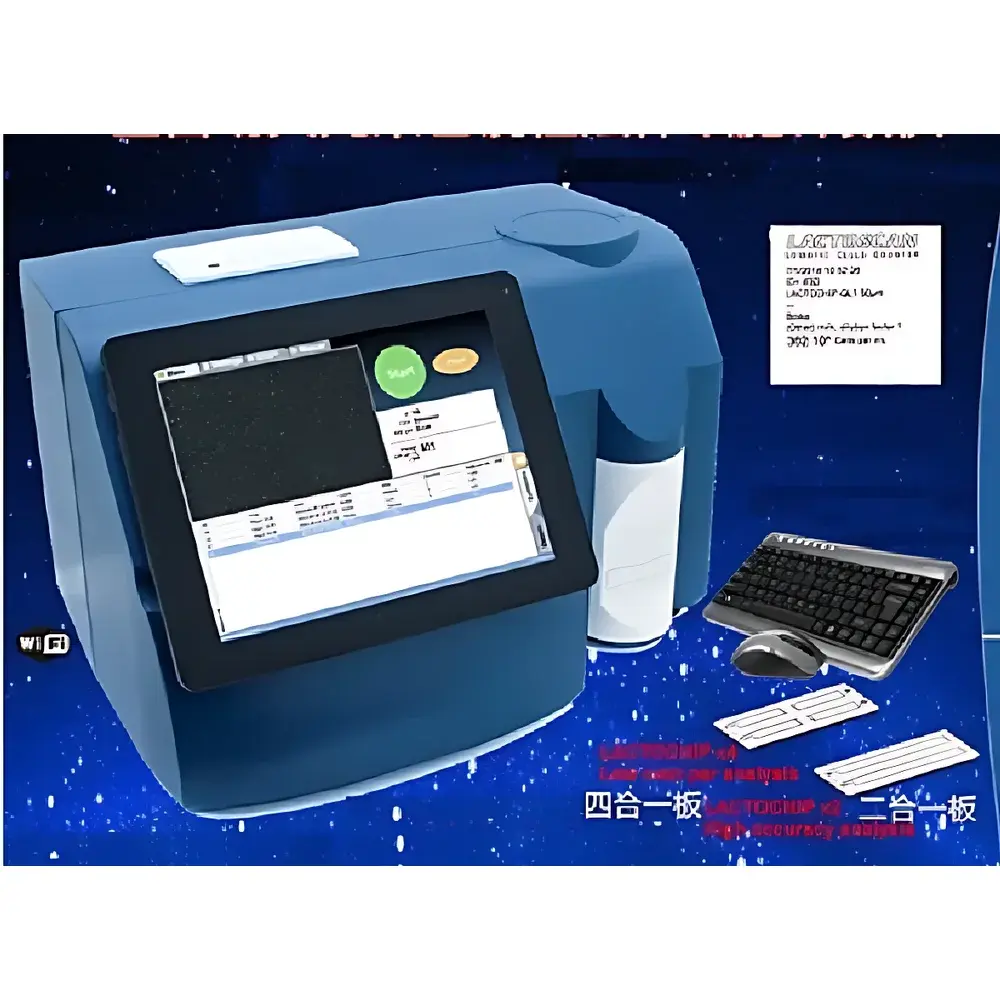
LACTOSCAN SCC Automated Fluorescent Staining Microscopy-Based Somatic Cell Counter for Raw Milk
| Origin | Bulgaria |
|---|---|
| Manufacturer Type | Authorized Distributor |
| Origin Category | Imported |
| Model | LACTOSCAN SCC |
| Detection Scope | 10,000–10,000,000 cells/mL |
| Analysis Speed | 450 samples/hour |
| Repeatability | <0.5% RSD |
| Accuracy | <1% deviation from reference method (ISO 13366-1) |
| Sample Throughput Mode | Up to 4 samples simultaneously |
| Measurement Time per Sample | <60 s |
| Display | 10-inch capacitive touchscreen interface |
| Connectivity | Integrated Wi-Fi, USB, Ethernet |
| Data Storage | Unlimited on-device archival with timestamped audit trail |
| Software | Field-upgradable firmware with GLP-compliant data management |
Overview
The LACTOSCAN SCC is an automated, benchtop somatic cell counter engineered specifically for raw milk quality control in dairy farms, collection centers, and accredited testing laboratories. It employs fluorescent staining microscopy — a validated optical detection principle compliant with ISO 13366-1:2006 — to quantify nucleated somatic cells (primarily leukocytes and epithelial cells) in bovine milk. Unlike flow cytometry or impedance-based systems, this method uses a proprietary DNA-binding fluorochrome that selectively labels cellular nuclei under controlled staining kinetics, followed by high-resolution digital imaging and AI-assisted cell segmentation and counting. The instrument delivers traceable, operator-independent results without requiring centrifugation, filtration, or manual slide preparation. Its design prioritizes robustness in variable ambient conditions (10–35 °C, 30–80% RH), making it suitable for both mobile lab vans and fixed QC environments.
Key Features
- Fully automated sample processing: integrated reagent dispensing, incubation, staining, rinsing, and imaging — no user intervention required after loading.
- High-throughput capability: processes up to 4 samples concurrently, achieving a nominal throughput of 450 samples per hour under continuous operation.
- Optimized optical path: dual-wavelength LED excitation (470 nm/530 nm) coupled with a 5-megapixel monochrome CMOS sensor ensures consistent fluorescence signal capture across the full dynamic range (10⁴–10⁷ cells/mL).
- Calibration traceability: includes two certified reference standards (low- and high-range bovine milk suspensions) supplied with each instrument shipment; calibration verification is performed automatically prior to each batch run.
- Compact footprint & low maintenance: net weight of 5.3 kg; no moving parts beyond fluidic valves and stepper-driven stage; consumables limited to single-use cuvettes and proprietary stain solution cartridges.
- Regulatory-ready interface: supports user role-based access control (admin/operator), electronic signatures, and full audit trail generation per FDA 21 CFR Part 11 requirements when configured with network authentication.
Sample Compatibility & Compliance
The LACTOSCAN SCC is validated for use with chilled raw cow’s milk (pasteurized and ultra-high temperature-treated milk are excluded). It accommodates standard 10 mL plastic test tubes and integrates seamlessly into existing milk reception workflows. All analytical performance metrics — including precision (RSD <0.5%), accuracy (<1% bias vs. reference microscopy per ISO 13366-1 Annex B), and linearity (r² >0.999 over 10⁴–10⁷ cells/mL) — were established during independent inter-laboratory trials conducted under EN ISO/IEC 17025-accredited conditions. The system meets EU Regulation (EC) No 853/2004 hygiene requirements for dairy product analysis and supports compliance with national mastitis monitoring programs aligned with IDF Standard 148A.
Software & Data Management
The embedded operating system runs LACTOSCAN v4.2 firmware, featuring a browser-based configuration portal accessible via local Wi-Fi or Ethernet. Data files are stored in encrypted SQLite databases with automatic daily backup to external USB drives. Each result includes metadata: sample ID, operator ID, instrument serial number, calibration status, environmental logs (temperature/humidity), and raw image thumbnails (retained for 90 days, configurable). Export formats include CSV (for LIMS integration), PDF reports (with optional farm-specific branding), and XML (compatible with Eurofins DairyLink and QMS DairySuite). Remote software updates are delivered via secure HTTPS push, with version rollback capability and change-log documentation provided for GMP/GLP validation purposes.
Applications
- Routine herd health surveillance: early detection of subclinical mastitis through longitudinal SCC trending.
- Raw milk payment classification: real-time grading according to national thresholds (e.g., EU ≤400,000 cells/mL; USA ≤750,000 cells/mL).
- Process optimization in dairy plants: correlation of SCC levels with thermal stability, cheese yield, and shelf-life prediction models.
- Research applications: quantification of immune response markers in experimental feeding trials or selective breeding programs.
- Third-party certification: supporting ISO/IEC 17025 accreditation for milk testing laboratories seeking scope expansion in somatic cell enumeration.
FAQ
What regulatory standards does the LACTOSCAN SCC comply with?
It conforms to ISO 13366-1:2006 for somatic cell counting methodology and supports implementation of GLP/GMP data integrity requirements per FDA 21 CFR Part 11 and EU Annex 11 when deployed with network authentication and audit logging enabled.
Can the instrument be integrated into a laboratory information management system (LIMS)?
Yes — via standardized CSV or XML export protocols; optional API integration is available under enterprise licensing agreements.
Is routine calibration required between samples?
No — internal calibration verification occurs automatically before each batch using onboard reference standards; full recalibration is recommended every 30 days or after 500 measurements.
What consumables are needed for daily operation?
Single-use optical cuvettes and sealed fluorochrome reagent cartridges; typical cost per test is below USD 0.45 at scale.
Does the system require external PC or dedicated server?
No — all computation, imaging, and data storage occur on-board; only optional remote monitoring or bulk reporting requires external infrastructure.