
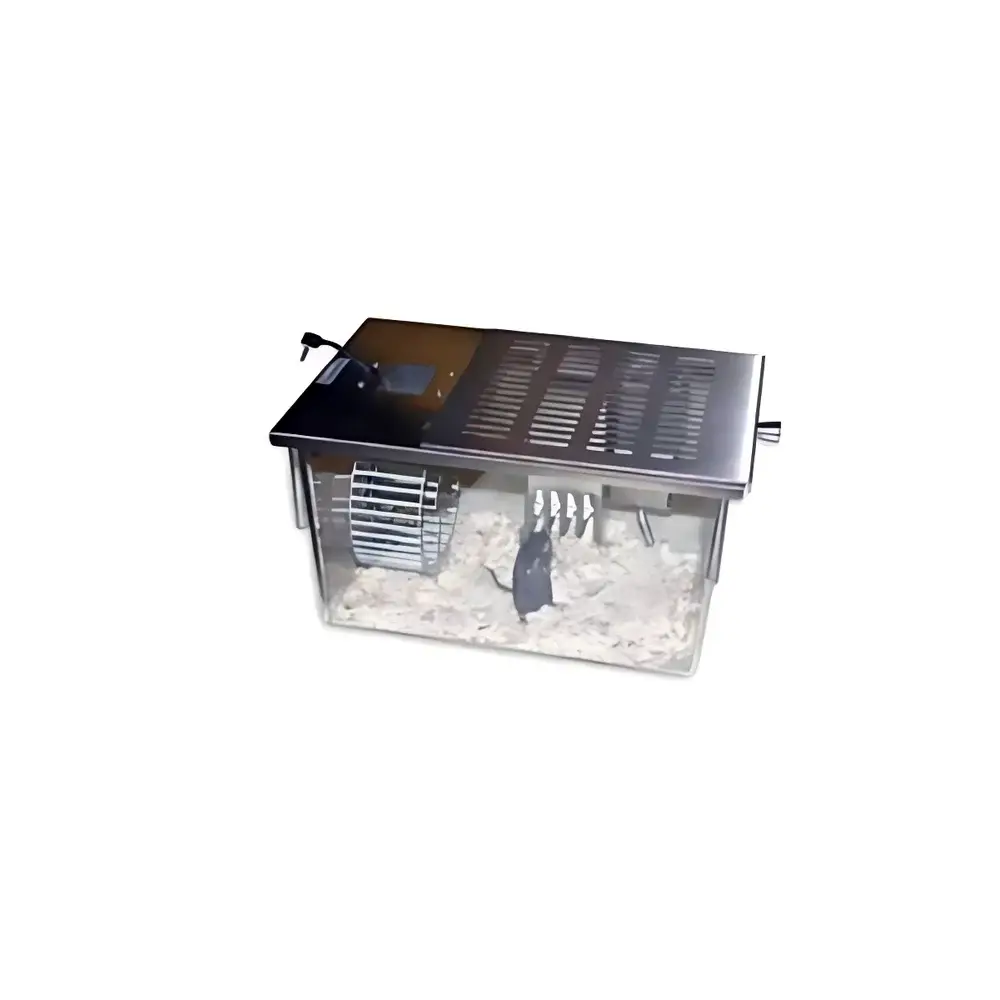
Lafayette Lafayette Autonomous Activity Wheel System
| Brand | RWD |
|---|---|
| Origin | USA |
| Manufacturer | RWD Life Science |
| Product Type | Imported Instrument |
| Model | Lafayette Autonomous Activity Wheel System |
| Price | USD 14,000 (approx.) |
Overview
The Lafayette Autonomous Activity Wheel System is a precision-engineered behavioral phenotyping platform designed for long-term, unobtrusive monitoring of voluntary locomotor activity in rodents. Based on the natural propensity of mice and rats to run spontaneously on wheels, this system enables quantitative assessment of circadian rhythm, baseline activity patterns, fatigue resistance, motor coordination, and pharmacologically induced changes in neuromuscular function. The system operates on the principle of rotational displacement detection via high-resolution optical or magnetic encoders integrated into low-friction Rulon®-bearing wheel assemblies—ensuring mechanical stability, minimal torque resistance (<0.5 g·cm), and signal fidelity across multi-week continuous recordings. It is widely deployed in preclinical neuroscience, chronobiology, toxicology, and drug development laboratories where reproducible, objective, and ethologically relevant activity metrics are required under controlled housing conditions.
Key Features
- Low-inertia, stainless-steel and polycarbonate construction ensures structural integrity, chemical resistance, and compliance with IACUC-approved caging standards.
- Rulon® composite bearing system provides near-frictionless rotation (static coefficient of friction < 0.05), enabling detection of subtle movement initiation and sustained low-speed running without mechanical hysteresis.
- Modular activity cage integrates standardized food hopper, gravity-fed water bottle with stainless-steel sipper tube, and optional drink-counting sensor for concurrent hydration behavior analysis.
- Manually operable access door allows temporary restriction of wheel access—critical for baseline control periods, habituation protocols, or post-dose observation windows.
- Compact wheel geometry (diameter: 11.5 cm for mice; 17.8 cm for rats) prevents limb entrapment and minimizes escape risk while maintaining ergonomic running posture.
- Programmable electromagnetic brake module supports precise experimental paradigms including time-triggered locking, position-dependent braking, or cumulative revolution-based termination.
- Scalable architecture supports up to 128 independently addressable wheels (organized in 8 × 16 matrix configuration) via synchronized USB/Ethernet data acquisition.
Sample Compatibility & Compliance
The system accommodates C57BL/6, BALB/c, CD-1, and Sprague-Dawley strains across standard weight ranges (18–35 g for mice; 250–500 g for rats). All components meet ISO 9001-certified manufacturing specifications and comply with NIH Guide for the Care and Use of Laboratory Animals, AAALAC International standards, and EU Directive 2010/63/EU. Cage dimensions conform to IACUC space requirements (≥ 200 cm² floor area per mouse; ≥ 450 cm² per rat), and materials are autoclavable or compatible with common disinfectants (e.g., 70% ethanol, Virkon®). Data acquisition software supports audit trails and user-level permissions, facilitating GLP-compliant study execution per FDA 21 CFR Part 11 guidelines when configured with electronic signatures.
Software & Data Management
The included Activity Wheel Data Acquisition Software (v5.2+) delivers real-time visualization of revolutions, distance (km), velocity (rpm), active/inactive time bins, and inter-event intervals. Raw encoder pulses are timestamped at 10 ms resolution and stored in binary .AWD format; export options include CSV, MATLAB (.mat), and HDF5 for interoperability with Python (NumPy/Pandas), R, and MATLAB-based circadian analysis toolkits (e.g., ChronoStar, El Temps). The GUI supports multi-wheel overlay plots, spectral density analysis (FFT-based periodogram), and automated onset/offset detection using adaptive thresholding algorithms. All sessions are logged with metadata (subject ID, protocol ID, operator, start/end timestamps), supporting traceability in regulatory submissions.
Applications
- Chronobiological studies: quantification of free-running period (tau), phase shifts, and amplitude damping under constant darkness or light-dark cycles.
- Neuropharmacology: evaluation of dopaminergic, GABAergic, and serotonergic agents on spontaneous activity and fatigue onset latency.
- Toxicology screening: detection of motor deficits following subchronic exposure to neurotoxic compounds (e.g., rotenone, MPTP).
- Muscle physiology: longitudinal tracking of endurance capacity in transgenic models of muscular dystrophy or mitochondrial myopathy.
- Metabolic phenotyping: correlation of wheel-running energy expenditure with indirect calorimetry endpoints (VO₂, VCO₂).
- Behavioral validation: confirmation of locomotor hyperactivity or hypoactivity in genetic knockouts prior to cognitive testing.
FAQ
What rodent species and strains are validated for use with this system?
Mice (C57BL/6J, BALB/c, FVB/N) and rats (Sprague-Dawley, Wistar) are fully supported. Wheel diameter and cage height are strain-specific and configurable per order.
Is the system compatible with existing vivarium environmental monitoring systems?
Yes—via TTL-compatible trigger outputs and RS-232/USB serial interface, enabling synchronization with temperature/humidity loggers and light-control systems.
Can data from multiple wheels be time-aligned across independent computers?
All units synchronize to host PC system clock with sub-100 ms drift over 30 days; network time protocol (NTP) support is available in enterprise license mode.
Does the software support automated detection of rest bouts or sleep-like inactivity?
While not a polysomnography substitute, the software identifies immobility epochs ≥ 40 s using adaptive variance thresholds, consistent with published definitions of behavioral quiescence in rodents.
What maintenance is required for long-term operation?
Rulon bearings require no lubrication; quarterly visual inspection of encoder alignment and monthly cleaning of food/water ports with 70% ethanol is recommended. No scheduled calibration is needed due to digital pulse counting architecture.



