
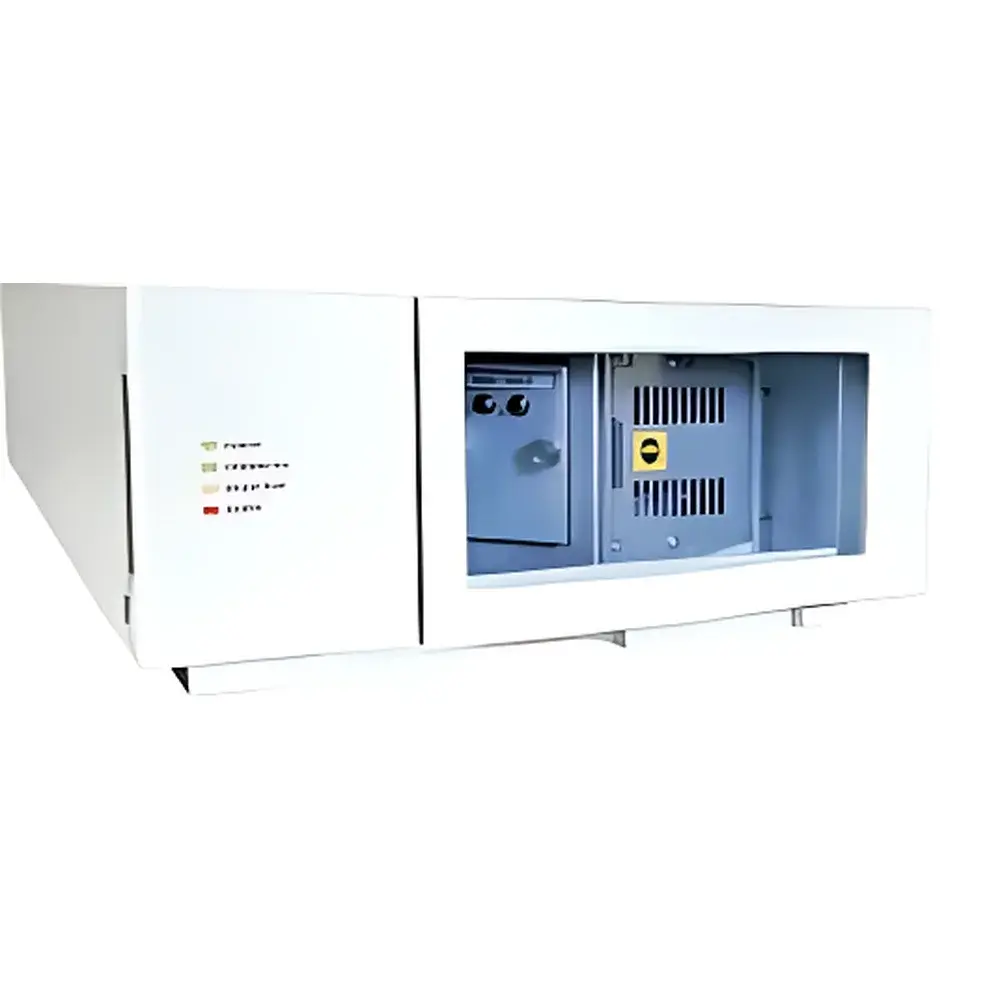
Lambert LB8170 Differential Refractometer Detector
| Origin | USA |
|---|---|
| Manufacturer Type | Authorized Distributor |
| Origin Category | Imported |
| Model | LB8170 |
| Instrument Type | Differential Refractometer Detector (RID) |
| Wavelength Range | 190–900 nm |
| Detection Method | Dual-Beam |
| Light Source | Deuterium Lamp |
Overview
The Lambert LB8170 Differential Refractometer Detector is a high-stability, dual-beam optical detector engineered for universal detection in liquid chromatography systems—particularly gel permeation chromatography (GPC), size-exclusion chromatography (SEC), and high-performance liquid chromatography (HPLC) applications where analytes lack chromophores. Unlike UV-Vis detectors, the LB8170 operates on the principle of measuring minute differences in refractive index (Δn) between sample and reference streams, enabling quantitative detection of non-UV-absorbing compounds—including carbohydrates, polyols, polysaccharides, synthetic polymers, aliphatic hydrocarbons, and surfactants. Its design adheres to fundamental optical physics: a collimated deuterium lamp provides broad-spectrum illumination (190–900 nm), while a thermally isolated optical path minimizes thermal drift-induced noise. The detector integrates real-time reference channel monitoring, automatic temperature compensation (±0.01 °C stability), and active solvent compensation—ensuring baseline integrity even under gradient elution or high-backpressure conditions typical in SEC analysis of macromolecules.
Key Features
- Dual-beam optical architecture with independent sample and reference flow cells, delivering inherent compensation for solvent composition fluctuations and pump pulsation.
- Thermally insulated optical chamber and precision-machined fused-silica flow cells to suppress thermal lensing and maintain long-term signal stability (RSD < 0.5% over 24 h).
- Automated zero-baseline correction and solvent flush sequence controlled via front-panel interface or remote command protocol—reducing manual intervention and operator-induced variability.
- Integrated analog-to-digital (A/D) conversion with 24-bit resolution and 100 Hz sampling rate, supporting high-fidelity peak shape capture for molecular weight distribution (MWD) calculations in polymer characterization.
- Compact benchtop footprint (240 × 360 × 180 mm) with standardized 1/16″ stainless-steel fittings and pressure rating up to 20 MPa—compatible with mainstream HPLC/GPC systems from Waters, Agilent, Shimadzu, and Thermo Fisher.
Sample Compatibility & Compliance
The LB8170 is validated for use with common SEC mobile phases including tetrahydrofuran (THF), chloroform, dimethylformamide (DMF), and aqueous buffers—provided refractive index differentials exceed ~1 × 10⁻⁶ RIU. It meets essential performance criteria outlined in ASTM D5296 (Standard Test Method for Molecular Weight Averages and Molecular Weight Distribution of Polymers by SEC) and ISO 16014-4 (Plastics — Determination of average molecular parameters of polymers by size-exclusion chromatography). While not intrinsically 21 CFR Part 11 compliant, its digital output supports integration into validated chromatography data systems (CDS) with full audit trail, electronic signature, and user access control when deployed within GxP environments under documented SOPs.
Software & Data Management
The LB8170 outputs analog voltage (0–1 V or 0–10 V, selectable) and RS-232/USB digital signals compatible with industry-standard acquisition platforms—including Empower, Chromeleon, OpenLab CDS, and custom LabVIEW-based DAQ configurations. Raw refractive index differential data is time-stamped and scaled in milli-refractive index units (mRIU), enabling direct import into GPC calibration software (e.g., Cirrus, OmniSEC, or PolyCAD) for absolute molecular weight determination. Firmware supports remote triggering of auto-zero and purge cycles via TTL-level commands, facilitating unattended operation in multi-detector arrays.
Applications
- Quantitative analysis of sucrose, lactose, sorbitol, xylitol, and other sugar alcohols in food, pharmaceutical, and fermentation process streams.
- Molecular weight distribution profiling of polystyrene, poly(methyl methacrylate), polyethylene glycol, and biopolymers using SEC/GPC with multi-angle light scattering (MALS) or viscometry coupling.
- Stability testing of emulsions and colloidal dispersions via refractive index shifts correlated with particle concentration or aggregation state.
- Method development for isocratic or gradient HPLC of saturated hydrocarbons, fatty acids, and silicone oils where UV detection fails due to low molar absorptivity.
- QC release testing of excipients (e.g., dextran, hydroxypropyl methylcellulose) per USP and Ph. Eur. 2.2.57 monographs requiring refractive index–based quantification.
FAQ
What is the minimum detectable refractive index change (Δn) for the LB8170?
The detector achieves a noise-equivalent Δn of ≤ 2 × 10⁻⁸ RIU at 1 Hz bandwidth, corresponding to ~10 ng injection of polystyrene in THF under optimized flow conditions.
Can the LB8170 be used with aqueous mobile phases containing high salt concentrations?
Yes—provided the reference and sample streams are identically buffered; however, rapid salt precipitation may occur in the flow cell if solubility limits are exceeded. Pre-filtration (0.1 µm) and post-run flushing with water/methanol are recommended.
Does the LB8170 require column oven synchronization for temperature control?
No—its internal Peltier-based thermal regulation maintains flow cell temperature within ±0.02 °C of setpoint independently, eliminating need for external oven coordination.
Is the deuterium lamp user-replaceable?
Yes—the lamp module is field-serviceable with standard Torx tools; typical lifetime exceeds 2,000 hours at nominal intensity settings.
How does the LB8170 handle baseline drift during long SEC runs?
Through continuous real-time reference subtraction, automated periodic zeroing (configurable interval: 1–60 min), and dynamic solvent compensation algorithms embedded in firmware.





