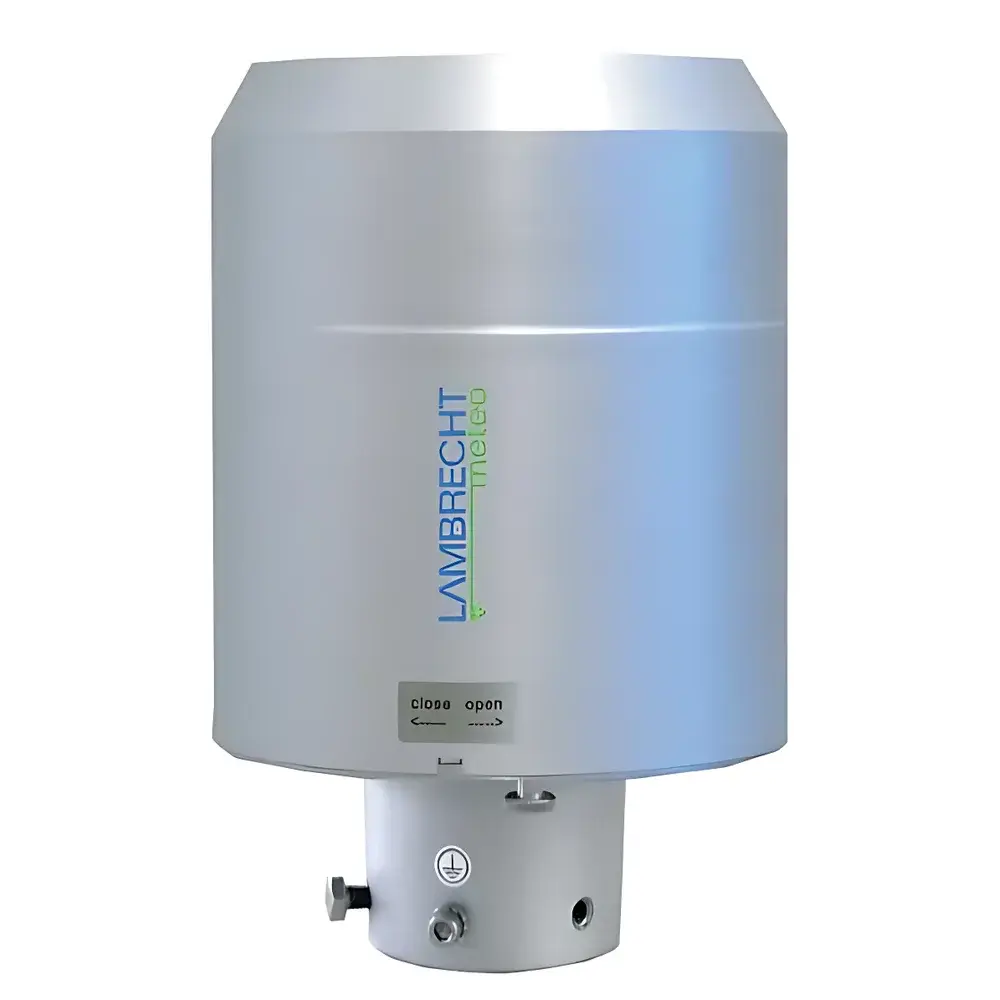
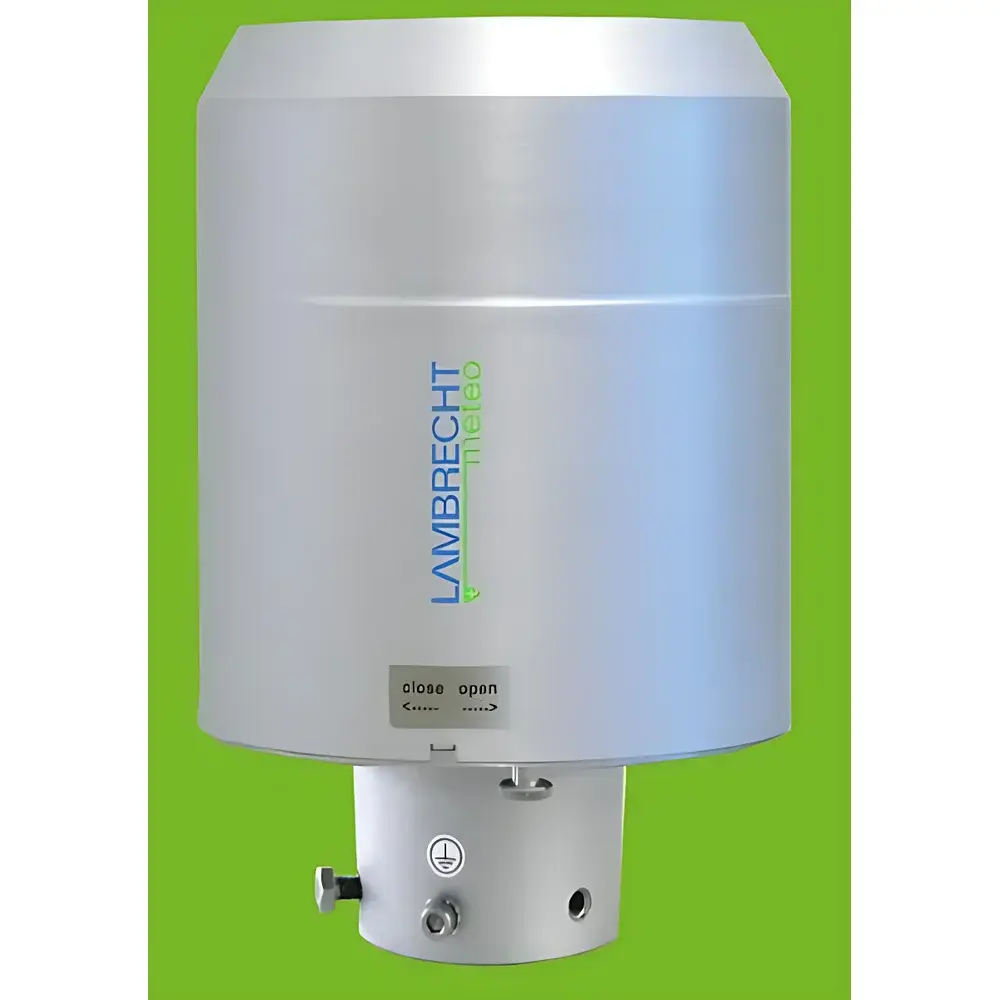
Lambrecht 15184 Weighing-Type Precipitation Gauge
| Brand | Lambrecht |
|---|---|
| Origin | Germany |
| Model | 15184 |
| Measurement Principle | Weighing + Automatic Emptying |
| Resolution | 0.001 mm |
| Accuracy | ±0.1 mm/min or ±2% |
| Measuring Range | 0.005–10 mm/min (0–600 mm/h) |
| Catchment Area | 200 cm² |
| Heating Power | 80 W (funnel) + 60 W (outlet), 24 V DC |
| Output Options | SDI-12, RS-485 (ASCII/TALKER), dual pulse, 4–20 mA / 0–2.5 V / 0–5 V |
| IP Rating | IP67 |
| Dimensions | H 292 mm × Ø 159.6 mm |
| Weight | 3.5 kg |
| Compliance | WMO No. 8, VDI 3786 Bl. 7, EN 61000-2/-4, EN 61000-4-2/3/4/5/6/11, NAMUR NE-21 |
Overview
The Lambrecht 15184 Weighing-Type Precipitation Gauge is a high-reliability, field-deployable instrument engineered for continuous, all-weather measurement of liquid and solid precipitation—including rain, snow, sleet, and mixed-phase events. Unlike tipping-bucket gauges, which suffer from undercatch in wind-driven or low-intensity events, the 15184 employs a precision weighing mechanism combined with an automatic emptying cycle to deliver traceable mass-based accumulation data. Its measurement principle conforms to the WMO’s recommended practice for weighing gauges (WMO-No. 8), ensuring metrological consistency across national meteorological networks. The integrated heating system—comprising independent 80 W (funnel) and 60 W (outlet) elements powered by 24 V DC—enables uninterrupted operation in sub-zero environments down to −40 °C, preventing ice bridging, rim freezing, and snow compaction that compromise data integrity. Designed for long-term unattended deployment, the gauge features a robust stainless steel and anodized aluminum construction, sealed to IP67, and optimized for minimal wind-induced turbulence over its 200 cm² WMO-standard catchment area.
Key Features
- High-resolution weighing sensor with 0.001 mm equivalent resolution (pulse output configurable at 0.01 mm step)
- Dual-heating architecture: independently controlled funnel and outlet heaters ensure complete melt-through and drainage even during prolonged snowfall
- Automatic emptying cycle triggered by preset mass thresholds or time intervals—minimizing evaporation loss and enabling true cumulative mass integration
- Compact, lightweight design (3.5 kg) with vertical mounting compatibility via Ø60 mm tube—ideal for rooftop, mast, and portable station integration
- Multi-protocol digital outputs: SDI-12 (default), RS-485 supporting ASCII and TALKER command sets for seamless integration into Campbell Scientific, Onset, or custom SCADA systems
- Analog and pulse outputs coexist: 4–20 mA (scalable to 0–2.5 V or 0–5 V) plus two optically isolated pulse channels for redundancy or legacy logger compatibility
- Low power consumption: typical 7.5 mA @ 24 V (analog mode); 12.5 mA @ 12 V (pulse mode); max 45 mA during active heating
Sample Compatibility & Compliance
The Lambrecht 15184 is validated for measurement of all natural precipitation phases without phase-specific calibration offsets. Its catchment geometry and surface finish comply with WMO No. 8 recommendations for aerodynamic performance and wetting error minimization. The device meets electromagnetic compatibility requirements per EN 61000-4 series (including surge, ESD, fast transient burst, and conducted/radiated immunity tests), and adheres to VDI 3786 Bl. 7 for environmental monitoring instrumentation. Electrical safety and emissions conform to EN 61000-2 and EN 61000-4-11. For operational traceability in regulated environments (e.g., hydrometric networks under national water agency mandates), the gauge supports audit-ready logging when paired with compliant data loggers—fully compatible with GLP-aligned metadata tagging (timestamp, heater status, emptying event flag, temperature compensation status).
Software & Data Management
No proprietary software is required. The 15184 operates as a standards-compliant peripheral: SDI-12 commands enable full configuration (heater enable/disable, emptying threshold, output scaling, unit selection) via any SDI-12 master. RS-485 communication allows extended cable runs (>1 km with proper termination) and multi-drop network topologies. All output protocols transmit calibrated precipitation depth (mm), accumulated mass (g), heater status, internal temperature, and diagnostic flags—including “low battery warning”, “overflow pending”, and “emptying in progress”. When integrated with data acquisition systems supporting 21 CFR Part 11 compliance (e.g., Campbell CR6 with secure firmware), the raw sensor readings and configuration logs can be archived with electronic signatures, audit trails, and user access controls—meeting QA/QC requirements for hydrological monitoring programs.
Applications
- National meteorological services requiring WMO-compliant precipitation totals for climate benchmarking and model validation
- Hydrological observatories measuring snowmelt contribution and basin-scale water balance
- Airport weather stations fulfilling ICAO Annex 3 requirements for real-time precipitation type and intensity reporting
- Urban flood forecasting networks where sub-hourly resolution and snow detection are critical
- Research-grade field campaigns studying microphysical precipitation processes, including riming efficiency and aggregation dynamics
- Long-term environmental monitoring sites operating under GLP/GMP-aligned QA frameworks (e.g., EPA-certified ambient air/water networks)
FAQ
Does the 15184 require periodic recalibration?
No routine recalibration is specified by Lambrecht. The load cell is factory-calibrated against NIST-traceable mass standards; drift is <0.05% FS/year. Annual verification using certified test weights (recommended per WMO guidance) is sufficient for operational continuity.
Can the gauge distinguish between rain and snow in real time?
It does not classify phase optically—but snow accumulation is inherently captured as mass. Combined with co-located temperature and humidity sensors, phase identification is achieved algorithmically in post-processing or edge-computing gateways.
What maintenance is required in high-snowfall regions?
Biannual inspection of the funnel lip, drain channel, and heater contacts is recommended. No lubrication or consumables are needed; the stainless steel body resists corrosion in marine or de-icing salt environments.
Is the analog output linear across the full 0–10 mm/min range?
Yes—the 4–20 mA signal is factory-linearized to ±0.1% of span across the entire dynamic range, with temperature compensation applied internally.
How does the automatic emptying cycle affect data continuity?
Emptying occurs within <2 seconds and is timestamped. Integrated firmware interpolates mass loss during the cycle using pre- and post-emptying slopes, preserving temporal resolution without data gaps.