
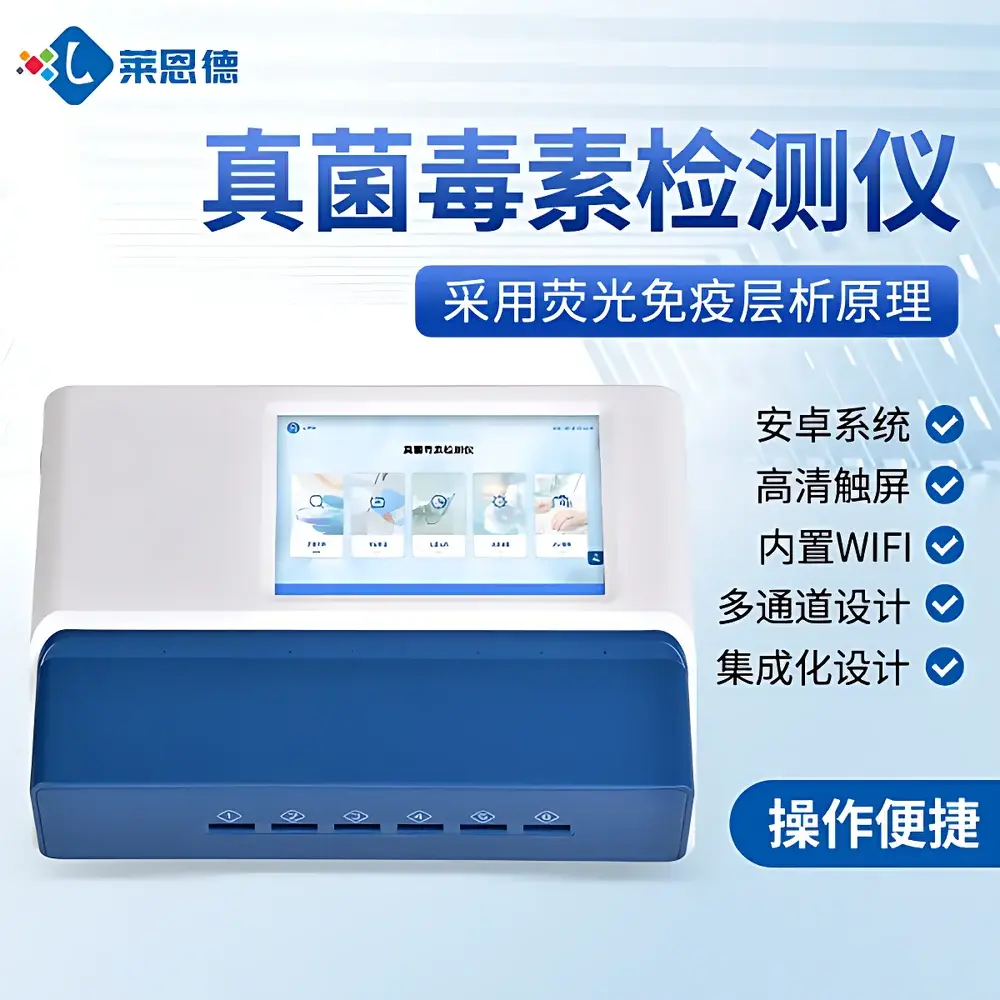
LANENDE LD-DY10 Intelligent Mycotoxin Quantitative Fluorescence Immunoassay Analyzer
| Brand | LANENDE |
|---|---|
| Origin | Shandong, China |
| Manufacturer Type | Direct Manufacturer |
| Country of Origin | China |
| Model | LD-DY10 |
| Instrument Category | Multi-Mycotoxin Rapid Quantitative Analyzer |
| Detection Principle | Fluorescent Lateral Flow Immunoassay (FLFIA) |
| Detection Channels | 6 independent quantitative channels |
| Fluorescence Excitation Wavelength | 365 nm |
| Detector | Silicon Photodiode |
| Sample Processing Time | ≤12 min (including extraction and assay) |
| Assay Time per Test Strip | <4 s |
| Repeatability (CV) | ≤0.8% |
| Stability (Drift) | ≤0.6% |
| Relative Standard Deviation (RSD) | ≤6% |
| Data Storage Capacity | ≥1,000,000 records |
| Operating Temperature | 5–40 °C |
| Humidity Range | 10–90% RH |
| Dimensions (W×D×H) | 300 × 240 × 125 mm |
| Net Weight | 1.7 kg |
| Power Supply | 220 V ±22 V, 50 Hz ±1 Hz |
| DC Output | 12 V / 5 A |
| Rated Power | 40 W |
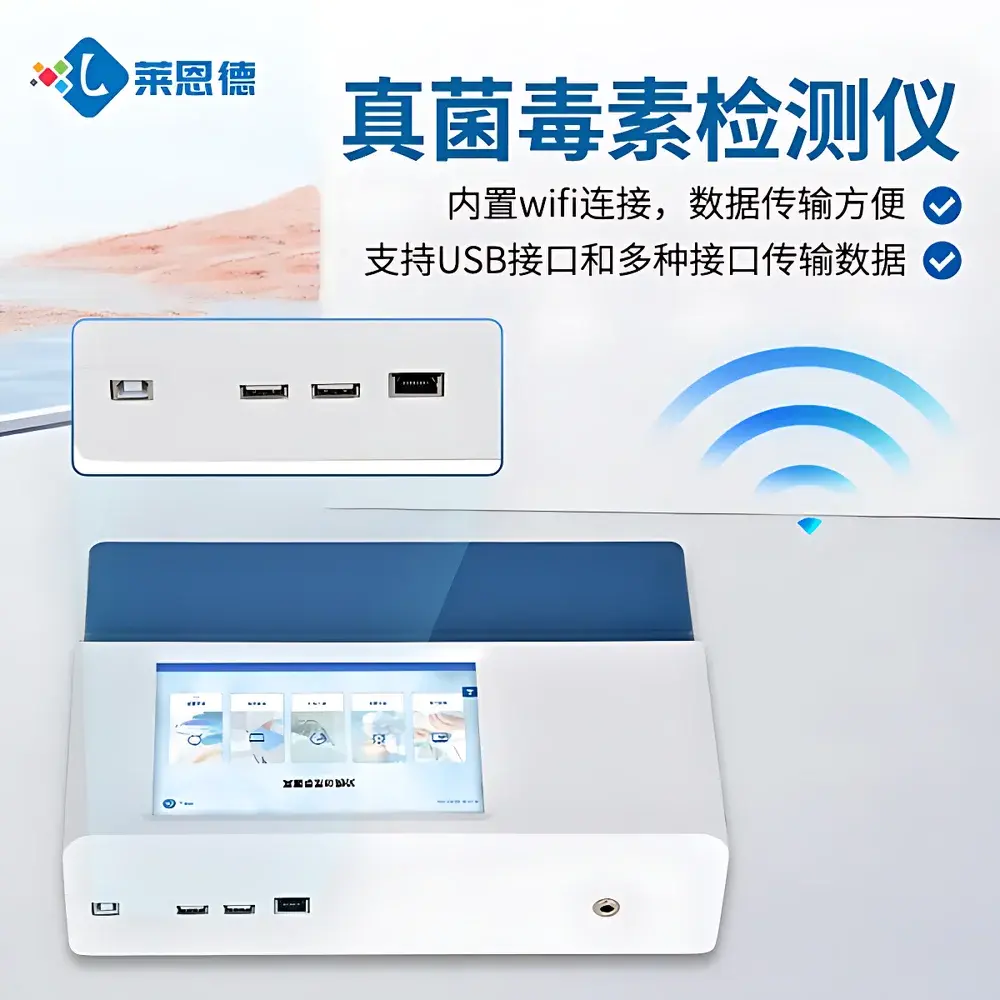
| Connectivity | Dual USB-A, USB-B, RJ45 Ethernet, Wi-Fi 802.11 b/g/n, Bluetooth 4.2 |
Overview
The LANENDE LD-DY10 Intelligent Mycotoxin Quantitative Fluorescence Immunoassay Analyzer is a compact, benchtop rapid detection platform engineered for precise, quantitative analysis of multiple mycotoxins in food and feed matrices. It employs fluorescent lateral flow immunoassay (FLFIA) — a validated, high-sensitivity adaptation of lateral flow technology widely adopted in clinical diagnostics and regulatory food safety laboratories. Unlike qualitative strip tests, the LD-DY10 quantifies target analytes by measuring the fluorescence intensity ratio between test (T) and control (C) lines relative to background, referencing pre-calibrated, lot-specific standard curves embedded in the instrument firmware. This eliminates manual curve generation and minimizes operator exposure to hazardous mycotoxins during calibration. Designed for routine use in grain elevators, feed mills, flour processors, dairy facilities, and third-party testing labs, the system delivers reliable results for deoxynivalenol (DON), zearalenone (ZEN), fumonisins (FB1/FB2), aflatoxins (B1/B2/G1/G2), ochratoxin A (OTA), and T-2 toxin — all within a single 12-minute workflow from sample extract to digital report.
Key Features
- Integrated incubation and optical readout: Six independently controlled 37 °C incubation wells with auto-start timing upon strip insertion — eliminating manual timing errors and ensuring uniform reaction kinetics.
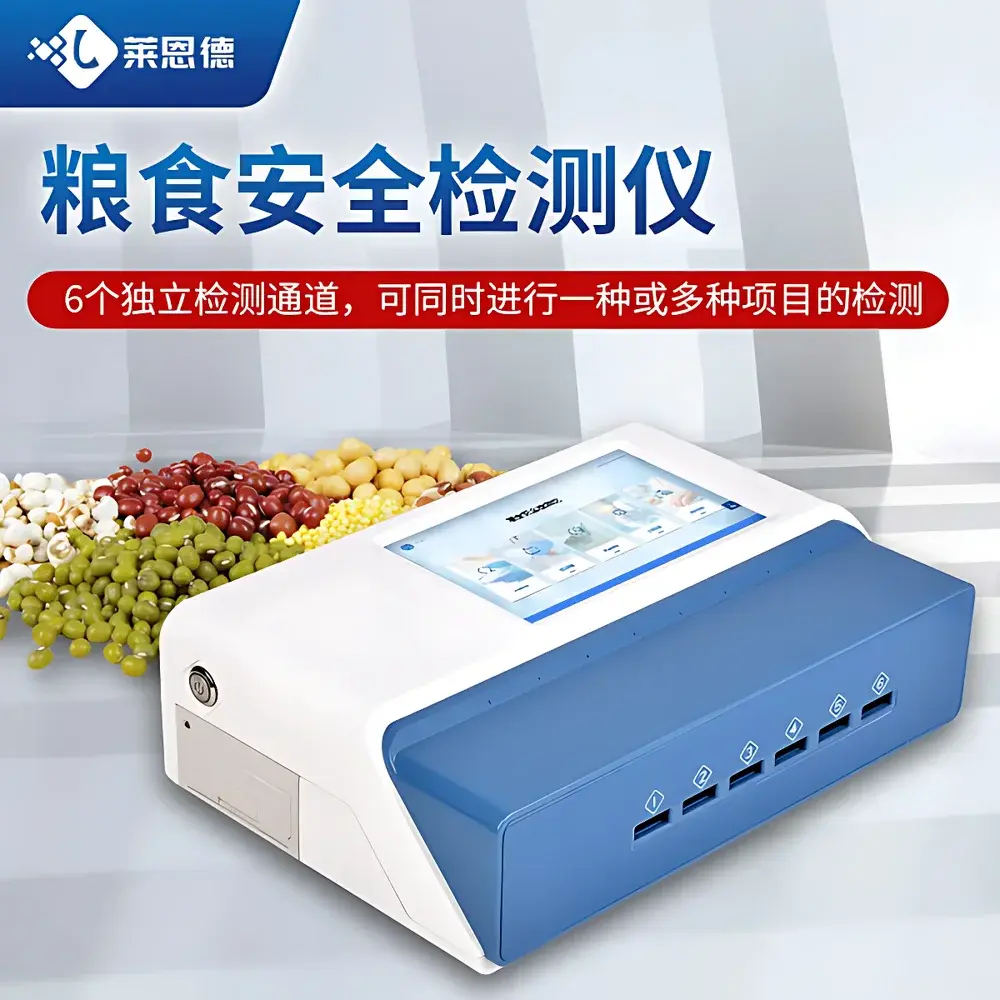
- Six-channel parallel detection: Simultaneous quantitative analysis of up to six samples or multi-analyte strips (e.g., ZEN + DON on one strip), with no cross-talk between channels.
- High-stability fluorescence detection: 365 nm UV LED excitation paired with calibrated silicon photodiodes ensures consistent signal capture; uses proprietary uniform-size fluorescent microspheres to guarantee inter- and intra-batch reproducibility (CV ≤0.8%).
- Embedded quantitative calibration: Factory-loaded, lot-matched standard curves stored in non-volatile memory — no standard reconstitution or curve-fitting required during daily operation.
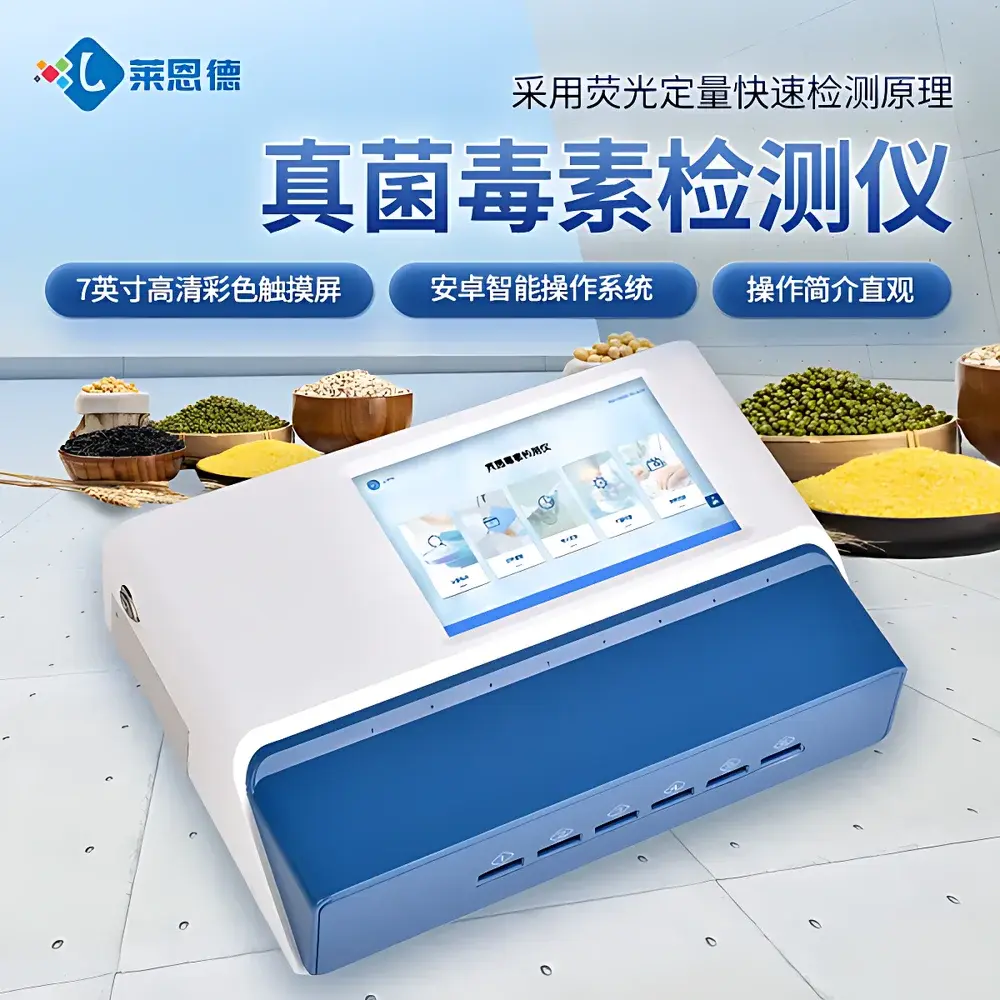
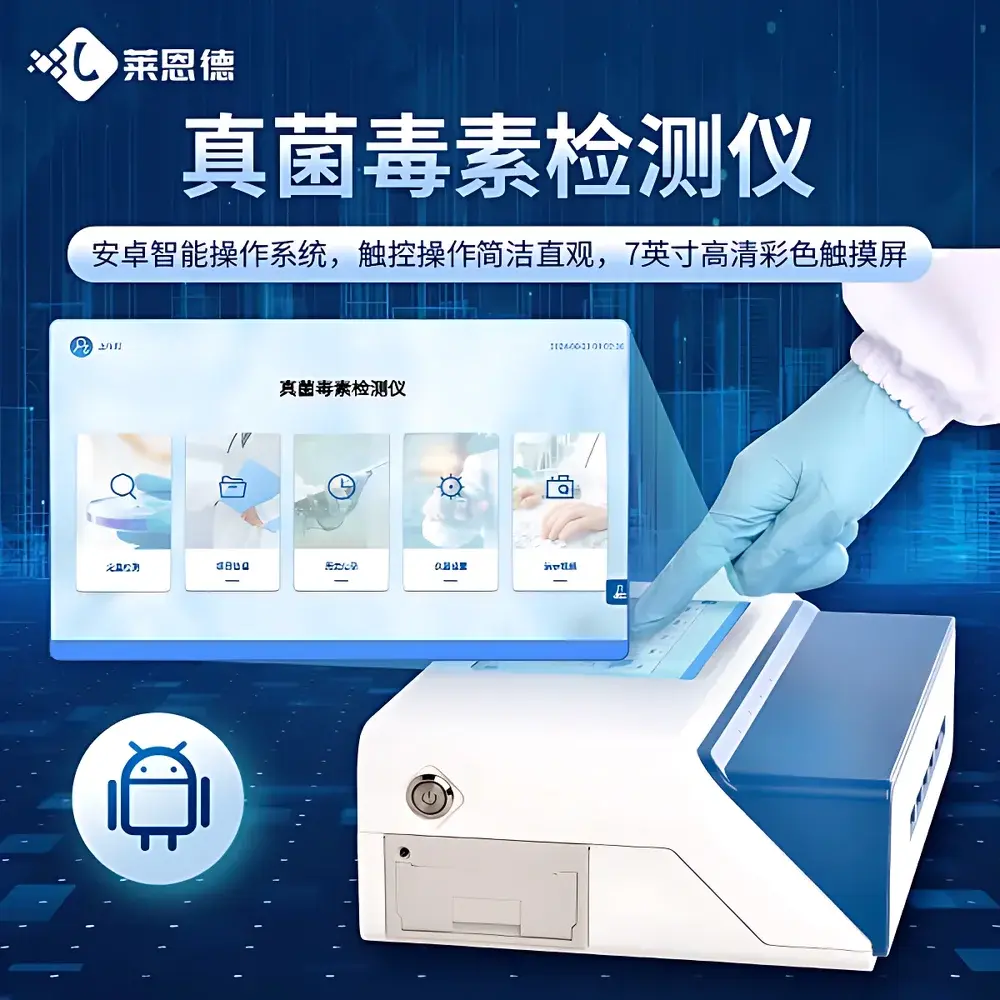
- Android-based intelligent interface: 7″ IPS touchscreen (1280×800), Android 7.1.1 OS, quad-core processor, and 1 GB RAM support intuitive navigation, real-time data visualization, and over-the-air firmware updates.
- Comprehensive connectivity suite: Dual USB-A ports for peripheral devices or flash storage, USB-B for PC synchronization, RJ45 Ethernet, Wi-Fi (802.11 b/g/n), and Bluetooth 4.2 for seamless integration into LIMS or regulatory reporting platforms.
- Built-in thermal printer: Configurable print templates for audit-ready hardcopy reports including sample ID, timestamp, analyte concentration, LOQ, and pass/fail status per EU Commission Regulation (EC) No 1881/2006 thresholds.
Sample Compatibility & Compliance
The LD-DY10 accepts extracts prepared from a broad range of commodities using standardized AOAC or ISO-compliant extraction protocols — including corn, wheat, barley, rice, sorghum, soybean meal, compound feed, finished pet food, edible oils, and liquid dairy products. Its open-sample definition architecture allows user-defined matrix-specific validation parameters. The instrument meets key performance criteria outlined in ISO/IEC 17025:2017 for testing laboratories, and its data integrity features align with FDA 21 CFR Part 11 requirements: audit-trail-enabled user login, electronic signatures, immutable timestamped records, and role-based access control. All firmware and calibration files are digitally signed to prevent unauthorized modification — supporting GLP and GMP-aligned quality systems.
Software & Data Management
Data management is handled via an embedded database capable of storing ≥1,000,000 test records with full metadata (operator ID, sample ID, batch number, instrument serial, environmental conditions, and raw fluorescence values). The system supports advanced query filters (date range, analyte, result status), statistical summaries (mean, SD, CV%), and batch export in CSV or PDF formats. Remote curve updates are delivered via encrypted IC card or secure OTA channel. When connected to Wi-Fi, instruments automatically synchronize test results to centralized food safety monitoring platforms — enabling real-time dashboarding, trend analysis, and automated alerting for out-of-specification results per EU or Codex Alimentarius limits.
Applications
- Grain procurement screening at state-owned and commercial elevators — verifying compliance with national maximum residue levels (MRLs) prior to intake.
- In-process quality control in feed mills — monitoring mycotoxin carryover across premixes, concentrates, and finished pellets.
- Raw material verification in flour mills and breakfast cereal manufacturers — ensuring wheat and maize inputs meet internal specifications.
- Regulatory surveillance by provincial food and drug administrations — field-deployable for on-site inspections with traceable digital reporting.
- Contract testing labs accredited to ISO/IEC 17025 — delivering auditable, repeatable data for certification and dispute resolution.
FAQ
What mycotoxins can the LD-DY10 quantitatively detect?
The instrument supports quantitative detection of deoxynivalenol (DON), zearalenone (ZEN), fumonisins (FB1/FB2), aflatoxins (B1/B2/G1/G2), ochratoxin A (OTA), and T-2 toxin — provided compatible certified lateral flow test strips are used.
Is method validation documentation available for regulatory submissions?
Yes — LANENDE provides instrument-specific validation reports including precision (repeatability and intermediate precision), linearity, limit of quantification (LOQ), and robustness data aligned with AOAC Official Method guidelines and EU Commission Recommendation 2006/76/EC.
Can the LD-DY10 be integrated into an existing LIMS environment?
Yes — through HL7-compatible API endpoints, direct database sync via ODBC, or scheduled CSV exports over FTP/SFTP. Custom integration support is available under NDA.
How often does the instrument require recalibration or maintenance?
No routine recalibration is needed due to factory-loaded, strip-lot-matched curves. Annual performance verification using control strips is recommended per ISO/IEC 17025 clause 6.5.3.
Does the system comply with data integrity requirements for regulated environments?
Yes — it implements electronic signature capability, time-stamped audit trails, user authentication, and write-protected data storage — fully compliant with FDA 21 CFR Part 11 and EU Annex 11 expectations for computerized systems in food safety testing.




