
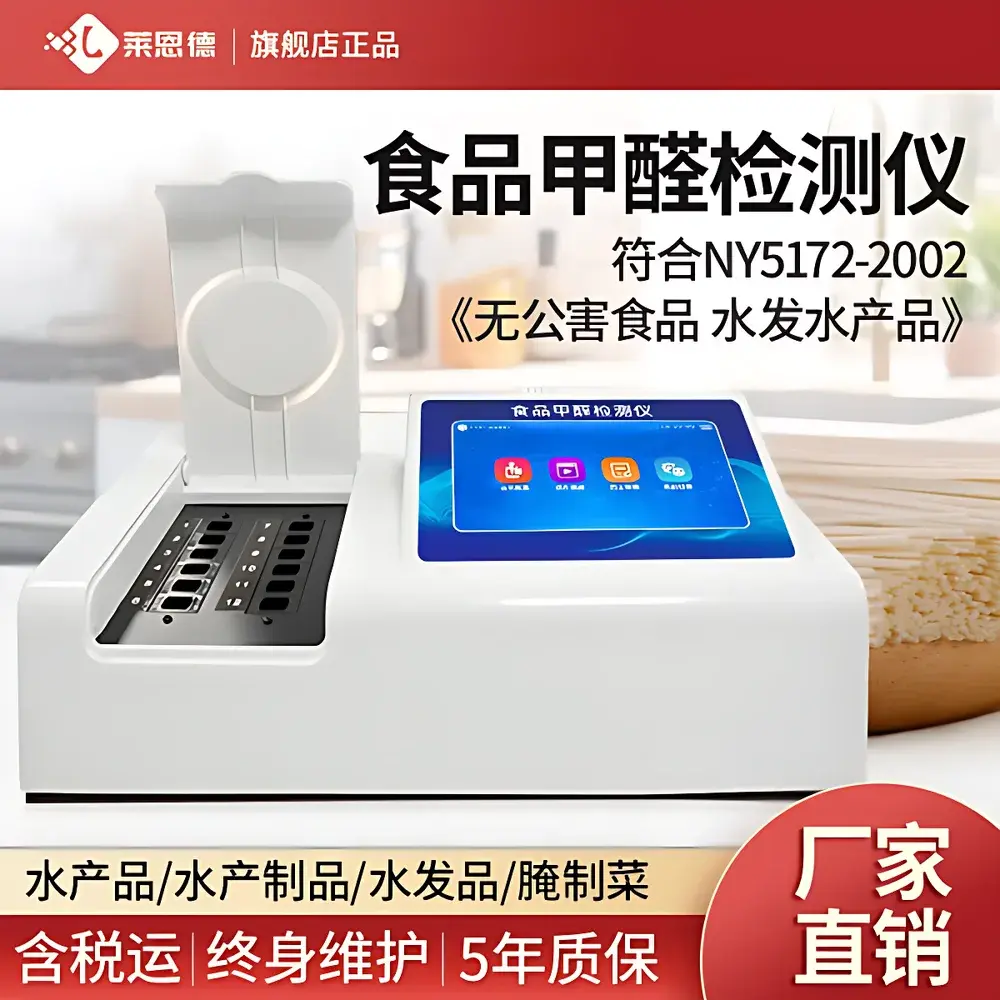
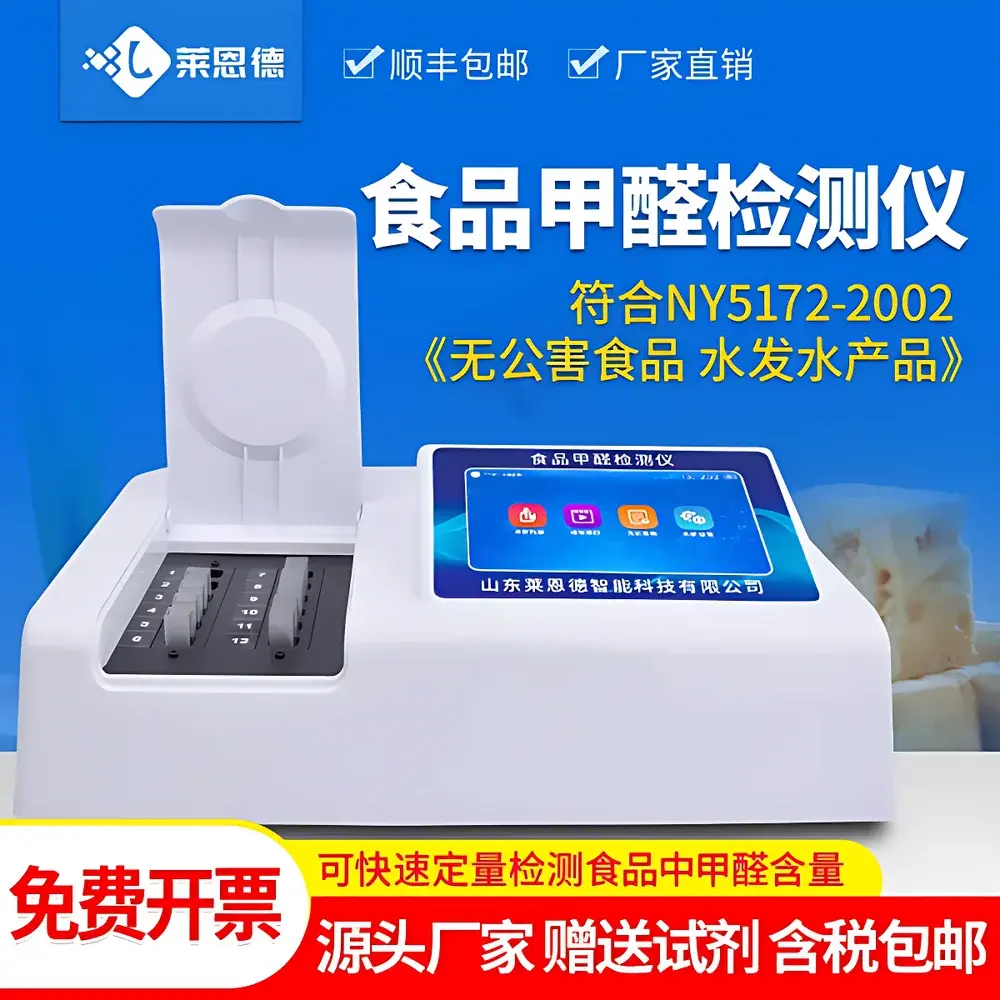
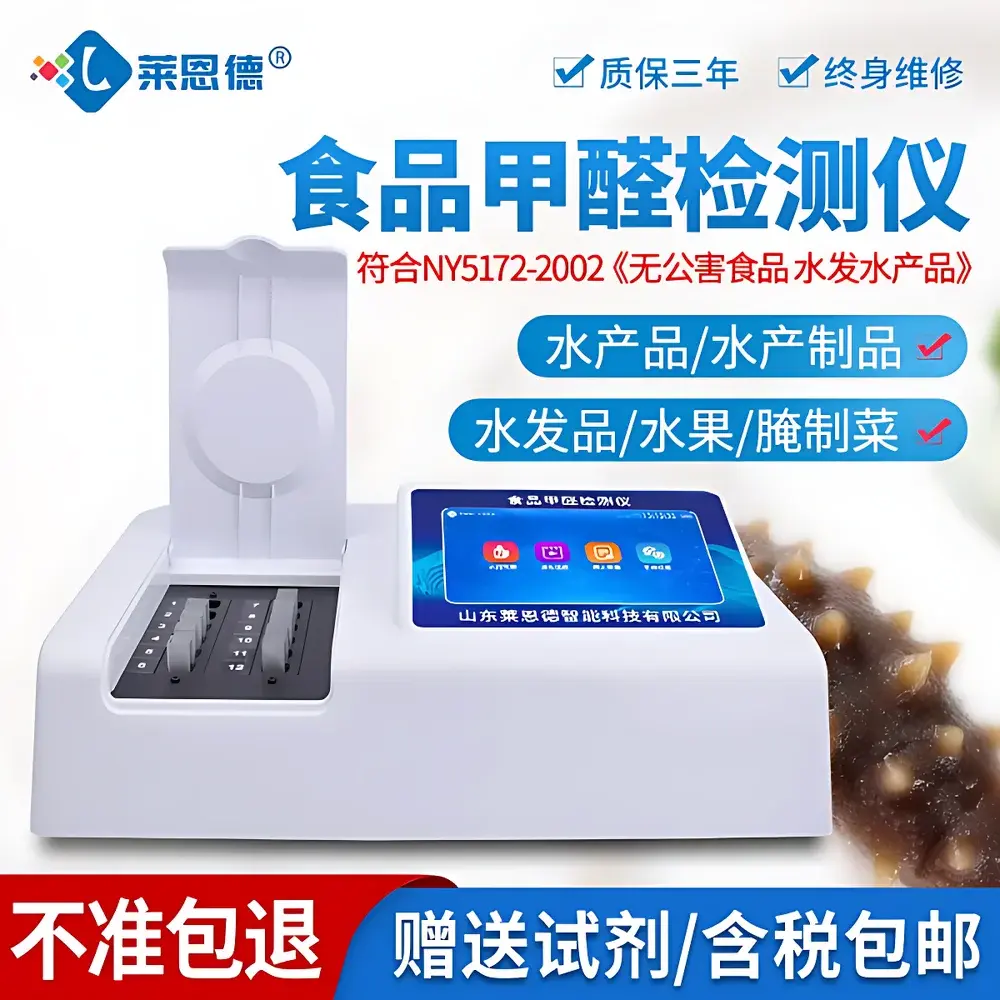
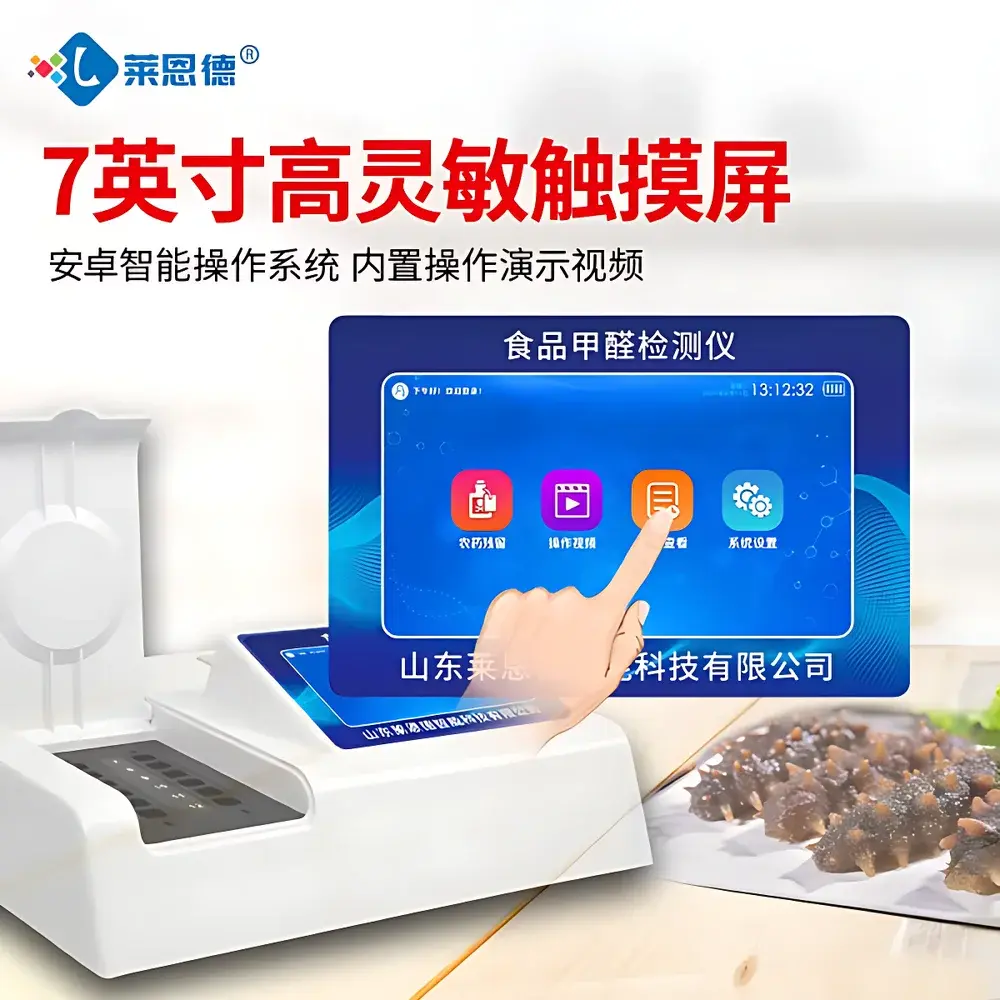
LANENDE LD-JQ12 Desktop Food Formaldehyde Rapid Analyzer
| Brand | LANENDE |
|---|---|
| Origin | Shandong, China |
| Manufacturer Type | Manufacturer |
| Country of Origin | Domestic (China) |
| Model | LD-JQ12 |
| Detection Limit | 1 mg/kg |
| Detection Range | 0–100 mg/kg |
| Absorbance Range | 0.000–4.000 A |
| Repeatability | ±0.1% (A) |
| Absorbance Repeatability Error | ≤0.003 A |
| Photometric Drift | ±0.002 A (3 min) |
| Absorbance Accuracy | ±2.0% |
| Linearity Error | ±1.0% |
| Processor | ARM Cortex-A7 RK3288 (4-core, 1.88 GHz) |
| Display | 7-inch capacitive touchscreen (Chinese UI) |
| Power Supply | DC 12 V (supports vehicle power & optional 6 Ah Li-ion battery) |
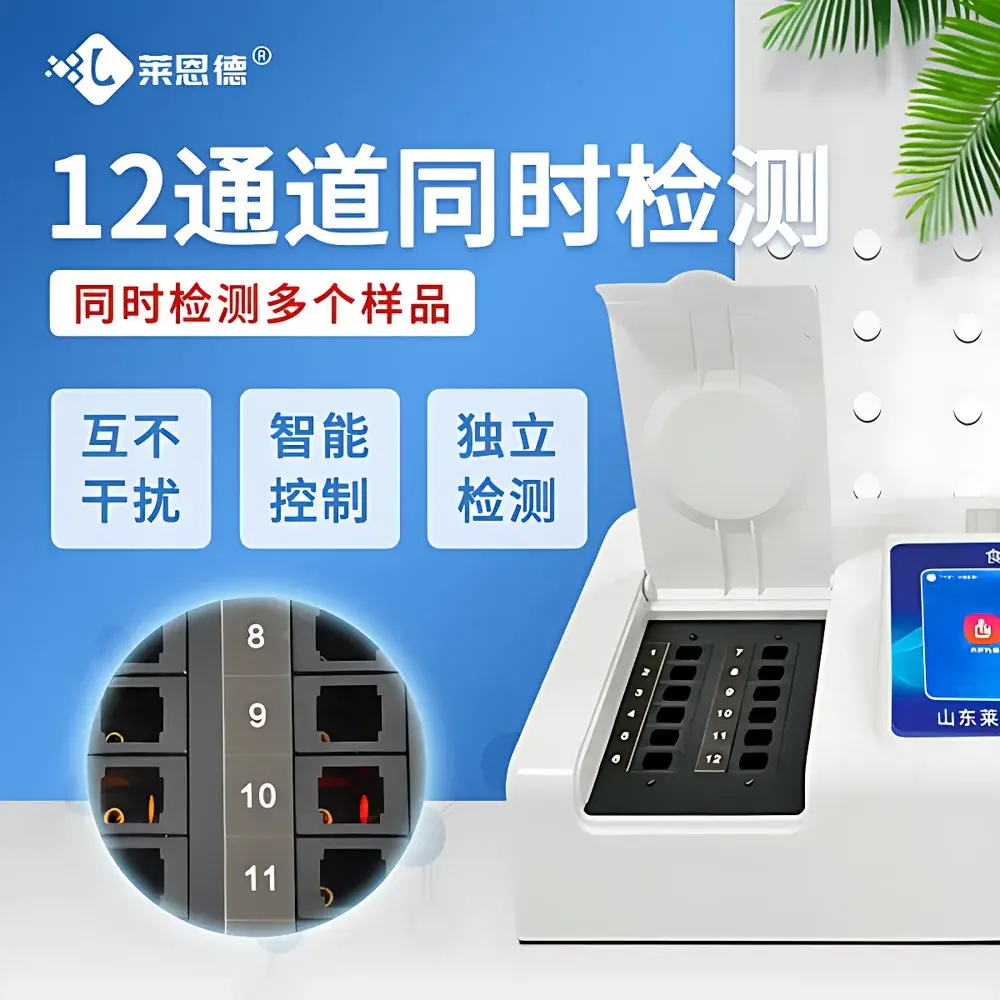
| Detection Channels | ≥12 independent optical channels |
| Connectivity | Ethernet, Wi-Fi, GPRS, USB 2.0 |
| Data Output | Thermal printer (embedded), QR code generation, cloud upload via regulatory platform |
| Compliance Support | Designed for routine QC in food safety labs operating under GB 5009.49–2023, ISO/IEC 17025-aligned workflows, and internal GLP procedures |
Overview
The LANENDE LD-JQ12 Desktop Food Formaldehyde Rapid Analyzer is a dedicated photometric analyzer engineered for quantitative determination of formaldehyde residues in food matrices—including aquatic products, meat derivatives, wheat-based staples, and processed snacks. It operates on the principle of chromogenic reaction coupled with visible-light absorbance measurement at defined wavelengths (typically 412 nm or 630 nm, depending on the derivatization chemistry). Following standardized sample extraction and reaction with acetylacetone or chromotropic acid reagents, the resulting colored complex is measured in a fixed-pathlength (1 cm) cuvette within a thermally stabilized optical chamber. The instrument employs a high-stability, solid-state LED light source (rated >100,000 hours) and matched silicon photodetector, eliminating thermal drift and ensuring consistent photometric performance across extended operational cycles. Its architecture supports both laboratory benchtop deployment and mobile field use—enabled by dual power modes (DC 12 V mains or integrated Li-ion battery) and ruggedized enclosure design compliant with IP54 environmental rating.
Key Features
- Twelve or more independently controlled optical detection channels—enabling parallel analysis of up to 12 samples without cross-talk or signal interference.
- Embedded ARM Cortex-A7 RK3288 quad-core processor (1.88 GHz) ensures rapid data acquisition, real-time curve fitting, and seamless multitasking during multi-sample runs.
- 7-inch high-resolution capacitive touchscreen with intuitive Chinese-language interface—designed for operators with minimal technical training in analytical laboratories.
- Integrated thermal printer with automatic report generation, including sample ID, test date/time, concentration result (mg/kg), pass/fail flag per national limit thresholds, and scannable QR code linking to raw absorbance values and calibration metadata.
- Comprehensive connectivity suite: Gigabit Ethernet, IEEE 802.11 b/g/n Wi-Fi, and GPRS module for secure, encrypted transmission of results to centralized food safety monitoring platforms.
- Self-diagnostic routines: automated zero-point calibration, photometric stability verification, repeatability validation, and system health logging prior to each assay batch.
- User-accessible firmware update path and expandable assay library—allowing future integration of additional analytes (e.g., melamine, nitrite, sulfites) without hardware modification.
Sample Compatibility & Compliance
The LD-JQ12 is validated for use with homogenized, centrifuged, and filtered extracts prepared from representative food specimens per GB 5009.49–2023 (National Food Safety Standard – Determination of Formaldehyde in Foods). Compatible matrices include fresh/frozen fish, cured meats, tofu, rice noodles, and dried seaweed. Each channel accommodates standard 1 cm pathlength glass or quartz cuvettes; no fluidic transfer steps are required post-reaction, minimizing handling error. While not certified to ISO/IEC 17025 as a standalone device, the system supports laboratory accreditation when operated within documented SOPs—including daily verification using certified reference materials (CRMs), traceable to NIM (National Institute of Metrology, China). Instrument logs retain full audit trails (user login, calibration events, result exports), satisfying internal GLP requirements and preparatory alignment with FDA 21 CFR Part 11 electronic record controls.
Software & Data Management
The embedded Android-based OS hosts a proprietary LIMS-ready application that manages sample registration, method selection, curve interpolation (linear, quadratic, or cubic), and statistical summary reporting. All absorbance measurements are timestamped and tagged with operator ID, instrument serial number, and environmental sensor readings (ambient temperature/humidity if external sensors are connected). Data export options include CSV via USB flash drive, encrypted HTTPS POST to cloud-hosted dashboards, and direct PDF printing. The regulatory platform integration enables role-based access control, configurable alert thresholds (e.g., >10 mg/kg triggers SMS notification), and longitudinal trend visualization—supporting root-cause analysis of supplier nonconformities over time. Firmware updates are delivered OTA (over-the-air) with SHA-256 signature verification to ensure integrity.
Applications
- Routine screening of formaldehyde adulteration in low-cost seafood substitutes (e.g., “fake shark fin” or surimi products).
- QC release testing for wet-noodle manufacturers where formaldehyde may be used illicitly as a preservative.
- Field deployment by municipal food safety bureaus during market surveillance campaigns targeting informal vendors.
- Research applications in food authenticity studies requiring high-throughput quantification across large sample cohorts.
- Training environments in vocational colleges teaching food chemistry and regulatory compliance protocols.
FAQ
What formaldehyde detection method does the LD-JQ12 employ?
It uses spectrophotometric quantification following acetylacetone-based derivatization (Hantzsch reaction), measuring absorbance at 412 nm.
Can the instrument be used outside a laboratory setting?
Yes—its DC 12 V input supports vehicle power adapters, and an optional 6 Ah rechargeable lithium battery enables >8 hours of continuous operation in mobile inspection units.
Is method validation documentation provided?
LANENDE supplies a technical validation report outlining precision (RSD ≤3.2%), accuracy (recovery 94–103%), and linearity (r² ≥0.999) per GB/T 5009.49–2023 guidelines.
How are calibration curves stored and managed?
Up to 50 preloaded working curves are embedded; users may also import custom curves via USB or generate new ones using supplied standards.
Does the system support multi-user authentication?
Yes—administrator-configurable accounts with password protection, session timeouts, and activity logging ensure accountability in shared lab environments.
Related Products






