
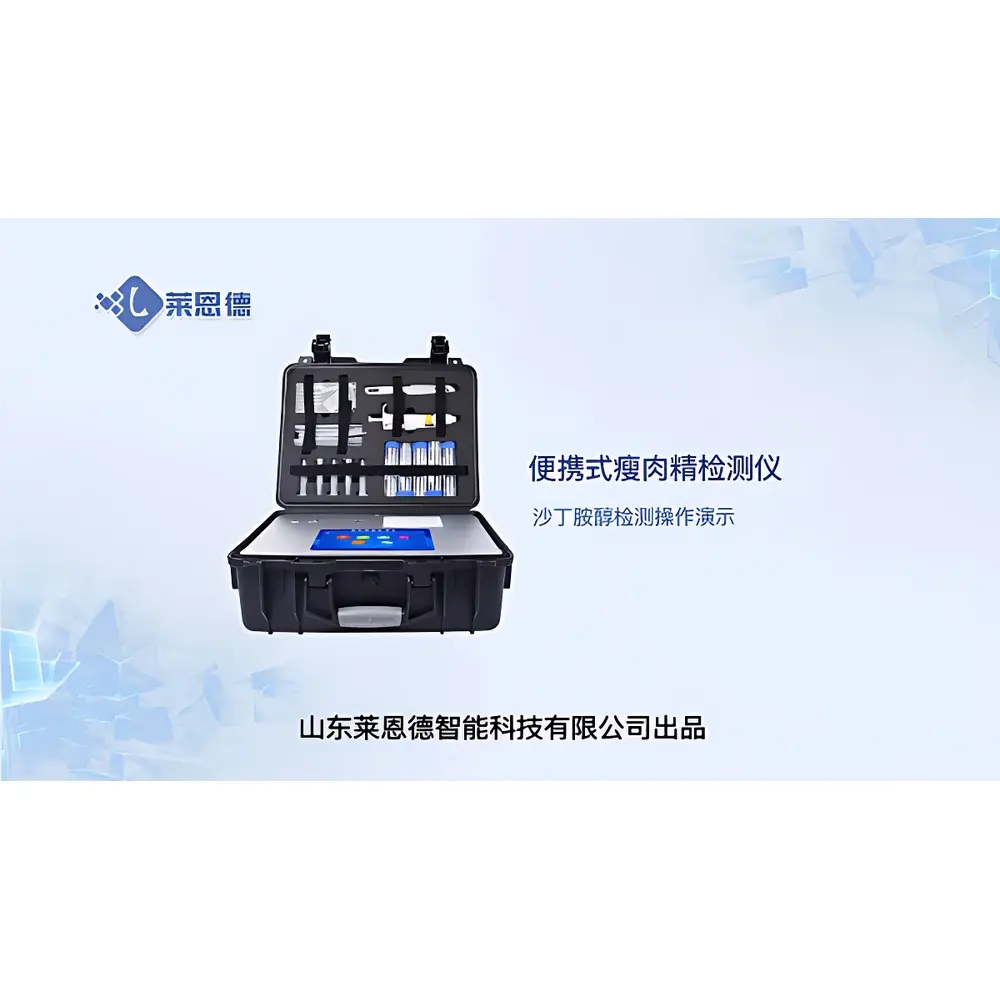
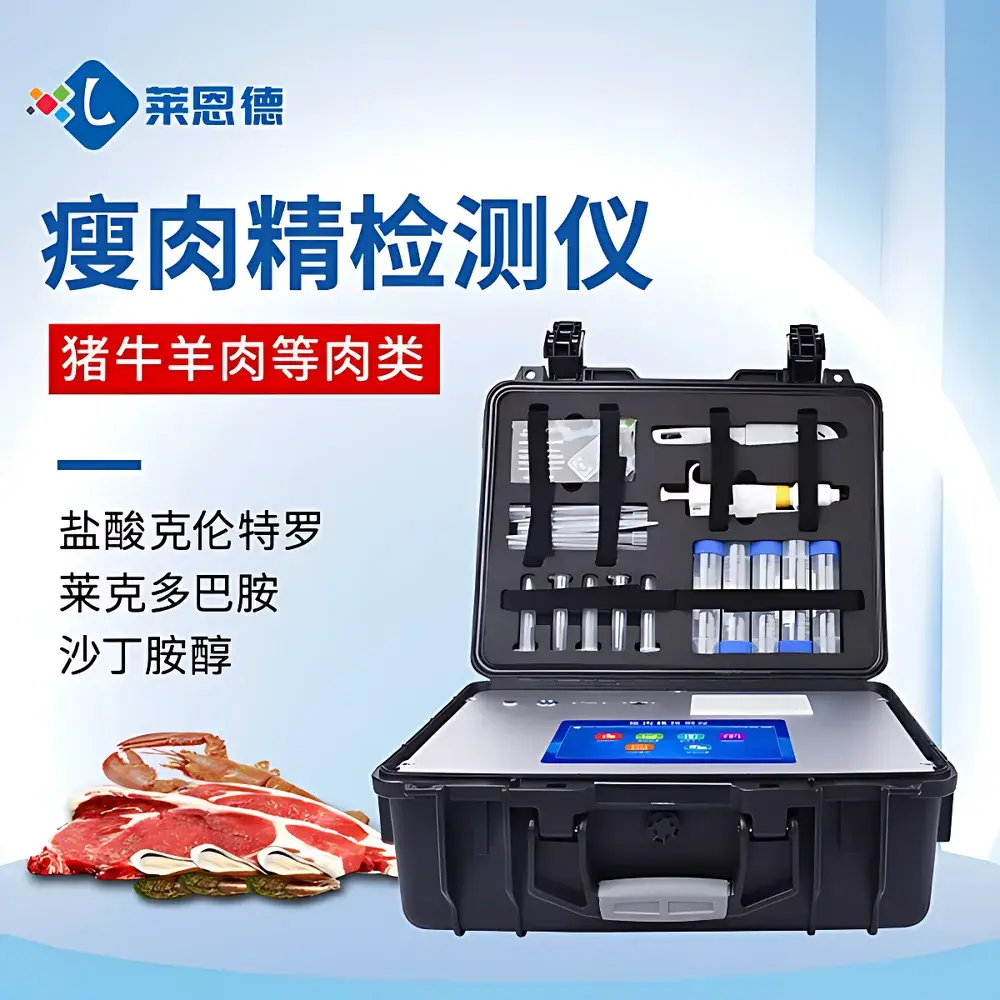
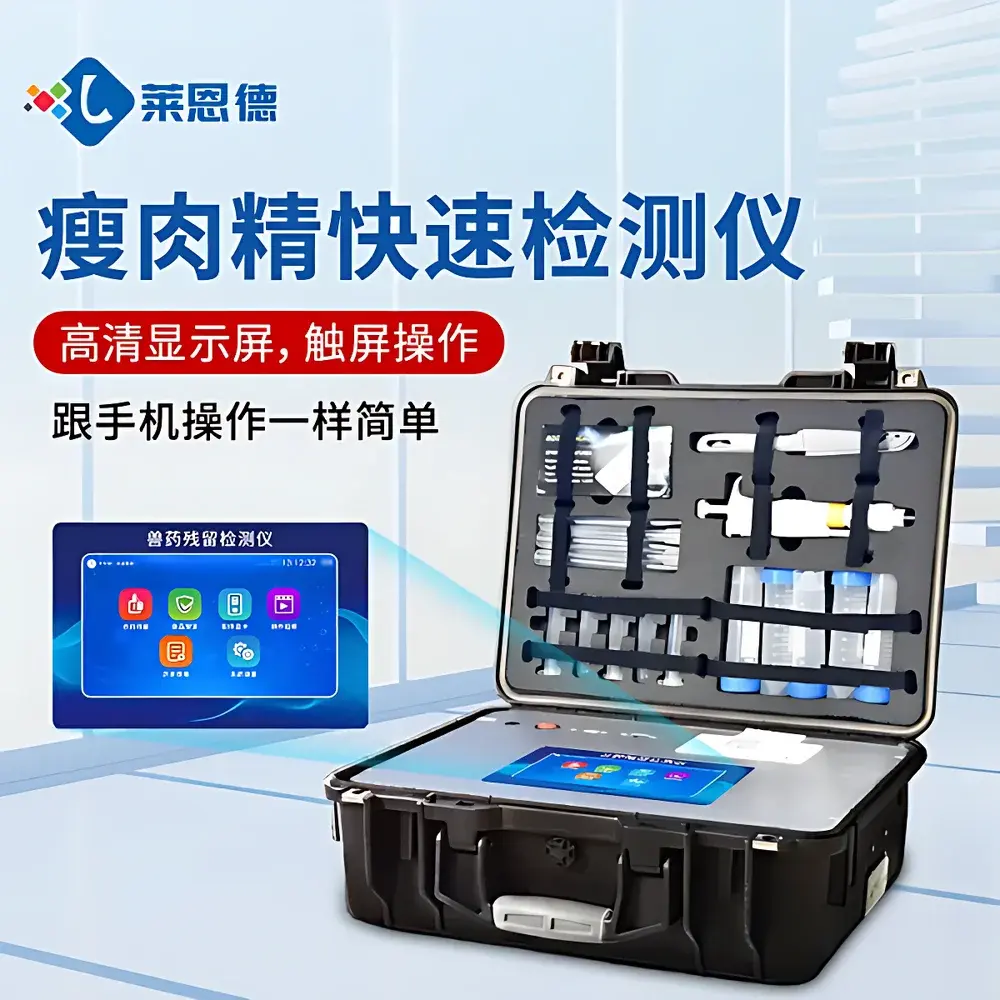
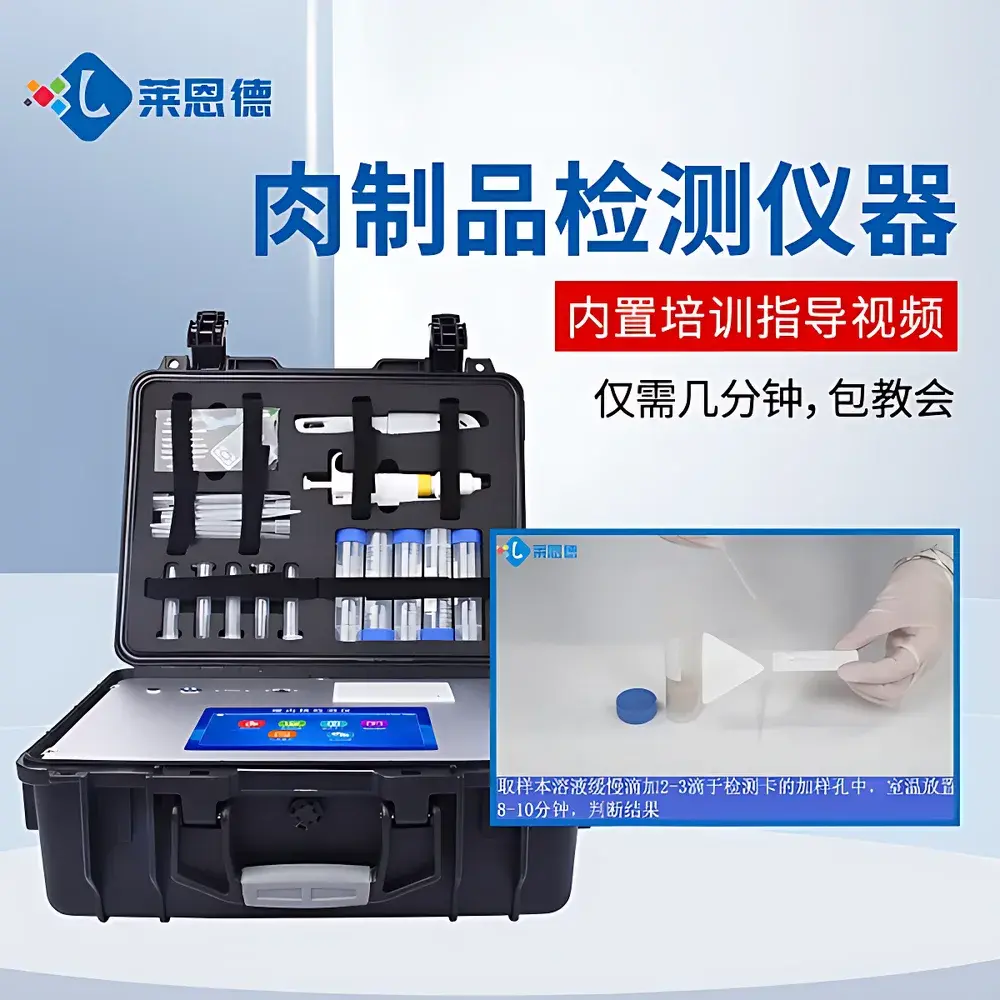
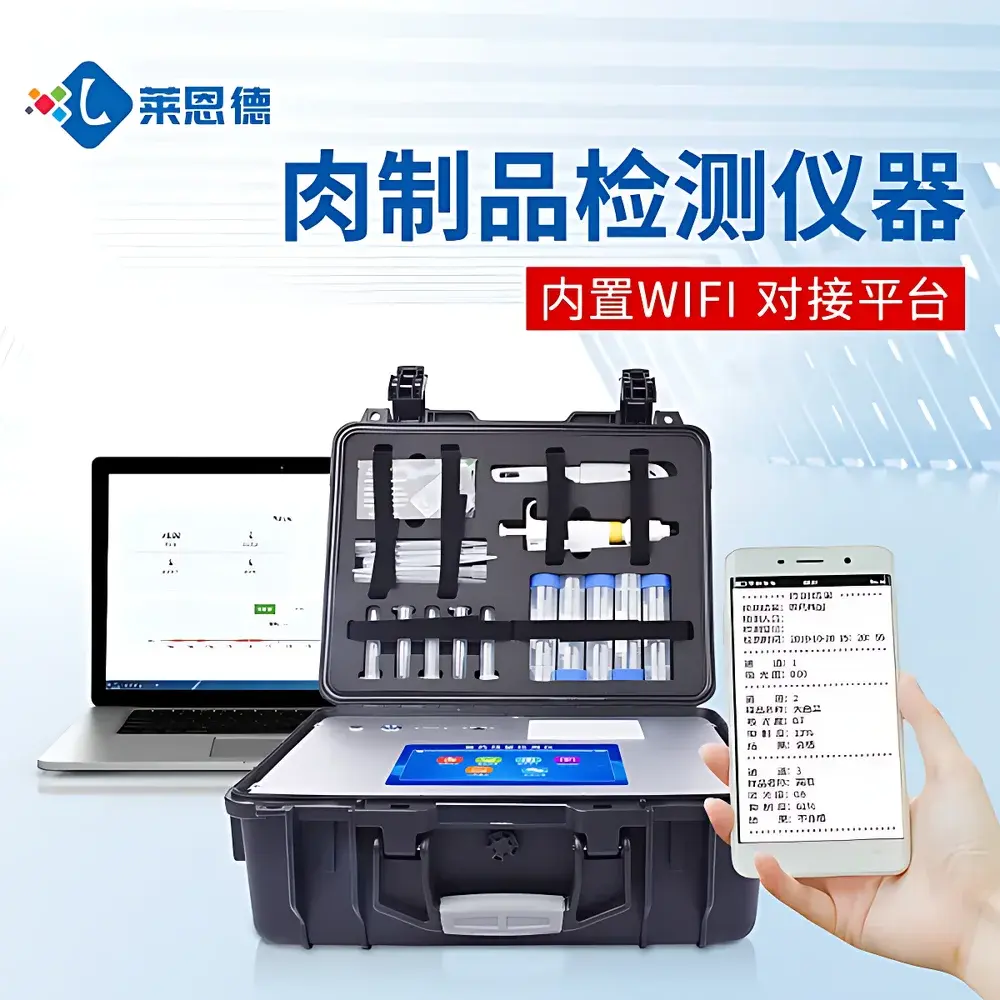
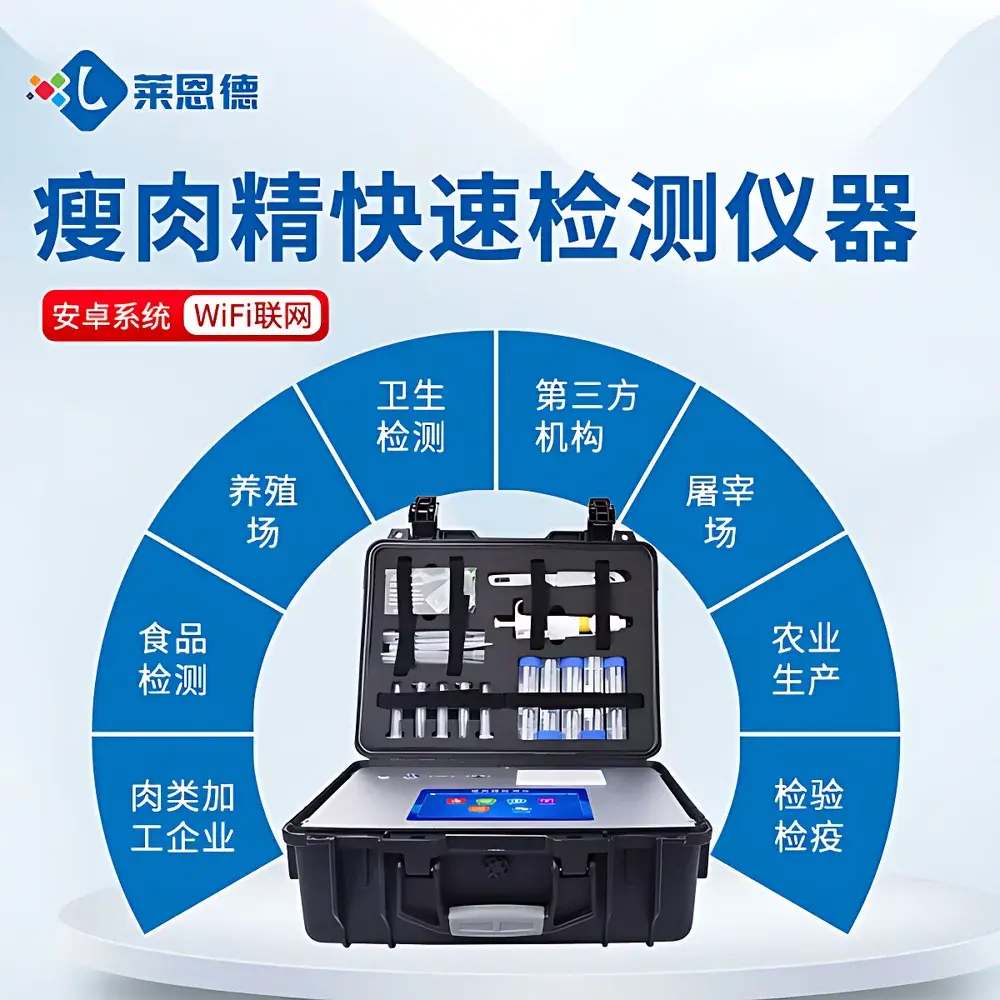
LANENDE LD-SSJ Clenbuterol Rapid Detection Analyzer for Meat Products
| Brand | LANENDE Intelligent Technology |
|---|---|
| Origin | Shandong, China |
| Manufacturer Type | Direct Manufacturer |
| Country of Origin | China |
| Model | LD-SSJ |
| Price | USD 780 (FOB) |
| Detection Method | Colloidal Gold Immunochromatographic Assay |
| Connectivity | Wi-Fi, 4G, GPRS, Ethernet |
| Reporting | Integrated Thermal Printer with QR Code Output |
| Data Management | Cloud & LAN-Compatible Regulatory Platform |
| Sample Throughput | Multi-channel Simultaneous Analysis |
| Regulatory Alignment | Designed for Compliance with CNAS-CL01, GB/T 27404–2008, and GB 29693–2013 |
| Sample Types | Raw meat, minced pork/beef, liver, urine, feed extracts |
| Detectable Analytes | Clenbuterol hydrochloride, Ractopamine, Salbutamol, Diethylstilbestrol, Carbadox |
| Expandability | Modular firmware architecture supports future assay kits (e.g., antibiotics, sulfonamides, tetracyclines) |
Overview
The LANENDE LD-SSJ Clenbuterol Rapid Detection Analyzer is a field-deployable, regulatory-grade immunoassay platform engineered for quantitative and qualitative screening of β-agonist residues—including clenbuterol hydrochloride, ractopamine, salbutamol, diethylstilbestrol, and carbadox—in animal-derived food matrices. Based on colloidal gold immunochromatography, the instrument employs high-precision optical scanning to measure signal intensity at the test (T) and control (C) lines of lateral flow strips, converting optical density into concentration values via built-in calibration curves. Its architecture follows the principle of competitive binding immunoassay: analyte in the sample competes with immobilized antigen conjugates for limited antibody binding sites, producing an inverse relationship between signal intensity and analyte concentration. Designed for use in mobile laboratories, slaughterhouses, border inspection posts, and municipal food safety supervision centers, the LD-SSJ meets operational requirements for rapid turnaround (≤15 min per test), minimal sample preparation, and trace-level sensitivity aligned with national residue limits (e.g., ≤0.1 µg/kg for clenbuterol in pork tissue per GB 29693–2013).
Key Features
- Android-based embedded OS with intuitive touchscreen interface and multi-language support (English, Spanish, Arabic, Vietnamese preloaded)
- Integrated high-sensitivity optical sensor with auto-calibrating photometric scanning—capable of detecting optical density differences as low as 0.02 OD units across 0–3.0 OD range
- Motorized track-driven strip transport system ensuring consistent positioning and repeatable scan geometry
- Dual-mode connectivity: simultaneous Wi-Fi (802.11 b/g/n), 4G LTE Cat.4, and Ethernet (RJ45) for real-time data synchronization with centralized food safety platforms
- Onboard thermal printer with automatic report generation, including sample ID, detection date/time, operator ID, LOD/LOQ flags, pass/fail status, and scannable QR code linking to raw image and analysis metadata
- Role-based access control (RBAC) with configurable user accounts, password policies, and audit log retention (≥10,000 entries)
- Expandable assay library: firmware supports plug-and-play cartridge recognition; new test protocols deployable via encrypted OTA updates
- Self-diagnostic suite: automatic baseline drift correction, zero-point validation, and inter-strip repeatability assessment (CV ≤8% at 1.5× LOD)
- Robust mechanical design: IP54-rated enclosure, shock-absorbing chassis, and battery-backed real-time clock ensuring data integrity during power interruption
Sample Compatibility & Compliance
The LD-SSJ accepts homogenized tissue extracts (pork, beef, liver), urine supernatants, and feed leachates prepared using standardized extraction buffers (e.g., 0.1 M PBS + 0.5% Tween-20). It accommodates all commercially available colloidal gold test cassettes compliant with ISO/IEC 17025–accredited manufacturing practices—including those certified under CNAS-CL01:2018 and registered with NMPA Class II IVD listing. The system’s measurement uncertainty profile has been validated against reference methods (LC-MS/MS per GB/T 21313–2007) and satisfies the performance criteria outlined in GB/T 27404–2008 (Laboratory Quality Control Guidelines for Food Microbiology and Residue Testing). All data outputs meet traceability requirements for GLP-compliant reporting, with timestamped digital signatures and immutable audit trails supporting 21 CFR Part 11 readiness when deployed within controlled IT environments.
Software & Data Management
The proprietary LANENDE FoodSafe™ software (v3.2+) provides end-to-end data governance—from sample registration and assay configuration to statistical trend analysis and export-ready reporting. Data is structured in FAIR-compliant format (Findable, Accessible, Interoperable, Reusable), enabling seamless ingestion into national food safety surveillance systems such as China’s National Food Safety Risk Assessment Information System (NFRAIS). Local storage retains ≥50,000 test records with full metadata (image capture, environmental temperature/humidity logs, operator ID). Cloud sync options include SFTP push to designated FTP servers or RESTful API integration with third-party LIMS (e.g., LabVantage, STARLIMS). Firmware updates are digitally signed and verified prior to installation, ensuring cryptographic integrity and version-controlled deployment.
Applications
The LD-SSJ serves as a frontline screening tool across the meat supply chain: pre-slaughter testing at farms and collection points; in-process verification at abattoirs and deboning facilities; post-processing checks in sausage and jerky manufacturing; and regulatory verification by provincial market supervision bureaus. Its modular design allows phased expansion into broader residue monitoring—antibiotics (tetracyclines, fluoroquinolones), nitroimidazoles, and mycotoxins—without hardware modification. Field studies conducted with 12 provincial CDC laboratories demonstrated >94% concordance with confirmatory LC-MS/MS for clenbuterol in porcine kidney samples (n=327, κ=0.91), validating its suitability for Tier-1 triage in national foodborne risk mitigation frameworks.
FAQ
What regulatory standards does the LD-SSJ comply with?
It adheres to GB/T 27404–2008, GB 29693–2013, and ISO/IEC 17025 requirements for rapid screening devices; full documentation package includes metrological verification reports and method validation summaries.
Can the instrument be integrated with existing LIMS or ERP systems?
Yes—via configurable REST API endpoints, CSV/Excel batch export, or direct database mirroring using ODBC/JDBC drivers.
Is training and technical support available internationally?
LANENDE provides remote video-based SOP training, multilingual user manuals (EN/ES/AR/VI), and 24/7 email-based engineering support with <4-hour response SLA for critical issues.
Does the device require annual recalibration?
No scheduled recalibration is required; however, users may perform on-site verification using supplied optical density reference strips (NIST-traceable, Lot-specific certificate included).
Are consumables proprietary or open-platform?
The LD-SSJ is fully open to third-party colloidal gold cassettes meeting ISO 15197:2013 dimensional and optical specifications—no vendor lock-in enforced.





