
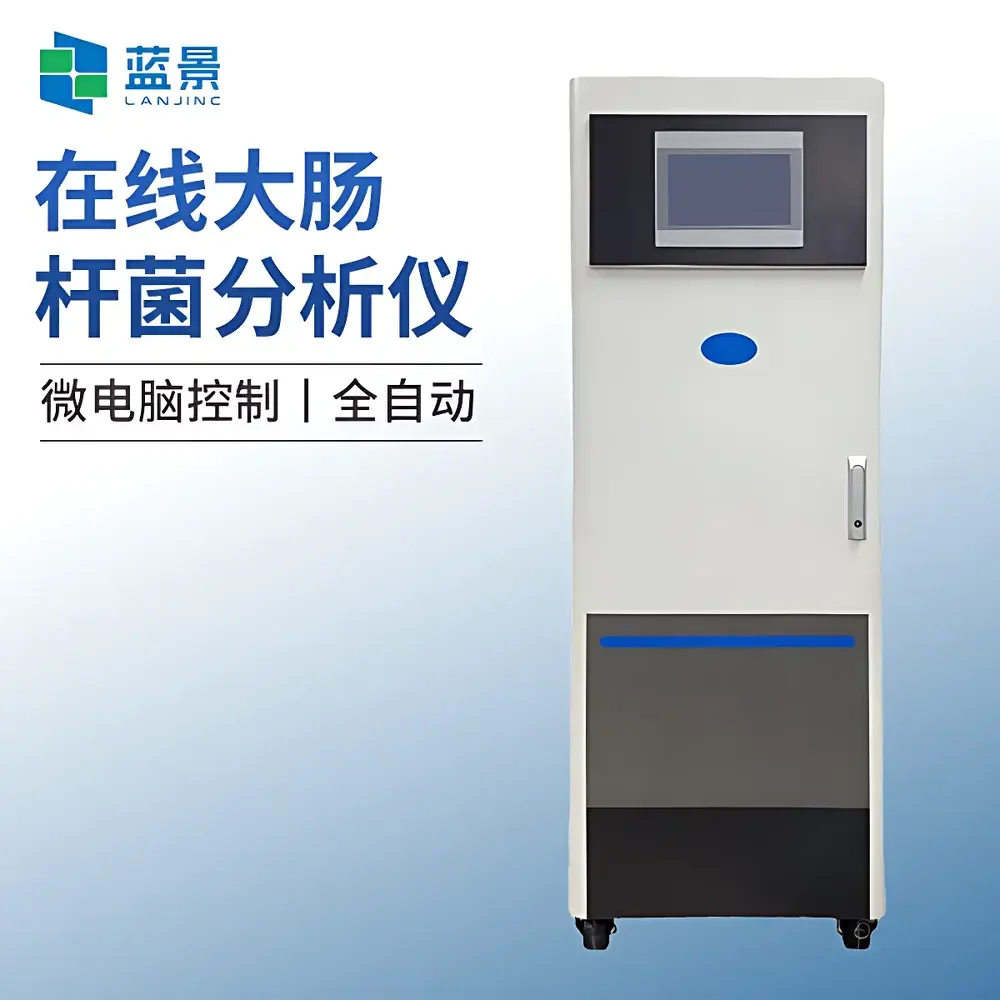
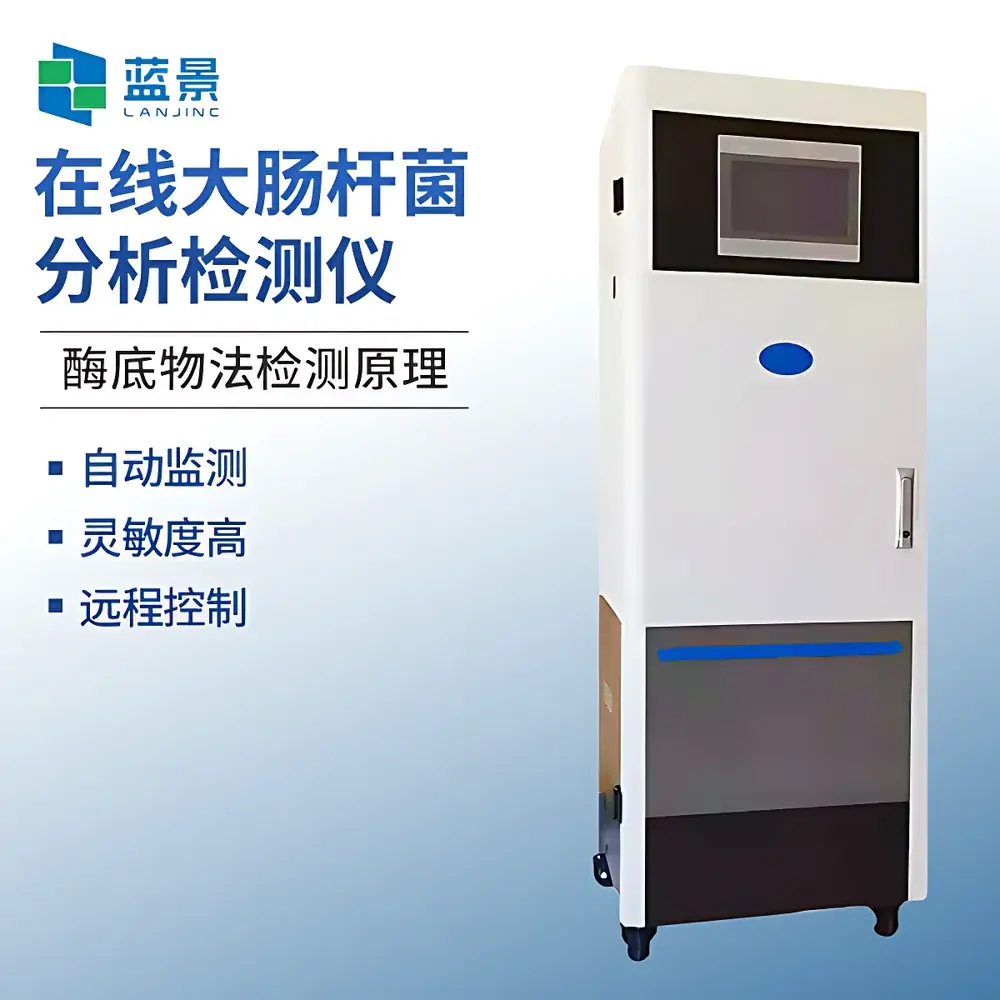
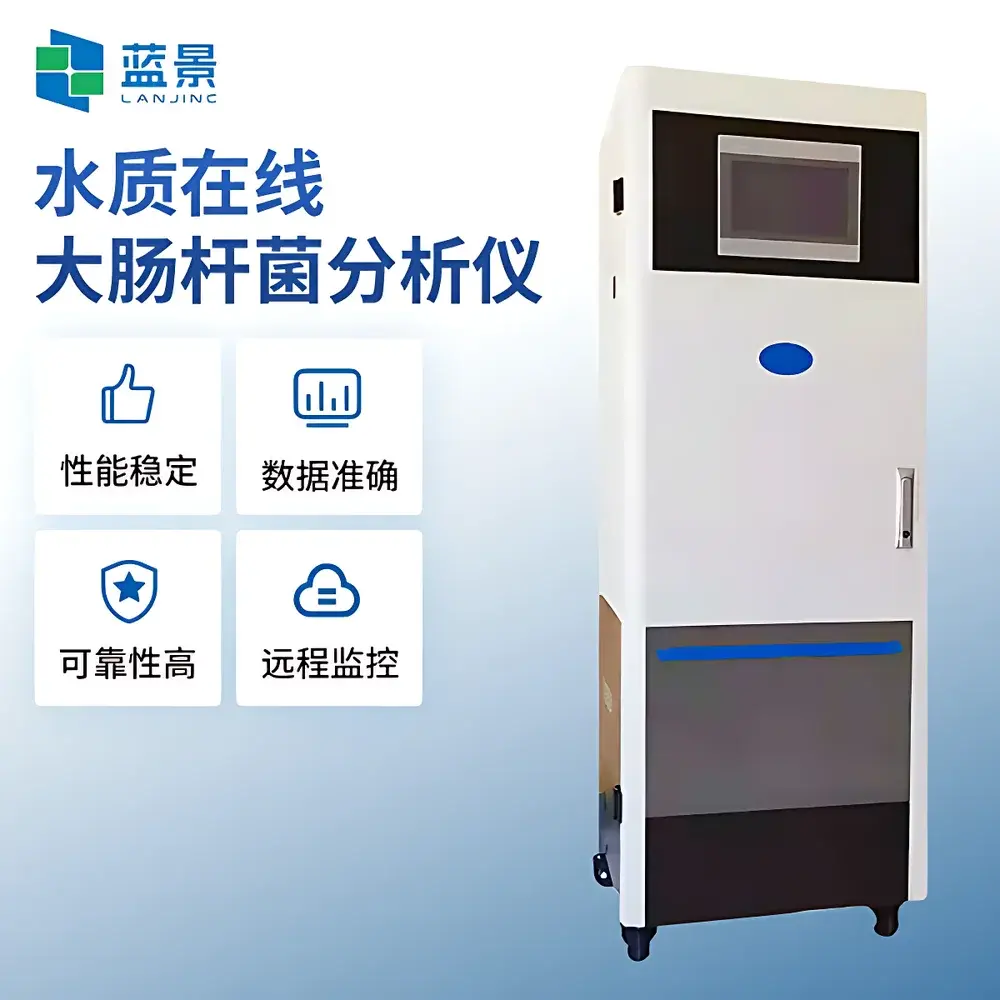
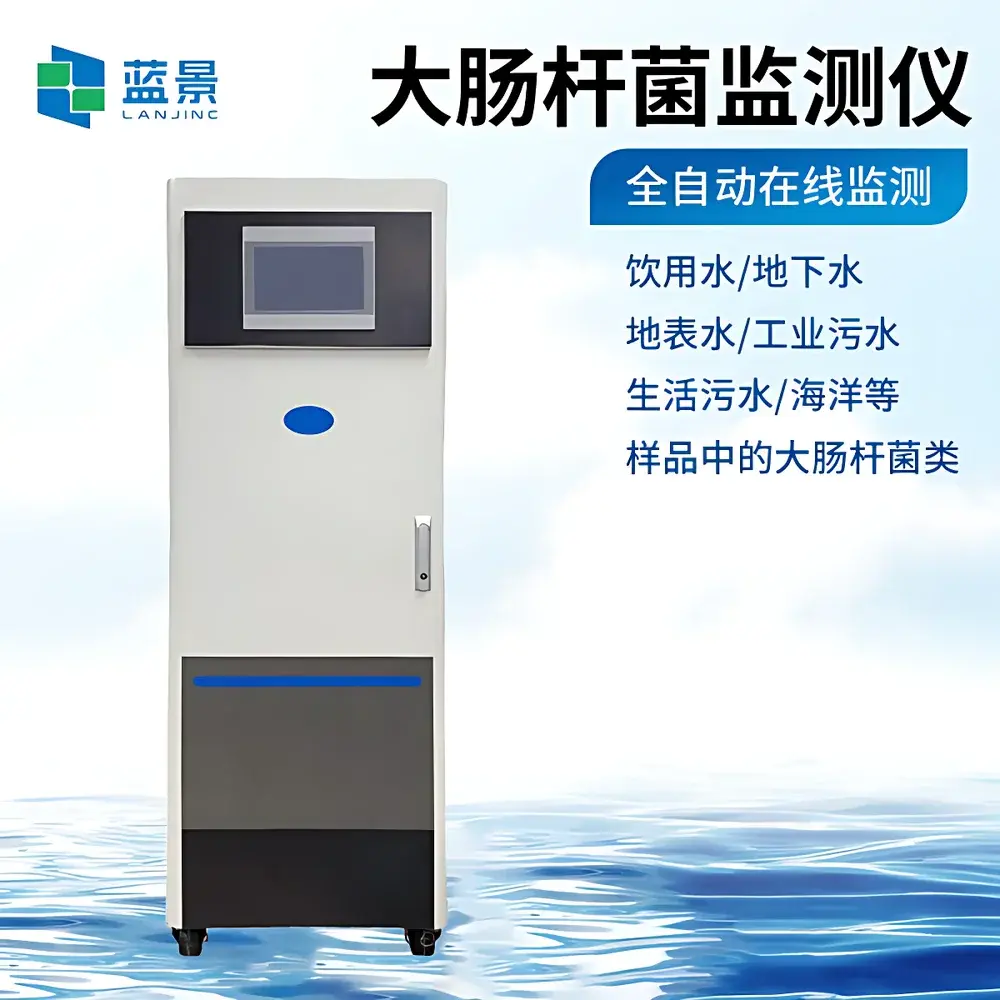
Lanjing LJ-DC8000 Online Escherichia coli Analyzer
| Brand | Lanjing |
|---|---|
| Origin | Shandong, China |
| Manufacturer Type | OEM Manufacturer |
| Country of Origin | China |
| Model | LJ-DC8000 |
| Price | USD 25,000 (FOB) |
| Measurement Principle | Enzyme-Substrate (β-D-galactosidase/ONPG) |
| Detection Range | 0–100 MPN/100 mL and 0–10,000 MPN/100 mL (extendable) |
| Sample Volume | 100 mL per analysis |
| Analysis Time | ≤24 h |
| Repeatability | ±5% |
| Accuracy (Standard Deviation) | ±20% |
| Drift | ±5% F.S. |
| Operating Temperature | 5–35 °C |
| Humidity Limit | <90% RH (non-condensing) |
| Enclosure Rating | IP66 / NEMA 4 |
| Dimensions (H×W×D) | 1675 × 630 × 610 mm (incl. reagent cabinet) |
| Power Supply | 220 V AC, auto-restart on power recovery |
| Data Storage | 100,000 records internal |
| Output Interfaces | 4–20 mA / 0–10 V analog, RS232, RS485 (Modbus RTU), Ethernet |
| Remote Capabilities | GPRS/4G, Wi-Fi, remote calibration & control |
| Sample Intake | Built-in peristaltic pump (suction head ≤2 m) |
| Reagent Consumption | 18 mL per test |
| Sample Consumption | ~100 mL per test |
| Compliance | Designed for ISO 9308-1, ASTM D5392, US EPA Method 1604, and GLP-aligned operational traceability |
Overview
The Lanjing LJ-DC8000 Online Escherichia coli Analyzer is an automated, laboratory-grade water quality monitoring system engineered for continuous, real-time quantification of viable Escherichia coli, total coliforms, and thermotolerant coliforms in diverse aqueous matrices. It implements the internationally validated enzyme-substrate method—specifically targeting β-D-galactosidase activity—as defined in ISO 9308-1:2014, ASTM D5392-93(2020), and US EPA Method 1604. Unlike membrane filtration or culture-based approaches requiring incubation and manual colony counting, the LJ-DC8000 delivers quantitative Most Probable Number (MPN) results within 24 hours using optical detection of enzymatic hydrolysis products. The instrument operates on the biochemical principle that viable E. coli cells express β-D-galactosidase, which cleaves the chromogenic substrate o-nitrophenyl-β-D-galactopyranoside (ONPG) to yield o-nitrophenol (ONP)—a yellow compound with strong absorbance at 420 nm. This photometric signal is measured in a low-maintenance, UV-stable optical cell, enabling high reproducibility and minimal drift under field conditions.
Key Features
- Automated MPN quantification across two dynamic ranges: 0–100 MPN/100 mL and 0–10,000 MPN/100 mL—with optional extension for higher concentrations.
- Dual-stage fluidic conditioning: pre-rinse with deionized water followed by sample flush to eliminate carryover and dilution bias—critical for low-concentration environmental samples.
- Proprietary Polynosis normalization algorithm integrated into firmware, correcting for temperature-dependent reaction kinetics and background absorbance drift.
- 10-inch industrial-grade touchscreen HMI with dual-language (English/Chinese) interface, hierarchical password protection, and audit-trail-enabled operation logging (100,000 entries).
- IP66/NEMA 4-rated enclosure fabricated from reinforced glass-fiber polycarbonate; electrically isolated wet and dry compartments with positive-pressure purge for corrosive ambient environments.
- Low operational footprint: only 18 mL reagent and ~100 mL sample consumed per analysis; no consumable filters or membranes required.
- Configurable analysis frequency—from hourly to weekly—and programmable start triggers (time-based or event-driven via digital I/O).
Sample Compatibility & Compliance
The LJ-DC8000 is validated for use with drinking water, groundwater, surface water, wastewater effluent, seawater, and industrial process water. Its enzymatic selectivity—enhanced by proprietary selective inhibitors—suppresses >100 heterotrophic bacteria per assay dose, minimizing false negatives without compromising sensitivity for E. coli. The system meets functional requirements outlined in ISO/IEC 17025 for method validation and supports GLP-compliant data integrity through time-stamped, immutable internal storage and MODBUS/RTU protocol traceability. Optional GPRS/Wi-Fi telemetry enables remote verification of calibration status, alarm logs (leak, reagent depletion, over-range), and raw absorbance curves—facilitating regulatory readiness for utilities operating under EU Drinking Water Directive (2020/2184) or US Safe Drinking Water Act reporting frameworks.
Software & Data Management
Embedded firmware provides full local control—including method editing, curve fitting, and threshold adjustment—without dependency on external PCs. All analytical data are timestamped, stored internally with cyclic overwrite protection, and exportable via USB mass storage in CSV format. Communication protocols include analog 4–20 mA output (user-scaled to MPN range), RS485 Modbus RTU for SCADA integration, and Ethernet TCP/IP for secure HTTP/HTTPS API access. Remote diagnostics and parameter updates are supported via encrypted OTA (Over-the-Air) firmware delivery. Audit trails record operator ID, action type, timestamp, and pre/post-change values—fully compliant with FDA 21 CFR Part 11 requirements when paired with role-based authentication and electronic signature modules (optional add-on).
Applications
- Drinking water treatment plants: real-time early warning for fecal contamination events at intake, filtration, and distribution points.
- Wastewater reclamation facilities: compliance monitoring for Class A reuse standards (e.g., EPA 833-R-18-002).
- Environmental agencies: unattended river/lake monitoring stations with solar-battery hybrid power options.
- Pharmaceutical manufacturing: purified water (PW) and water-for-injection (WFI) system surveillance per USP <85> and EU Annex 1.
- Marine aquaculture: rapid detection of E. coli surges linked to stormwater runoff or sewage discharge.
FAQ
What regulatory methods does the LJ-DC8000 align with?
It implements the enzyme-substrate principle specified in ISO 9308-1, ASTM D5392, and US EPA Method 1604, and is functionally compatible with WHO Guidelines for Drinking-water Quality (4th ed.) microbial risk assessment frameworks.
Can the analyzer distinguish E. coli from other coliforms?
Yes—via selective inhibition chemistry combined with incubation temperature control (44.5 °C for thermotolerant strains), enabling differentiation of E. coli from total coliforms and thermotolerant coliforms per ISO 9308-2.
Is method validation documentation provided?
Yes—each unit ships with a Factory Acceptance Test (FAT) report, including linearity, limit of detection (LOD), repeatability, and cross-reactivity assessments against ATCC reference strains.
How is calibration maintained during extended无人值守 operation?
Automatic zero-point correction using deionized water occurs before each analysis cycle; optional NIST-traceable ONPG standard kits enable periodic span verification without service engineer intervention.
What pre-treatment is recommended for turbid or high-organic-content samples?
An optional integrated pre-filtration module (0.45 µm PES membrane) and activated carbon adsorption stage are available to reduce particulate interference and oxidant quenching—validated per ISO 5667-3 for representative sampling.







