Lanjing LJ-DJ1S UV254 Absorption-Based Online COD & Turbidity Sensor with Integrated Temperature Compensation
| Brand | Lanjing |
|---|---|
| Origin | Shandong, China |
| Manufacturer Type | OEM/ODM Producer |
| Origin Category | Domestic (China) |
| Model | LJ-DJ1S |
| Price | USD 850 (FOB Qingdao) |
| Measurement Principle | Dual-Beam UV254 Absorption + Nephelometric Turbidity |
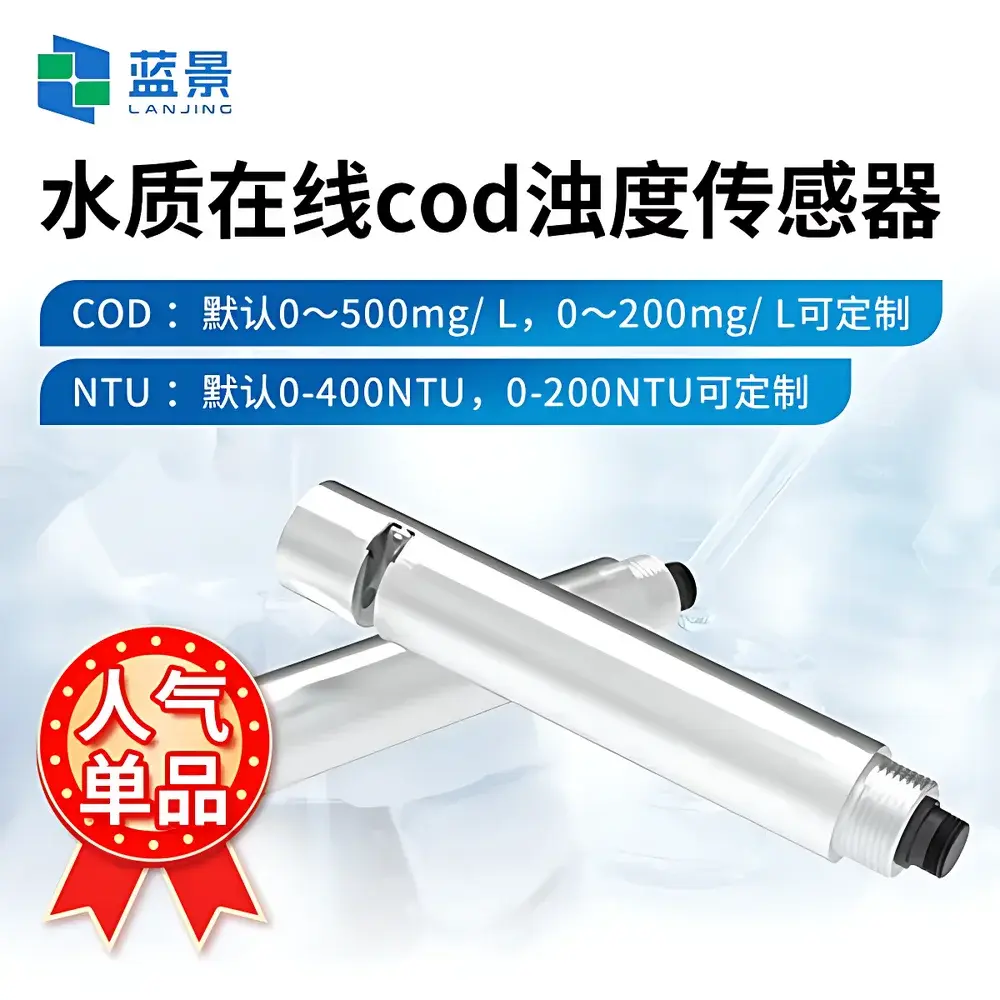
| COD Range | 0–500 mg/L (customizable to 0–200 mg/L) |
| COD Resolution | 0.1 mg/L |
| COD Accuracy | ±5% of reading |
| Turbidity Range | 0–400 NTU (customizable to 0–200 NTU) |
| Turbidity Resolution | 0.1 NTU |
| Temperature Range | 0–50 °C |
| Temp. Accuracy | ±0.3 °C |
| Temp. Compensation | Automatic |
| Auto-Cleaning | Integrated mechanical wiper with programmable cycle control |
| Power Supply | DC 12–24 V |
| Power Consumption | 0.7 W |
| Output | RS-485 (Modbus RTU protocol) |
| Enclosure Material | ABS housing + 316L stainless steel wetted parts |
| Protection Rating | IP68 |
| Installation | Submersible, 3/4" NPT thread |
| Cable Length | 5 m (5-conductor shielded) |
| Storage Temperature | −5 to +65 °C |
| Calibration | Two-point (zero & span) for both COD and turbidity channels |
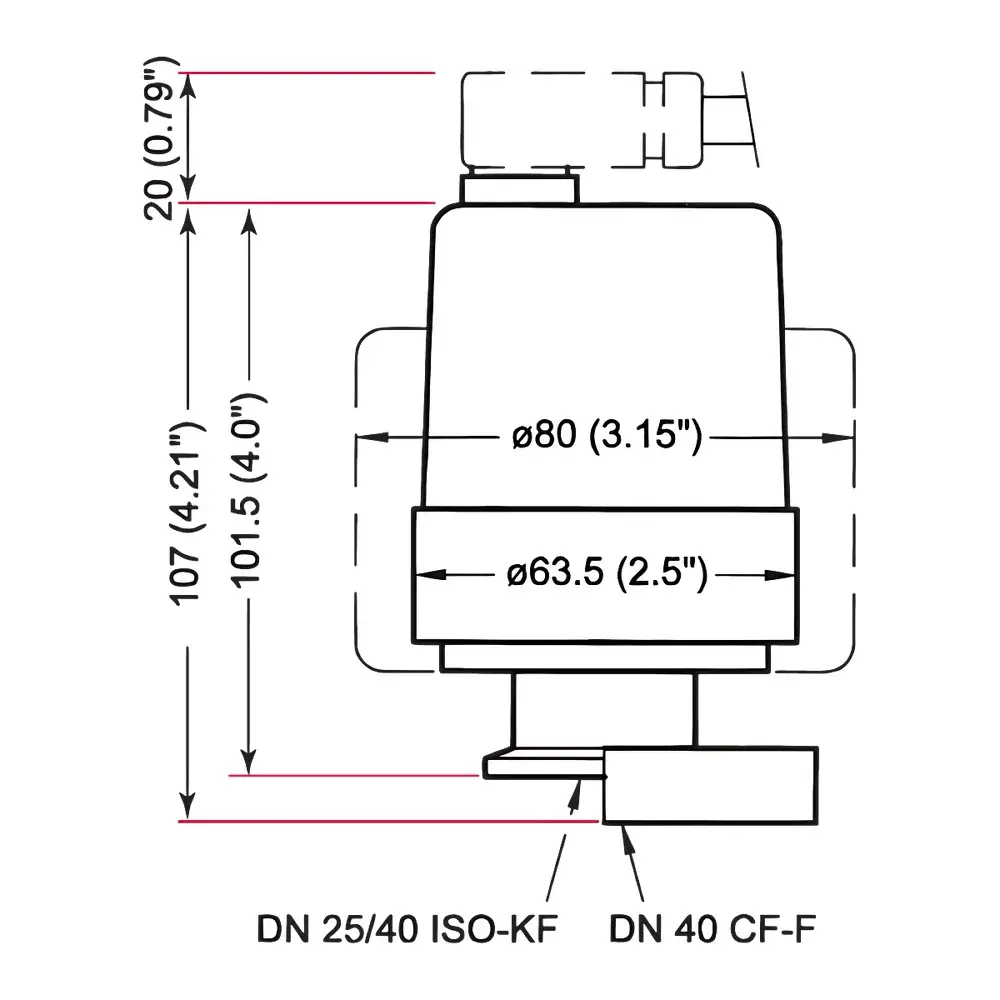
| Dimensions | See technical drawing (L×W×H: 185 × 62 × 62 mm) |
| Compliance | Designed per ISO 7027 (turbidity), ASTM D5540 & EPA 415.3 (UV254-based organic carbon estimation), CE-marked for EMC and LVD |
Overview
The Lanjing LJ-DJ1S is a submersible, multi-parameter online sensor engineered for continuous, real-time monitoring of chemical oxygen demand (COD) and turbidity in municipal wastewater, industrial effluent, drinking water pre-treatment, and surface water applications. It employs a dual-beam optical architecture: one UV254 nm light path quantifies dissolved organic carbon indirectly via absorbance (in accordance with EPA Method 415.3 and ASTM D5540 principles), while the second visible-light path performs nephelometric turbidity measurement per ISO 7027. Simultaneous temperature acquisition enables dynamic thermal compensation across both measurement channels—critical for maintaining metrological integrity under field-varying thermal conditions. Unlike single-wavelength or scattered-light-only sensors, the LJ-DJ1S’s dual-source design mitigates cross-interference between turbidity-induced scattering and UV absorption, thereby improving COD estimation fidelity in suspended-solids-rich matrices.
Key Features
- Dual-optical-path architecture: Independent UV254 nm LED (254 ± 2 nm) and white-light LED (520–580 nm) sources ensure orthogonal measurement of organic absorbance and particulate scattering.
- Integrated temperature sensor (PT1000-class accuracy): Embedded within the optical block for minimal thermal lag and synchronized compensation of both COD and NTU outputs.
- Programmable mechanical auto-cleaner: Stainless-steel wiper blade actuated on user-defined intervals (e.g., every 2–24 hours); prevents biofilm accumulation and sediment adhesion on sapphire optical windows without chemical reagents.
- Robust submersible construction: IP68-rated housing combines corrosion-resistant 316L stainless steel (wetted parts) and impact-modified ABS (body), rated for continuous operation at ≤0.2 MPa hydrostatic pressure.
- Low-power embedded electronics: Consumes only 0.7 W average—enabling deployment in solar-powered or battery-backed remote stations.
- Standardized digital interface: RS-485 output compliant with Modbus RTU protocol (slave ID configurable, baud rates 9600–115200 bps), supporting integration into SCADA, PLC, and IoT edge gateways.
Sample Compatibility & Compliance
The LJ-DJ1S is validated for use in aqueous media with pH 4–10 and total suspended solids (TSS) ≤ 500 mg/L. Its UV254-based COD estimation correlates strongly with dichromate reflux (ISO 6060) in samples where aromatic and unsaturated organics dominate (e.g., textile, pharmaceutical, and food processing effluents). Turbidity measurements adhere to ISO 7027’s formazin-equivalent calibration traceability. The device meets electromagnetic compatibility (EMC) and low-voltage directive (LVD) requirements under EU Directive 2014/30/EU and 2014/35/EU. While not certified under FDA 21 CFR Part 11, its Modbus RTU data stream supports audit-trail-capable SCADA systems compliant with GLP/GMP data integrity standards when deployed with time-stamped historian logging.
Software & Data Management
No proprietary PC software is required. Configuration, calibration, and diagnostics are executed via ASCII command set over RS-485 using standard terminal emulators (e.g., PuTTY, Tera Term). Supported commands include: zero calibration (distilled water immersion), span calibration (certified formazin and potassium hydrogen phthalate standards), auto-clean scheduling, and factory reset. All calibration parameters are stored in non-volatile memory with write-protection logic. Raw sensor outputs (COD in mg/L, turbidity in NTU, temperature in °C) are transmitted as 16-bit signed integers with CRC-16 error checking. Third-party platforms—including Ignition SCADA, Node-RED, and custom Python-based data loggers—can parse and visualize streams via open Modbus register mapping (holding registers 40001–40006).
Applications
- Real-time influent/effluent monitoring in municipal wastewater treatment plants (WWTPs) for process optimization and regulatory reporting (e.g., EU Urban Wastewater Treatment Directive).
- Pre-treatment screening in industrial discharge points to detect organic shock loads before biological treatment units.
- Source water quality surveillance in reservoirs and rivers to support early-warning systems for algal blooms or runoff events.
- Performance verification of membrane filtration or UV disinfection systems via correlated turbidity and organic load trends.
- Long-term environmental monitoring stations powered by solar-battery hybrid systems, leveraging ultra-low power consumption and ruggedized IP68 design.
FAQ
What is the recommended calibration frequency?
For routine operational use under stable conditions, quarterly two-point calibration (zero and span) is sufficient. In high-fouling environments (e.g., raw sewage), monthly calibration is advised.
Can the sensor be installed vertically downward?
No. The sensor must be mounted at ≥15° from vertical to prevent air bubble entrapment on optical surfaces and ensure proper wiper contact trajectory.
Is it compatible with Modbus TCP networks?
Not natively. An RS-485-to-TCP gateway (e.g., Moxa EDS-G205A) is required for Ethernet integration.
Does the auto-cleaner require consumables or replacement parts?
The wiper blade is rated for >10,000 cycles; no consumables are needed during normal service life. Blade replacement kits are available separately (Part No. LJ-WP-KIT-01).
How is temperature compensation implemented?
Temperature data from the integrated PT1000 sensor is used in real time to adjust both the UV absorbance coefficient (for COD) and the scattering coefficient (for NTU) via polynomial correction algorithms embedded in firmware.