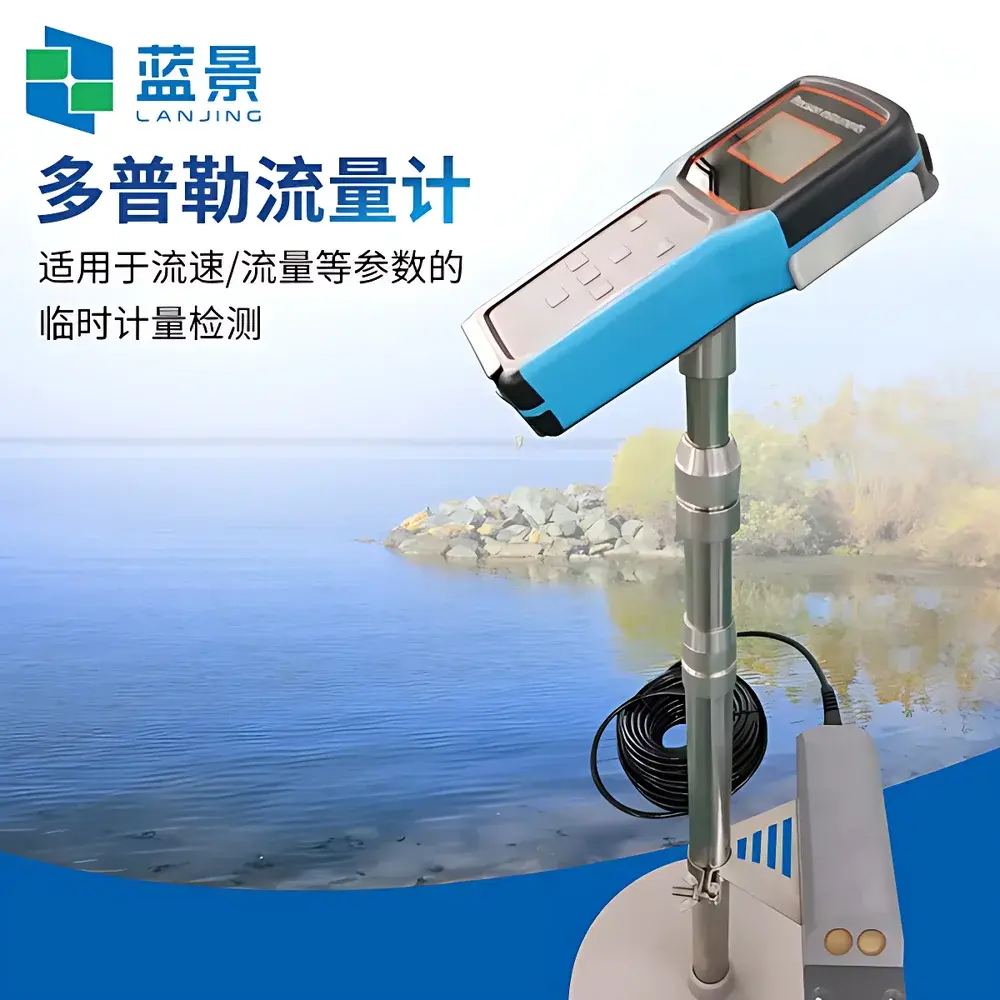
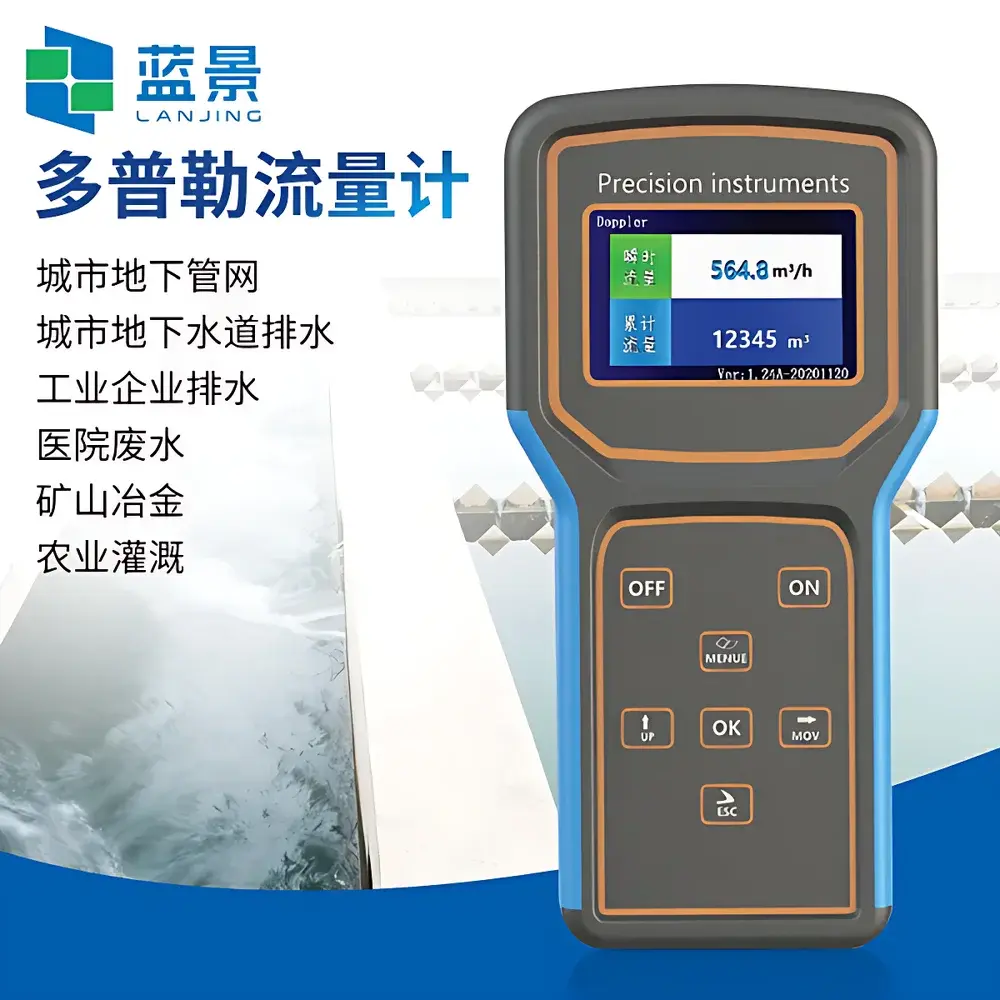
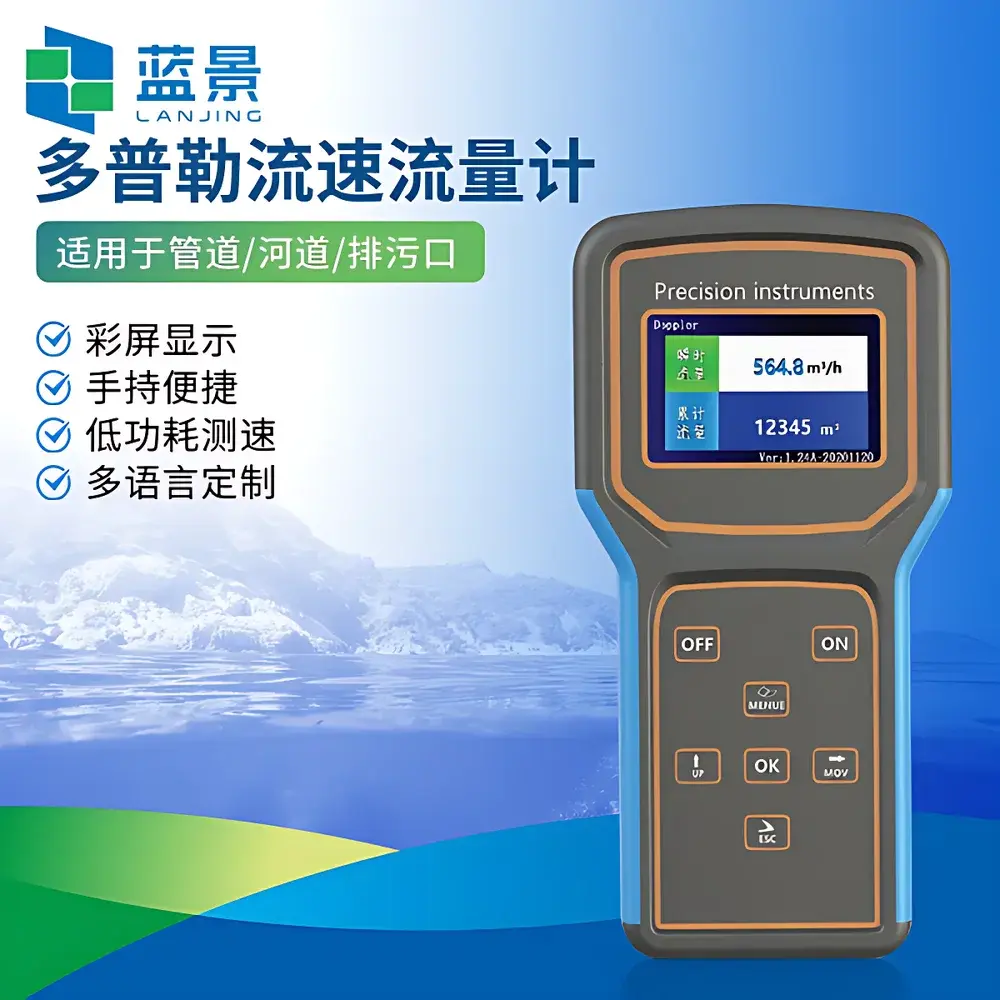
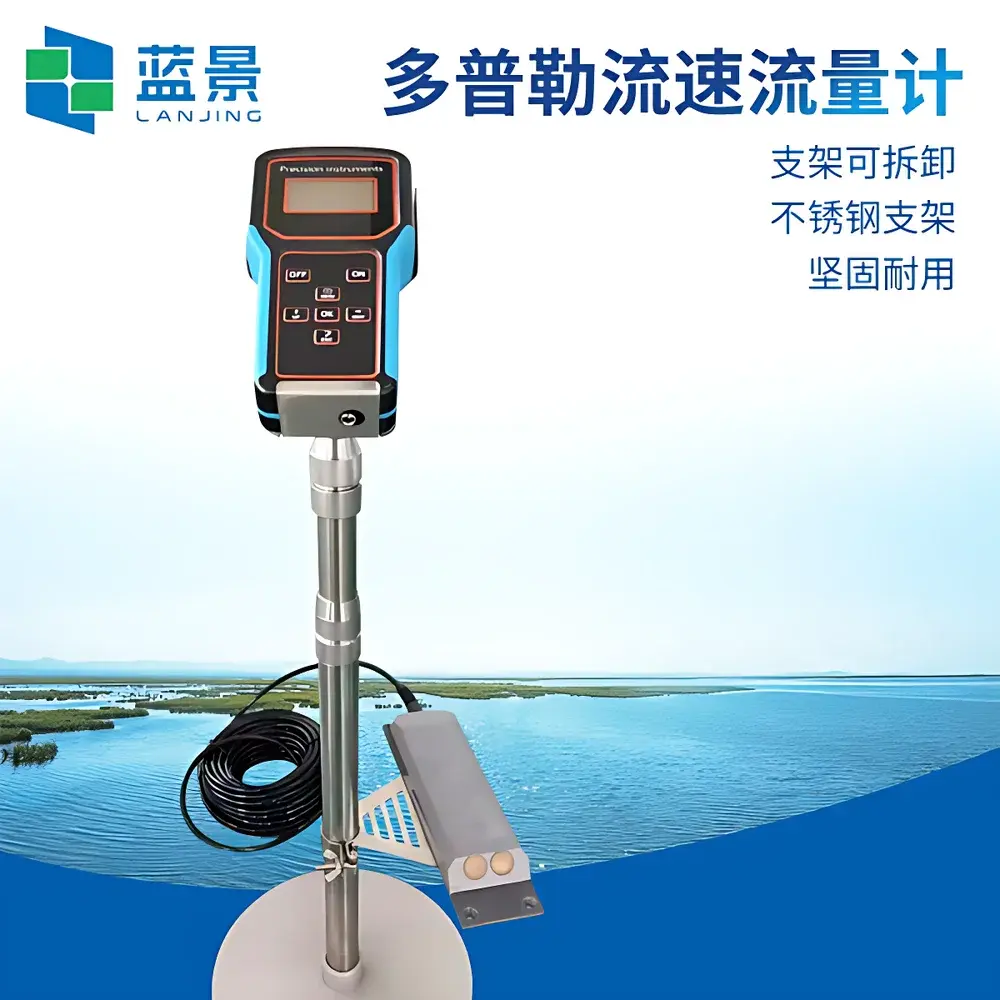
Lanjing LJ-DP501 Portable Ultrasonic Doppler Flowmeter
| Brand | Lanjing |
|---|---|
| Origin | Shandong, China |
| Manufacturer Type | OEM/ODM Manufacturer |
| Country of Origin | China |
| Model | LJ-DP501 |
| Liquid Mass Flow Accuracy | ±1.0% ± 1 mm/s |
| Liquid Level Range | 0–10 m (Resolution: 0.001 m) |
| Velocity Range | 0–5 m/s (Accuracy: <5%, Resolution: 0.001 mm/s) |
| Instantaneous Flow Range | 0–999,999,999 m³/h (Resolution: 0.1 m³/h) |
| Totalized Flow Range | 0–999,999,999 m³ |
| Temperature Range | −10–70 °C (Accuracy: ≤±0.5 °C, Resolution: 0.1 °C) |
| Housing Material | PVC |
| Power Consumption | <2 W |
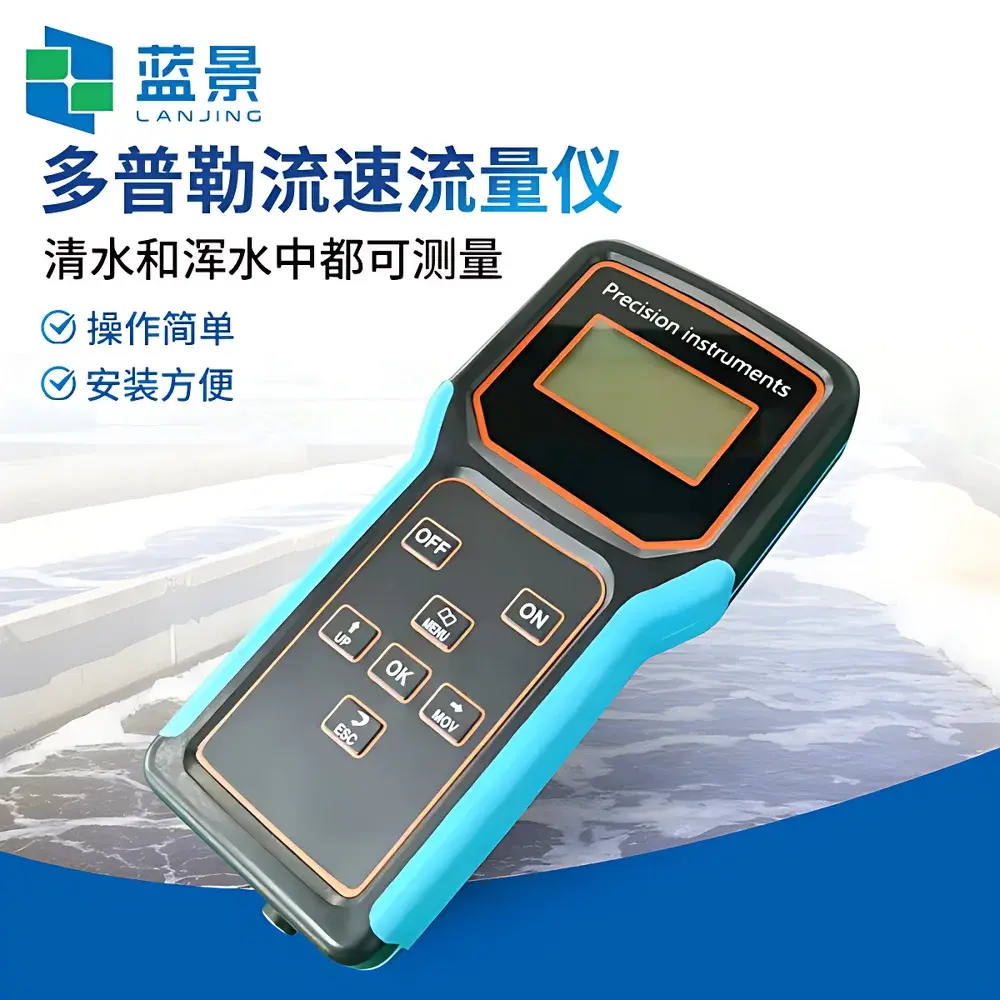
| Display | TFT Color LCD |
| Protection Rating | IP65 (Host), IP68 (Sensor) |
| Power Supply | Rechargeable 12 V Li-ion Battery (Host), 9–24 V DC (Sensor) |
| Output Signals | RS-485 (standard), 4–20 mA analog output (standard), HART / NB-IoT / LoRa (optional) |
| Installation Method | Submersible Mount with Adjustable Bracket |
| Standard Cable Length | 10 m (Polyurethane, corrosion-resistant, extendable) |
Overview
The Lanjing LJ-DP501 Portable Ultrasonic Doppler Flowmeter is a non-intrusive, clamp-on or submersible liquid flow measurement instrument engineered for open-channel, partially filled pipe, and natural waterway applications. It operates on the principle of ultrasonic Doppler shift: two transducers emit and receive high-frequency acoustic waves (typically 1–4 MHz) into the flowing medium; particles or suspended solids in the liquid act as scattering centers, causing a frequency shift proportional to the axial velocity component. By analyzing this shift—combined with cross-sectional geometry and fluid level data—the device computes real-time volumetric flow rate without requiring pipe cutting, flange modification, or primary flow elements such as weirs or flumes. This makes it especially suitable for retrofitting legacy infrastructure, temporary monitoring campaigns, and environments where hydraulic disruption must be avoided.
Key Features
- True portable architecture with integrated rechargeable 12 V Li-ion battery (host), enabling field-deployable operation for up to 12 hours per charge under typical usage conditions
- Submersible sensor rated IP68, constructed with corrosion-resistant polyurethane cable and PVC housing, validated for continuous immersion in wastewater, seawater, and aggressive industrial effluents
- TFT color LCD display with user-configurable interface layout, supporting multi-language UI (English, Spanish, French, Arabic, Chinese) and customizable parameter screens
- Onboard data logging with internal memory capable of storing >100,000 timestamped records (flow, level, velocity, temperature); export via plug-and-play USB mass storage mode—no driver installation required
- Real-time graphical visualization including historical trend curves (flow vs. time, level vs. time), statistical summaries (min/max/avg/std dev), and automatic event-triggered logging (e.g., overflow detection)
- Dual-output capability: standard RS-485 Modbus RTU and 4–20 mA analog output; optional communication modules support HART 7, NB-IoT, and LoRaWAN for integration into SCADA, IoT telemetry, or cloud-based water management platforms
Sample Compatibility & Compliance
The LJ-DP501 is designed for conductive and non-conductive liquids containing ≥20 ppm suspended solids or bubbles—ideal for raw sewage, stormwater runoff, irrigation return flows, aquaculture recirculation systems, and mine drainage. It does not require calibration against a reference meter for routine use, though traceable verification per ISO 4064-2 (water meters) or ASTM D5389 (open-channel flow measurement) is supported through documented field procedures. The device complies with electromagnetic compatibility standards IEC 61326-1 (industrial environment) and meets RoHS Directive 2011/65/EU. Its firmware architecture supports audit-trail-enabled operation aligned with GLP principles, including user login tracking, configuration change logs, and tamper-evident data export timestamps.
Software & Data Management
Comprehensive PC software (Windows/Linux/macOS compatible) provides configuration, firmware update, and advanced post-processing capabilities—including hydraulic profile modeling, Manning’s n coefficient estimation, and cross-sectional area correction based on user-defined channel geometry. All logged data are stored in CSV and SQLite formats, ensuring compatibility with third-party analytics tools (e.g., Python Pandas, MATLAB, Tableau). The USB export function generates dated folders with embedded metadata (sensor ID, location tag, UTC timestamp), facilitating chain-of-custody documentation required in regulatory reporting (e.g., EPA NPDES compliance, ISO 5667-22 water quality monitoring).
Applications
- Municipal wastewater networks: Real-time flow surveillance in combined sewers, lift stations, and CSO outfalls
- Industrial process discharge monitoring: Continuous compliance verification for chemical, pharmaceutical, and food processing facilities subject to local environmental permits
- Agricultural water accounting: Field-level irrigation scheduling and canal flow distribution verification under water rights regimes
- Environmental research: Long-term hydrological studies in rivers, streams, and wetlands where minimal site impact is mandatory
- Emergency response: Rapid deployment for flood stage assessment, leak detection in pressurized mains (via insertion probe variant), and post-disaster infrastructure diagnostics
FAQ
Does the LJ-DP501 require zero-flow calibration before deployment?
No. It uses self-referencing Doppler signal processing and does not rely on static zero-point adjustment. However, initial setup requires accurate input of channel geometry and sensor mounting offset parameters.
Can it measure in fully filled, pressurized pipes?
Yes—when used with an optional insertion-type sensor and appropriate pipe coupling, it supports full-pipe velocity profiling under pressure up to 10 bar (dependent on sensor model variant).
Is the device certified for hazardous locations (e.g., Class I Div 1)?
Not by default. Intrinsically safe variants with ATEX/IECEx certification are available upon request with modified enclosure and power supply design.
How is temperature compensation handled?
An integrated Pt1000 RTD sensor measures fluid temperature in real time and dynamically corrects sound speed assumptions in the Doppler algorithm, improving velocity accuracy across seasonal variations.
What is the minimum particle concentration required for reliable Doppler signal generation?
A minimum of 20 mg/L suspended solids (or equivalent bubble density) is recommended. Signal strength diagnostics and SNR indicators are displayed live on the screen to guide optimal sensor placement.