
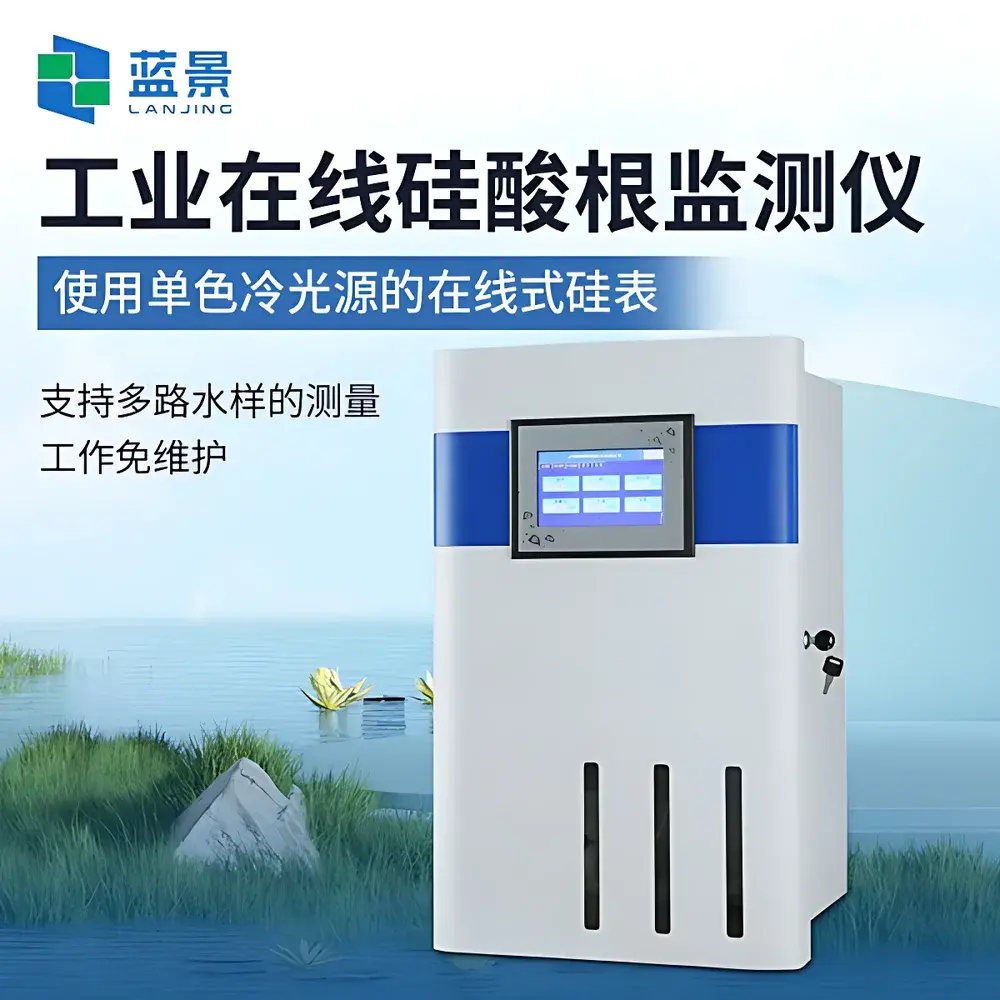
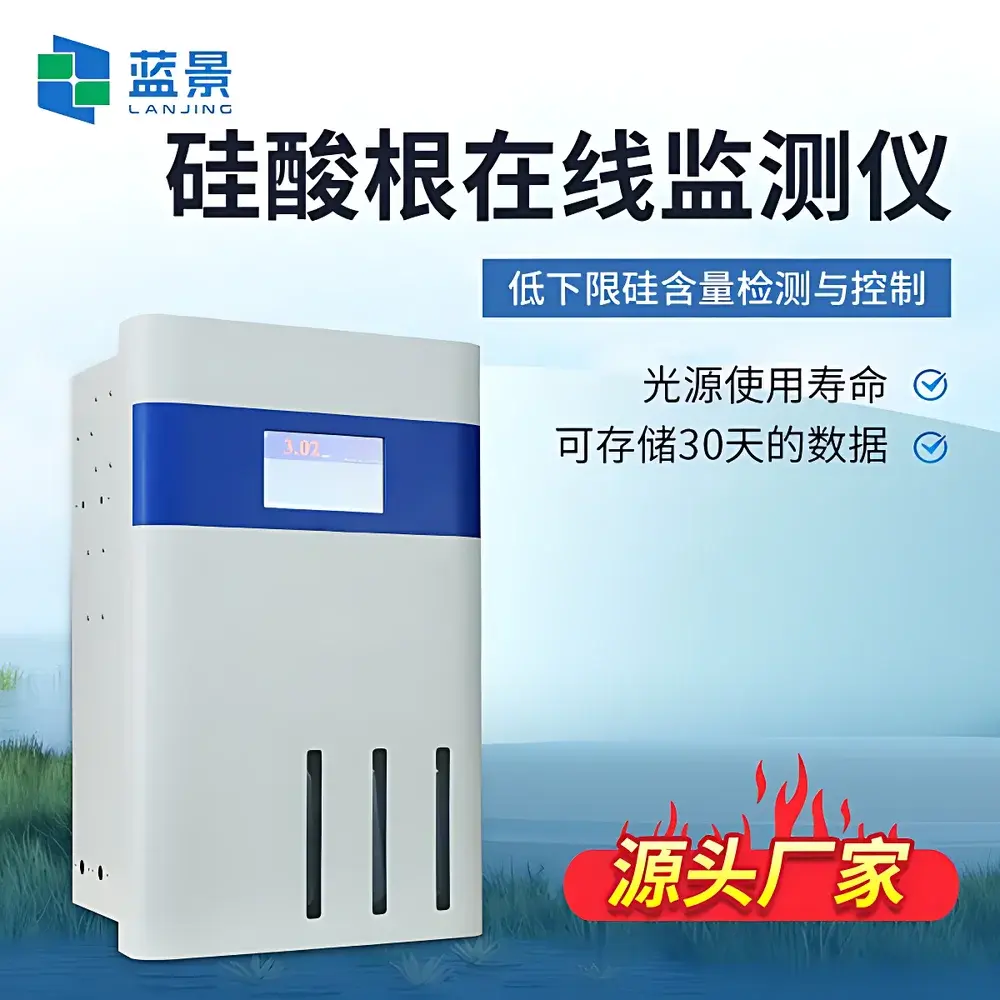
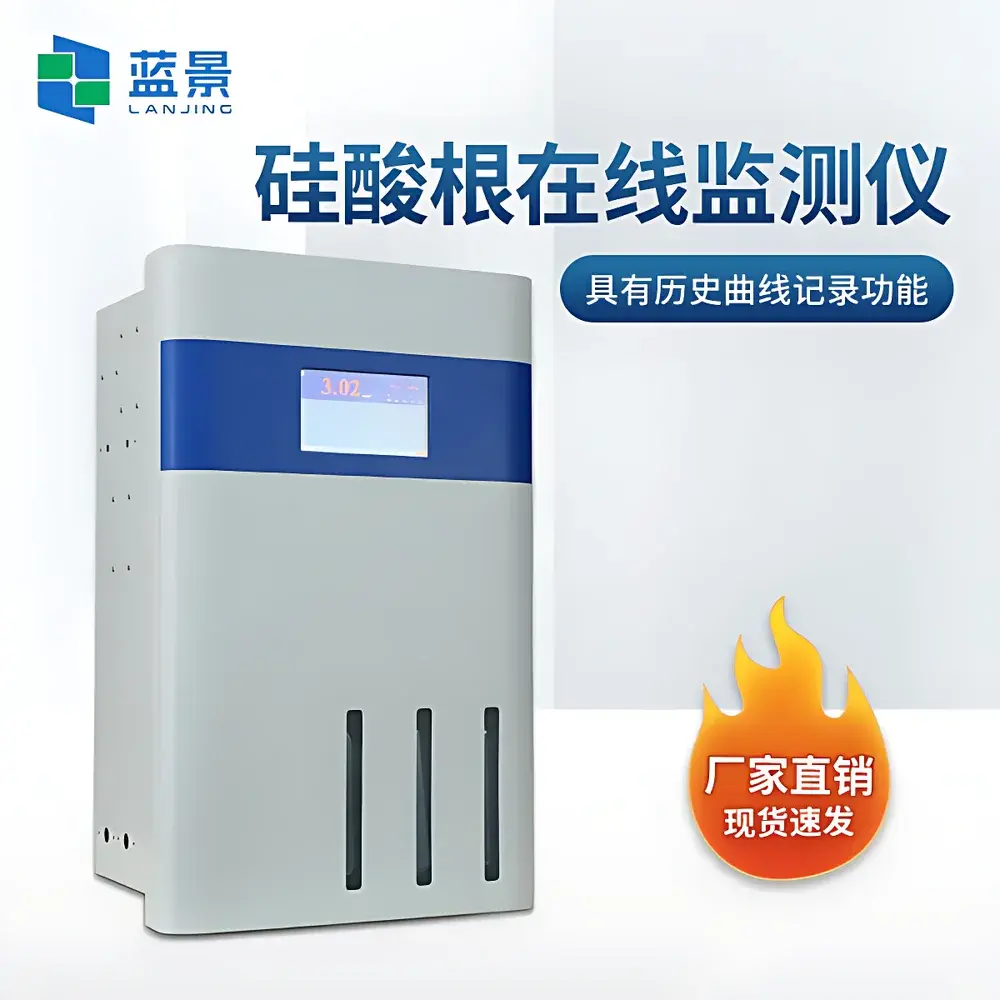
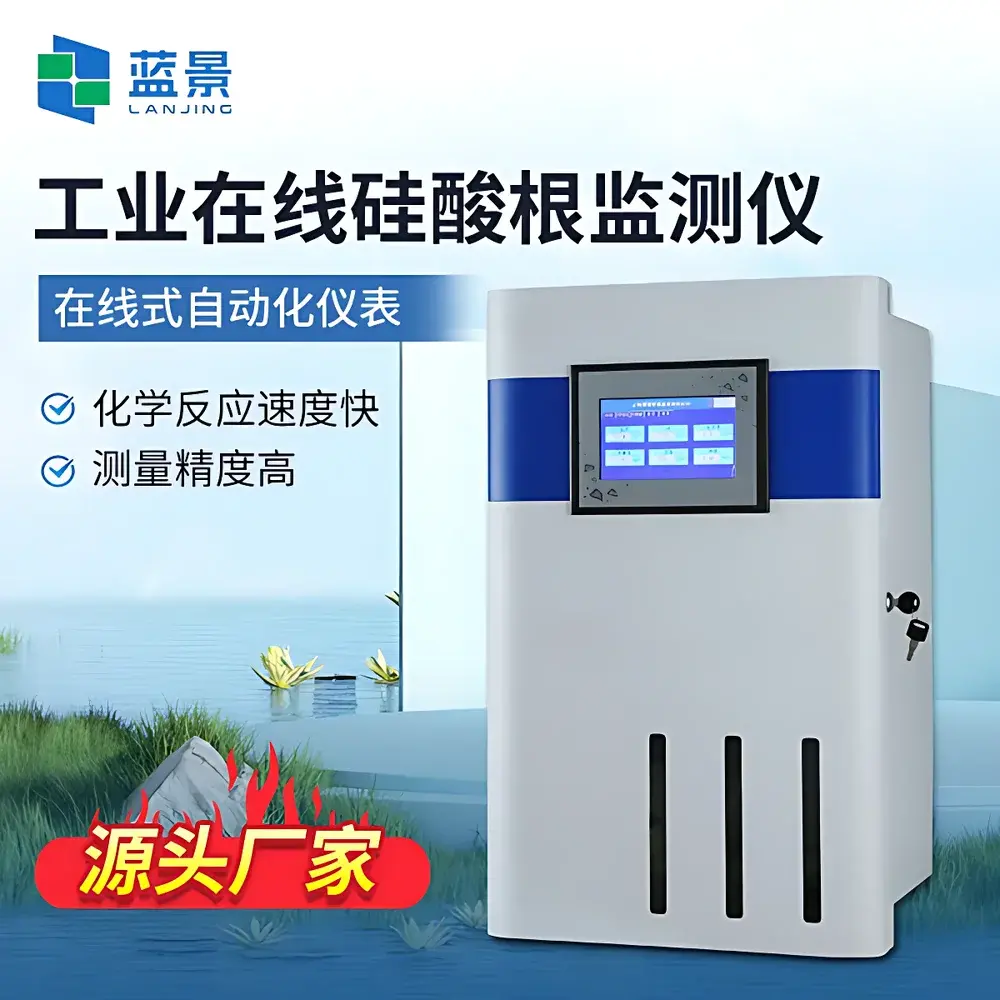
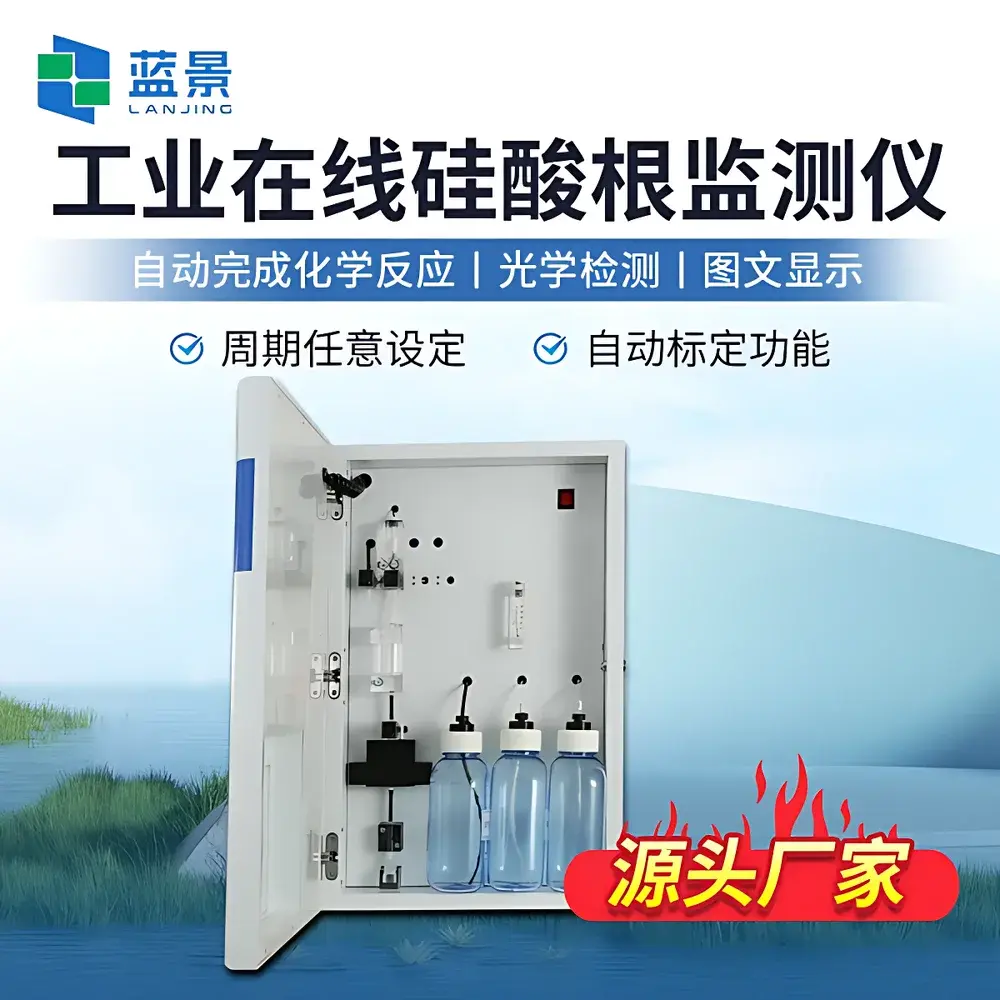
Lanjing LJ-ZGSG Online Silica Analyzer
| Brand | Lanjing |
|---|---|
| Origin | Shandong, China |
| Manufacturer Type | Manufacturer |
| Country of Origin | China |
| Model | LJ-ZGSG |
| Instrument Type | Online Analyzer |
| Measurement Ranges | 0–30 ppb, 0–500 ppb, 0–5000 ppb |
| Accuracy | ±1% F.S. |
| Repeatability | ±1% F.S. |
| Drift | ≤±1% F.S. / 24 h |
| Response Time | 12 min (initial) |
| Sampling Cycle | ~10 min per channel |
| Sample Flow Rate | >100 mL/min |
| Sample Temperature | 10–45 °C |
| Sample Pressure | 10–100 kPa |
| Ambient Temperature | 5–45 °C |
| Relative Humidity | <85% RH |
| Reagent Consumption | ~3 L/month per reagent (3 reagents total) |
| Output | 4–20 mA (configurable, per-channel independent) |
| Alarm Output | Relay NO contact (220 VAC / 1 A) |
| Power Supply | AC 220 V ±10%, 50 Hz |
| Power Consumption | ≈50 VA |
| Dimensions (H×W×D) | 720 × 460 × 300 mm |
| Panel Cutout | 665 × 405 mm |
Overview
The Lanjing LJ-ZGSG Online Silica Analyzer is a fully automated, photometric process analyzer engineered for continuous, real-time monitoring of dissolved silica (SiO2) in high-purity water streams—particularly in power generation, semiconductor ultrapure water (UPW) systems, and pharmaceutical purified water loops. It operates on the molybdenum blue colorimetric principle: soluble silicate ions react with ammonium molybdate under acidic conditions to form heteropoly acids, which are subsequently reduced to intensely colored molybdenum blue complexes. Absorbance is measured at a fixed wavelength using a stable monochromatic cold light source, enabling high specificity and minimal spectral interference. Unlike conventional benchtop or semi-automated analyzers, the LJ-ZGSG integrates sample conditioning, reagent metering, air-agitated reaction kinetics, optical detection, and digital signal processing into a single robust industrial enclosure—designed for unattended operation in demanding plant environments.
Key Features
- Monochromatic cold light source with extended service life (>10,000 hours), eliminating thermal drift and wavelength instability common in halogen or LED-based systems
- Air-assisted mixing technology ensures rapid and homogeneous reagent-sample interaction, reducing initial response time to ≤12 minutes and improving reproducibility
- Multi-channel capability: configurable for 1–6 independent sample streams, each with dedicated flow control, reaction chamber, and photometric cell
- Full-color LCD interface with intuitive Chinese-language menu navigation, real-time trend curves, system diagnostics, and event logging
- Auto-calibration function with user-defined intervals (e.g., every 2, 4, 8, or 24 hours), supporting both standard addition and zero-span verification
- Integrated data retention: stores up to 30 days of timestamped measurement records (including raw absorbance, calculated silica concentration, and alarm status) in non-volatile memory
- True maintenance-light architecture: requires only periodic reagent replenishment and calibration standard replacement—no routine optical alignment, pump tube changes, or valve servicing
Sample Compatibility & Compliance
The LJ-ZGSG is validated for use with low-conductivity, particle-free water samples meeting ASTM D4582–22 (Standard Practice for Measuring Silica in High-Purity Water) and ISO 10523:2022 (Water Quality — Determination of pH). It complies with IEC 61000-6-2 (EMC immunity) and IEC 61000-6-4 (EMC emissions) for industrial environments. While not inherently 21 CFR Part 11 compliant, its audit-ready data log supports GLP/GMP-aligned documentation when deployed with external secure data servers. Sample inlet requirements—flow ≥100 mL/min, temperature 10–45 °C, pressure 10–100 kPa—are compatible with standard side-stream sampling skids used in boiler feedwater, condensate, and turbine steam cycle monitoring. The analyzer excludes turbid, high-organic, or fluoride-rich matrices without pretreatment.
Software & Data Management
Data output is provided via isolated 4–20 mA analog signals (per channel, individually configurable for range and damping), along with dry-contact relay alarms (220 VAC/1 A) for high/low limit violation or system fault conditions. Optional RS-485 Modbus RTU interface enables integration into DCS, SCADA, or MES platforms for centralized visualization and historical trending. All internal measurements—including absorbance values, temperature-compensated concentration, calibration timestamps, and error codes—are stored with millisecond-resolution timestamps. The embedded firmware supports password-protected configuration access and provides full change history for critical parameters (e.g., calibration slope, zero offset, alarm thresholds), satisfying basic traceability requirements for quality-critical applications.
Applications
- Real-time silica surveillance in fossil fuel and nuclear power plant feedwater, condensate, and steam lines to prevent silica deposition on turbine blades and heat exchanger surfaces
- Monitoring of demineralized water and mixed-bed effluent in petrochemical and chemical process cooling circuits
- Final polish loop verification in semiconductor fab UPW distribution systems where sub-ppb silica control is mandated by SEMI F63 standards
- Pharmaceutical purified water (PW) and water for injection (WFI) systems subject to USP <846> and EP 2.2.42 guidelines
- Environmental compliance monitoring of treated effluent from silicon wafer manufacturing wastewater treatment plants
FAQ
What silica species does the LJ-ZGSG measure?
It quantifies reactive (dissolved) orthosilicic acid [Si(OH)4] and readily hydrolyzable silicates—collectively reported as “SiO2” in ppb. It does not detect colloidal silica or polymeric silicates without acid digestion pretreatment.
Can the instrument operate continuously without operator intervention?
Yes—once commissioned and loaded with reagents, it runs unattended for ≥30 days. Only monthly reagent top-up and quarterly calibration verification are required under normal operating conditions.
Is remote diagnostics supported?
The base model includes local display and analog outputs only. Remote access requires optional Modbus RTU integration with third-party SCADA or cloud-based asset monitoring platforms.
How is temperature compensation handled?
An integrated Pt100 sensor monitors reaction cell temperature in real time; the firmware applies empirically derived correction coefficients to absorbance-to-concentration conversion, minimizing thermal bias across the 10–45 °C operational range.
What maintenance certifications or calibration standards are recommended?
Calibration should be performed using NIST-traceable silica standards (e.g., AccuStandard S-103 or equivalent). No formal certification is required for routine operation, but annual verification against certified reference materials is recommended for regulated environments.
Related Products







