
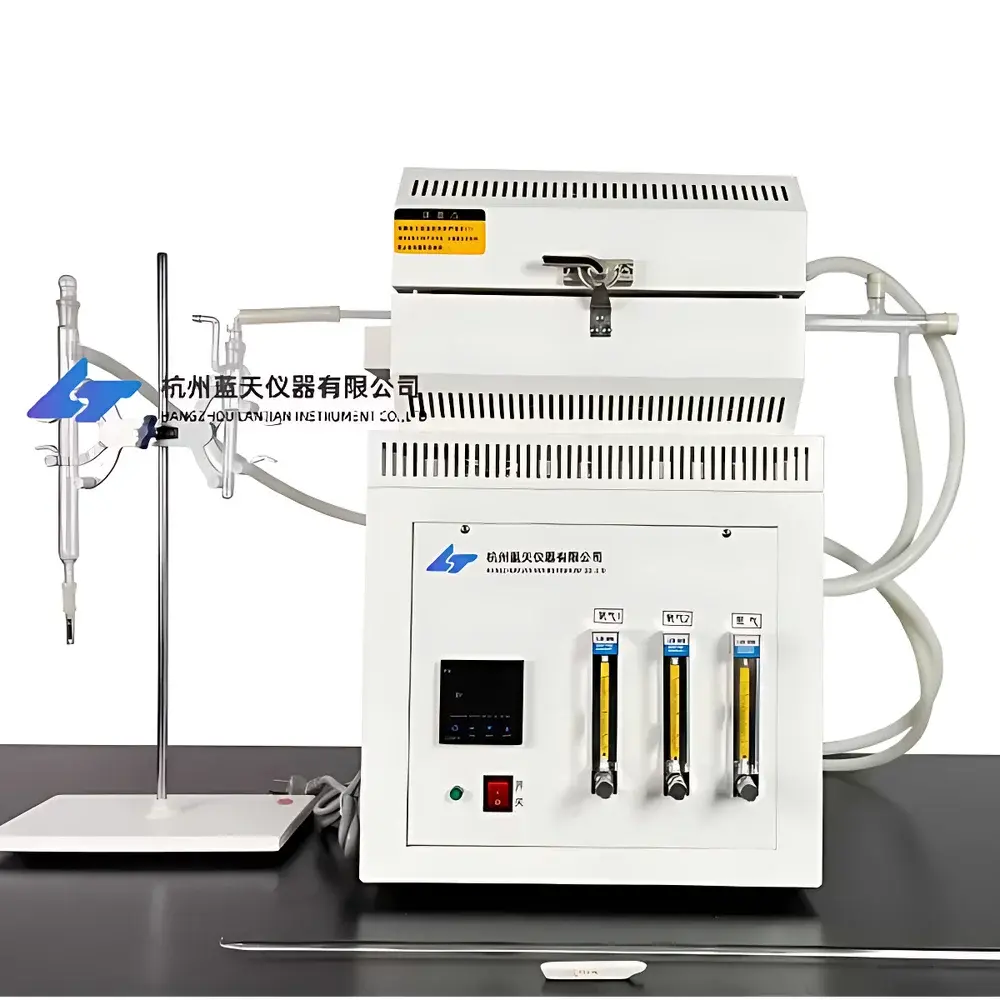
LANTIAN AOX-C Integrated Tube Furnace for Adsorbable Organic Halogens (AOX) Analysis with Ion Chromatography
| Brand | LANTIAN |
|---|---|
| Model | AOX-C |
| Origin | Zhejiang, China |
| Manufacturer | LANTIAN Instrument Co., Ltd. |
| Application | AOX determination in water and solid matrices per HJ/T 83–2001, ISO 9562:1989, and GB/T 15959–1995 |
| Detection Method | High-temperature catalytic combustion followed by alkaline absorption and ion chromatographic quantification of F⁻, Cl⁻, Br⁻ |
| Sample Types | Drinking water, surface water, groundwater, wastewater, effluent, seawater, pulp mill discharge, soil, sediment, sludge, and waste oils |
| System Configuration | Integrated furnace with built-in scrubbing system, quartz combustion tube, dual-zone oxygen supply, nitrogen-driven adsorption module, standardized absorption train, and IC-compatible sample preparation workflow |
| Compliance | Designed to support GLP-compliant AOX testing workflows |
Overview
The LANTIAN AOX-C Integrated Tube Furnace is a purpose-built thermal combustion system engineered for the quantitative determination of Adsorbable Organic Halogens (AOX) in environmental matrices—including aqueous samples (drinking water, wastewater, seawater), solid-phase materials (soil, sediment, sludge), and industrial process streams (pulp mill effluents, waste oils). It operates on the principle of high-temperature catalytic oxidation (900–950 °C) under controlled oxygen/nitrogen atmospheres, converting adsorbed organohalogen compounds into inorganic hydrogen halides (HF, HCl, HBr). These gaseous species are subsequently trapped in dilute alkaline absorbent solutions (e.g., 1 mM NaOH), yielding stable halide ions (F⁻, Cl⁻, Br⁻) suitable for precise quantification via ion chromatography (IC). Unlike microcoulometric detection—used in older AOX methods—the AOX-C enables simultaneous, speciated analysis of individual halogens, supporting regulatory reporting under China’s HJ/T 83–2001 and international frameworks including ISO 9562:1989 and GB/T 15959–1995.
Key Features
- Integrated dual-zone tube furnace with independent inner/outer tube heating control for optimized oxidative pyrolysis and complete halogen recovery
- Built-in gas purification and scrubbing system to remove CO₂, NOₓ, and acidic interferences prior to absorption
- Standardized nitrogen-driven adsorption module with calibrated pressure regulation (0.1–0.3 MPa), compatible with activated carbon-packed columns per method specifications
- Quartz combustion tube (OD 15 mm) with high-purity alumina catalyst bed and thermocouple feedback for ±5 °C temperature stability across 900–950 °C operating range
- Modular absorption train comprising two parallel absorption bottles and two absorption tubes, all constructed from borosilicate glass with PTFE stopcocks and calibrated volume markings (10 mL and 25 mL)
- Dedicated hardware kit: two sample boats (quartz), one quartz push rod, two silicone rubber end caps, five gas-washing bottles, custom-length silicone tubing (1.27 m total, pre-cut per connection protocol), and dedicated mounting fixtures for absorption vessels
Sample Compatibility & Compliance
The AOX-C supports analysis of liquid samples (100–500 mL), suspended solids (up to 5 g dried weight), and solvent-extracted organic phases. Its design conforms to the sample preparation and combustion parameters defined in HJ/T 83–2001, ensuring full alignment with Chinese EPA certification requirements for environmental laboratories. For international validation, the system meets the physical and procedural prerequisites of ISO 9562:1989—particularly concerning adsorption efficiency (>95% recovery for chlorinated benzenes), combustion completeness (>99% halogen conversion), and blank control (<0.5 µg Cl⁻ per run). All wetted components comply with USP Class VI and ISO 8573-1:2010 compressed gas purity standards. The system architecture supports audit-ready documentation when paired with IC systems validated under FDA 21 CFR Part 11 and ISO/IEC 17025 quality management frameworks.
Software & Data Management
While the AOX-C is a hardware-only combustion platform (no embedded firmware or onboard software), its operational workflow integrates seamlessly with commercial ion chromatography data systems (e.g., Thermo Scientific Dionex Chromeleon™, Metrohm MagIC Net™, or Shodex IC Solutions). All manual steps—including adsorption timing, furnace ramp profiles, absorption volume verification, and IC injection protocols—are documented in standard operating procedures (SOPs) compliant with GLP and ISO/IEC 17025. Optional digital logbooks and electronic batch records can be implemented using LIMS platforms (e.g., LabVantage, STARLIMS) to track sample IDs, reagent lots, operator signatures, and calibration histories—enabling full traceability for regulatory submissions and third-party audits.
Applications
The AOX-C is routinely deployed in municipal water utilities for compliance monitoring of disinfection byproduct precursors; in pulp and paper facilities to assess chlorinated organic load in bleaching effluents; in environmental testing labs conducting Tier 1 screening of contaminated sites (e.g., former pesticide manufacturing zones); and in research institutions studying halogen speciation dynamics during advanced oxidation processes (AOPs). Its capacity to resolve F⁻, Cl⁻, and Br⁻ independently allows differentiation between anthropogenic contamination (e.g., chlorinated solvents, brominated flame retardants) and natural halogen cycling (e.g., marine aerosol-derived Cl⁻), supporting both regulatory reporting and mechanistic environmental forensics.
FAQ
Does the AOX-C include an ion chromatograph?
No. The AOX-C is a dedicated combustion and absorption system only. It must be coupled with a separate ion chromatograph equipped with an anion-exchange column, suppressed conductivity detection, and certified halide standards.
What is the typical detection limit achievable with this system?
When used with modern high-sensitivity IC systems (e.g., sub-ppq detection limits), the overall method detection limit (MDL) for AOX is typically 0.5–2.0 µg Cl⁻/L in water, depending on sample volume, blank control, and IC configuration.
Can the system be used for iodine-containing compounds (AOI)?
No. The current configuration is validated for F, Cl, and Br only. Iodine species (e.g., HOI, I⁻) exhibit lower volatility and may undergo incomplete recovery or redox degradation under standard combustion conditions.
Is operator training included with purchase?
Yes. LANTIAN provides on-site installation, method verification, and hands-on operator training covering adsorption setup, furnace calibration, absorption train assembly, blank minimization, and troubleshooting of common combustion artifacts (e.g., incomplete oxidation, carryover, CO₂ interference).
Are replacement consumables available through LANTIAN?
Yes. Quartz combustion tubes, activated carbon cartridges, absorption bottles, silicone tubing kits, and certified halide standards are supplied directly by LANTIAN Instrument Co., Ltd. with documented lot traceability and QC certificates.







