
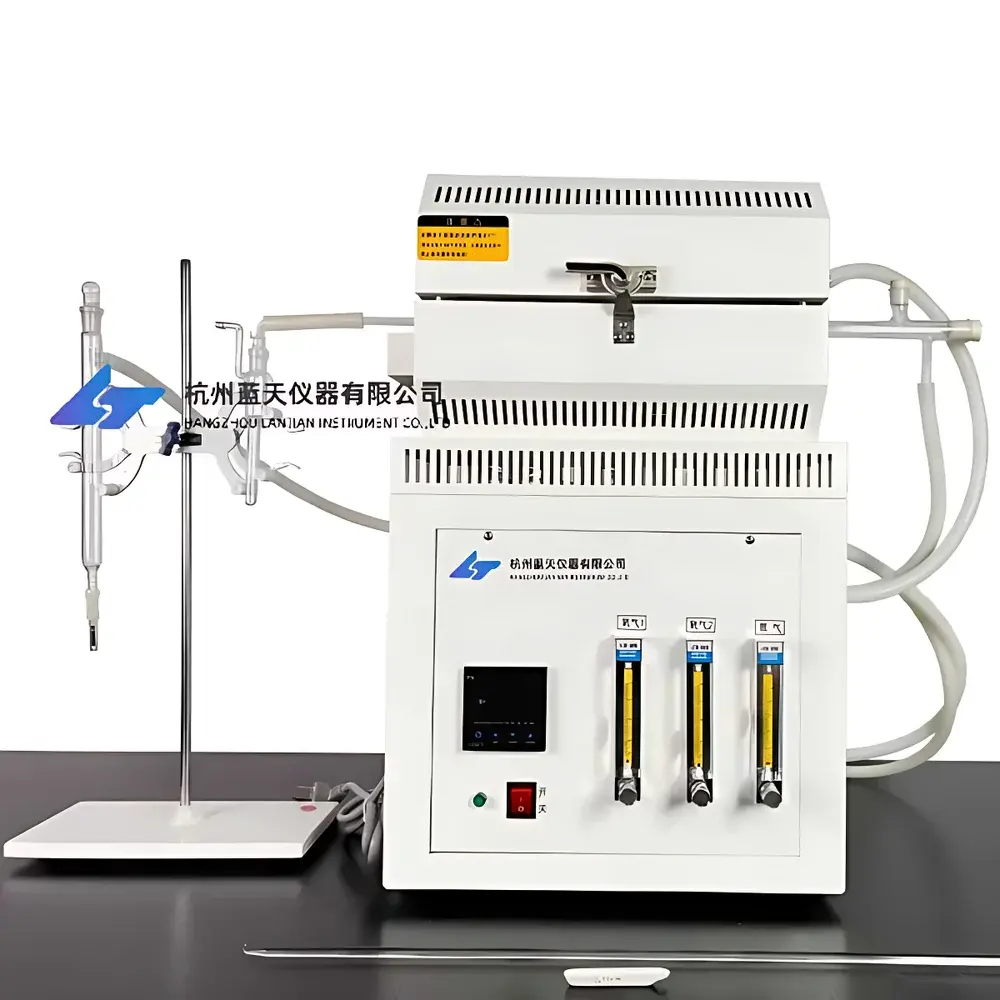
LANTIAN AOX-C Integrated Tube Furnace System for Adsorbable Organic Halogens (AOX) Analysis by Ion Chromatography
| Brand | LANTIAN |
|---|---|
| Origin | Zhejiang, China |
| Manufacturer Type | Direct Manufacturer |
| Model | AOX-C |
| Compliance | HJ/T 83–2001, ISO 9562:1989, GB/T 15959–1995 |
| Detection Method | High-Temperature Combustion Coupled with Ion Chromatography (IC) |
| Measurable Species | AOX (as Cl), AOCl, AOF, AOBr |
| Sample Matrices | Drinking water, surface water, groundwater, wastewater, effluent, seawater, pulp mill discharge, soil, sediment, sludge, and waste oils |
| System Configuration | Integrated furnace with built-in gas scrubbing, dual-zone combustion tube, nitrogen pressurized adsorption unit, alkaline absorption train, and IC-ready halide quantification |
Overview
The LANTIAN AOX-C Integrated Tube Furnace System is a purpose-engineered analytical platform designed for the quantitative determination of adsorbable organic halogens (AOX) in environmental matrices according to internationally recognized standard methods. It implements a high-temperature catalytic combustion protocol—operating at up to 950 °C—to quantitatively convert adsorbed organic halogen compounds (chlorinated, fluorinated, and brominated) into their corresponding hydrogen halides (HF, HCl, HBr). These gaseous species are then absorbed in dilute alkaline solution (e.g., NaOH or Na₂CO₃/NaHCO₃), forming stable halide anions (F⁻, Cl⁻, Br⁻) suitable for precise separation and quantification via ion chromatography. Unlike microcoulometric detection, this IC-coupled approach delivers speciated results—enabling independent reporting of AOX (as Cl), adsorbable organic chlorine (AOCl), organic fluorine (AOF), and organic bromine (AOBr)—with improved selectivity, lower detection limits, and full traceability under GLP-compliant workflows.
Key Features
- Integrated dual-zone tubular furnace with independent temperature control for optimized pyrolysis (pre-combustion zone) and complete oxidation (combustion zone), ensuring quantitative halogen release without charring or incomplete decomposition.
- Built-in gas purification train comprising five serial scrubbing bottles to remove SO₂, NOₓ, CO₂, and acidic interferences prior to halide absorption—minimizing matrix-induced suppression in downstream IC analysis.
- Nitrogen-pressurized adsorption module featuring calibrated flow control, stainless-steel adsorption columns packed with activated carbon (ASTM D3860-compliant), and pressure-rated fittings for reproducible sample loading across variable water volumes (10–500 mL).
- Custom quartz combustion tube with concentric inner/outer gas pathways—oxygen supplied separately to both zones to maintain stoichiometric oxidation while preventing back-diffusion of combustion products.
- Modular absorption system with two parallel absorption tubes and dedicated holders, enabling simultaneous capture of HF/HCl/HBr in 1–5 mL of 0.1–1.0 mol/L NaOH, compatible with standard IC autosampler vials.
- All wetted components constructed from inert materials (quartz, PTFE, borosilicate glass, and EPDM-free silicone) to eliminate halogen memory effects and ensure long-term calibration stability.
Sample Compatibility & Compliance
The AOX-C system accommodates a broad spectrum of aqueous and semi-solid environmental samples per HJ/T 83–2001 and ISO 9562:1989, including potable water, river and lake water, groundwater, municipal and industrial wastewater, landfill leachate, pulp and paper mill effluents, seawater, and saline process streams. Solid-phase matrices—including soils, sediments, sludges, and waste oils—are processed using standardized solvent extraction and pre-concentration protocols prior to carbon adsorption. The system supports method validation requirements under ISO/IEC 17025, including spike recovery testing (70–110%), reagent blank monitoring (<0.5 µg Cl⁻), and intermediate precision assessment (RSD ≤8% at 50 µg/L AOX). All hardware and procedural documentation align with audit-ready GLP practices, facilitating integration into regulated environmental laboratories operating under CNAS or EPA-equivalent accreditation frameworks.
Software & Data Management
While the AOX-C furnace itself operates as a hardware-controlled standalone unit, its output is fully interoperable with commercial ion chromatography data systems (e.g., Thermo Scientific Dionex Chromeleon, Metrohm MagIC Net, or Shimadzu IC Solutions). Absorbed halide solutions are injected directly into IC systems equipped with suppressed conductivity detection and gradient elution capabilities. The workflow supports electronic record retention, audit trails for method parameters and calibration history, and automated report generation compliant with FDA 21 CFR Part 11 when paired with validated IC software. Optional digital logbooks—configured for timestamped operator entries, gas cylinder pressure logs, and furnace temperature ramp verification—further strengthen data integrity for regulatory submissions.
Applications
This system serves as a core component in environmental compliance monitoring for facilities subject to discharge permits under national pollutant discharge elimination systems (NPDES), EU Industrial Emissions Directive (IED), or China’s “Zero Liquid Discharge” initiatives. It is routinely deployed in municipal wastewater treatment plants for evaluating halogenated disinfection by-product (DBP) formation potential; in pulp and paper mills for monitoring chlorinated lignin derivatives; in pharmaceutical and agrochemical manufacturing sites for tracking halogenated process residuals; and in environmental testing laboratories supporting ISO 14001-certified EMS programs. Its ability to speciate AOF and AOBr—species increasingly regulated under emerging PFAS and brominated flame retardant frameworks—provides forward-looking analytical readiness beyond legacy AOX (as Cl) reporting.
FAQ
What standards does the AOX-C system validate against?
It is fully aligned with HJ/T 83–2001 (China), ISO 9562:1989 (International), and GB/T 15959–1995 (China), and its combustion and absorption performance meets the acceptance criteria specified in ASTM D5908–22 for AOX determination.
Can the system quantify fluorine independently from chlorine and bromine?
Yes—due to the selectivity of ion chromatography with carbonate/bicarbonate eluents and hydroxide-selective columns, F⁻, Cl⁻, and Br⁻ are baseline-resolved and quantified without cross-interference.
Is nitrogen gas purity critical for adsorption?
Yes—grade 5.0 (99.999%) N₂ is recommended to prevent oxidation of activated carbon and ensure consistent adsorption capacity across batches.
What maintenance intervals are recommended for the quartz combustion tube?
Visual inspection after every 50 analyses; replacement advised after 200–300 runs or upon observed etching, discoloration, or reduced halogen recovery in certified reference material checks.
Does the system support unattended operation?
The furnace and adsorption module require manual sample loading and gas line configuration; however, once initiated, the combustion and absorption sequence proceeds autonomously for up to 45 minutes per sample.







