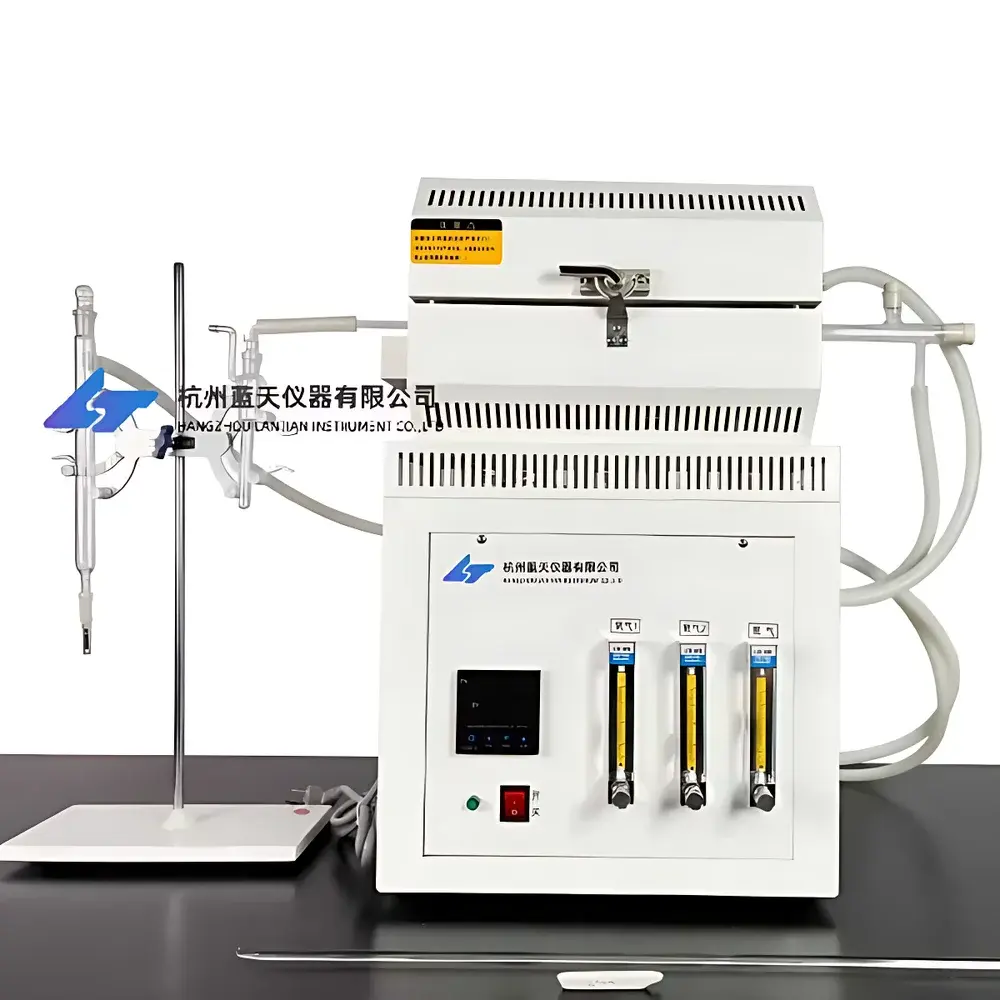
LANTIAN AOX-C Ion Chromatography-Based Adsorbable Organic Halogens (AOX) Analyzer
| Brand | LANTIAN |
|---|---|
| Origin | Zhejiang, China |
| Manufacturer Type | Direct Manufacturer |
| Product Category | Domestic Instrument |
| Model | AOX-C Ion Chromatography-Based AOX Analyzer |
| Price | USD 4,200 (FOB Zhejiang) |
Overview
The LANTIAN AOX-C Ion Chromatography-Based Adsorbable Organic Halogens (AOX) Analyzer is a dedicated laboratory instrument engineered for the quantitative determination of adsorbable organic halogen compounds—including adsorbable organic chlorine (AOCl), bromine (AOBr), and fluorine (AOF)—in aqueous and solid environmental matrices. It operates on the principle of adsorption–combustion–hydrolysis–ion chromatographic detection: organic halogenated compounds are first retained on activated carbon under nitrogen pressure; the loaded carbon is then combusted at high temperature (≥950 °C) in an oxygen-rich environment to quantitatively convert organohalogens into hydrogen halides (HX); these gaseous species are absorbed in dilute alkaline solution (e.g., NaOH or KOH), where they dissociate into halide anions (Cl⁻, Br⁻, F⁻); finally, the resulting anions are separated, identified, and quantified using high-resolution ion chromatography with suppressed conductivity detection. This method aligns with the fundamental analytical logic of HJ/T 83–2001 (China EPA), ISO 9562:1989, and GB/T 15959–1995—while replacing microcoulometric titration with ion chromatography for enhanced selectivity, multi-halogen speciation capability, and improved trace-level reproducibility.
Key Features
- Integrated modular architecture: Combines nitrogen-driven adsorption unit, high-temperature combustion furnace (programmable up to 1000 °C), quartz combustion tube with dual-zone oxygen supply, and built-in gas purification system in a single chassis.
- Dual-path oxygen delivery: Independent inner-tube and outer-tube oxygen inlets ensure complete oxidative decomposition of refractory organohalogens (e.g., polyhalogenated aromatics, chlorinated pesticides) without carbon residue formation.
- Optimized gas transfer routing: Precision-calibrated silicone tubing set (OD 15 mm) ensures leak-tight, inert transport of HX gases from combustion zone to absorption train—minimizing analyte loss and cross-contamination.
- Standardized sample introduction: Includes two ceramic sample boats, quartz push rod, dual rubber end caps, and pressure-rated adsorption columns compatible with ASTM D5908–17 sample preparation protocols.
- Comprehensive accessory suite: Five acid-scrubbing wash bottles, two alkali absorption bottles with fixed mounts, two U-shaped absorption tubes, and auxiliary consumables (gauze, adhesive tape, cable ties) support GLP-compliant daily operation and method validation.
Sample Compatibility & Compliance
The AOX-C analyzer accommodates diverse environmental samples per regulatory scope: drinking water, surface water, groundwater, municipal and industrial wastewater, effluents, seawater, treated reuse water, pulp and paper mill discharges, soil leachates, sediment pore water, sludge extracts, and waste oils. All operational procedures adhere to the methodological framework of HJ/T 83–2001, which specifies sample volume (100–500 mL), adsorption pH (≤2.0), carbon loading mass (100 mg), and combustion dwell time (10 min). The instrument’s measurement output—reported as µg Cl⁻/L (or µg X/L for individual halogens)—is directly traceable to NIST SRM ionic standards when paired with certified IC calibration solutions. Its design supports audit readiness for ISO/IEC 17025-accredited laboratories and satisfies data integrity prerequisites for US EPA Method 1650 (AOX by IC) and EU Directive 2013/39/EU priority substance monitoring.
Software & Data Management
While the AOX-C itself is a hardware-dedicated analyzer (no embedded OS or touchscreen), it is fully interoperable with commercial ion chromatography data systems (e.g., Thermo Chromeleon™, Metrohm MagIC Net™, or Dionex IC Pilot™) via analog voltage output (0–1 V) or digital RS-232 interface. Raw peak area and retention time data are exported in ASTM E1792-compliant .csv format. When deployed in regulated environments (e.g., contract environmental labs serving EU Water Framework Directive reporting), users may configure third-party IC software to enforce 21 CFR Part 11-compliant electronic signatures, audit trails, and user-access hierarchies—ensuring full compliance with GLP and GMP documentation requirements.
Applications
- Regulatory compliance testing for AOX discharge limits in wastewater treatment plants (e.g., EU BAT conclusions for pulp & paper, chlor-alkali, and textile sectors).
- Source tracking of halogenated pollutants in river basins impacted by pharmaceutical manufacturing or pesticide formulation facilities.
- Method validation studies comparing IC-based AOX against reference microcoulometric methods (ISO 9562) for interlaboratory precision assessment.
- Research on thermal degradation pathways of PFAS precursors in incineration ash leachates.
- Monitoring halogen speciation shifts during advanced oxidation processes (e.g., UV/H₂O₂, O₃/UV) applied to landfill leachate treatment.
FAQ
Does the AOX-C require external ion chromatography instrumentation?
Yes. The AOX-C serves exclusively as the sample preparation and conversion module. Quantitative analysis requires connection to a validated ion chromatograph equipped with an anion-exchange column, chemical suppressor, and conductivity detector.
Can the system analyze iodinated compounds (AOI)?
No. Due to thermal instability of hydrogen iodide (HI) above 300 °C and its rapid recombination to I₂, the current combustion–absorption–IC workflow is not validated for AOI. Only Cl, Br, and F are reliably determined.
Is operator training included with purchase?
Yes. LANTIAN provides on-site installation, method verification support, and hands-on operator training covering HJ/T 83–2001 protocol execution, system leak-checking, combustion parameter optimization, and absorption efficiency validation per Section 7.3 of ISO 9562.
What maintenance intervals are recommended for the combustion furnace?
Quartz combustion tube inspection every 200 runs; ceramic furnace insulation check annually; oxygen/nitrogen regulator calibration semiannually; absorption bottle replacement before each batch to prevent CO₂ ingress-induced carbonate interference.
Are spare parts and consumables available internationally?
Yes. LANTIAN maintains a global distributor network supplying certified quartz tubes, activated carbon cartridges (ASTM D3860-compliant), alkali absorption solutions, and OEM silicone tubing kits with documented lot traceability and CoA.
Related Products