
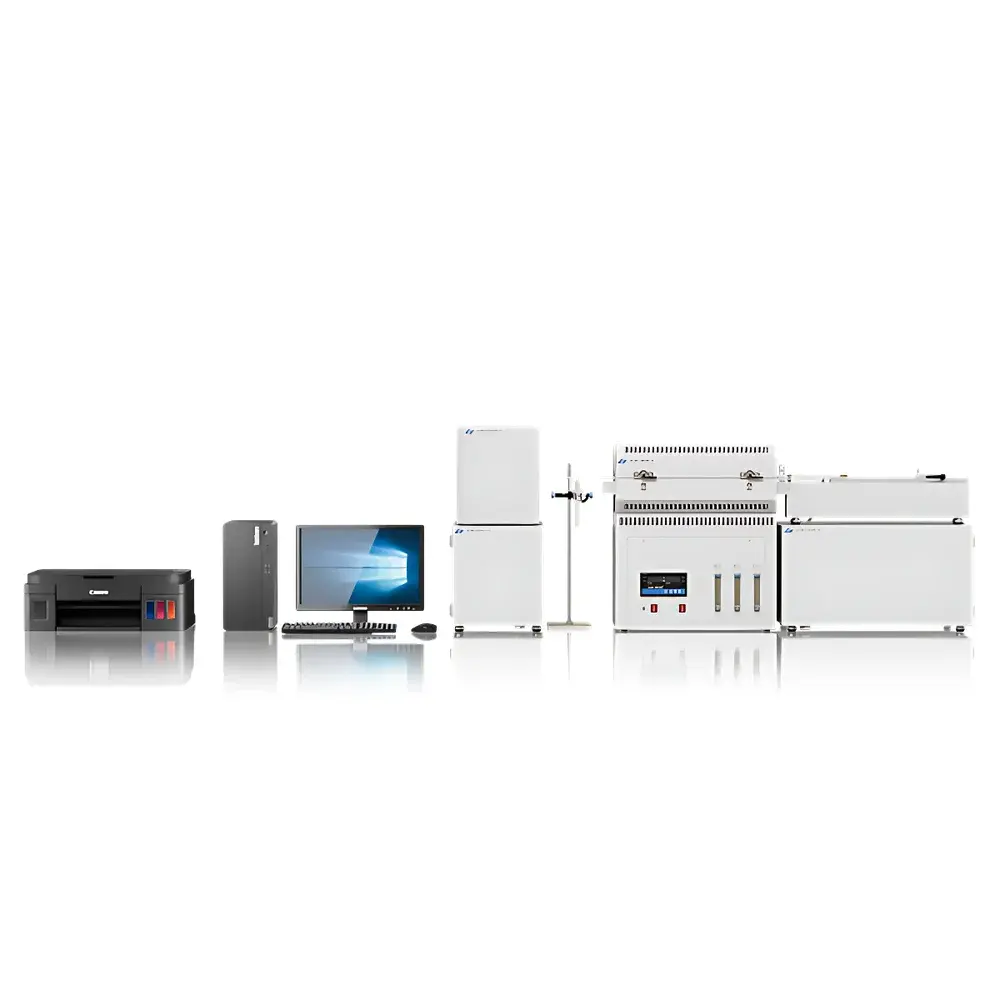
LANTIAN AOX-WK-3 Microcoulometric Halogen Analyzer
| Brand | LANTIAN |
|---|---|
| Origin | Zhejiang, China |
| Manufacturer Type | Direct Manufacturer |
| Model | AOX-WK-3 Microcoulometric Halogen Analyzer |
| Detection Principle | Microcoulometric Titration after High-Temperature Combustion (900–1100 °C) |
| Applicable Standards | GB/T 34845–2017, GB/T 22904–2008, GB/T 35613–2017, GB/T 39084–2020, GB/T 35611–2017, GB/T 41533–2022 |
| Detection Target | Adsorbable Organic Halogens (AOX), expressed as Cl⁻ |
| Detection Limit | 2 mg/kg |
| Quantification Range | 0.5–5 mg/kg (Cl) |
| Precision | ±1 µg Cl |
| Repeatability | ≤10% RSD at ≤2 mg/L sample concentration |
| Combustion Temperature Control | 500–1100 °C, ±1 °C accuracy |
| Generator Current Range | ±2 mA |
| Amplifier Output Voltage | ±30 V |
| Bias Voltage Adjustment | 0–500 mV, continuously adjustable |
| Sample Introduction | 50 mg ±5 mg activated carbon cartridge |
| Power Supply | AC 220 V ±10%, 50 Hz ±0.5 Hz |
| Rated Power | 3000 W |
| Interface | RS-232 (DB9) |
| Software Platform | Windows-based proprietary AOX analysis suite with real-time parameter monitoring, data logging, audit trail, and report generation (PDF/CSV export) |
Overview
The LANTIAN AOX-WK-3 Microcoulometric Halogen Analyzer is a dedicated laboratory instrument engineered for the quantitative determination of Adsorbable Organic Halogens (AOX) in pulp, paper, paperboard, and related cellulose-based materials—including tissue, toilet paper, kitchen towels, facial tissues, and sanitary papers. It operates on the principle of high-temperature pyrolytic combustion followed by microcoulometric titration, in full compliance with internationally referenced Chinese national standards including GB/T 34845–2017 (Determination of AOX in household paper), GB/T 22904–2008 (Total and organic chlorine in pulp and paper), and multiple green product evaluation standards (GB/T 35613–2017, GB/T 39084–2020, GB/T 35611–2017, GB/T 41533–2022). The system thermally decomposes halogenated organics at controlled temperatures up to 1100 °C in an oxygen-rich quartz furnace environment, converting all organic halogens (Cl, Br, I) into hydrogen halides, which are then absorbed in a sodium hydroxide trap and quantified via coulometric titration using a silver/silver chloride indicator electrode and generator electrode pair. This method delivers trace-level sensitivity with robust reproducibility and eliminates interferences common in chromatographic or spectrometric alternatives.
Key Features
- Integrated high-efficiency AOX combustion furnace with precise temperature control (500–1100 °C, ±1 °C stability), optimized for complete mineralization of halogenated compounds in complex lignocellulosic matrices.
- Dedicated microcoulometric detection cell featuring dual-electrode configuration (generator and indicator), enabling direct charge-based quantification without reagent consumption calibration curves.
- Pre-calibrated, user-replaceable electrolytic cell with integrated Ag/AgCl reference system and low-noise amplifier circuitry (±30 V output, ±2 mA current range).
- Adjustable bias voltage (0–500 mV) and real-time current feedback loop ensure optimal endpoint detection across variable sample loadings and matrix compositions.
- Automated sample introduction via precision-engineered ceramic boat and quartz cup assembly (50 mg ±5 mg activated carbon loading), minimizing manual handling and cross-contamination risk.
- RS-232 serial interface compliant with Windows OS environments, supporting secure data transfer, time-stamped audit logs, and GLP-compliant electronic records per FDA 21 CFR Part 11 requirements.
Sample Compatibility & Compliance
The AOX-WK-3 is validated for solid-phase samples derived from wood or non-wood fiber sources, including unbleached and bleached pulps, recycled paperboard, molded fiber packaging, and hygiene-grade tissue products. It accommodates standard AOX sample preparation workflows per GB/T 34845–2017: adsorption onto activated carbon, acidification, filtration through chlorine-free filter media, and combustion of the loaded carbon cartridge. All wet chemistry components—including nitrogen-purged adsorption columns, vacuum filtration units (250 mL capacity), and halogen-free reagents—are fully compatible with ISO/IEC 17025-accredited testing laboratories. Instrument design adheres to electrical safety standards IEC 61010-1 and electromagnetic compatibility requirements EN 61326-1. Calibration verification is supported through certified AOX reference materials traceable to NIM (National Institute of Metrology, China).
Software & Data Management
The embedded Windows-based software provides a modular interface for method setup, real-time signal visualization (current vs. time), automatic endpoint recognition, and integrated calculation of AOX concentration (mg/kg Cl-equivalent). Each analysis session generates a timestamped record containing operator ID, sample ID, combustion parameters, raw coulometric curve, final result, and pass/fail status against user-defined acceptance criteria. Data files are stored in encrypted binary format with optional CSV/PDF export for LIMS integration. Audit trail functionality logs all critical events—including method edits, calibration updates, and result overrides—with immutable timestamps and user attribution. Software supports multi-level access control (administrator, analyst, reviewer) and complies with documentation requirements under GLP and GMP frameworks.
Applications
The AOX-WK-3 serves as a primary analytical tool in quality control laboratories of pulp and paper manufacturers, third-party certification bodies (e.g., China Quality Certification Center, CQC), and environmental testing facilities conducting conformity assessments for green product labeling schemes. Typical use cases include routine AOX screening of finished tissue products prior to market release; validation of elemental chlorine-free (ECF) or totally chlorine-free (TCF) bleaching processes; assessment of recycled fiber streams for halogenated contaminant carryover; and regulatory submission support for compliance with national green product evaluation criteria (e.g., GB/T 35613–2017 Annex C). Its cost-performance ratio and operational simplicity make it particularly suitable for mid-volume laboratories requiring reliable, standards-aligned AOX data without the capital and maintenance overhead of high-end ion chromatography or ICP-MS platforms.
FAQ
What standards does the AOX-WK-3 comply with?
It is fully aligned with GB/T 34845–2017, GB/T 22904–2008, GB/T 35613–2017, GB/T 39084–2020, GB/T 35611–2017, and GB/T 41533–2022.
Is the system compatible with LIMS integration?
Yes—via RS-232 serial output and configurable CSV export, supporting automated data ingestion into most modern LIMS platforms.
Does the instrument include validation documentation?
Each unit ships with a factory calibration certificate, installation qualification (IQ) checklist, and operation qualification (OQ) protocol templates aligned with GLP requirements.
What consumables require regular replacement?
Activated carbon cartridges, quartz combustion cups,裂解 tubes (quartz pyrolysis tubes), electrolyte solution, and chlorine-free filter paper must be replaced per batch or after defined usage cycles.
Can the system quantify bromine or iodine separately?
No—it reports total AOX as chloride-equivalent mass concentration; speciation requires complementary techniques such as IC-MS or HR-GC/MS.






