
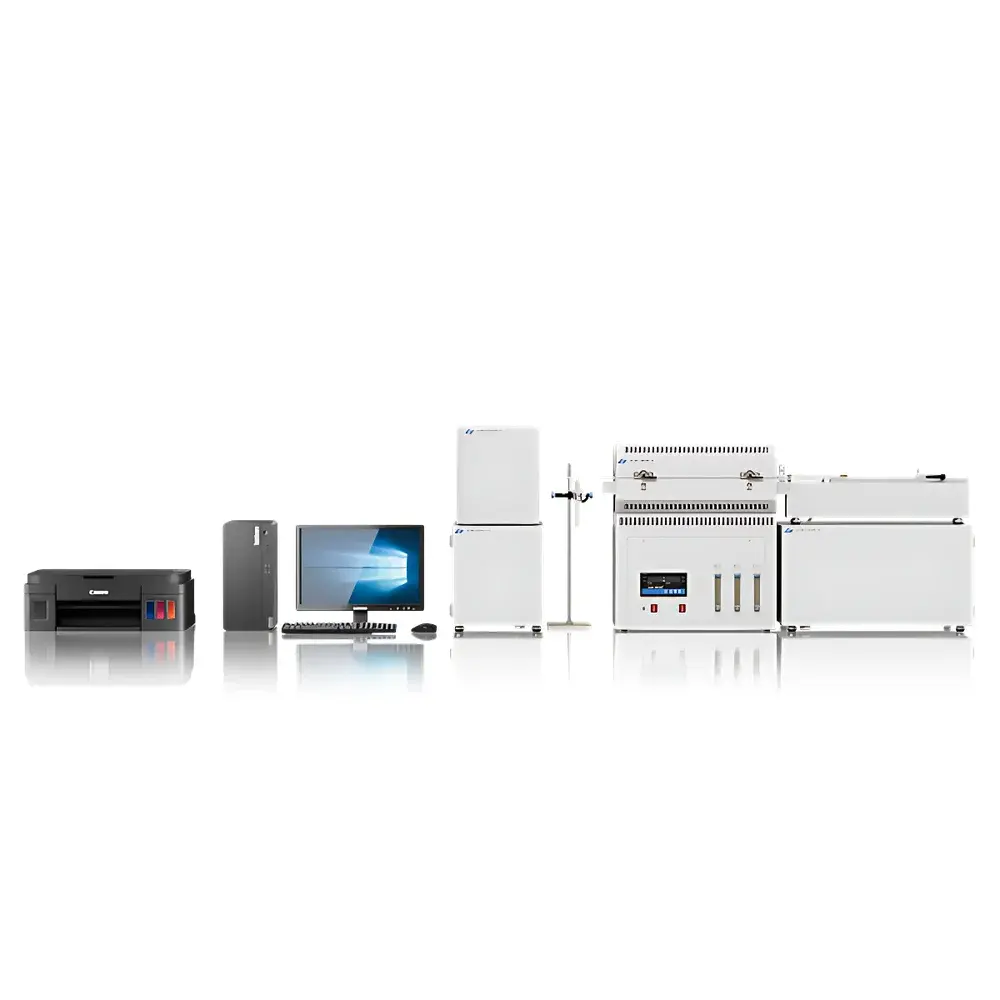
LANTIAN AOX-WK-S Microcoulometric Adsorbable Organic Halogens (AOX) Analyzer
| Brand | LANTIAN |
|---|---|
| Origin | Zhejiang, China |
| Manufacturer Type | Direct Manufacturer |
| Model | AOX-WK-S |
| Compliance Standard | HJ 1214–2021 (PRC National Ecological and Environmental Standard) |
| Generator Current Range | ±2 mA |
| Amplifier Output Voltage | ±30 V |
| Bias Voltage Adjustment Range | 0–500 mV (continuously adjustable) |
| Detection Limit | 0.007 µg/L (at 100 mL sample volume) |
| Measurement Range (as Cl) | 0.02–2 mg/kg |
| Accuracy | ±1 µg Cl |
| Repeatability | ≤10% RSD (for samples ≤2 mg/L) |
| Activated Carbon Dosage | 50 mg ±5 mg |
| Combustion Temperature Control Range | 500–1100 °C |
| Stability | ±1 °C |
| Power Supply | AC 220 V ±10%, 50 Hz ±0.5 Hz |
| Rated Power | 3000 W |
Overview
The LANTIAN AOX-WK-S Microcoulometric Adsorbable Organic Halogens (AOX) Analyzer is a dedicated benchtop instrument engineered for the quantitative determination of adsorbable organic halogens in aqueous environmental matrices, fully compliant with the People’s Republic of China national standard HJ 1214–2021: “Determination of Adsorbable Organic Halogens (AOX) in Water—Microcoulometric Method.” The system implements a standardized two-stage process: first, solid-phase adsorption of halogenated organic compounds onto activated carbon under controlled pH and flow conditions; second, high-temperature catalytic combustion (500–1100 °C) of the loaded carbon, followed by microcoulometric titration of liberated halide ions (Cl⁻, Br⁻, I⁻) in an electrolytic cell. This method delivers trace-level sensitivity, robust inter-laboratory reproducibility, and direct quantification without reliance on calibration curves—leveraging Faraday’s law for absolute measurement based on charge integration.
Key Features
- Integrated dual-module architecture: independent combustion furnace (with PID-controlled heating up to 1100 °C, ±1 °C stability) and microcoulometric detection unit with dual platinum electrodes (working and counter), Ag/AgCl reference, and magnetic stirrer.
- Precision sample introduction via custom push-rod auto-sampler, enabling consistent 50 mg ±5 mg activated carbon dosing and minimizing operator variability.
- Real-time parameter monitoring and result visualization through a native Windows-based control interface—displaying bias voltage, generator current, titration charge (µC), and calculated AOX concentration (µg/L or mg/kg) during analysis.
- Comprehensive hardware configuration including quartz sample cups, pyrolysis tubes, drying and adsorption columns, nitrogen pressurization manifold, and integrated vacuum pump (supplied).
- Pre-configured method templates aligned with HJ 1214–2021—including recommended gas flow rates, temperature ramp profiles, and electrolyte composition (e.g., 0.4 g/L KBr in glacial acetic acid).
- Front-panel controls and RS-232 serial communication (DB9) for external data logging, instrument diagnostics, and remote operation within validated laboratory networks.
Sample Compatibility & Compliance
The AOX-WK-S is validated for use with surface water, groundwater, domestic wastewater, and industrial effluents per HJ 1214–2021. Sample preparation follows strict protocol: filtration through chlorine-free filter paper, acidification to pH ≤2.0, adsorption onto 50 mg activated carbon at defined flow rate (≤50 mL/min), and thorough rinsing to remove inorganic halides. The analyzer meets all instrumental performance criteria specified in the standard—including detection limit verification (0.007 µg/L at 100 mL), accuracy assessment (±1 µg Cl, relative deviation <10%), and repeatability validation (≤10% RSD at ≤2 mg/L). While not certified to ISO/IEC 17025 out-of-the-box, the system supports GLP-aligned documentation: full audit trail of method parameters, raw charge-integration data, and timestamped result export (CSV/PDF) for regulatory submission.
Software & Data Management
Operating on Microsoft Windows OS, the embedded software provides a modular GUI with three core workspaces: Method Setup (bias voltage, current range, temperature profile), Run Monitor (live coulometric signal, baseline drift compensation, endpoint detection logic), and Data Review (integrated peak integration, batch reporting, pass/fail flagging against QC limits). All analytical sessions are automatically time-stamped and archived locally. Export functions support CSV (for LIMS ingestion), PDF (for QA review), and XML (for e-reporting systems). The software architecture permits configuration of user roles and electronic signatures—facilitating alignment with FDA 21 CFR Part 11 requirements when deployed with supplemental IT validation protocols.
Applications
- Regulatory compliance testing for municipal wastewater treatment plants discharging to sensitive aquatic ecosystems.
- Industrial pretreatment monitoring for chlorinated solvent users (e.g., metal degreasers, PCB manufacturers, pesticide formulators).
- Environmental impact assessment of landfill leachate and pulp/paper mill effluents.
- Research-scale evaluation of AOX formation during disinfection byproduct (DBP) studies using chlorine, chloramine, or ozone.
- Verification of activated carbon adsorption efficiency in pilot-scale water reuse schemes.
FAQ
Does the AOX-WK-S comply with international standards such as ISO 9562 or EPA Method 1650?
The instrument is designed and validated exclusively for HJ 1214–2021. While its microcoulometric detection principle aligns conceptually with ISO 9562, method-specific validation (e.g., spike recovery in seawater, matrix interference testing per EPA 1650) is not included in factory certification.
Can the system quantify individual halogens (Cl, Br, I) separately?
No—the method measures total halogen content as chloride-equivalent (AOXCl). Speciation requires coupling with IC-MS or HR-GC/MS prior to combustion.
What maintenance intervals are recommended for the combustion tube and electrolytic cell?
Quartz combustion tubes should be inspected after every 100 analyses; replacement is advised if discoloration or cracking occurs. The titration cell electrolyte must be refreshed daily, and electrodes require weekly polishing with alumina slurry.
Is nitrogen gas purity critical for accurate results?
Yes. Grade 5.0 (99.999%) nitrogen is required to prevent background halogen contamination and ensure stable baseline current during titration.
How is system suitability verified before sample analysis?
Daily verification includes running a 5 µg Cl standard (potassium chloride solution), confirming recovery between 85–115%, and verifying baseline noise <0.05 µA over 5 minutes.
Related Products






