
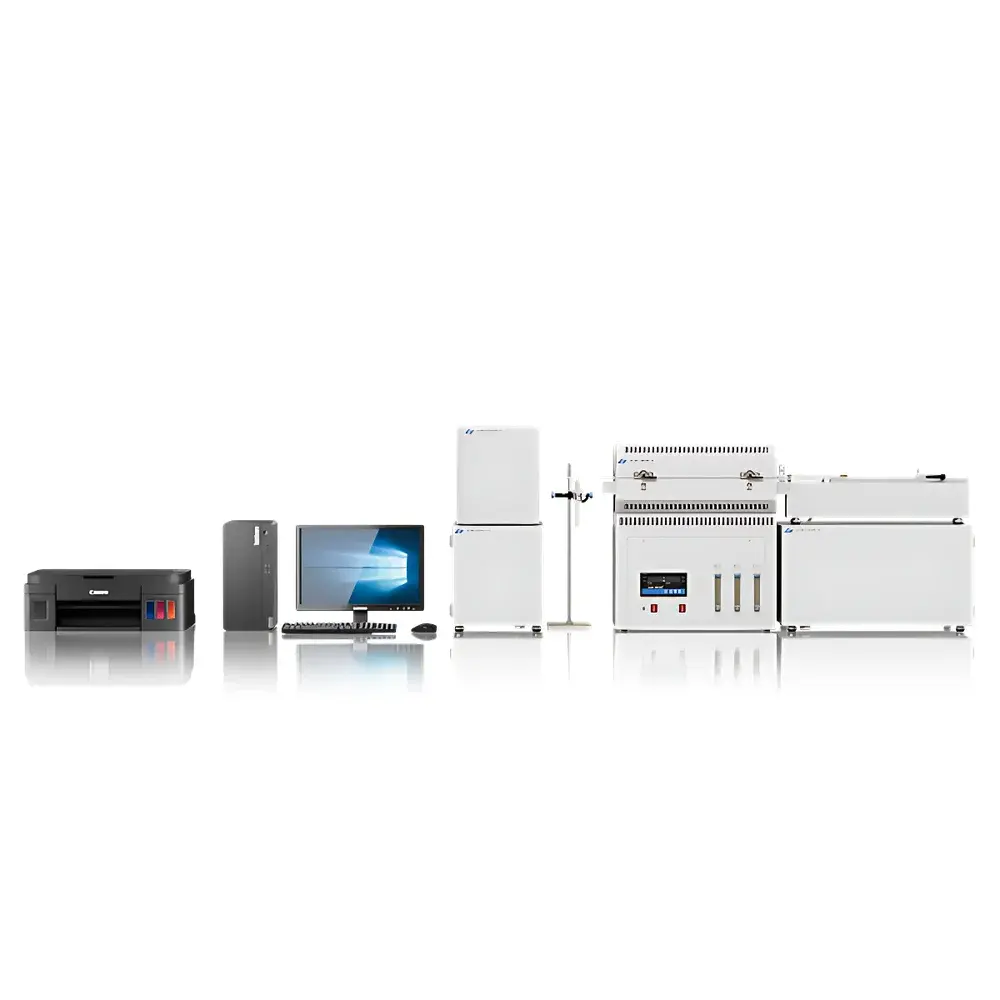
LANTIAN AOX-WK-S Microcoulometric Analyzer for Adsorbable Organic Halogens (AOX)
| Brand | LANTIAN |
|---|---|
| Origin | Zhejiang, China |
| Manufacturer Type | Direct Manufacturer |
| Model | AOX-WK-S |
| Detection Principle | Microcoulometric Titration after High-Temperature Combustion |
| Compliance | HJ 1214–2021 (China National Standard) |
| Maximum Generator Current | ±2 mA |
| Amplifier Output Voltage | ±30 V |
| Bias Voltage Range | 0–500 mV (continuously adjustable) |
| Detection Limit | 0.007 µg/L (at 100 mL sample volume) |
| Optimal Measurement Range (as Cl) | 0.02–2 mg/kg |
| Precision | ≤10% RSD (for samples ≤2 mg/L) |
| Activated Carbon Loading | 50 mg ±5 mg |
| Combustion Temperature Range | 500–1100 °C (±1 °C accuracy) |
| Power Supply | AC 220 V ±10%, 50 Hz ±0.5 Hz |
| Rated Power | 3000 W |
Overview
The LANTIAN AOX-WK-S Microcoulometric Analyzer is a dedicated instrumental system designed for the quantitative determination of Adsorbable Organic Halogens (AOX) in aqueous environmental matrices—specifically aligned with the methodology stipulated in China’s national standard HJ 1214–2021, “Determination of Adsorbable Organic Halogens (AOX) in Water—Microcoulometric Method.” The instrument operates on the principle of high-temperature catalytic combustion followed by microcoulometric titration: water samples are first passed through activated carbon to adsorb organic halogen compounds; the loaded carbon is then combusted quantitatively at controlled temperatures (500–1100 °C) in an oxygen-rich atmosphere. Halogens released as hydrogen halides (e.g., HCl, HBr) are absorbed into an electrolyte solution, where coulometric generation of silver ions (Ag⁺) is employed to titrate halide ions. The charge consumed during titration—measured precisely via a dual-electrode coulometric cell—is directly proportional to the halogen mass, enabling trace-level quantification down to 0.007 µg/L (at 100 mL sample volume). Engineered for robustness and analytical reproducibility, the AOX-WK-S integrates thermal control, gas flow management, electrochemical detection, and data acquisition within a single Windows-based platform.
Key Features
- Compliance-ready architecture validated against HJ 1214–2021, supporting full method execution from adsorption to coulometric quantification.
- High-precision temperature control system with ±1 °C stability across the 500–1100 °C combustion range, ensuring complete and consistent halogen release from complex organic matrices.
- Dual-electrode microcoulometric detection cell featuring Ag/Ag⁺ reference and working electrodes, optimized for low-noise, high-sensitivity halide measurement (detection limit: 1 µg Cl).
- Integrated modular hardware configuration: includes dedicated combustion furnace, programmable push-pull sample introducer, quartz sample cups, custom-designed combustion boats, and nitrogen-pressurized gas delivery system.
- Real-time parameter monitoring and result visualization via native Windows GUI—displaying bias voltage, generator current, amplifier output, titration curve, and integrated charge (in Coulombs).
- Full data traceability: all method parameters, raw signals, calibration records, and final results are timestamped and exportable in CSV or PDF format for audit readiness.
Sample Compatibility & Compliance
The AOX-WK-S is validated for use with surface water, groundwater, domestic wastewater, and industrial effluents—covering matrices with variable turbidity, dissolved organic carbon (DOC), and suspended solids, provided pretreatment (e.g., filtration with chlorine-free filter paper) is performed per HJ 1214–2021. Sample preparation follows standardized adsorption on 50 mg ±5 mg activated carbon under controlled pH and contact time. The system supports method-defined quality control requirements including procedural blanks, matrix spikes, and duplicate analyses. While HJ 1214–2021 is its primary regulatory anchor, the underlying microcoulometric combustion principle aligns conceptually with ISO 9562 and EPA Method 1650, facilitating cross-method comparability in multi-laboratory studies. Instrument design adheres to general electrical safety standards (IEC 61010-1) and electromagnetic compatibility (EMC) directives applicable to laboratory analytical equipment.
Software & Data Management
The embedded Windows application provides a structured workflow interface—from method setup and instrument calibration to sample run sequencing and report generation. Calibration is performed using potassium chloride (KCl) standard solutions across the 0.02–2 mg/kg Cl range, with automatic slope calculation and linearity verification (r² ≥ 0.999). All user actions—including method edits, calibration runs, and result approvals—are logged with operator ID and timestamp. Data files are stored in a secure local directory with optional password-protected access. Export functions support GLP-compliant archiving: results include raw coulombic integrals, peak identification markers, retention of baseline correction parameters, and digital signatures where enabled. The system does not implement FDA 21 CFR Part 11 electronic signature functionality out-of-the-box but retains full audit trail capability suitable for internal QA/QC and third-party accreditation (e.g., CNAS, CMA) documentation.
Applications
- Regulatory monitoring of AOX in municipal wastewater treatment plant (WWTP) discharges and receiving waters.
- Industrial compliance testing for pulp and paper mills, chlor-alkali facilities, pharmaceutical manufacturing sites, and textile dyeing operations.
- Environmental impact assessment (EIA) studies evaluating halogenated organic load in riverine and coastal systems.
- Research laboratories investigating formation and fate of adsorbable halogenated disinfection by-products (DBPs) in drinking water distribution networks.
- Method validation and interlaboratory comparison programs requiring trace-halogen quantification with documented uncertainty budgets.
FAQ
What sample volume is required for analysis?
Standard operation uses 100 mL of filtered water sample for adsorption onto 50 mg activated carbon; alternative volumes may be used with proportional adjustment of carbon mass and recalibration.
Is nitrogen gas required for operation?
Yes—high-purity nitrogen (≥99.998%) serves as both carrier gas and pressure source for the adsorption column and combustion gas delivery; a supplied vacuum pump supports sample transfer and system purging.
Can the instrument quantify bromine or iodine separately from chlorine?
The method measures total halogens (expressed as Cl); speciation requires coupling with complementary techniques such as IC-MS or HR-GC/MS.
What maintenance is required for long-term reliability?
Routine maintenance includes periodic replacement of quartz combustion tubes, drying agents in desiccant traps, and electrolyte in the coulometric cell; electrode polishing and calibration verification are recommended before each analytical batch.
Does the system support automated sample introduction?
The AOX-WK-S employs a manual push-pull injector; fully automated liquid handling or carousel-based autosampling is not included but can be interfaced externally via RS-232 control signals.
Related Products






