
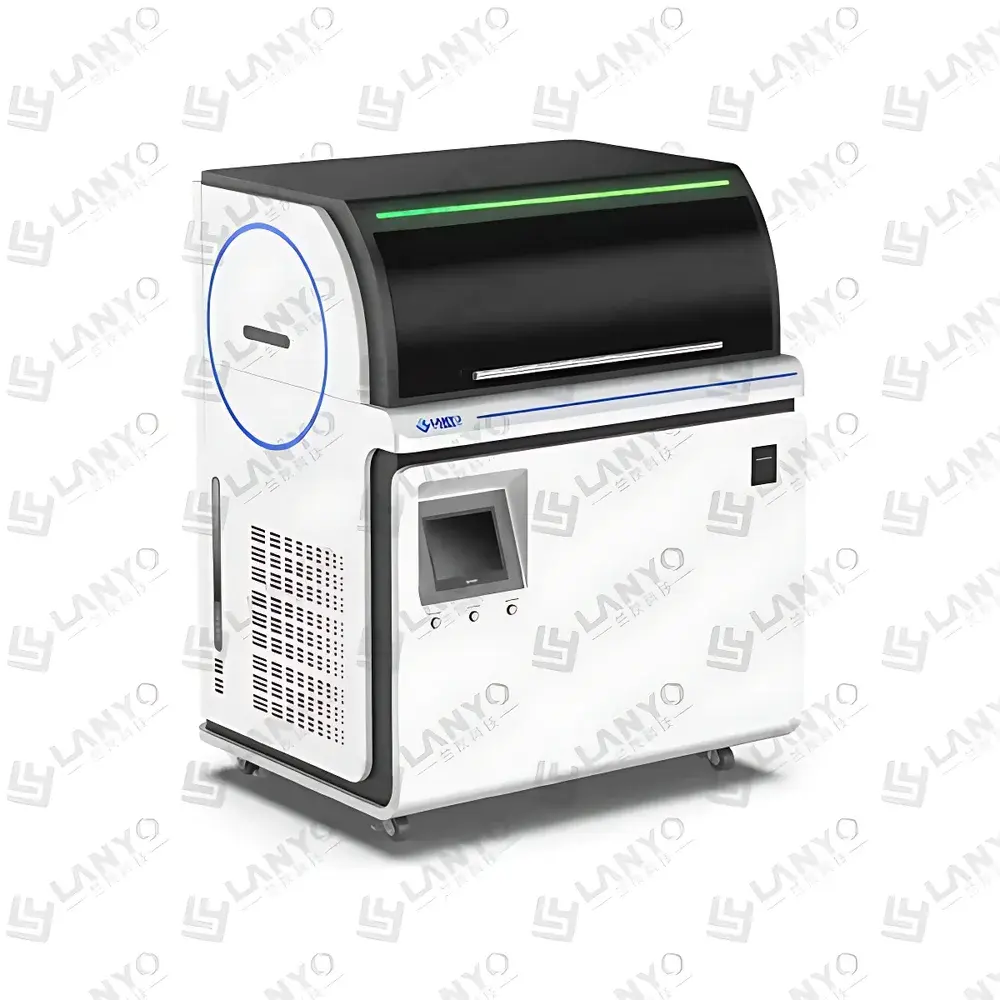
LANYO RLTD-05/10 Rapid Low-Temperature Soil Sample Dryer
| Brand | LANYO |
|---|---|
| Origin | Beijing, China |
| Model | RLTD-05/10 |
| Sample Capacity | 5 positions |
| Drying Temperature Control | 35 ± 5 °C |
| Contact Materials | Metal-free (non-interfering with target elements) |
| Compliance | HJ/T 166–2004, NY/T 395–2012, DZ/T 0130.4–2006, HJ/T 20–1998, EJ 428–1989, LY/T 1210–1999 |
| Control System | Software-based real-time temperature feedback per drying chamber |
| Mixing Mechanism | Automated in-situ tumbling during drying cycle |
| Cleaning | Smooth, non-porous contact surfaces for residue-free decontamination |
Overview
The LANYO RLTD-05/10 Rapid Low-Temperature Soil Sample Dryer is an engineered solution for controlled, low-thermal-stress dehydration of environmental solid matrices—specifically soil, sediment, and sludge samples—prior to chemical analysis. Unlike conventional oven-drying or ambient air-drying methods, the RLTD-05/10 employs a precisely regulated convective airflow system operating at a fixed nominal setpoint of 35 °C ± 5 °C. This temperature range is scientifically selected to minimize volatilization loss of labile analytes—including mercury, arsenic species, organic acids, and certain exchangeable cations—while ensuring complete moisture removal within ≤2.5 hours. The unit implements passive humidity extraction combined with continuous mechanical agitation, eliminating surface crusting and promoting uniform mass transfer across heterogeneous particulate matrices. Its architecture aligns with internationally recognized sample integrity principles defined under ISO/IEC 17025:2017 Clause 7.4 (Sampling) and EPA SW-846 Method 5035A (Soil Moisture Determination), supporting trace-level elemental and speciation workflows where pre-analytical bias must be rigorously controlled.
Key Features
- Five independent drying chambers with hardware-isolated sample compartments—eliminating cross-contamination risk between batches.
- Individual PID-controlled heating and airflow regulation per chamber, enabling parallel processing of dissimilar sample types (e.g., clay-rich vs. sandy soils) under identical thermal profiles.
- Non-metallic wetted path: All surfaces contacting samples are constructed from certified inert polymers (e.g., PTFE-coated stainless steel housing, FDA-grade silicone gaskets, and ceramic-coated agitator blades), ensuring zero contribution of Fe, Cu, Zn, Pb, Cr, or Ni to analytical blanks.
- Programmable tumble mixing sequence synchronized with drying progress—preventing particle stratification and enhancing drying homogeneity without manual intervention.
- Smooth, crevice-free interior geometry compliant with GLP cleaning validation protocols; compatible with aqueous detergent washes and ethanol rinses between runs.
- Integrated temperature logging with timestamped records stored internally and exportable via USB—supporting audit readiness for ISO 17025 and US EPA Region-specific QA/QC requirements.
Sample Compatibility & Compliance
The RLTD-05/10 accommodates standard 100–500 g soil aliquots in certified polypropylene or glass drying vessels (not supplied). It has been operationally validated for use with fine-grained sediments (clay/silt fractions), organic-rich peats, calcareous soils, and metal-contaminated industrial site samples. Regulatory alignment includes full conformance with Chinese national standards referenced in the device documentation: HJ/T 166–2004 (soil monitoring methodology), NY/T 395–2012 (agricultural soil quality assessment), DZ/T 0130.4–2006 (geological lab QA), and EJ 428–1989 (radiological soil handling). While not CE-marked or UL-listed, its electrical design complies with IEC 61010-1:2010 safety requirements for laboratory equipment. For laboratories operating under FDA 21 CFR Part 11 or EU Annex 11, optional firmware upgrades support electronic signature-capable audit trails and user-access-tiered software controls.
Software & Data Management
The embedded control interface provides real-time visualization of chamber temperature, elapsed time, and mixing status via a high-contrast monochrome LCD. Data acquisition occurs at 10-second intervals and is retained onboard for up to 100 drying cycles. Export functionality supports CSV-formatted logs via micro-USB port for integration into LIMS environments (e.g., LabWare, STARLIMS, Thermo Fisher SampleManager). No cloud connectivity or remote access capabilities are implemented—ensuring data sovereignty and compliance with institutional cybersecurity policies governing environmental sample metadata. Firmware updates are performed offline using signed binary files distributed directly by LANYO Technical Support.
Applications
- Preparation of soil samples prior to total element digestion (EPA 3050B, 3051A, 3052) and sequential extraction schemes (BCR, Tessier).
- Routine moisture content determination per ASTM D2216 and ISO 11274, with improved repeatability versus gravimetric oven methods.
- Stabilization of field-moist samples during inter-laboratory proficiency testing programs requiring strict adherence to turnaround timelines.
- Supporting national soil census initiatives where throughput, contamination control, and regulatory traceability are mandatory.
- Enabling rapid turnaround for emergency response scenarios (e.g., post-spill screening) without compromising analytical fidelity.
FAQ
Does the RLTD-05/10 meet U.S. EPA or ASTM drying method requirements?
Yes—it satisfies the thermal stability criteria outlined in EPA SW-846 Method 5035A and ASTM D2216 for low-temperature moisture removal, provided final moisture content is verified independently by gravimetry.
Can the unit dry samples containing volatile organic compounds (VOCs)?
No. The RLTD-05/10 is not designed for VOC-retentive drying; it lacks sealed vapor recovery or cold-trap integration. It is intended exclusively for inorganic and semi-volatile elemental workflows.
Is calibration verification required before each use?
Per ISO/IEC 17025, users must perform periodic temperature sensor verification using NIST-traceable reference thermometers—at minimum annually or after any maintenance event affecting thermal subsystems.
What maintenance schedule is recommended?
Daily wipe-down of chamber surfaces; quarterly inspection of agitator drive belts and airflow filters; annual recalibration of all five temperature sensors by authorized service personnel.
Are replacement drying vessels available through LANYO?
Yes—certified polypropylene vessels (500 mL, autoclavable) and borosilicate glass options are available as consumables under part numbers LV-500-PP and LV-500-GS, respectively.



