
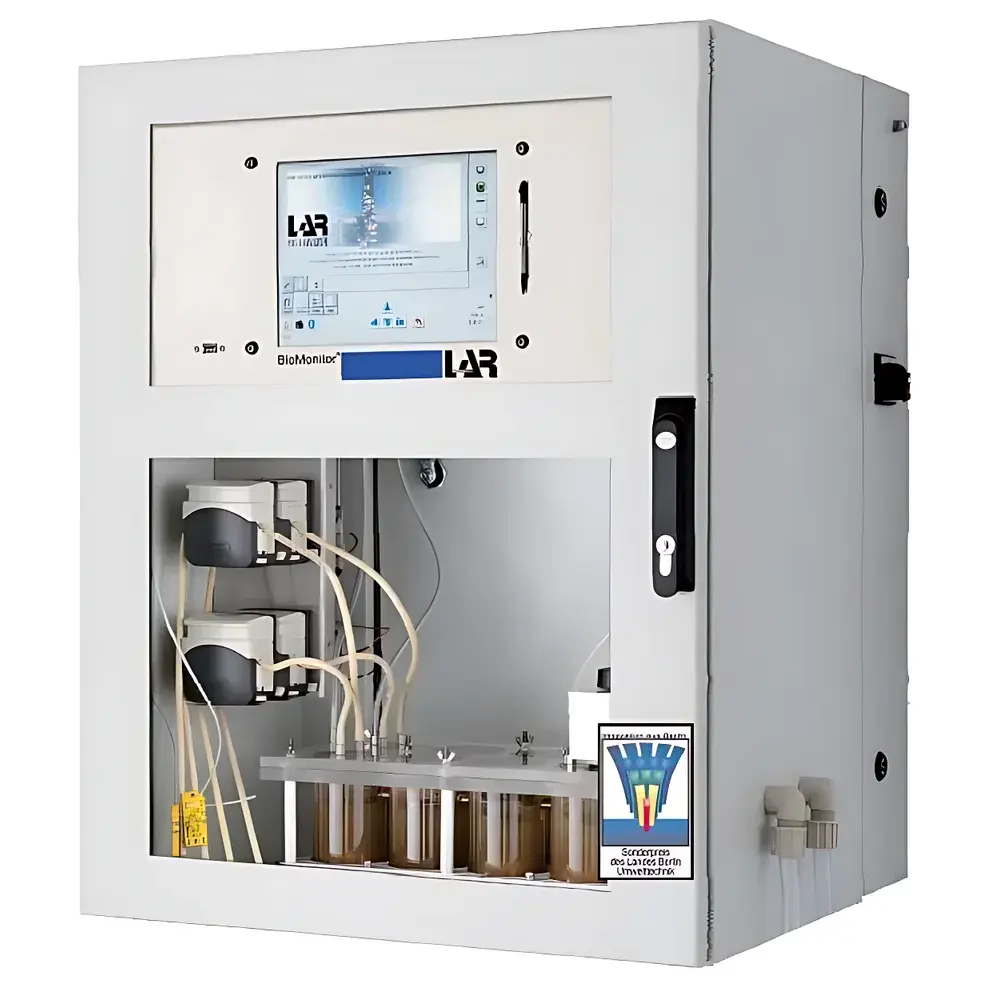
LAR Biomonitor Online BOD Monitoring System
| Brand | LAR |
|---|---|
| Origin | Germany |
| Model | Biomonitor |
| BOD Range | 1–50 mg/L and 1–200,000 mg/L (user-selectable) |
| Measurement Interval | Every 3–4 minutes |
| Sample Preparation | Maintenance-free particle separator |
| Display | High-resolution backlit LCD |
| Data Storage | Secure SD card logging |
| Output Signals | Dual 4–20 mA (BOD and activated sludge activity) |
| Communication Interfaces | RS-232/RS-485 serial, TCP/IP Ethernet for remote monitoring and control |
| Inlet Connection | 30 mm ID tubing or M32 threaded pipe (custom options available) |
| Power Supply | 230/115 V AC, 50/60 Hz, 150 VA |
| Enclosure Rating | IP54 |
| Dimensions (W×H×D) | 600 × 862 × 540 mm (23.6 × 33.9 × 21.3 in) |
| Weight | 70 kg |
Overview
The LAR Biomonitor Online BOD Monitoring System is a continuous, real-time respirometric analyzer engineered for unattended, long-term biochemical oxygen demand (BOD) assessment in wastewater treatment plants, industrial effluent streams, and environmental monitoring stations. Unlike conventional lab-based BOD5 methods relying on 5-day incubation, the Biomonitor applies dynamic, dual-channel microbial respiration kinetics—using continuously fed, actively maintained activated sludge biomass—to quantify oxygen consumption rates under controlled aerobic conditions. This principle enables true online BOD estimation with high temporal resolution (measurement every 3–4 minutes), directly correlating oxygen uptake to biodegradable organic load. The system operates on the fundamental premise of microbial metabolic activity as a proxy for biodegradability, making it particularly suitable for process control, load balancing, and early warning of shock loads or toxicity events in biological treatment units.
Key Features
- Dual-channel respirometry: Simultaneous real-time monitoring of bulk BOD concentration and activated sludge-specific activity (respiration rate per unit MLSS), enabling differentiation between influent load changes and biological system health.
- User-selectable BOD range: Configurable measurement spans—1–50 mg/L for sensitive municipal or tertiary effluent monitoring, and 1–200,000 mg/L for high-strength industrial wastewaters—without hardware modification.
- Maintenance-free sample conditioning: Integrated passive particle separator eliminates need for filters, centrifuges, or regular cleaning cycles; designed for stable operation in suspended-solids-rich streams up to 10,000 mg/L TSS.
- Robust industrial interface suite: Dual isolated 4–20 mA analog outputs (one for BOD, one for sludge activity), RS-232/RS-485 serial port for SCADA integration, and native TCP/IP Ethernet support for secure remote access, firmware updates, and alarm forwarding via standard protocols (Modbus TCP, SNMP).
- Self-diagnostics and automated calibration support: Onboard diagnostics monitor sensor stability, airflow consistency, and temperature regulation; guided maintenance routines accessible via LCD menu with embedded technical reference tables and service history logging.
Sample Compatibility & Compliance
The Biomonitor accepts raw or clarified wastewater samples without pretreatment beyond the integrated particle separation stage. It is validated for use with municipal sewage, food processing effluents, pharmaceutical discharge streams, and pulp-and-paper mill waters. While not a replacement for standardized laboratory BOD5 (ISO 5815-1:2019, ASTM D5211), the system delivers traceable, process-relevant data aligned with ISO 8192 (wastewater characterization) and supports compliance reporting frameworks requiring continuous biodegradability indicators. Its architecture meets IEC 61326-1 (EMC for industrial environments) and EN 60529 (IP54 ingress protection), ensuring operational integrity in outdoor kiosks or wet-process areas.
Software & Data Management
Data acquisition and system configuration are managed through an embedded Linux-based controller with local web interface (HTTPS) and optional cloud gateway integration. All measurements—including dissolved oxygen consumption rate, temperature-compensated BOD equivalents, sludge activity index (SAI), and diagnostic flags—are timestamped and stored on encrypted SD cards with configurable retention policies (up to 12 months at 1-min resolution). Audit trails record user logins, parameter changes, and calibration events—supporting GLP-aligned documentation requirements. Export formats include CSV and XML; historical datasets integrate natively with PI System, Ignition SCADA, and LabVantage LIMS via OPC UA or RESTful API.
Applications
- Real-time load forecasting and aeration basin optimization in activated sludge plants
- Early detection of toxic shocks (e.g., heavy metals, biocides) via abrupt suppression of sludge respiration
- Performance verification of membrane bioreactors (MBRs) and moving bed biofilm reactors (MBBRs)
- Compliance trending for discharge permits requiring continuous biodegradability metrics
- Research-grade kinetic modeling of heterotrophic growth rates and substrate utilization profiles
FAQ
Does the Biomonitor replace laboratory BOD5 testing?
No—it provides continuous, process-correlative BOD estimation based on respirometry. Regulatory submissions still require standardized 5-day BOD5 per ISO or ASTM; however, Biomonitor data is widely accepted for operational control and trend analysis.
Can it operate in high-salinity or low-temperature wastewater?
Yes—temperature compensation is applied across 5–40 °C; salinity tolerance extends to 15 g/L NaCl equivalent, though extended exposure above 10 g/L may require periodic biomass refreshment.
Is remote software update supported?
Yes—firmware and configuration updates can be deployed over secure HTTPS or SFTP; version history and rollback capability are built into the controller.
What maintenance intervals are recommended?
Sensor recalibration every 6 months; biomass reactor refresh every 3–6 months depending on influent toxicity and solids loading; no scheduled maintenance for the particle separator or pneumatic system.
How is data security ensured during TCP/IP transmission?
All remote connections enforce TLS 1.2+ encryption; user authentication uses role-based access control (RBAC); default credentials must be changed on first login per IEC 62443-3-3 guidelines.







