
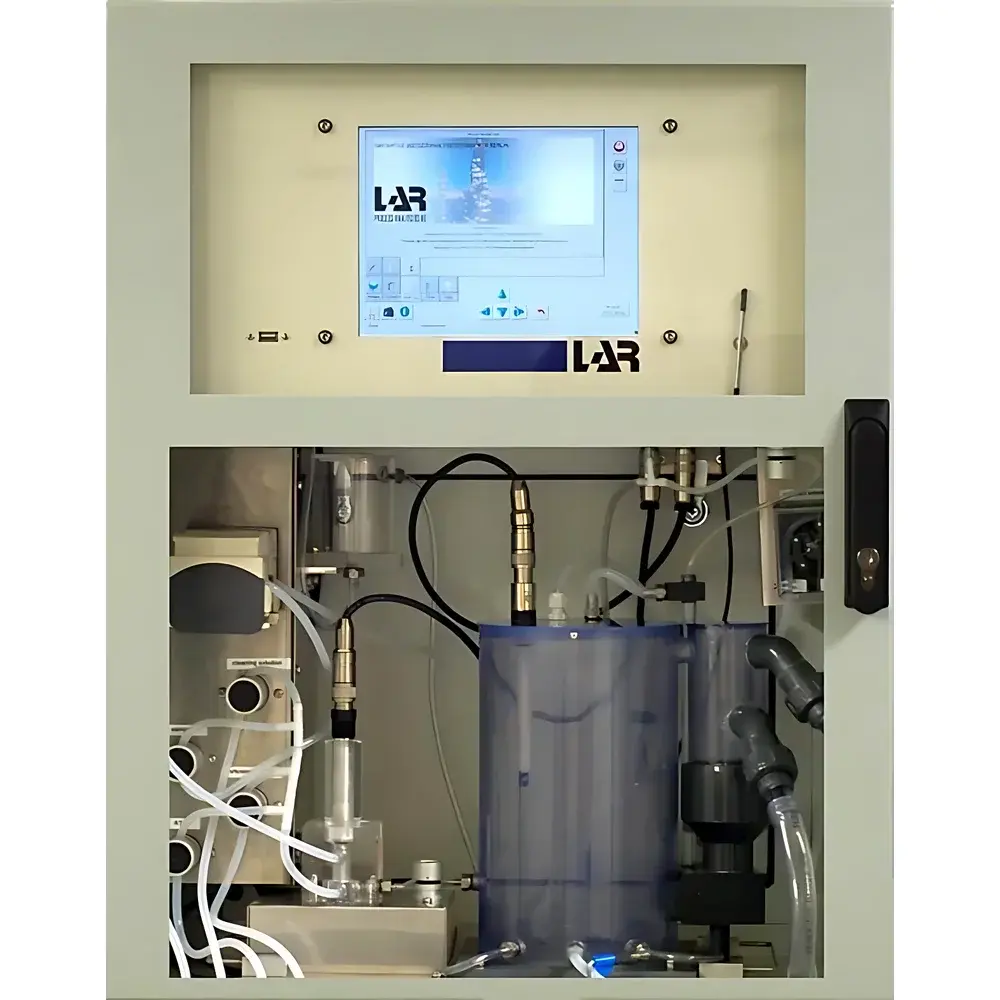
LAR ToxAlarm Online Biological Toxicity Early-Warning System
| Brand | LAR |
|---|---|
| Origin | Germany |
| Model | ToxAlarm |
| Instrument Type | Online Water Toxicity Analyzer |
| Biological Agent | Nitrifying Bacteria |
| Measurement Principle | Oxygen Consumption Rate (Respirometry) |
| Toxicity Range | 0–100% |
| Response Time | <5 minutes |
| Sample Preparation Time | 5–10 min |
| Enclosure Rating | IP54 |
| Dimensions (W×H×D) | 870 × 600 × 560 mm |
| Weight | ~70 kg |
| Power Supply | 230/115 V~, 50/60 Hz, 100 VA |
| Inlet/Outlet Tubing | 20 mm ID (6 × 1 mm & 4 × 1 mm auxiliary lines) |
| Analog Output | 0/4–20 mA |
| Serial Interface | RS232 + USB |
| Remote Access | TCP/IP (Ethernet) |
| Display | High-resolution backlit LCD touchscreen |
| Compliance | Designed for continuous operation in drinking water and surface water monitoring per DIN EN ISO 11348 and ASTM D5905 respirometric toxicity testing principles |
Overview
The LAR ToxAlarm Online Biological Toxicity Early-Warning System is an engineered solution for real-time, continuous assessment of acute toxicity in drinking water distribution networks and natural surface water bodies. Unlike chemical-specific sensors or endpoint assays, ToxAlarm employs a living biological detection principle based on the metabolic response of nitrifying bacteria to toxicants. The system quantifies inhibition of oxygen consumption rate—a well-established respirometric endpoint—under controlled, standardized conditions. This physiological measurement reflects the integrated toxic effect of complex mixtures (e.g., heavy metals, pesticides, industrial solvents, disinfection by-products), offering functional relevance where conventional physicochemical parameters fall short. Designed for unattended 24/7 operation, ToxAlarm delivers actionable alerts within <5 minutes of contaminant ingress, enabling rapid intervention before public exposure thresholds are exceeded. Its architecture adheres to the foundational principles of biological early-warning systems defined in DIN EN ISO 11348 (water quality — determination of the inhibitory effect of water samples on the light emission of Vibrio fischeri) and aligns methodologically with ASTM D5905 (standard test method for determining toxicity using activated sludge respirometry).
Key Features
- Continuous, real-time toxicity monitoring: Operates autonomously with configurable measurement intervals down to 3-minute cycles, ensuring high temporal resolution without manual intervention.
- Self-sustaining bacterial culture: Utilizes a robust, continuously regenerating population of nitrifying bacteria housed in a dedicated bioreactor; no periodic replacement of test organisms required.
- No memory effect: Each measurement cycle uses a fresh, independent bacterial subpopulation, eliminating carryover bias between samples and ensuring analytical independence.
- Low operational overhead: Integrated maintenance-free particle separator eliminates pre-filtration requirements; annual calibration verification suffices under routine use.
- Integrated hardware interface suite: Includes 0/4–20 mA analog output for SCADA integration, RS232 and USB for local diagnostics, and full TCP/IP Ethernet connectivity for remote configuration, data retrieval, and alarm management.
- Intuitive human-machine interface: High-resolution, backlit LCD touchscreen with multilingual support provides real-time trend visualization, event logging, and guided system diagnostics.
Sample Compatibility & Compliance
ToxAlarm is validated for direct analysis of raw and treated drinking water, river and lake surface water, and wastewater-impacted streams. It accommodates variable turbidity and organic load through its passive particle separation module (no moving parts, no consumables). While not certified for regulatory compliance reporting under US EPA or EU WFD Annex X frameworks, the system meets technical prerequisites for early-warning deployment under national drinking water safety ordinances (e.g., German TrinkwV Annex 3, UK DWI Technical Guidance Note 35). Data integrity supports GLP-aligned operational records, and audit trails—including timestamped measurement logs, system status flags, and alarm acknowledgments—are exportable in CSV format for internal QA review. The respirometric methodology is recognized in ISO 8192 (water quality — guidance on the use of biological tests for monitoring purposes) as a tier-1 screening tool for ecotoxicological hazard identification.
Software & Data Management
The embedded firmware supports automated data acquisition, baseline drift compensation, and toxicity index calculation (0–100%, referenced to control response). All measurements are time-stamped and stored locally on non-volatile memory (≥30 days at 5-min interval). Remote access via TCP/IP enables secure HTTP-based dashboard viewing, threshold adjustment, and firmware updates. Exported datasets include raw O2 consumption curves, normalized inhibition values, and system health metrics (temperature, flow rate, reactor viability indicators). No proprietary software installation is required on client PCs; standard web browsers and spreadsheet applications suffice for routine analysis. For enterprise integration, the system complies with Modbus TCP and OPC UA (via optional gateway) protocols, facilitating interoperability with central water management platforms such as GE Digital Proficy, Siemens Desigo CC, or Schneider EcoStruxure.
Applications
- Early detection of accidental or intentional contamination events in municipal drinking water supply intakes and distribution nodes.
- Monitoring effluent discharge points from industrial parks to verify compliance with local toxicity limits prior to environmental release.
- Supporting source water protection programs by identifying upstream pollution pulses in rivers feeding reservoirs.
- Validating the efficacy of advanced oxidation or activated carbon treatment units through dynamic challenge testing.
- Providing supplementary evidence during incident investigation when chemical forensics are inconclusive or analytically unavailable.
FAQ
Does ToxAlarm identify specific toxic compounds?
No. It provides a functional, mixture-weighted toxicity index—not compound-specific identification. Confirmation requires complementary GC-MS or LC-HRMS analysis.
How often must the bacterial culture be replenished?
The nitrifying bacteria colony is self-renewing under continuous feed conditions; no scheduled organism replacement is necessary. Culture viability is monitored automatically and reported via system diagnostics.
Can ToxAlarm operate in cold-climate installations?
Yes. The unit includes internal temperature stabilization (15–30 °C operating range) and is rated IP54 for outdoor cabinet mounting; external thermal enclosures are recommended below 5 °C ambient.
Is validation against reference toxicants required before deployment?
Yes. Initial commissioning includes a 72-hour sensitivity verification using potassium dichromate (K2Cr2O7) per ISO 11348-3 to confirm system responsiveness and establish site-specific baseline thresholds.
What cybersecurity measures are implemented for remote access?
TCP/IP communication supports configurable firewall rules, user role-based authentication (admin/operator), and encrypted session logging. Firmware updates require signed package verification; no default passwords are shipped.







