
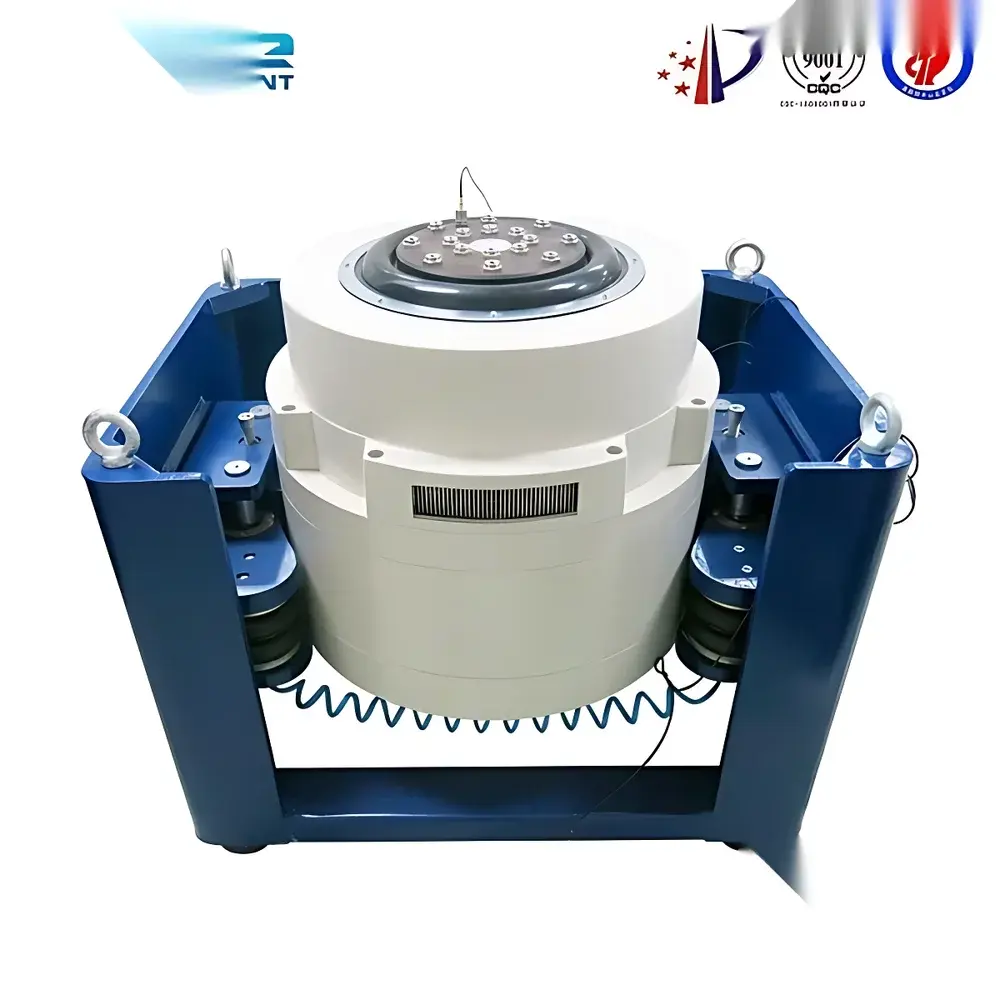
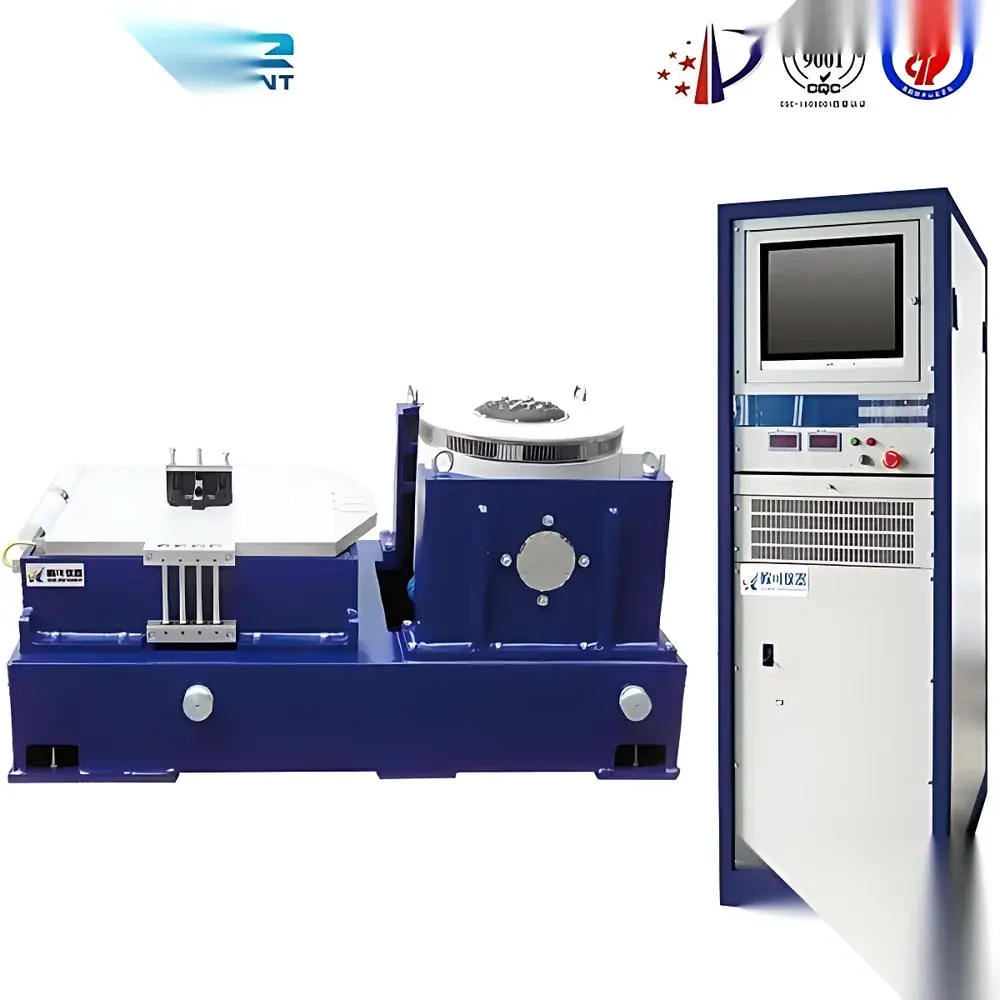
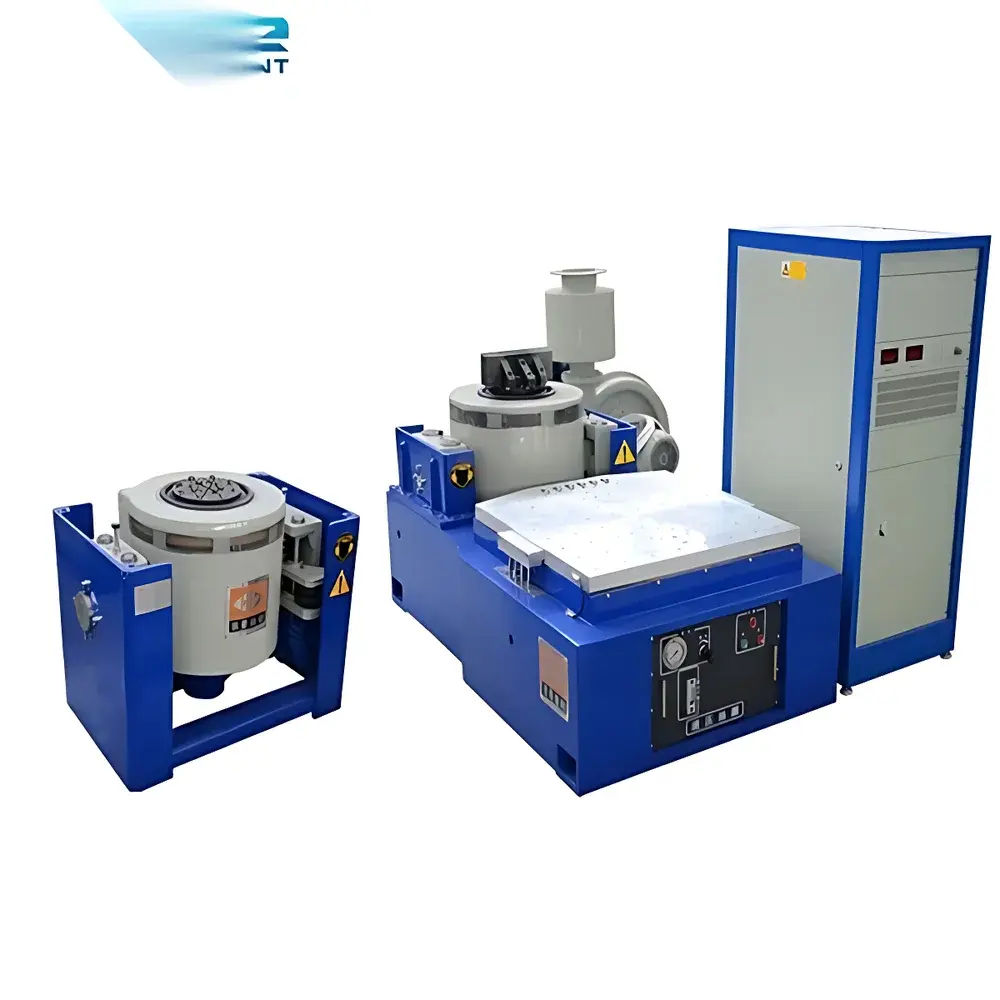
Large-Displacement Electromagnetic Vibration Testing System
| Brand | Other Brands |
|---|---|
| Origin | Imported |
| Manufacturer Type | General Distributor |
| Stroke | 25.4 mm (1 inch) |
| Table Size | 1000 mm × 1000 mm |
| Payload Capacity | 100 kg |
| Frequency Range | 120–300 RPM (continuous adjustment) |
| Speed Accuracy | ±3 RPM |
| Timer Range | 0.00–99.99 hours |
| Overall Dimensions (L×W×H) | 2200 × 2200 × 700 mm |
| Compliance | ASTM D999, ISTA 1A-2001, EN 71 |
Overview
The Large-Displacement Electromagnetic Vibration Testing System is a precision-engineered electrodynamic shaker platform designed for simulating real-world transportation-induced mechanical stress on packaged goods, electronic assemblies, and industrial components. Unlike hydraulic or servo-hydraulic systems, this unit employs a high-torque DC motor coupled with synchronous belt transmission and optimized electromagnetic actuation to deliver controlled, repeatable sinusoidal vibration profiles across its full stroke range of 25.4 mm peak-to-peak. Its fundamental operating principle relies on rotational-to-linear motion conversion via eccentric cam mechanisms—enabling deterministic displacement amplitude control independent of payload within the specified 100 kg limit. The system is explicitly calibrated and validated against internationally recognized transport simulation standards, including ASTM D999 (Standard Test Methods for Shock and Vibration Testing of Shipping Containers), ISTA 1A-2001 (General Simulation Performance Tests for Parcel Delivery Systems), and EN 71-1 (Safety of Toys – Mechanical and Physical Properties). It serves as a core tool in packaging validation laboratories, quality assurance departments, and R&D facilities where physical durability under distribution chain conditions must be quantitatively assessed prior to market release.
Key Features
- 25.4 mm maximum stroke displacement—engineered for high-fidelity replication of road, rail, and maritime transport vibration spectra
- 1000 mm × 1000 mm stainless steel test table with integrated aluminum alloy linear guide rails for rapid, tool-free fixture reconfiguration
- Robust structural architecture featuring heavy-duty channel steel base frame and vibration-damping rubber mounts to isolate ambient floor-borne interference
- Digitally monitored speed control with ±3 RPM accuracy over the full 120–300 RPM operational range, displayed via front-panel LED indicator
- Multi-turn potentiometer-based frequency adjustment enabling fine-grained resolution and long-term repeatability
- Programmable digital timer with 0.01-hour resolution (0.00–99.99 h), supporting unattended extended-duration testing protocols
- Low-noise synchronous belt drive system minimizing harmonic distortion and ensuring smooth torque transfer under variable load conditions
- Modular clamping interface compatible with standard ISO/ASTM fixture plates and custom-designed mounting brackets
Sample Compatibility & Compliance
This vibration testing system accommodates a broad spectrum of sample configurations—from small consumer electronics enclosures and pharmaceutical blister packs to large automotive subassemblies and palletized cargo units. The 100 kg payload capacity and 1 m² table surface allow for multi-unit batch testing while maintaining compliance with standardized test specimen positioning requirements defined in ASTM D999 Annex A1 and ISTA 1A Section 5.2. All mechanical and electrical subsystems conform to CE marking directives (2014/30/EU EMC Directive and 2014/35/EU Low Voltage Directive). Calibration documentation includes traceable verification against NIST-traceable tachometric references, and the system supports GLP-compliant audit trails when operated with external data logging hardware.
Software & Data Management
While the base configuration operates via standalone analog controls, optional RS-485 or USB-C serial interfaces enable integration with third-party PC-based acquisition software (e.g., LabVIEW, MATLAB, or custom Python scripts) for time-synchronized acceleration, displacement, and current waveform capture. Real-time monitoring of motor current draw provides indirect insight into dynamic load variations during test execution. For regulated environments, optional firmware upgrades support timestamped event logging—including start/stop triggers, speed setpoint changes, and timer expiration—with exportable CSV reports suitable for FDA 21 CFR Part 11–compliant record retention when paired with validated electronic signature modules.
Applications
- Transportation simulation for package integrity validation per ASTM D999 and ISTA series protocols
- Vibration fatigue assessment of solder joints, connectors, and PCB-mounted components in electronics manufacturing
- Structural resonance screening of mechanical assemblies prior to environmental stress screening (ESS)
- Pre-shipment qualification testing for medical device packaging under ISO 11607-1
- Material-level damping characterization of cushioning foams and corrugated board composites
- Verification of fastener retention performance under sustained low-frequency oscillatory loading
FAQ
Is this system suitable for sine sweep or random vibration testing?
No—this unit is configured exclusively for fixed-frequency or stepwise sinusoidal vibration at constant amplitude. It does not support closed-loop spectral control or real-time waveform synthesis.
Can the stroke amplitude be adjusted below 25.4 mm?
Amplitude is mechanically fixed at 25.4 mm peak-to-peak; however, effective vibrational intensity can be modulated via frequency selection and payload mass distribution per ASTM D999 guidance.
What maintenance intervals are recommended?
Belt tension inspection every 500 operational hours; lubrication of guide rail systems every 1,000 hours; annual calibration verification of speed sensor and timer circuitry.
Does the system include test report generation functionality?
The embedded controller does not generate formal test reports; however, all operational parameters (set speed, elapsed time, stop condition) are logged internally and exportable via optional serial interface for integration into LIMS or QMS platforms.
Is technical support available for international customers?
Yes—remote diagnostics, English-language documentation, and application engineering consultation are provided globally; on-site installation and commissioning services are available upon request with advance scheduling.



