
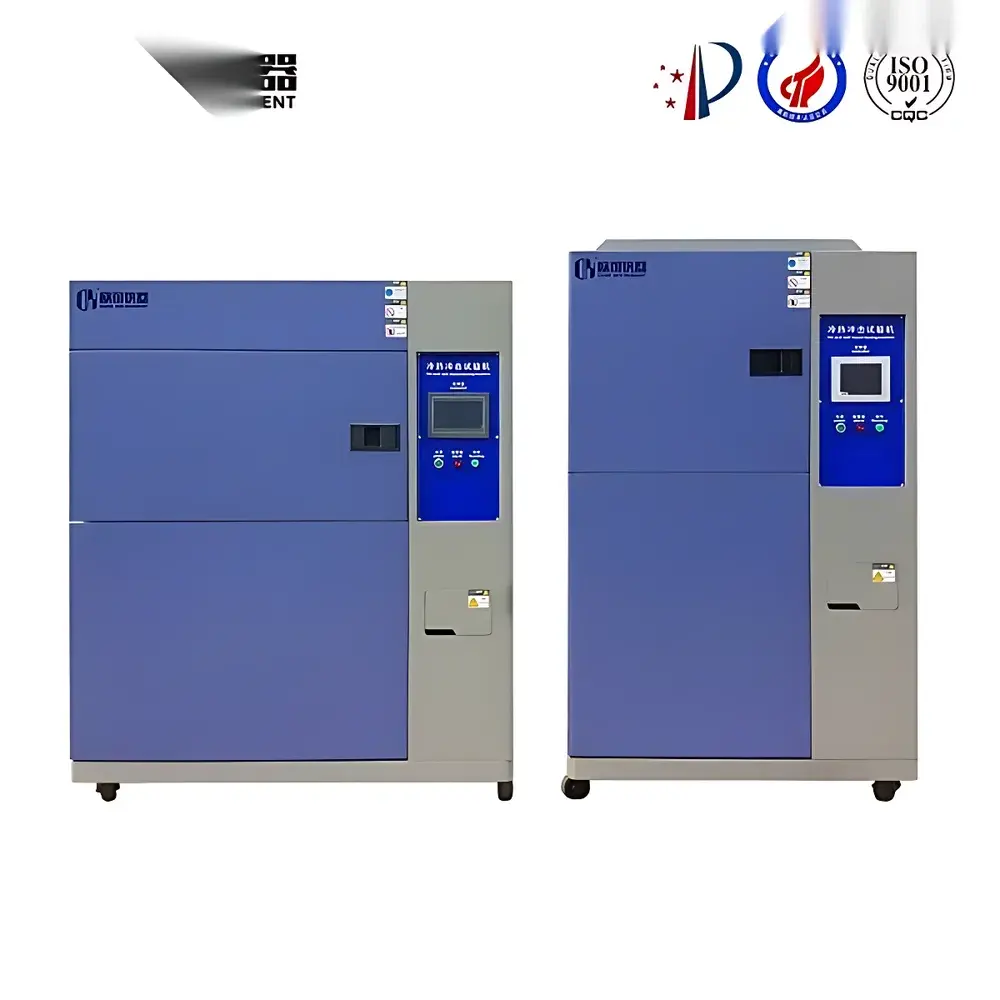
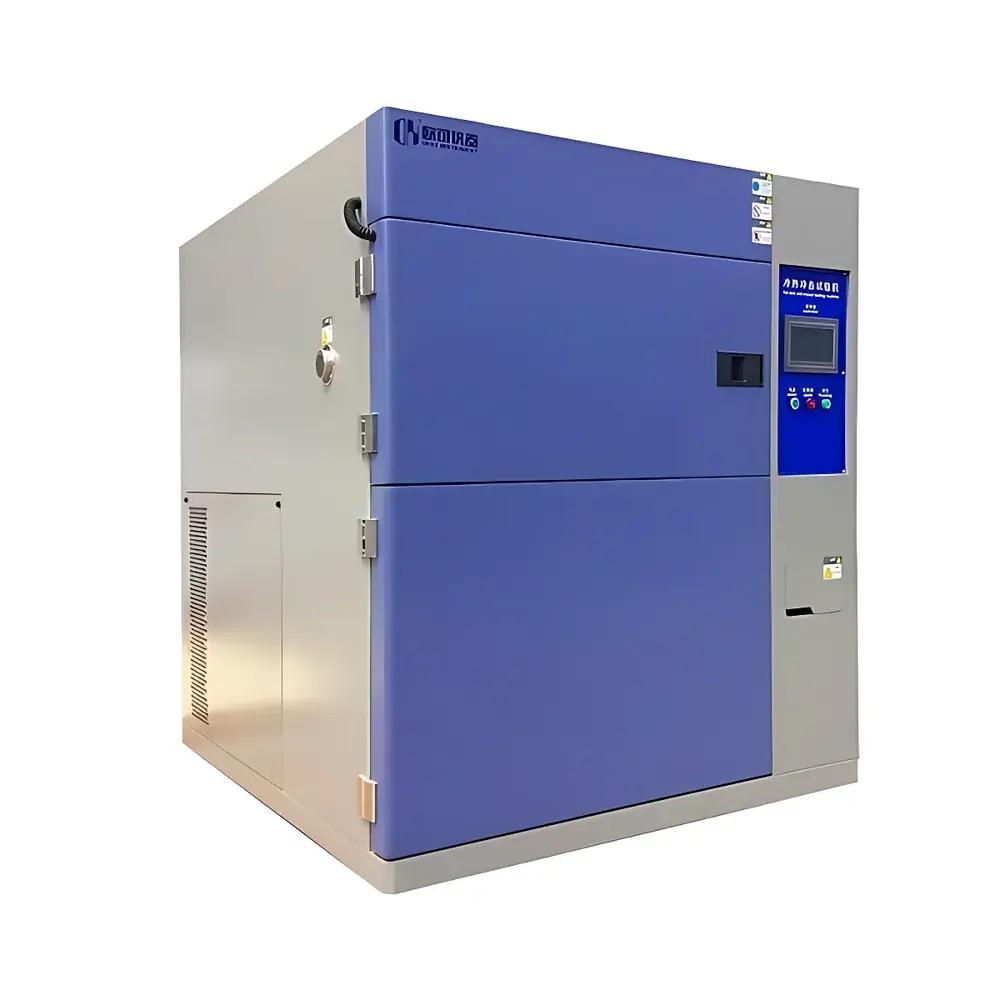
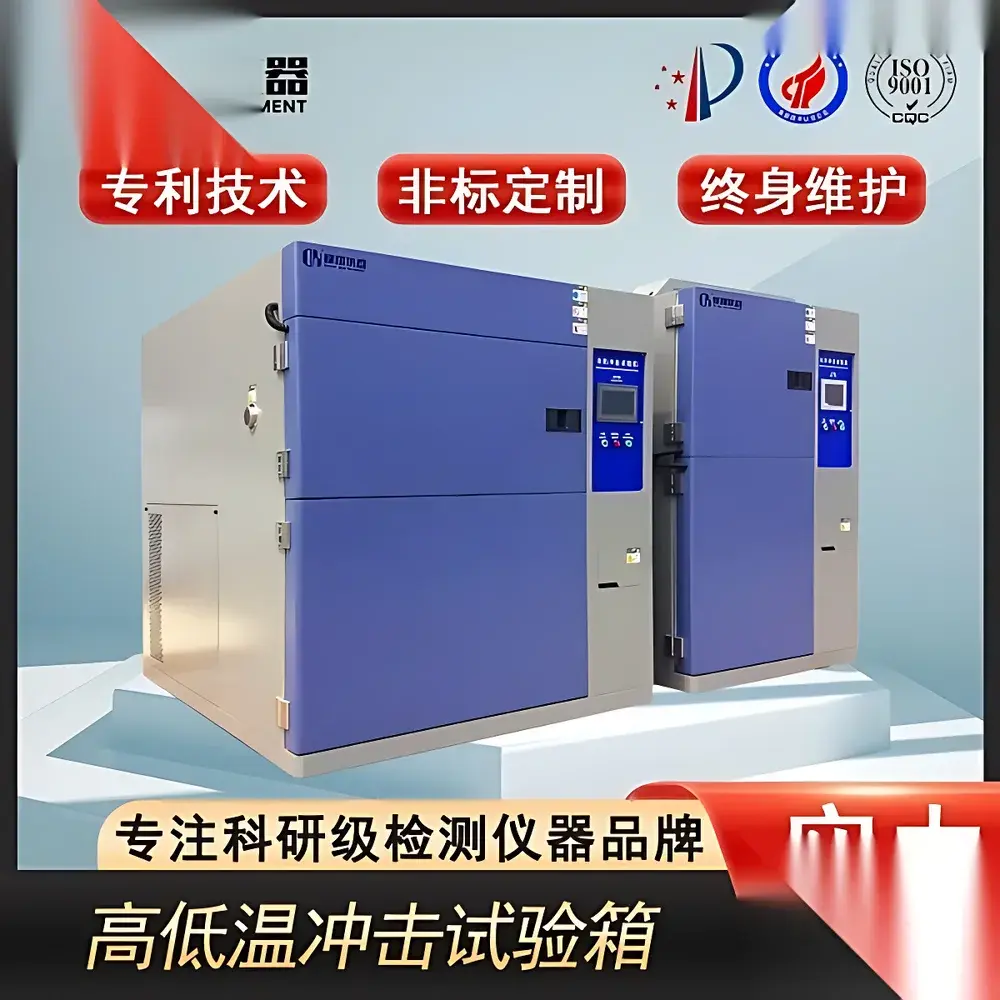
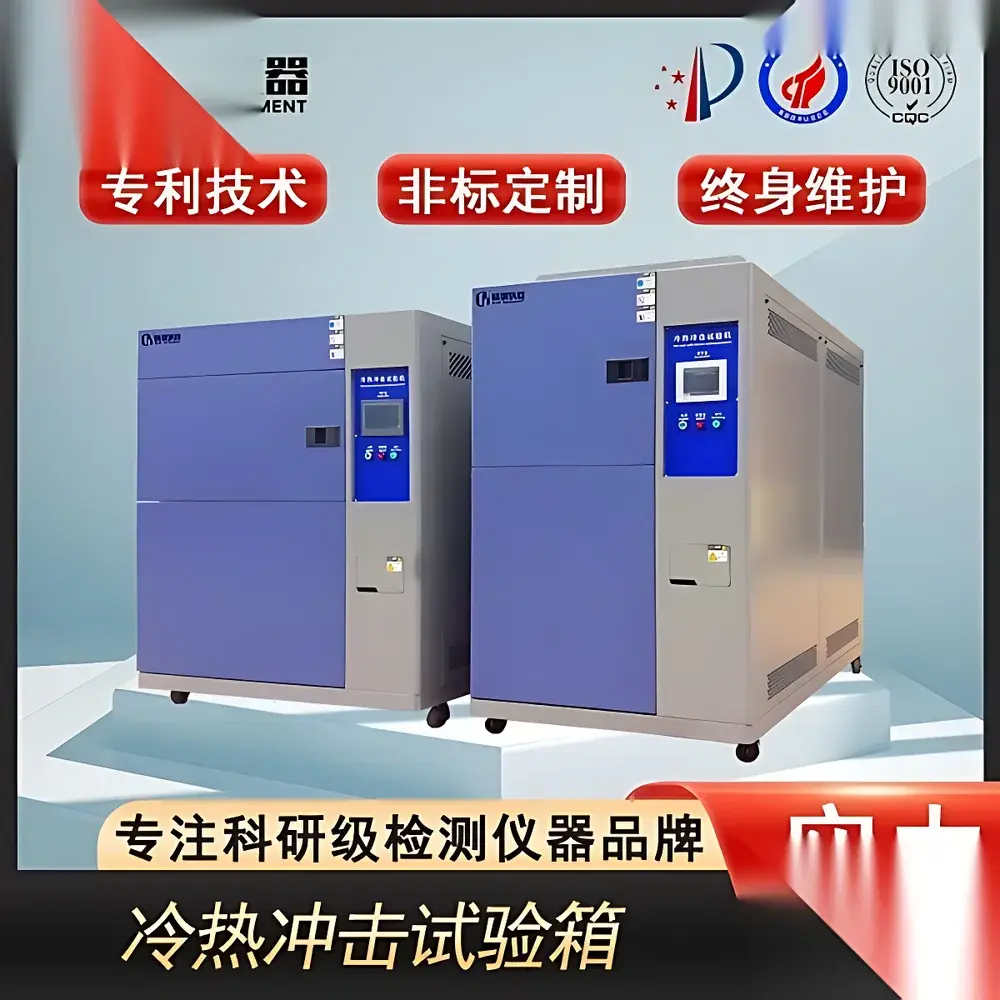
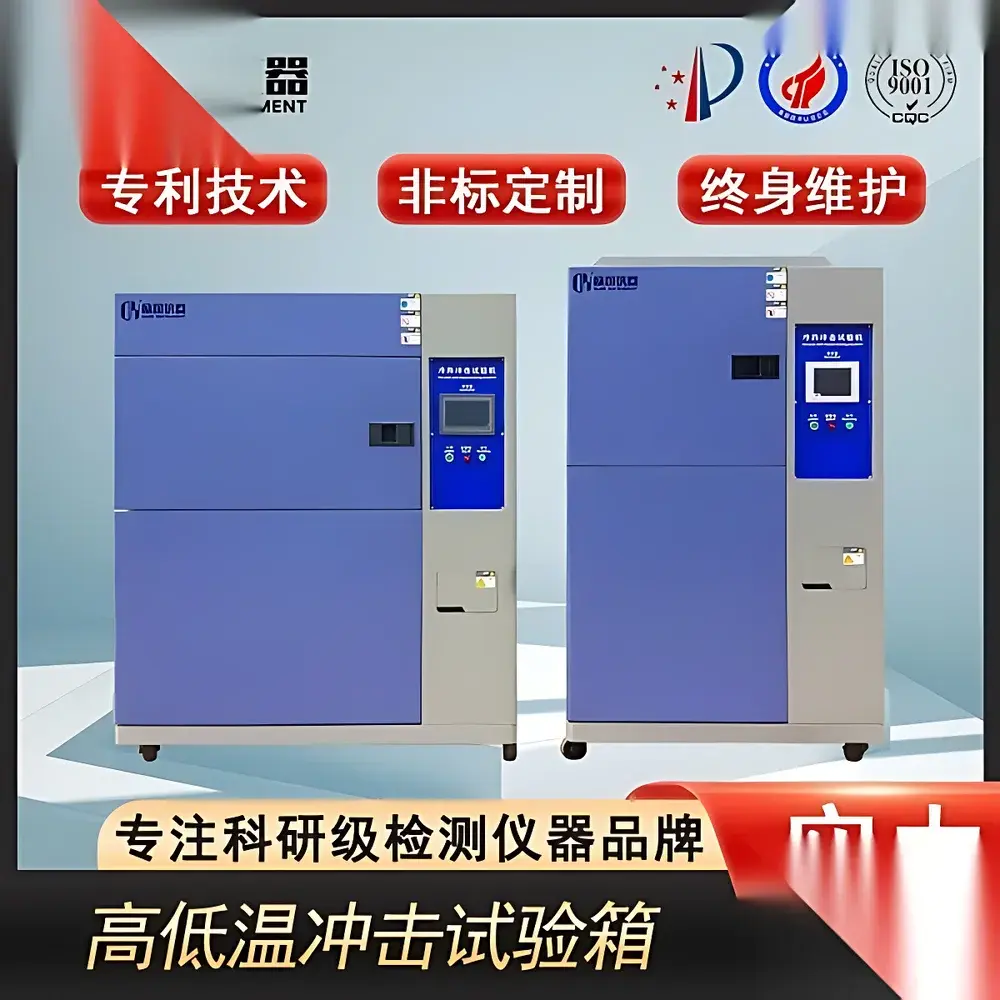
Large Thermal Shock Test Chamber
| Brand | Other Brands |
|---|---|
| Origin | Imported |
| Manufacturer Type | General Distributor |
| Price | USD 11,200 (FOB) |
| Temperature Range | −70°C to +180°C |
| Shock Transition Time (5% Zone) | ≤15 s (Typical, 150 L Unit) |
| Test Zone Volume | ≥500 L |
| Control System | Color TFT LCD Touchscreen Interface |
| Cooling System | Dual-Stage Cascade Refrigeration (Air-Cooled or Water-Cooled Options) |
| Max Cycle Count | 9999 |
| Max Dwell Time per Segment | 9999 min |
| Compliance | GB/T 2423.1, GB/T 2423.2, GB/T 5170.2, GB/T 2424.1, GB 11158, GB 10592 |
| Data Logging | Optional External Recorder or PC Interface (RS485/USB/Ethernet) |
Overview
The Large Thermal Shock Test Chamber is an engineered environmental stress screening (ESS) system designed for accelerated reliability evaluation of industrial components and materials under rapid, repetitive thermal transitions. Based on the principle of air-to-air thermal shock—where test specimens are physically transferred between thermally isolated high-temperature and low-temperature chambers via a mechanical lift-and-transfer mechanism or dynamically switched airflow pathways—the chamber subjects samples to controlled, high-rate temperature excursions. Unlike steady-state temperature cycling chambers, this system delivers true thermal shock conditions defined by ISO 16750-4, JEDEC JESD22-A104, and MIL-STD-810H Method 503.4, where temperature transition rates exceed 10°C/s and dwell times are programmable down to seconds. Its large-volume test zone (≥500 L) accommodates full assemblies—including automotive ECUs, aerospace avionics modules, battery packs, and medical device enclosures—enabling system-level qualification without disassembly.
Key Features
- Tri-zone architecture: independently insulated high-temperature chamber (up to +180°C), low-temperature chamber (down to −70°C), and central test compartment—minimizing thermal cross-talk and ensuring measurement stability.
- Dual-stage cascade refrigeration system with environmentally compliant R404A/R23 refrigerant blend, enabling rapid cooling ramp rates (>30°C/min from +25°C to −55°C) and stable sub-zero operation.
- Intelligent airflow switching mechanism: pneumatic or servo-driven damper arrays redirect conditioned air into the test zone within ≤15 seconds (measured at 5% temperature recovery zone), meeting stringent thermal shock timing specifications.
- 10.4-inch color TFT LCD touchscreen controller with multilingual UI (English/Chinese), real-time graphical trend display, and intuitive icon-based navigation—reducing operator training time and minimizing misconfiguration risk.
- Full programmability: supports up to 9999 thermal cycles; individual segment dwell times adjustable from 1 minute to 9999 minutes; flexible start mode selection (hot-first, cold-first, or user-defined sequence).
- Standard RS485 Modbus RTU and optional Ethernet (TCP/IP) interface for integration into centralized lab monitoring systems or MES platforms—supporting remote parameter setting, alarm notification, and event logging.
Sample Compatibility & Compliance
The chamber accommodates test specimens up to 600 mm × 600 mm × 600 mm (W×D×H) with uniform airflow distribution verified per IEC 60068-3-5. It supports rigid and semi-rigid samples including printed circuit board assemblies (PCBAs), metal housings, polymer enclosures, lithium-ion battery modules, and sealed optical sensors. All thermal profiles comply with mandatory national standards GB/T 2423.1 (cold test), GB/T 2423.2 (dry heat), GB/T 2424.1 (temperature cycling), and GB/T 5170.2 (performance verification of temperature chambers). Calibration traceability follows JJG 2040–2010 (National Metrological Verification Regulation for Environmental Test Equipment), with optional NIST-traceable certificate available upon request.
Software & Data Management
The embedded controller logs timestamped temperature data at 1-second intervals to internal flash memory (≥30 days retention). Export formats include CSV and Excel-compatible .xls files via USB drive. Optional PC-based software (sold separately) provides advanced features: multi-chamber synchronization, statistical process control (SPC) charting (X̄-R, Cp/Cpk), audit trail with user login authentication, and electronic signature capability aligned with FDA 21 CFR Part 11 requirements for regulated industries. All configuration changes, alarm events, and calibration records are time-stamped and non-erasable—ensuring GLP/GMP-compliant documentation integrity.
Applications
- Automotive electronics: validation of ADAS camera modules, power inverters, and infotainment systems against thermal fatigue per ISO 16750-4.
- Aerospace component qualification: thermal shock endurance testing of flight-critical sensors per RTCA DO-160 Section 4.5.
- Battery safety assessment: evaluating thermal runaway propagation resistance in EV battery packs during rapid ambient shifts.
- Medical device verification: confirming hermetic seal integrity and material dimensional stability of implantable electronics under cyclic condensation conditions.
- Quality assurance in contract manufacturing: incoming inspection of PCBAs for solder joint reliability prior to final assembly.
FAQ
What is the typical temperature transition time between extreme zones?
Measured from 10% to 90% of target temperature in the test zone center, transition time is ≤15 seconds for standard 500 L units under nominal load conditions.
Does the system support automated data export for regulatory audits?
Yes—via USB or network interface, with configurable file naming, timestamp format, and encryption options compatible with ISO 13485 and IEC 62304 documentation workflows.
Can the chamber operate continuously for extended qualification runs?
Rated for unattended 24/7 operation with dual redundant safety circuits, automatic defrost management, and compressor discharge temperature monitoring.
Is third-party calibration certification included?
Factory calibration report is standard; NIST-traceable certificate with uncertainty budget is available as an add-on service.
What maintenance intervals are recommended for the refrigeration system?
Compressor oil and filter replacement every 12 months or 4,000 operating hours—whichever occurs first—per OEM preventive maintenance schedule.



