
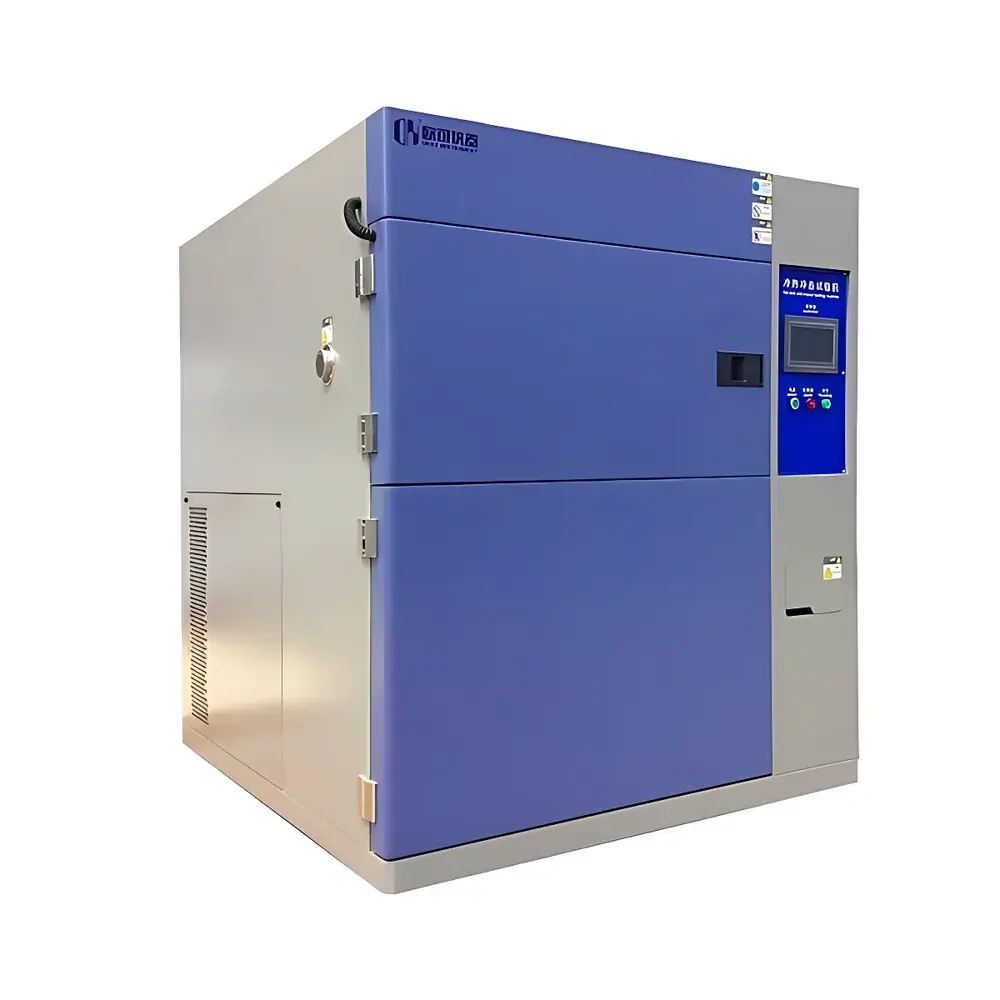
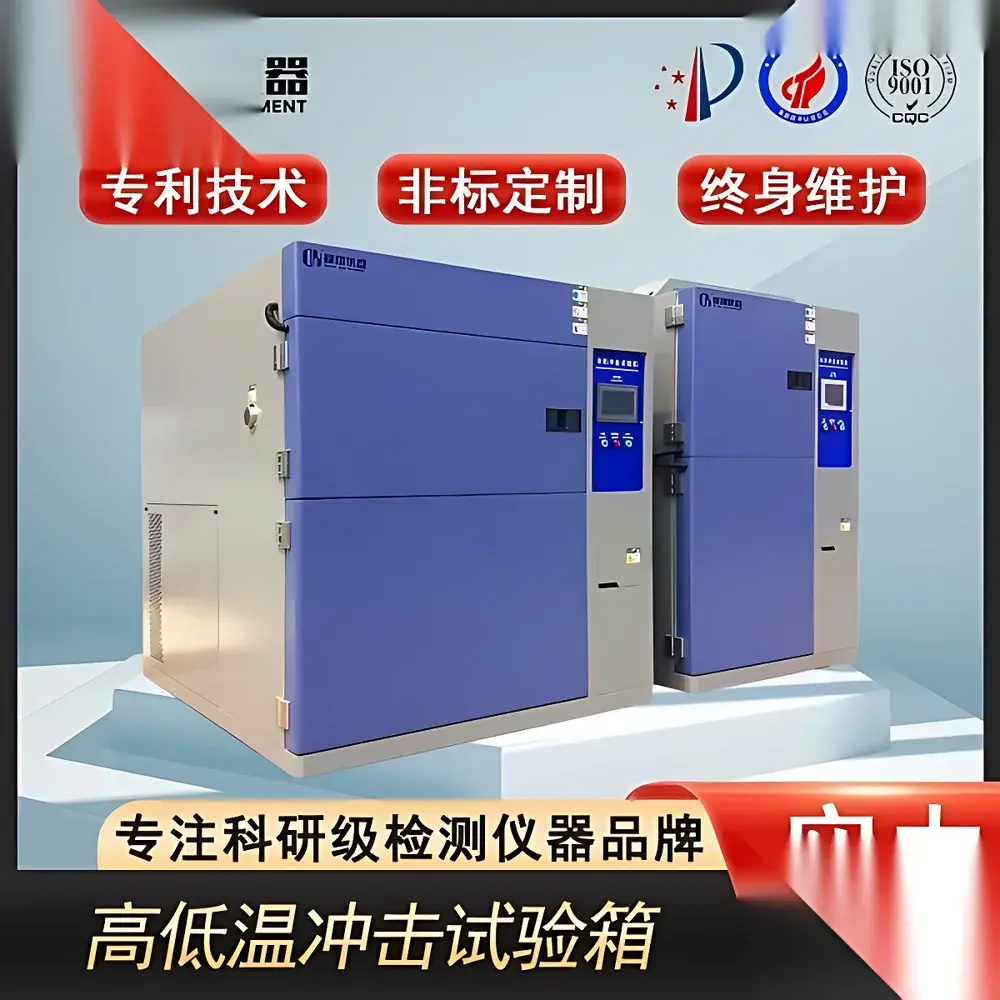
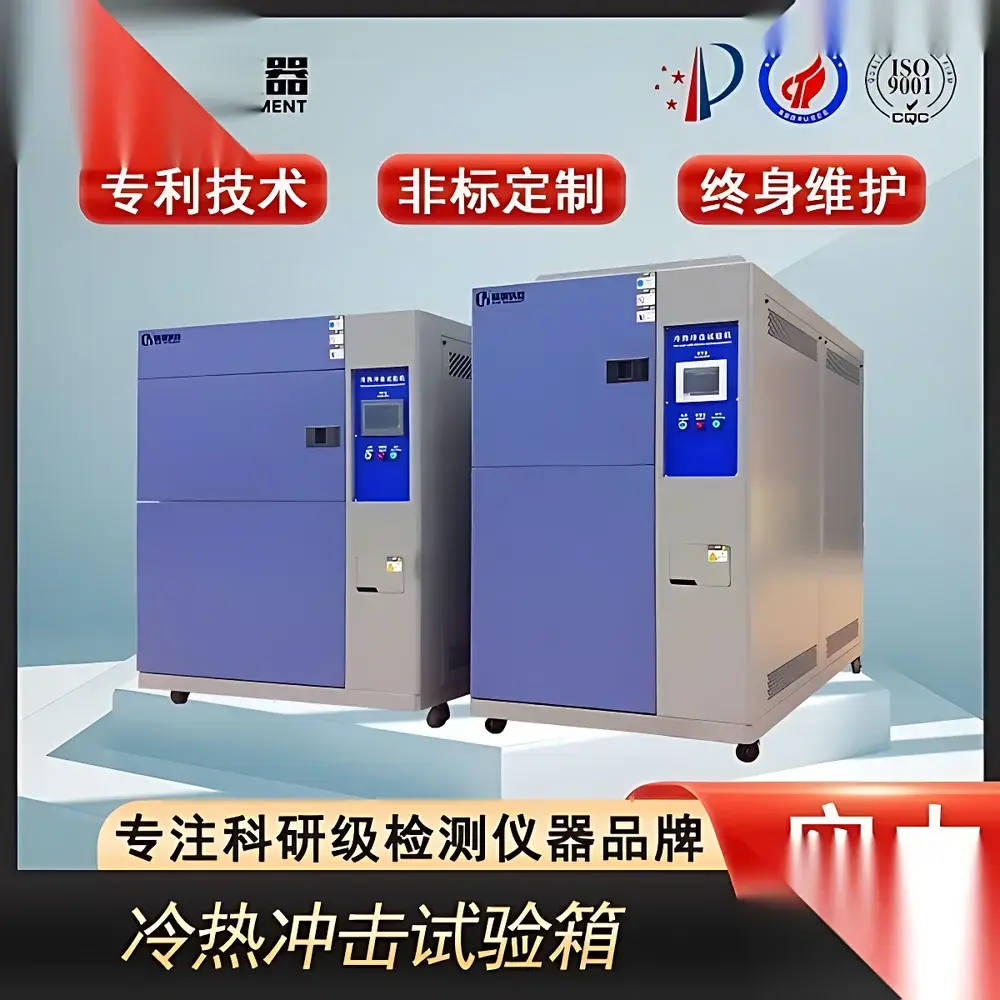
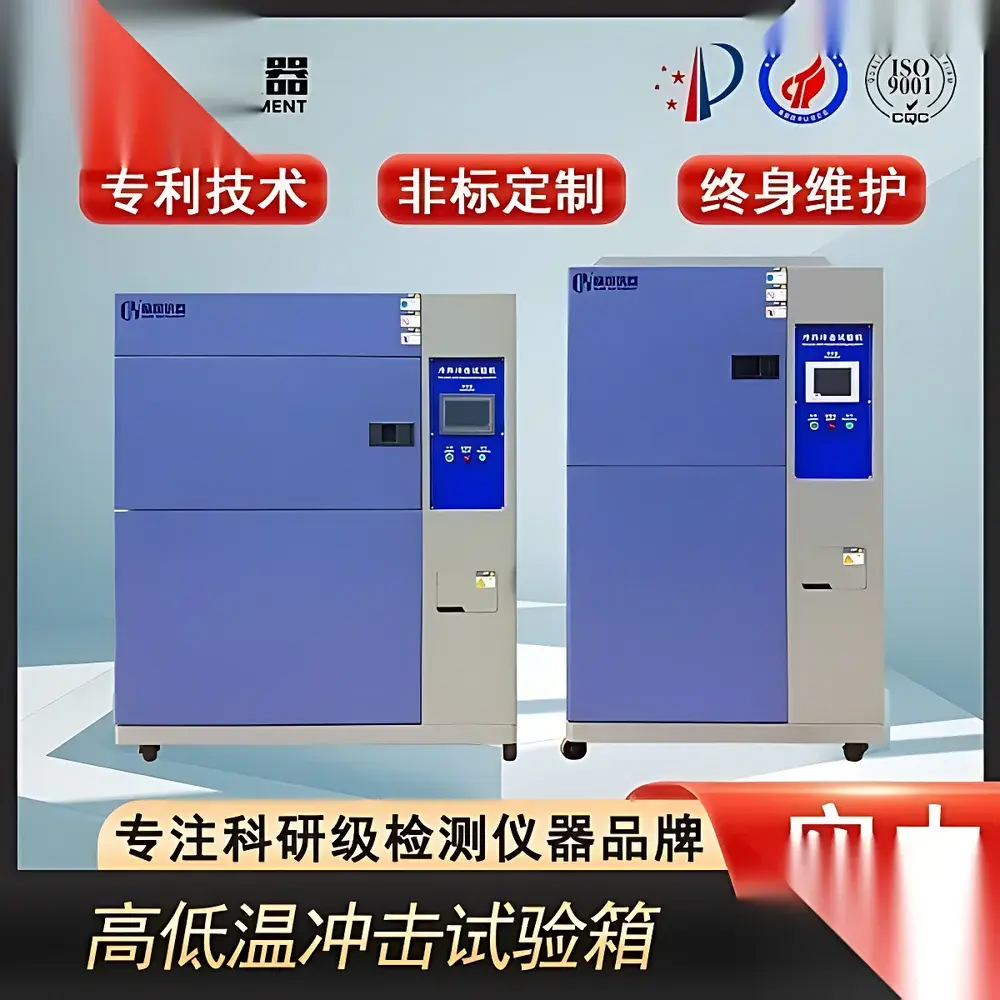
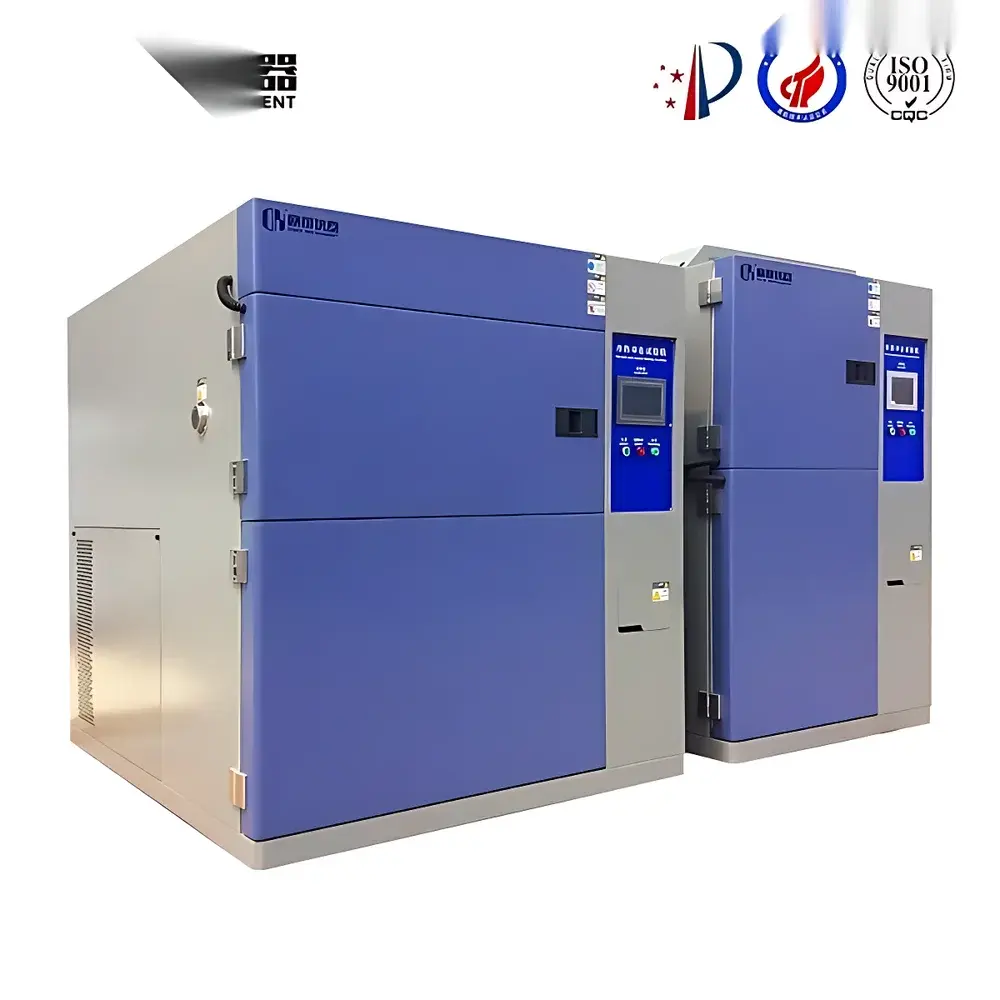
Large Thermal Shock Test Chamber
| Brand | Other Brands |
|---|---|
| Origin | Imported |
| Manufacturer Type | General Distributor |
| Price | USD 11,200 (FOB) |
| Compliance | GB/T 2423.1, GB/T 2423.2, GB/T 2423.22, GJB 150.3–150.5, GJB 360.7, GJB 367.2, IEC 60068-2-14, SJ/T 10186–10187, QC/T 17, EIA-364-32 |
| Refrigeration System | Dual-stage cascade refrigeration with imported German semi-hermetic compressors |
| Cooling Method | Water-cooled (external cooling tower required: 10 m³/h flow rate) |
| Temperature Range | –65 °C to +150 °C |
| Transition Time | ≤5 min (typical, 150 °C ↔ –65 °C, internal chamber air) |
| Configuration | Two-chamber (hot/cold separate chambers) |
| Control Accuracy | ±0.5 °C (steady-state), ±2.0 °C (transition phase) |
| Data Logging | Real-time temperature profiling with timestamped CSV export |
Overview
The Large Thermal Shock Test Chamber is an industrial-grade environmental stress screening (ESS) system engineered for rapid, repeatable, and highly controlled thermal cycling between extreme temperature extremes. Designed specifically for validation of electronic assemblies, automotive components, aerospace subsystems, and high-reliability packaging, it operates on the principle of two-chamber thermal shock—where test specimens are mechanically transferred between independently conditioned hot and cold zones. This architecture eliminates thermal mass interference and enables precise, high-fidelity simulation of real-world thermal transients. Unlike single-chamber ramp-based systems, the dual-zone configuration ensures true step-change thermal exposure with minimal dwell time uncertainty, making it suitable for accelerated life testing (ALT), failure mode analysis (FMA), and qualification per MIL-STD-810 and JEDEC JESD22-A106.
Key Features
- Dual-chamber design with independent hot (+150 °C) and cold (–65 °C) zones, minimizing cross-contamination and enabling strict adherence to transition time specifications per IEC 60068-2-14 Method N.
- Cascade refrigeration system utilizing two imported German semi-hermetic compressors—one for high-stage (R404A) and one for low-stage (R23)—integrated with a brazed plate evaporative condenser for efficient inter-stage heat exchange.
- Water-cooled condensing circuit requiring external cooling tower infrastructure (10 m³/h nominal flow), optimized for continuous-duty operation in ambient temperatures up to 40 °C.
- Energy modulation control via variable-speed compressor drives and electronic expansion valves, maintaining stable chamber setpoints while reducing power consumption by up to 30% during partial-load conditions.
- Stainless steel 304 interior chamber with reinforced insulated door seals, conforming to ISO 16750-4 and GJB 150.5 for vibration- and humidity-resistant thermal shock environments.
- Programmable controller with 100-segment profile storage, real-time deviation alarms, and hardware-based safety cutouts (dual independent overtemperature sensors, high-pressure switch, and emergency stop circuit).
Sample Compatibility & Compliance
The chamber accommodates specimens up to 1,200 mm × 1,000 mm × 1,000 mm (W×D×H) and supports standard test fixtures including PCB carriers, engine control units (ECUs), battery modules, and optical sensor housings. It is fully compliant with international standards governing thermal shock validation: IEC 60068-2-14 (Test Nb), MIL-STD-810H Method 503.5, GJB 150.5A–2009, GB/T 2423.22–2022, and EIA-364-32 for connector reliability assessment. All thermal profiles are traceable to NIST-calibrated reference thermocouples (Class A, T-type), and chamber uniformity meets ±1.5 °C across the working volume per ASTM E145-21 Annex A3. The system architecture supports GLP-compliant audit trails when integrated with optional 21 CFR Part 11–enabled software.
Software & Data Management
The embedded controller provides local operation via a 10.1″ capacitive touchscreen interface with multilingual support (English, German, Japanese). For centralized lab management, optional Ethernet/IP and Modbus TCP connectivity enable integration into LIMS or MES platforms. Data logging records temperature readings from up to six user-defined measurement points at configurable intervals (1 s to 60 min), exporting timestamped CSV files with metadata (profile ID, operator ID, chamber status flags). Optional PC-based software adds statistical process control (SPC) charting, deviation heatmaps, and automated report generation aligned with ISO/IEC 17025 documentation requirements.
Applications
- Qualification testing of avionics modules under MIL-STD-810H thermal shock protocols.
- Reliability screening of EV battery packs and power electronics subjected to repeated charge/discharge thermal cycles.
- Failure analysis of solder joint integrity in high-density PCBAs using JEDEC JESD22-A106B-defined profiles.
- Validation of hermetic seal performance in medical device enclosures exposed to rapid ambient transitions.
- Material compatibility testing of adhesives, potting compounds, and conformal coatings per IPC-9701A accelerated aging criteria.
- Automotive component certification per QC/T 17–2019 and ISO 16750-4 for climate endurance.
FAQ
What is the minimum achievable transition time between –65 °C and +150 °C?
Typical air-to-air transfer time is ≤5 minutes for standard load configurations (≤20 kg, non-insulated mass), verified per IEC 60068-2-14 Clause 6.3.
Does the system include calibration documentation?
Yes—each unit ships with a factory calibration certificate covering chamber uniformity, temperature stability, and sensor linearity, traceable to national metrology institutes.
Is remote monitoring supported out of the box?
Standard Ethernet port enables SNMP-based status polling; full remote control and data streaming require optional software license and secure VPN configuration.
Can the chamber operate unattended for extended qualification runs?
Yes—hardware watchdog timers, redundant thermal cutoffs, and automatic fault logging ensure safe 72+ hour continuous operation under validated test profiles.
What maintenance intervals are recommended for the cascade refrigeration system?
Compressor oil analysis and filter-drier replacement every 2,000 operating hours; full system leak check and refrigerant purity verification annually or after any service intervention.



