
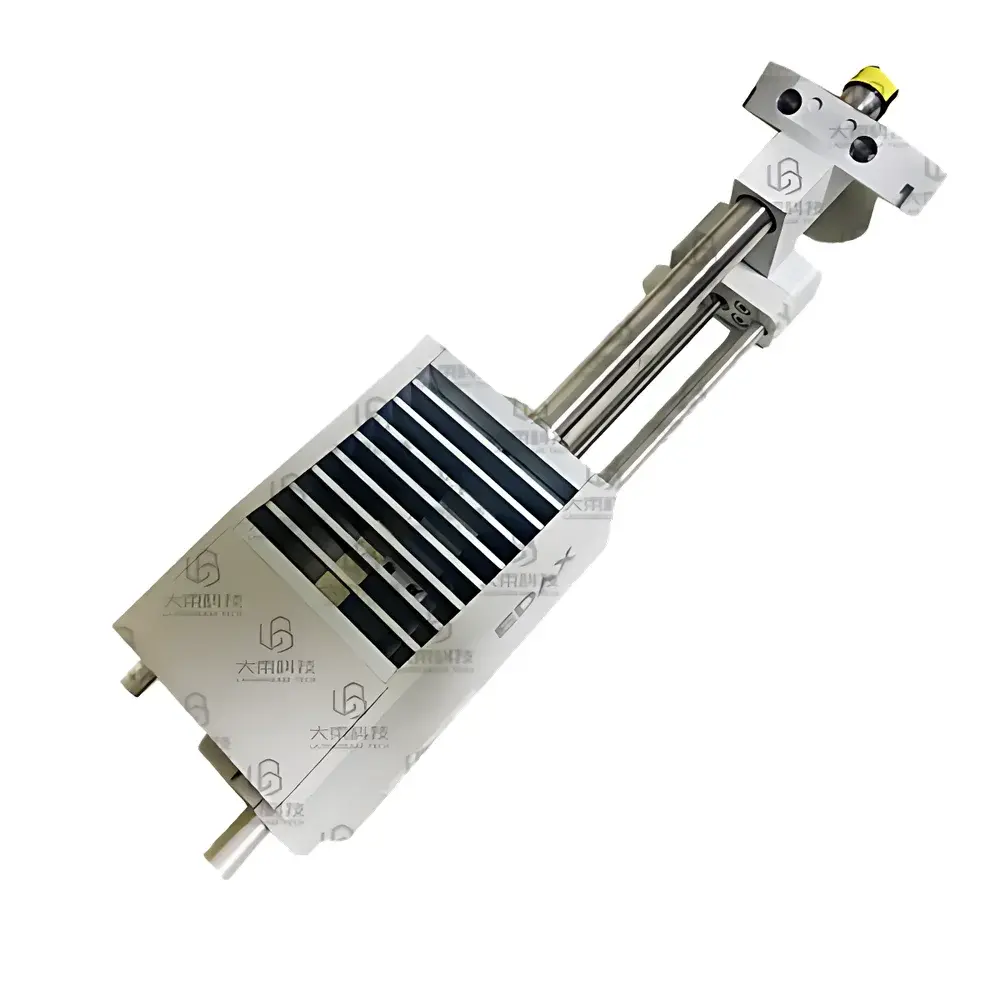
LARGEBEAM RIIDEye Energy-Dispersive X-ray Spectrometer (EDS) for Electron Microscopy
| Brand | LARGEBEAM |
|---|---|
| Origin | USA |
| Manufacturer Type | OEM Manufacturer |
| Import Status | Imported |
| Model | RIIDEye |
| Pricing | Upon Request |
| Detector Type | 2×2 NaI(Tl) scintillator & 1.5×1.5″ LaBr₃(Ce) crystal |
| Energy Range | 20 keV – 3 MeV |
| Display | 3.5″ TFT-LCD, 320×240 resolution, 32,000-color backlight |
| Battery Life | 8 hours (rechargeable Li-ion), with 6 spare AA battery slots |
| Weight | 2.6 kg (5.7 lb) with NaI configuration |
| Dimensions | 27.9 × 12.0 × 21.9 cm (11.0 × 4.7 × 8.6 in) |
| Operating Temperature | −20 °C to +50 °C (−4 °F to 122 °F) |
| Neutron Detection | 1.8 × 3.4 cm Ce-doped Cs₂LiYCl₆ (CLYC) crystal |
| Isotope Library | 47 nuclides |
| Trigger Modes | ANSI, ANSI+, Security, Medical, Industrial, User-Defined |
| Stabilization | Automatic K-40 background compensation, no external reference source required |
Overview
The LARGEBEAM RIIDEye Energy-Dispersive X-ray Spectrometer (EDS) is a high-sensitivity, integrated microanalysis module engineered for seamless coupling with scanning electron microscopes (SEM) and transmission electron microscopes (TEM). Unlike conventional EDS systems relying solely on silicon drift detectors (SDD), the RIIDEye employs a dual-detector architecture combining gamma-sensitive scintillation crystals—specifically 2×2″ NaI(Tl) and 1.5×1.5″ LaBr₃(Ce)—to extend analytical capability into the medium-to-high energy X-ray and gamma-ray regime (20 keV–3 MeV). This design enables simultaneous detection of characteristic X-rays from light elements (e.g., B, C, N, O) and high-energy emissions from actinides, fission products, and activated isotopes—critical for nuclear materials characterization, radioactive particle identification, and failure analysis in irradiated components. The system operates on solid-state pulse-height analysis principles, delivering quantitative elemental composition maps with high spectral throughput and low dead-time performance under variable beam currents and accelerating voltages (5–30 kV). Its compact form factor and ruggedized housing meet IP54 environmental rating requirements for use in both laboratory and field-deployable electron microscopy workflows.
Key Features
- Dual-crystal detection architecture: Independent NaI(Tl) and LaBr₃(Ce) sensors provide optimized count-rate linearity and energy resolution across complementary spectral windows.
- Real-time isotope identification: Embedded library of 47 radionuclides supports automated nuclide assignment via peak deconvolution and library-matching algorithms compliant with ANSI N42.42 data format standards.
- Field-rugged operation: Fully functional with gloved hands via 7-key tactile interface; menu navigation designed for rapid access during SEM/TEM session interruptions.
- Auto-stabilized spectral baseline: Continuous potassium-40 (⁴⁰K) background tracking eliminates need for manual recalibration or external reference sources.
- Multi-trigger acquisition logic: Six preconfigured trigger profiles—including ANSI N42.34-compliant security screening mode—enable context-aware data capture without software reconfiguration.
- Integrated neutron detection: CLYC scintillator (1.8 × 3.4 cm) provides coincident thermal/fast neutron sensitivity, supporting mixed-field radiation analysis in nuclear forensics applications.
Sample Compatibility & Compliance
The RIIDEye EDS is compatible with standard SEM/TEM sample holders, including bulk conductive specimens, coated non-conductive materials, and thin-film TEM grids. It requires no vacuum feedthroughs—detector electronics are housed within the microscope column’s auxiliary port or mounted externally via EDS-compatible flange interfaces (CF-63 or ISO-KF40). All firmware and spectral processing routines adhere to ASTM E1508-22 (Standard Guide for Quantitative Analysis by Energy-Dispersive Spectroscopy) and ISO 16574:2021 (Microbeam analysis — Electron probe microanalysis — Quantitative analysis using wavelength- and energy-dispersive spectrometry). Data export formats conform to NIST-recommended HDF5 and .SPE (ORTEC) standards, ensuring traceability for GLP/GMP-regulated environments. Full audit trail logging—including detector temperature, HV bias, live time, and user-initiated calibration events—is enabled per FDA 21 CFR Part 11 requirements when deployed with validated LARGEBEAM ControlSuite v3.x software.
Software & Data Management
Control and analysis are managed through LARGEBEAM ControlSuite—a Windows-based platform supporting real-time spectrum accumulation, elemental mapping, and spectral deconvolution using iterative least-squares fitting (ILSF) and Monte Carlo-based matrix correction (e.g., ZAF and φ(ρz)). The software includes built-in support for multi-detector synchronization, allowing concurrent acquisition from RIIDEye and a co-mounted SDD for hybrid X-ray/gamma spectroscopy. All raw spectra and processed results are stored in vendor-neutral formats with embedded metadata (acquisition date/time, instrument ID, beam parameters, detector settings). Automated report generation complies with ISO/IEC 17025 documentation requirements, including uncertainty propagation for peak-area quantification. Remote diagnostics and firmware updates are performed over encrypted TLS 1.2 connections, with optional integration into enterprise LIMS via RESTful API endpoints.
Applications
- Nuclear materials accountability: Identification and quantification of uranium enrichment levels, plutonium isotopic ratios, and fission product signatures in swipe samples or fuel fragments.
- Radioactive contamination forensics: Discrimination of natural vs. anthropogenic radionuclides (e.g., ¹³⁷Cs, ⁶⁰Co, ²⁴¹Am) in environmental particulates collected via TEM grid sampling.
- Failure analysis of irradiated components: Correlation of microstructural defects (observed in TEM) with localized elemental segregation or transmutation products (e.g., Ni → Co via neutron capture).
- Geological specimen characterization: Simultaneous detection of rare-earth elements (REEs) and high-Z accessory minerals (e.g., monazite, zircon) without requiring high-kV acceleration.
- Medical device sterilization validation: Mapping of residual cobalt-60 gamma dose markers in polymeric implants post-irradiation.
FAQ
Is the RIIDEye EDS compatible with third-party SEM platforms such as Thermo Fisher, Zeiss, or JEOL?
Yes—the system supports standard EDS communication protocols (including EDAX ESPRIT and Oxford AZtec SDK APIs) and can be integrated via RS-232, USB 2.0, or Ethernet interfaces.
Does the CLYC neutron detector require moderation or external shielding for routine operation?
No—its intrinsic thermal neutron sensitivity (via ⁶Li capture) and pulse-shape discrimination capability enable unmoderated detection in ambient lab conditions; optional polyethylene collimators are available for directional measurements.
Can spectral libraries be extended beyond the default 47 isotopes?
Yes—users may import custom nuclide definitions (energy peaks, intensities, branching ratios) in IAEA-supported .LIB format, subject to internal validation against NIST SRM 4355B reference spectra.
What maintenance is required for long-term calibration stability?
Annual verification using certified check sources (e.g., ²⁴¹Am, ¹³³Ba) is recommended; automatic K-40 stabilization minimizes drift between verifications.
Is remote technical support available for firmware troubleshooting?
Yes—LARGEBEAM offers secure remote desktop assistance and over-the-air firmware patches for registered instruments under active support contracts.



