
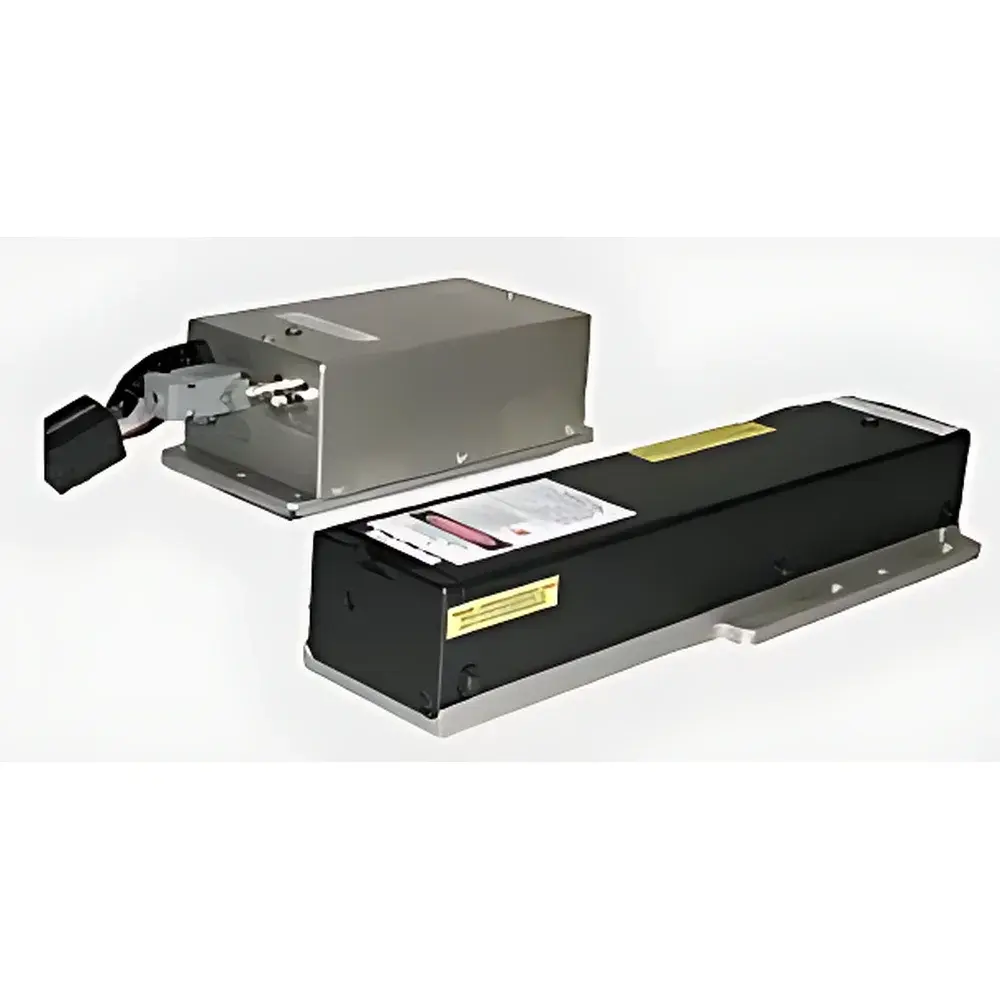
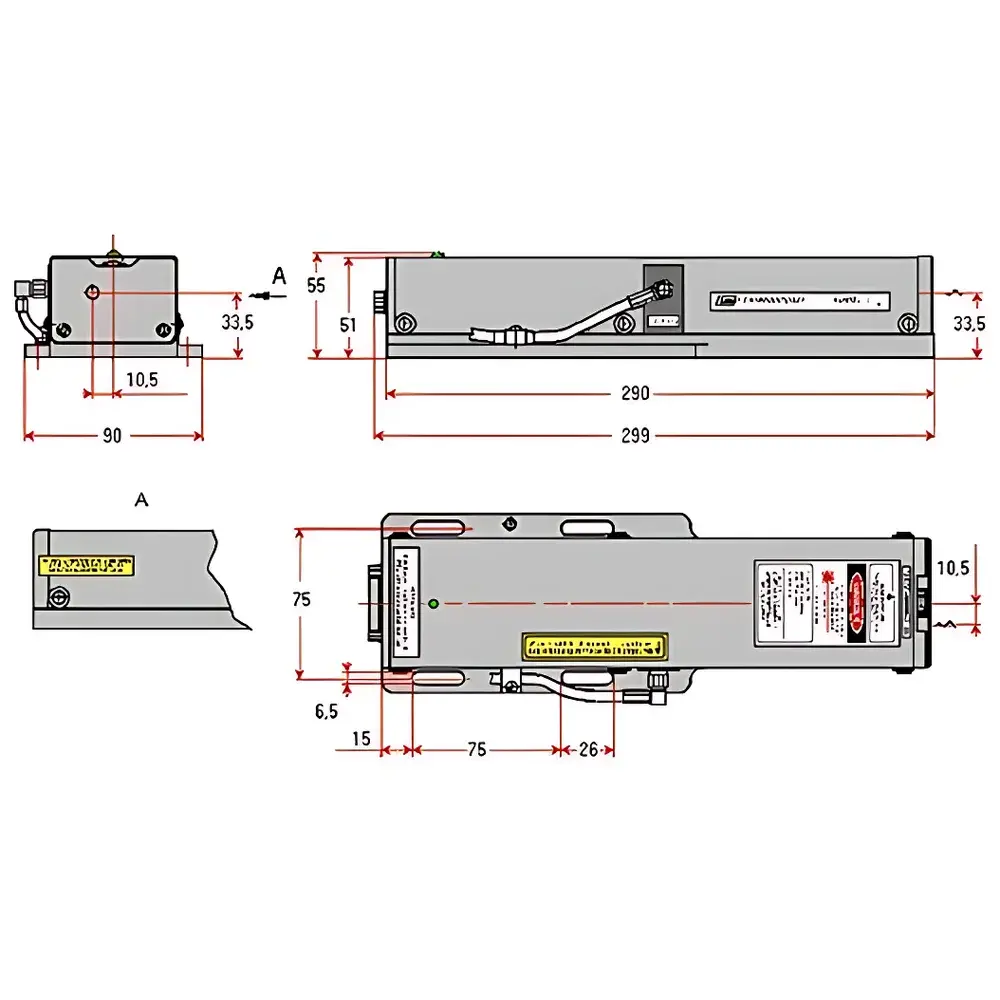
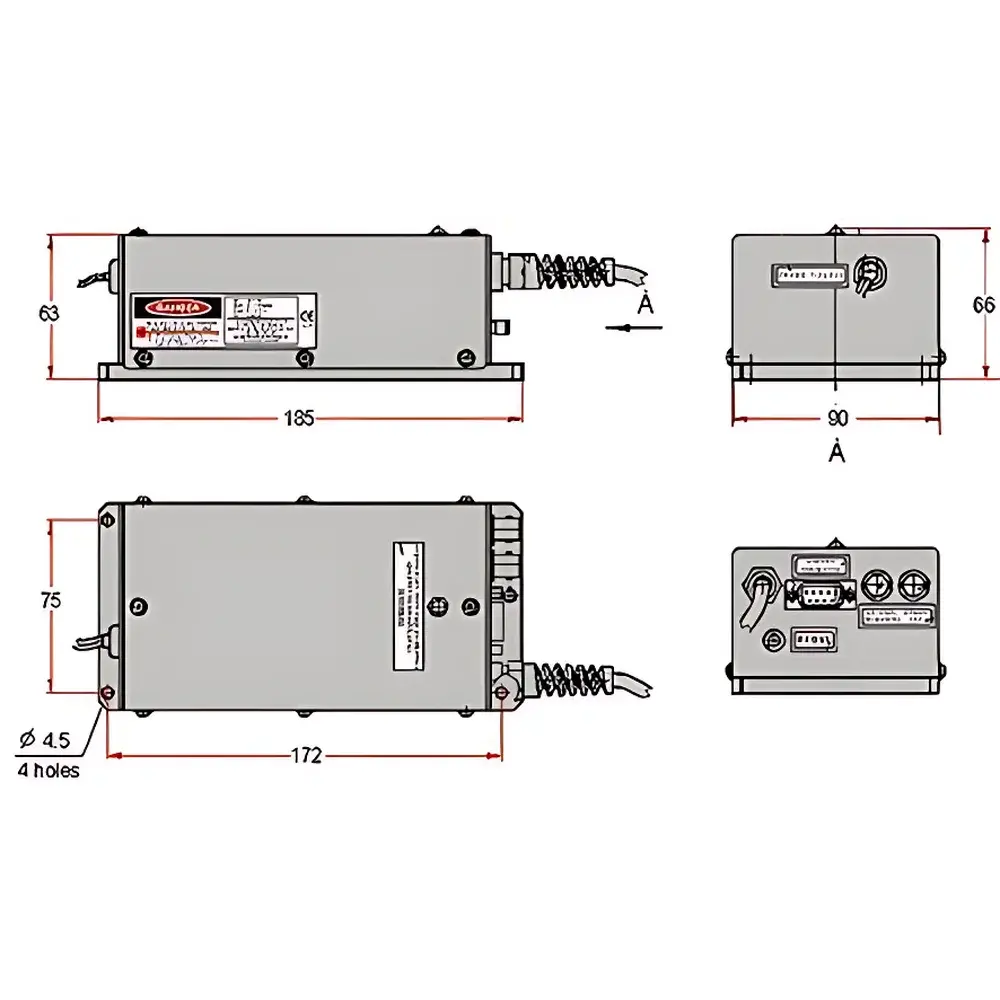
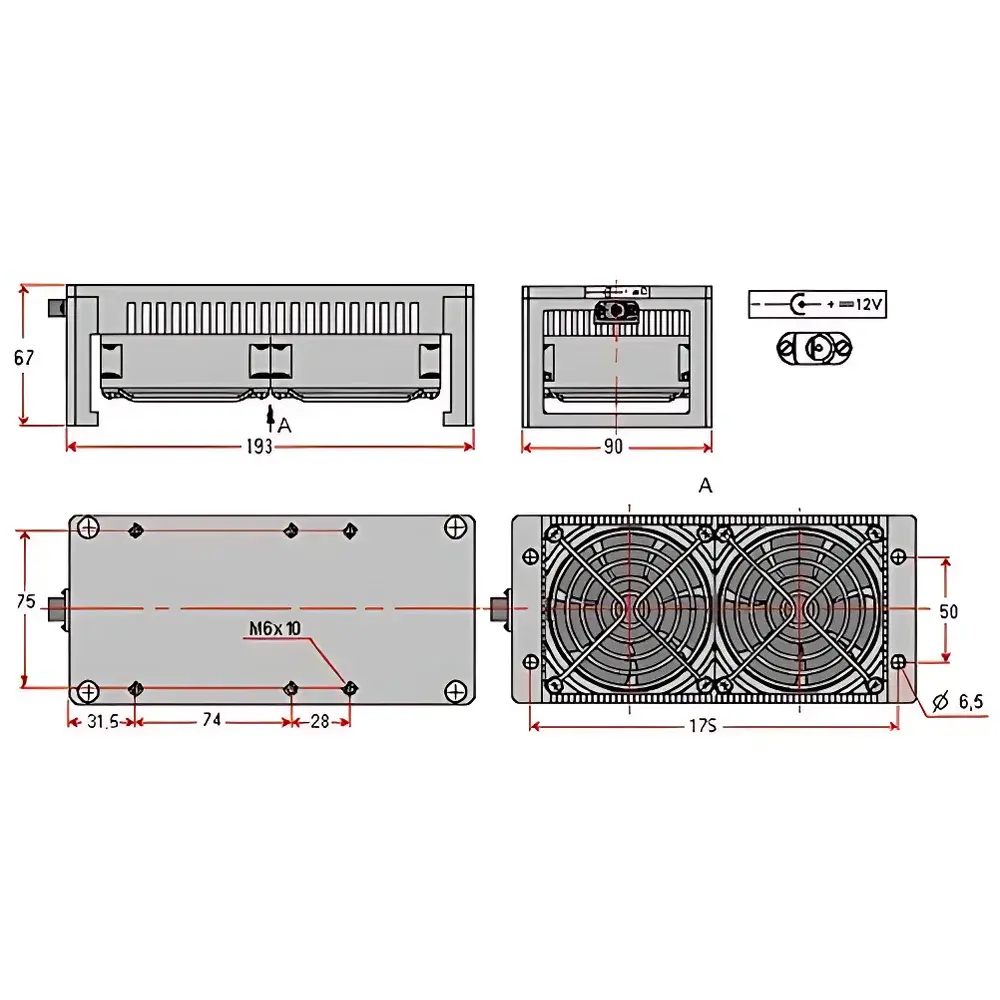
Laser-Export Garnet LCM-DTL-374QT Diode-Pumped Solid-State (DPSS) Q-Switched UV Laser
| Key | Wavelength: 355 nm |
|---|---|
| Repetition Rate (External Trigger Mode) | 200–2000 Hz (200 Hz nominal) |
| Pulse Energy | 20 ±10% mJ @ 200 Hz |
| Pulse Width | 5 ±2 ns (≤7 ns and ≥3 ns @ 200 Hz) |
| Beam Divergence | 3.4 ±0.5 mrad |
| Operating Temperature | 15–35 °C (RH <80%) |
| Manufacturer Origin | Russia |
| Compliance | CE, RoHS, IEC 60825-1:2014 Class 4 Laser Product |
Overview
The Laser-Export Garnet LCM-DTL-374QT is a compact, air-cooled, diode-pumped solid-state (DPSS) Q-switched ultraviolet laser engineered for high-reliability integration into analytical instrumentation—particularly time-of-flight (TOF) and matrix-assisted laser desorption/ionization (MALDI) mass spectrometry systems. Operating at a fundamental wavelength of 355 nm via third-harmonic generation (THG) from a Nd:YAG or Nd:YVO₄ gain medium, this laser delivers stable, nanosecond-duration pulses with precise temporal control under external TTL triggering. Its design emphasizes long-term amplitude stability (<±3% RMS over 8 hours), low spatial mode drift, and minimal pulse-to-pulse jitter (<5 ns), critical for reproducible ion yield and mass resolution in quantitative MS workflows. The system employs a monolithic resonator architecture with intracavity frequency conversion, reducing alignment sensitivity and enhancing robustness against mechanical vibration and thermal drift—key requirements for benchtop OEM integration in regulated laboratory environments.
Key Features
- Diode-pumped architecture ensures >10,000-hour pump diode lifetime and reduced thermal load vs. flashlamp-pumped alternatives
- Q-switched operation with externally triggered pulse timing (TTL-compatible, <10 ns rise time) enables synchronization with detector gating and sample introduction cycles
- Stable pulse energy output of 20 ±10% mJ at 200 Hz, optimized for MALDI matrix ablation efficiency and ion signal linearity across diverse biomolecular samples
- Nanosecond pulse width (5 ±2 ns typical, 3–7 ns range at 200 Hz) balances peak power density (>1 GW/cm² with standard focusing optics) and thermal confinement for clean desorption
- Beam divergence of 3.4 ±0.5 mrad supports efficient coupling into fiber delivery systems or collimation into MS ion sources without complex adaptive optics
- Compliant with IEC 60825-1:2014 as a Class 4 laser product; includes integrated interlock circuitry, emission indicator LED, and key-controlled enable switch for safety-critical installations
Sample Compatibility & Compliance
The LCM-DTL-374QT is routinely deployed in MALDI-TOF platforms for analysis of peptides, proteins, oligonucleotides, synthetic polymers, and small-molecule pharmaceuticals. Its 355 nm output exhibits strong absorption in common organic matrices (e.g., α-cyano-4-hydroxycinnamic acid, sinapinic acid), enabling efficient energy transfer and soft ionization with minimal fragmentation. The laser meets essential regulatory prerequisites for use in GLP-compliant laboratories: full traceability of firmware revision, hardware serialization, and configurable audit log export (via RS-232/USB). It supports integration into FDA 21 CFR Part 11–compliant instrument control frameworks when paired with validated host software that enforces electronic signatures, role-based access, and immutable data archiving.
Software & Data Management
Laser operation is managed through a dual-interface protocol: local front-panel controls (LCD + membrane keypad) for basic parameter verification and emergency shutdown, and remote command via ASCII-based serial protocol (RS-232 or USB virtual COM port). Supported commands include repetition rate setpoint, external trigger enable/disable, pulse energy monitoring (via internal photodiode calibration), and temperature status reporting. No proprietary GUI is bundled; instead, the device is designed for seamless incorporation into OEM control suites using standard SCPI-like syntax. All operational parameters are logged with timestamp and system ID to non-volatile memory, supporting retrospective failure analysis and ISO/IEC 17025 traceability requirements.
Applications
- MALDI-TOF mass spectrometry for clinical proteomics and microbial identification
- Laser ablation inductively coupled plasma mass spectrometry (LA-ICP-MS) for elemental mapping of semiconductor wafers and thin-film devices
- Time-resolved fluorescence lifetime imaging (FLIM) requiring UV excitation with sub-10 ns temporal resolution
- Optical pumping of tunable OPOs for broadband UV-VIS spectroscopy
- Calibration source for UV-sensitive photodetectors and CCD/CMOS sensors in metrology labs
FAQ
Is the LCM-DTL-374QT suitable for continuous-wave (CW) operation?
No. This is a Q-switched pulsed laser only; it does not support CW or quasi-CW modes.
What cooling method is required?
Air cooling via integrated fans and heatsinks; no chiller or liquid circulation is needed.
Can pulse energy be adjusted in real time during acquisition?
Pulse energy is fixed per model specification; fine-tuning requires external attenuation (e.g., calibrated UV-grade half-wave plate + polarizer).
Does the laser include beam profiling documentation?
Yes—each unit ships with a M² measurement report (ISO 11146 compliant) and near-field/far-field intensity distribution data.
What is the warranty coverage and service support structure?
Standard 24-month parts-and-labor warranty; technical support provided directly by Laser-Export’s European service center in Berlin, with spare laser head exchange available under extended service agreement.



