
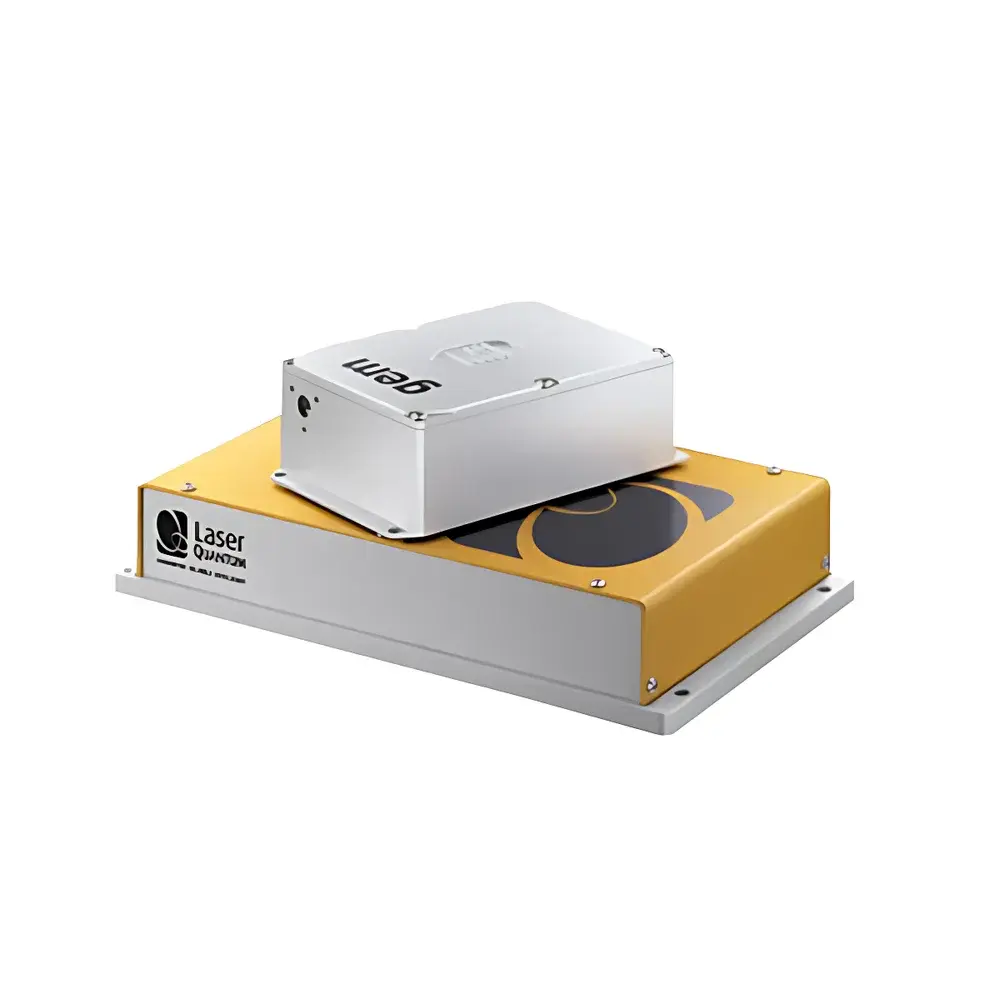
Laser Quantum Gem Series High-Power Compact OEM Continuous-Wave Solid-State Lasers
| Brand | Laser Quantum |
|---|---|
| Origin | United Kingdom |
| Manufacturer Type | Authorized Distributor |
| Product Type | Imported OEM Solid-State Laser System |
| Model | Gem473 / Gem532 / Gem561 / Gem660 / Gem671 |
| Wavelengths | 473 nm, 532 nm, 561 nm, 660 nm, 671 nm |
| Output Power Range | 50 mW to 2 W (model-dependent) |
| Beam Diameter | 0.75–1.0 mm ± tolerance |
| Spatial Mode | TEM₀₀ |
| Power Stability | ≤ 1.0% RMS |
| Beam Pointing Stability | < 10 µrad/°C |
| Noise Level | 0.6–1.5% (10 Hz–10 kHz) |
| Polarization Ratio | >100:1, Vertical |
| Coherence Length | ~7.5 mm (473/561 nm), ~25 µm (532/660/671 nm) |
| Spectral Bandwidth | 30–40 GHz |
| Divergence | < 0.8–1.5 mrad |
| Warm-up Time | 10–15 min |
| Operating Temperature | 15–40 °C |
Overview
The Laser Quantum Gem Series represents a family of high-power, compact, continuous-wave (CW) diode-pumped solid-state (DPSS) lasers engineered for OEM integration into demanding scientific and industrial instrumentation. Leveraging proprietary cavity architectures—including zero-pressure resonators in the Gem660 and Gem671 models—these lasers deliver diffraction-limited TEM00 output with exceptional beam quality (M² < 1.2), low amplitude noise, and outstanding long-term power stability. Each model is optimized for specific spectral regions critical to advanced photonic applications: blue (473 nm), green (532 nm), yellow-orange (561 nm), deep red (660 nm), and near-infrared-red (671 nm). The series is designed for seamless integration into space-constrained platforms where thermal management, mechanical robustness, and electromagnetic compatibility are essential—such as confocal microscopes, flow cytometers, Raman spectrometers, and super-resolution imaging systems.
Key Features
- Industry-leading reliability: >20,000 hours mean time between failures (MTBF), validated under continuous operation at rated power.
- Zero-pressure cavity design (Gem660/Gem671): Eliminates thermally induced stress birefringence, enabling superior pointing stability (100:1).
- Ultra-low noise performance: RMS intensity noise as low as 0.6% (10 Hz–10 kHz bandwidth), critical for fluorescence correlation spectroscopy (FCS) and quantitative imaging.
- OEM-optimized form factor: Compact footprint (<120 × 80 × 45 mm typical), integrated TEC control, and standardized electrical interfaces (TTL modulation, analog power control, status monitoring pins).
- High spectral purity: Narrow intrinsic linewidth (30–40 GHz FWHM) and stable longitudinal mode operation ensure consistent excitation efficiency in resonance-sensitive assays.
- Comprehensive thermal management: Active cooling with closed-loop temperature regulation maintains wavelength drift < ±0.01 nm over operating range (15–40 °C).
Sample Compatibility & Compliance
The Gem Series is compatible with a broad range of optical components and sample environments used in life science and materials analysis instrumentation. Its vertically polarized, Gaussian beam profile enables efficient coupling into single-mode fibers (SMF-28, 405–633 nm optimized), acousto-optic modulators (AOMs), and electro-optic deflectors (EODs). All models comply with IEC 60825-1:2014 Class 3B/4 laser safety requirements and include integrated interlock circuits meeting EN 61511 functional safety standards. For regulated environments, the lasers support audit-ready operation when integrated with host systems compliant with FDA 21 CFR Part 11 (electronic records/signatures) and ISO/IEC 17025 (testing laboratory competence). No hazardous substances are used in manufacturing per RoHS Directive 2011/65/EU.
Software & Data Management
Laser Quantum provides the Gem Control Suite—a cross-platform (Windows/macOS/Linux) application enabling real-time monitoring of laser parameters including output power, diode current, heatsink temperature, and error flags via USB or RS-232. The suite supports SCPI command protocol for integration into LabVIEW, Python (PyVISA), MATLAB, and EPICS-based control systems. All operational logs—including power ramp events, thermal cycles, and fault triggers—are timestamped and exportable in CSV format. When deployed in GLP/GMP workflows, the system architecture allows for full traceability: user access levels, parameter change history, and electronic signature capture can be implemented at the host instrument level. Firmware updates are digitally signed and delivered via secure HTTPS channels.
Applications
- Raman spectroscopy: Stable, narrow-linewidth excitation minimizes fluorescence background and improves signal-to-noise ratio in confocal and fiber-coupled systems.
- Super-resolution microscopy (STED, PALM, STORM): Gem532 and Gem660 provide ideal pump sources for depletion beams; Gem561 enables dual-color activation in multicolor nanoscopy.
- Flow cytometry & cell sorting: High brightness and low noise enable precise discrimination of dim fluorophores (e.g., PE-Cy5, APC-H7) without spectral spillover.
- DNA sequencing (SBS, nanopore): Gem532 serves as primary excitation source in Illumina-compatible platforms; Gem473 enhances detection sensitivity for blue-emitting dyes.
- Ophthalmic diagnostics & therapy: Gem532 and Gem671 meet ANSI Z136.1 requirements for retinal imaging systems and selective photocoagulation devices.
- Particle image velocimetry (PIV): Gem532’s 2 W TEM00 output enables high-energy sheet generation with minimal divergence for sub-pixel displacement resolution.
FAQ
What is the typical warm-up time required to achieve specified power stability?
All Gem models reach thermal equilibrium and meet RMS power stability specifications within 10 minutes (Gem473, Gem532, Gem561) or 15 minutes (Gem660, Gem671) after cold start.
Can the Gem lasers be modulated externally?
Yes—each model features TTL-compatible analog modulation input (0–5 V) supporting direct modulation up to 500 kHz (Gem473/Gem561) or 1 MHz (Gem532/Gem660/Gem671), with rise/fall times < 300 ns.
Is polarization-maintaining fiber coupling available as a factory option?
Standard delivery includes free-space output; however, PM fiber coupling (with FC/APC connector, extinction ratio >20 dB) is offered as a configurable OEM option—subject to wavelength and power rating constraints.
How is wavelength calibration maintained over lifetime?
Wavelength is stabilized via internal etalon feedback and monitored by an onboard thermistor array; no user recalibration is required. Drift remains within ±0.01 nm over 10,000 hours at nominal operating conditions.
Are service manuals and schematics available to qualified OEM partners?
Yes—Laser Quantum provides restricted-access engineering documentation packages (including mechanical drawings, electrical interface specs, and thermal profiles) under NDA to certified integration partners engaged in volume production.




