LaserTable-Base™ Integrated Active-Passive Vibration Isolation System
| Brand | Other brands |
|---|---|
| Origin | Imported |
| Manufacturer Type | General Distributor |
| Quotation | Upon Request |
Overview
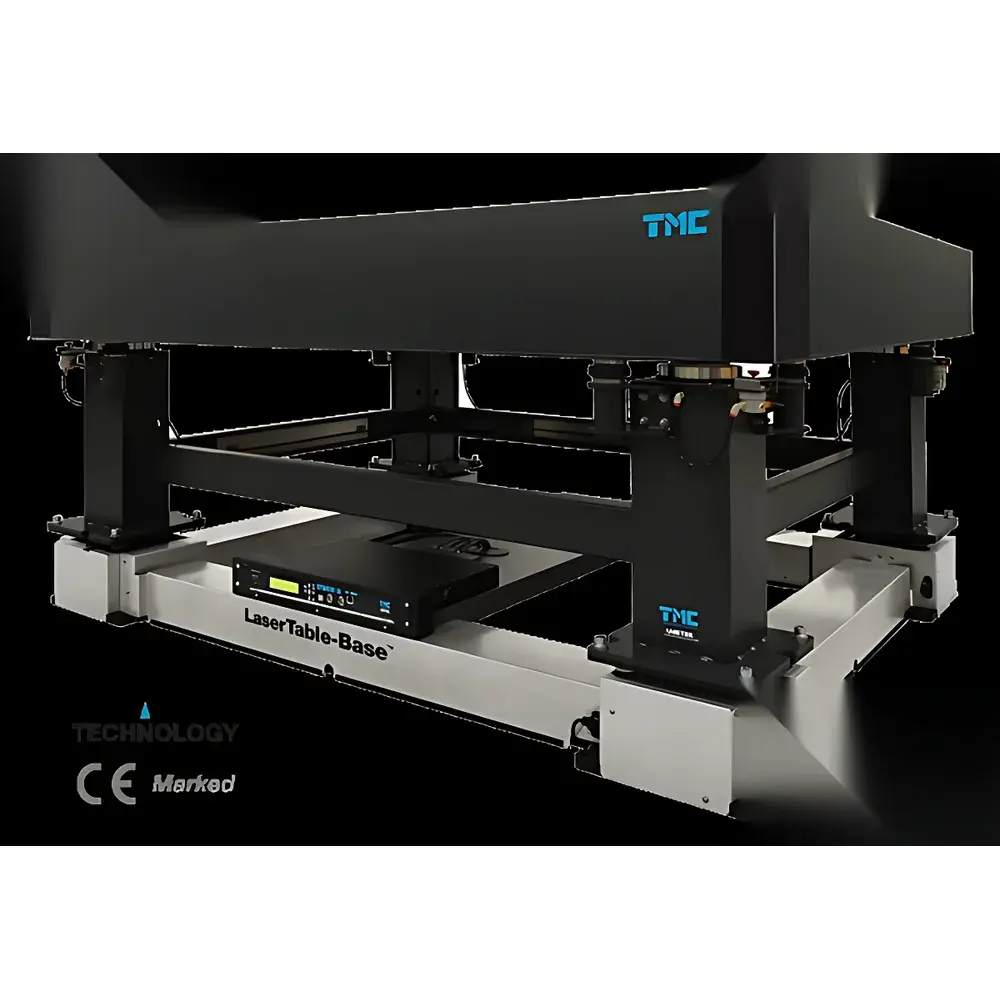
The LaserTable-Base™ is a high-performance, dual-stage vibration isolation system engineered specifically for ultra-sensitive optical and precision metrology applications. It integrates two complementary isolation technologies in series: a passive low-frequency pneumatic isolation stage (MaxDamp® air isolators) and an active inertial cancellation stage based on TMC’s proprietary STACIS® technology. This architecture addresses the fundamental limitation of conventional air tables—amplification of ground-borne vibrations in the 1–3 Hz range—by actively suppressing motion below 1 Hz while maintaining exceptional attenuation above 10 Hz. The system operates on the principle of real-time inertial sensing and closed-loop piezoelectric actuation, delivering six degrees-of-freedom (6-DOF) correction with sub-micron resolution. Designed for compatibility with standard optical tables (e.g., 4′ × 8′, 6′ × 8′, or custom sizes), LaserTable-Base™ serves as a foundational support platform—not a tabletop itself—but enables full decoupling of the mounted optical table from floor-borne disturbances including building sway, HVAC-induced tremors, and distant traffic.
Key Features
- STACIS®-based active inertial vibration cancellation with real-time feedback control
- Integrated dual-stage architecture: passive MaxDamp® air isolators + active piezoelectric actuators
- Effective vibration suppression starting below 1 Hz, extending continuously to >100 Hz
- 6-DOF active correction using inertial sensors and high-stroke piezoelectric actuators (up to 60 µm travel)
- Modular upper stage design: supports interchangeable mounting options—including Gimbal Piston isolators, MaxDamp® air isolators, or rigid non-isolating pedestals—tailored to application-specific stiffness and damping requirements
- DC-2020 digital controller included: provides intuitive GUI, real-time performance monitoring, system diagnostics, and configurable setpoints
- Optional under-table equipment shelves for housing lasers, detectors, or vacuum pumps without compromising isolation integrity
- Robust mechanical architecture compliant with ISO 14644-1 Class 5 cleanroom-compatible installation practices
Sample Compatibility & Compliance
LaserTable-Base™ is compatible with optical tables ranging from 1,200 mm × 2,400 mm (4′ × 8′) up to 1,800 mm × 2,400 mm (6′ × 8′), supporting static loads up to 907 kg (2,000 lbs). Its modular interface accommodates both metric and imperial mounting patterns. The system meets mechanical safety standards per ISO 12100 and is designed to operate within ambient laboratory conditions (15–30 °C, 30–70% RH, non-condensing). While not certified to a specific regulatory framework by default, its digital controller (DC-2020) supports audit-trail logging and user-access controls—enabling compliance with GLP and GMP documentation requirements when integrated into validated workflows. System performance data is traceable to NIST-traceable accelerometers and calibrated laser Doppler vibrometers, consistent with ASTM E1776 and ISO 20486 methodologies for vibration measurement in precision environments.
Software & Data Management
The DC-2020 digital controller runs embedded Linux firmware with a web-based HTML5 interface accessible via Ethernet. It records time-synchronized triaxial acceleration data from all six inertial sensors at 1 kHz sampling rate, storing raw and processed datasets in HDF5 format for post-acquisition spectral analysis (e.g., PSD, transmissibility, coherence). The software supports export to CSV, MATLAB (.mat), and Python-compatible formats. Built-in FFT engine enables real-time frequency-domain visualization, including overlay of theoretical transfer functions for validation against measured response. Controller firmware complies with IEC 62443-4-2 security requirements and supports role-based authentication (admin/operator/viewer), encrypted data transmission (TLS 1.2+), and optional integration with enterprise LIMS or MES platforms via RESTful API.
Applications
- Interferometric metrology (e.g., Fizeau, Twyman-Green, and phase-shifting interferometers)
- Single-molecule fluorescence microscopy (TIRF, PALM, STORM)
- Atomic force microscopy (AFM) and scanning tunneling microscopy (STM) in ambient and controlled environments
- Quantum optics experiments requiring sub-nanometer positional stability (e.g., cavity QED, cold atom traps)
- Photolithography alignment systems and mask inspection tools
- Gravitational wave detector prototype development and component testing
- Calibration laboratories performing ISO/IEC 17025-accredited dimensional measurements
FAQ
What is the lowest frequency at which LaserTable-Base™ achieves net attenuation?
Active cancellation begins below 1 Hz; measurable net attenuation relative to floor motion is confirmed from 0.7 Hz onward, verified via swept-sine and random vibration testing per ISO 10816-4.
Can the system be retrofitted to an existing optical table?
Yes—LaserTable-Base™ is designed as a drop-in foundation system. Mounting interfaces are standardized, and load distribution plates accommodate common table leg configurations.
Does the DC-2020 controller support FDA 21 CFR Part 11 compliance?
Out-of-the-box, it provides electronic signatures, audit trails, and secure user roles; full Part 11 compliance requires site-specific validation protocols and configuration management per organizational SOPs.
Is compressed air required for operation?
Yes—the passive pneumatic stage requires clean, dry, oil-free air at 80–100 psi (5.5–6.9 bar); typical consumption is <1.5 SCFM during stabilization.
How is thermal drift managed in the active piezoelectric stage?
The STACIS® actuators incorporate low-thermal-drift ceramic stacks and are thermally anchored to a stabilized baseplate; long-term positional drift is <±0.5 µm over 8 hours at constant ambient temperature.