
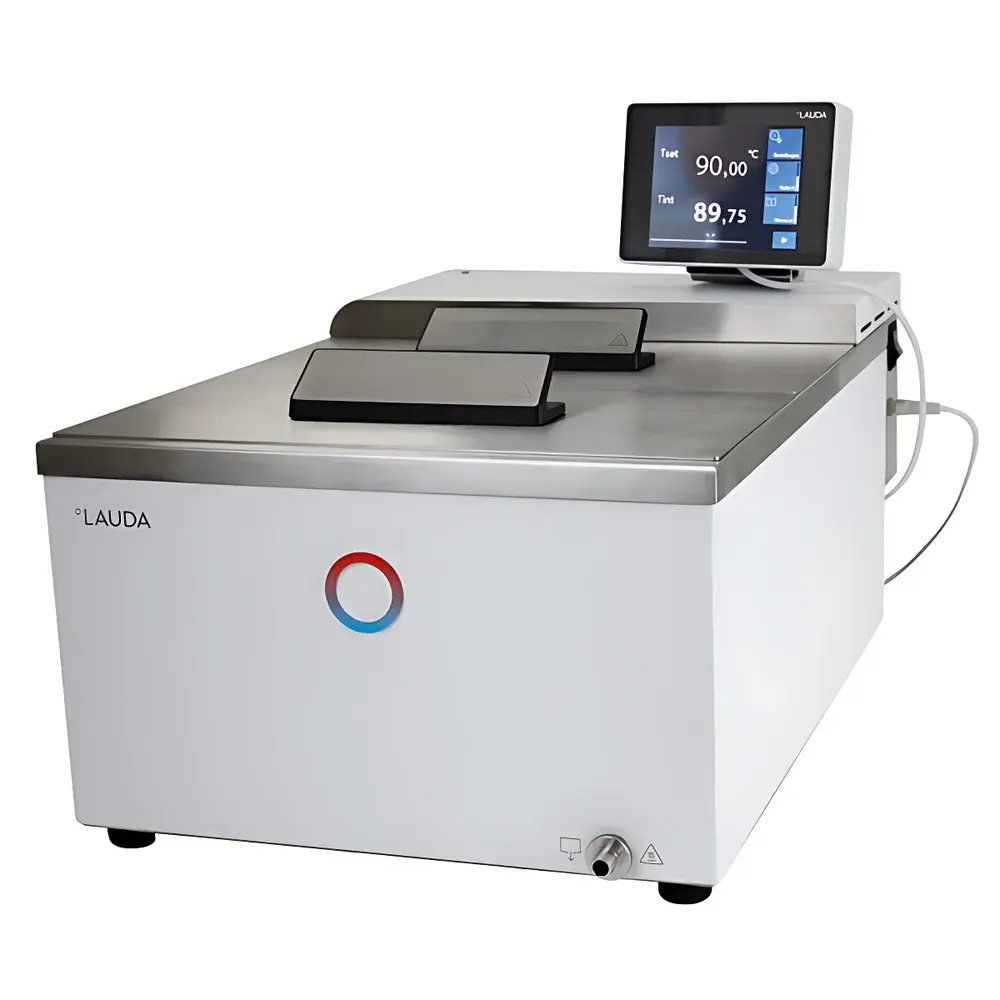
LAUDA PRO P 30 C High-Temperature Heated Circulating Bath
| Brand | LAUDA |
|---|---|
| Origin | Germany |
| Model | P 30 C |
| Bath Volume | 28.5 L |
| Temperature Range | 30–250 °C |
| Temperature Stability | ±0.01 °C |
| Max. Heating Power | 1.85 kW |
| Bath Dimensions (W×D×H) | 340 × 385 × 200 mm |
| Overall Dimensions (W×D×H) | 400 × 600 × 415 mm |
| Interface Standard | Ethernet, USB, Pt100, RS232/485, Profibus, EtherCAT, Analog/Contact Modules |
| Controller | 5.7″ Multi-Touch Color Display with Detachable Remote Unit |
| Pump | LAUDA Varioflex, 8-Stage Adjustable |
| Safety | Adjustable Low-Temp Overheat Protection with Audible Alarm |
| Programming Capacity | 100 Programs × 50 Segments |
| User Management | Up to 20 Users |
| Compliance | Designed for GLP/GMP environments |
Overview
The LAUDA PRO P 30 C is a high-precision, microprocessor-controlled heated circulating bath engineered for demanding laboratory and industrial applications requiring stable thermal environments up to 250 °C. Unlike conventional water baths limited to ≤100 °C, the P 30 C utilizes thermally stable heat transfer fluids (e.g., Therm 250) and a robust stainless-steel insulated bath vessel to maintain exceptional temperature uniformity and repeatability across its full operating range. Its core principle relies on closed-loop PID control of resistive heating elements, coupled with real-time feedback from a calibrated Pt100 sensor immersed in the fluid medium. The integrated LAUDA Varioflex circulation pump ensures laminar, pulse-free flow both internally (within the bath) and externally (to connected reactors, viscometers, or analytical instruments), minimizing thermal gradients and enabling precise temperature conditioning of external systems. Designed and manufactured in Germany, the unit meets stringent European safety standards (EN 61000-6-2/6-4, CE) and is constructed for long-term reliability in continuous operation under controlled ambient conditions (5–40 °C).
Key Features
- 5.7-inch multi-touch color display with intuitive graphical interface — fully detachable for remote mounting and 360° accessibility around the bath
- Built-in cooling coil enables rapid cooldown and extended low-end operational flexibility (20–250 °C with external chiller)
- Full electronic PID controller with independent internal/external control loops for simultaneous bath and process temperature regulation
- Varioflex circulation pump with 8 adjustable flow stages — optimized for low-noise, high-stability delivery to external equipment
- PowerAdapt energy management system dynamically adjusts heating output to match grid capacity and minimize thermal overshoot
- Advanced programmability: 100 user-defined temperature profiles, each supporting up to 50 time-temperature segments with ramp/soak logic
- Comprehensive safety architecture including adjustable overheat protection, audible alarm, and self-diagnostic startup routine
- Standard digital interfaces: Ethernet (for networked monitoring and control), USB (data export/import, firmware updates), and Pt100 input for external sensor integration
- Expandable I/O via optional modules: RS232/485, Profibus DP, EtherCAT, analog voltage/current outputs, and dry-contact relays
- Stainless-steel bath with integrated handles, drain valve, and thermal insulation — compatible with flammable and non-flammable heat transfer media
Sample Compatibility & Compliance
The P 30 C accommodates a wide range of heat transfer fluids, including silicone oils, glycols, and specialized high-temperature synthetics such as Therm 250 (flash point >250 °C). Its sealed, corrosion-resistant construction and configurable overheat thresholds make it suitable for use with both aqueous and organic media under GLP and GMP frameworks. While the instrument itself does not carry FDA certification, its hardware design and data-handling capabilities align with requirements for regulated environments: audit-trail-ready event logging (via optional LAUDA LabSoft or third-party SCADA), user-access controls (20-user management with role-based permissions), and electronic signature support when deployed with 21 CFR Part 11–validated software. It complies with ISO/IEC 17025 recommendations for temperature calibration traceability and supports routine verification per ASTM E1137/E1139 for liquid-bath performance.
Software & Data Management
The P 30 C operates natively with LAUDA’s LabSoft platform (Windows-based), which provides real-time graphing, automated report generation (PDF/CSV), and secure database archiving. All temperature setpoints, actual values, alarms, and user actions are timestamped and stored locally on-device via USB or remotely over Ethernet. When configured with LabSoft Validation Package, the system supports full 21 CFR Part 11 compliance — including electronic signatures, audit trails, and permission-controlled access levels. Raw data exports include metadata (operator ID, program name, sensor channel, calibration date), facilitating traceability in quality assurance workflows. Firmware updates are performed via USB stick or network push, ensuring consistent version control across multi-unit installations.
Applications
- Calibration of temperature-sensitive instrumentation (thermocouples, RTDs, infrared sensors) across extended ranges
- Thermal conditioning of rheometers, DSC units, and material testers requiring stable boundary conditions up to 250 °C
- Reaction temperature control in jacketed glass reactors and pilot-scale synthesis systems
- Accelerated stability testing of pharmaceuticals, polymers, and adhesives under defined thermal stress protocols
- Viscosity measurement support for high-temperature polymer melts using rotational or capillary viscometers
- Preconditioning of reference standards and metrology artifacts prior to dimensional or electrical characterization
- Environmental simulation for electronics reliability testing (e.g., thermal cycling, burn-in validation)
FAQ
What heat transfer fluids are recommended for operation at 250 °C?
Therm 250 synthetic heat transfer oil is LAUDA’s specified fluid for maximum temperature operation. Alternatives must have a flash point ≥280 °C and thermal stability exceeding 250 °C for continuous use.
Can the P 30 C be used for cooling-only applications?
No — it is a heating-only bath. However, the built-in cooling coil allows integration with an external chiller to extend the effective operating range down to 20 °C.
Is the bath cover included?
Yes — one insulated bath cover is supplied as standard to reduce evaporation and improve thermal efficiency.
How is temperature uniformity verified across the bath volume?
LAUDA specifies axial/radial uniformity of ≤±0.03 °C at 100 mm depth under static conditions (per internal test protocol); users may verify using NIST-traceable multi-point probes.
Does the unit support Modbus TCP communication?
Yes — via optional EtherCAT or RS485-to-Modbus gateway modules, enabling seamless integration into PLC-based automation networks.



