
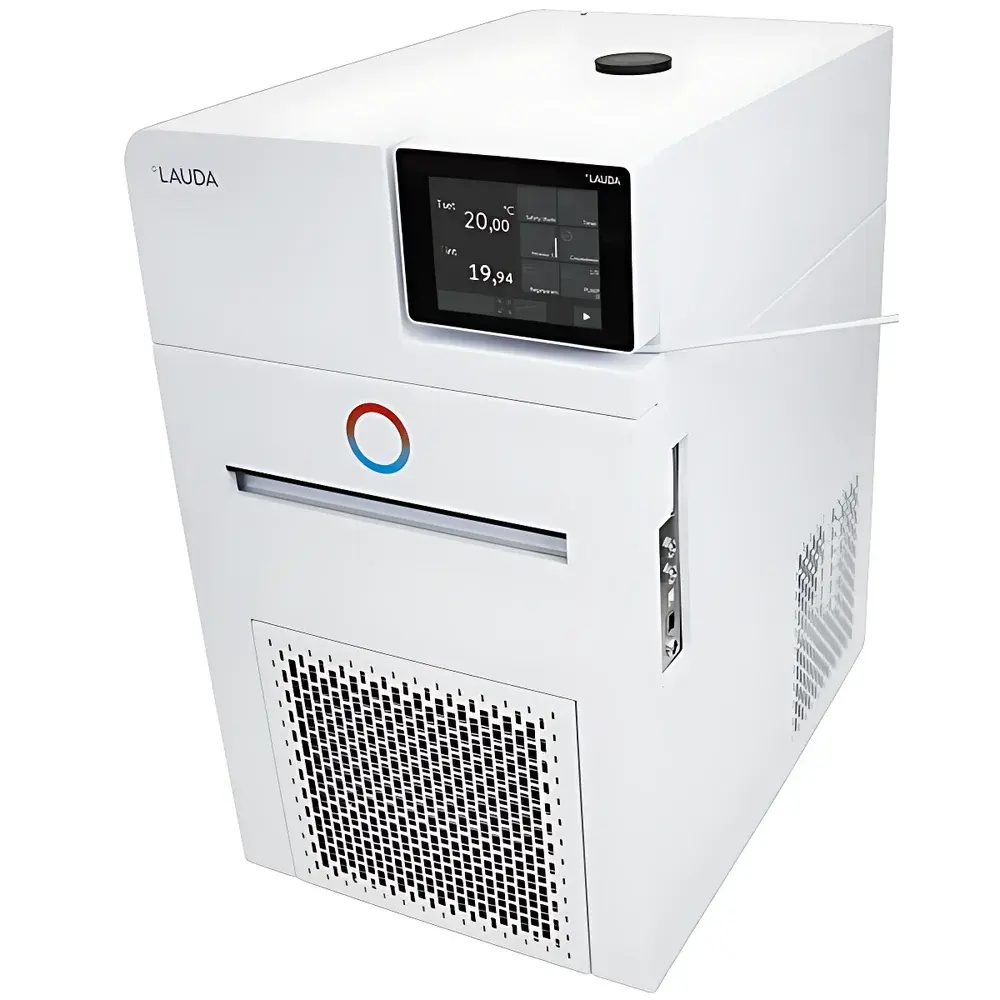
LAUDA PRO RP 290 EC External Circulation Temperature Controller
| Brand | LAUDA |
|---|---|
| Origin | Germany |
| Model | RP 290 EC |
| Temperature Range | –90 to 200 °C |
| Cooling Output | 0.6 kW / 0.8 kW (dual-stage) |
| Internal Volume | 2.4–4.4 L |
| Pump Type | LAUDA Varioflex (pressure/suction, 8-step adjustable) |
| Max Flow Rate | 22 L/min (pressure), 20 L/min (suction) |
| Max Pressure | 0.7 bar |
| Max Suction | 0.4 bar |
| Heating Power | 2.5 kW |
| Max Power Consumption | 3.7 kW |
| Temp Stability | ±0.05 K |
| Display | 5.7″ multi-touch color screen |
| Connectivity | USB, Ethernet, RS-232/485, Profibus, EtherCAT, analog/digital I/O |
| Compliance | DIN 12876, EU F-Gas Regulation (EU) No. 517/2014, RoHS |
Overview
The LAUDA PRO RP 290 EC External Circulation Temperature Controller is an engineered solution for precise, dynamic thermal management of external process loops—particularly in demanding applications such as jacketed reactor control, semiconductor thermal testing, and high-precision material characterization. Based on a dual-stage mixed-cooling architecture (air- and water-cooled condensers), the unit delivers rapid thermal response across an exceptionally wide operational range of –90 °C to +200 °C. Its compact tower design minimizes footprint while housing a low internal volume bath (2.4–4.4 L), enabling fast ramp rates and high thermal inertia compensation. The system integrates a full-electronic PID controller with independent internal and external control modes, supporting both bath-based stabilization and closed-loop feedback from user-supplied external sensors (e.g., Pt100 or thermocouple inputs). All models comply with DIN 12876 Class III safety standards for laboratory temperature control equipment and meet EU F-Gas Regulation (EC) No. 517/2014 through the use of low-GWP refrigerants R-452A (GWP = 2140) and R-170 (GWP = 3).
Key Features
- Integrated dual-stage cooling system: 0.6 kW (Stage 1) and 0.8 kW (Stage 2) capacity, enabling efficient heat extraction under variable load conditions
- LAUDA Varioflex pump with 8-step adjustable pressure/suction output, delivering up to 22 L/min at 0.7 bar max pressure and 20 L/min at 0.4 bar suction capability
- 5.7″ multi-touch color display with detachable operation mode—functions as a handheld remote when unmounted
- Advanced programmable logic: Up to 100 user-defined programs, each containing up to 50 segments with ramp/soak profiles, timers, and event-triggered actions
- SmartCool digital compressor management system—dynamically modulates compressor duty cycle based on real-time thermal load, reducing energy consumption and extending service life
- PowerAdapt technology—intelligently matches heater output to available mains supply capacity (230 V / 50 Hz), preventing circuit overloads during simultaneous heating/cooling transitions
- Comprehensive user management: Role-based access for up to 20 users, with audit-trail-capable login history and parameter-lock functionality
- Dual-level overtemperature protection: Independently adjustable low-setpoint thermal cutoff with audible alarm, certified for both flammable and non-flammable heat transfer fluids
- Stainless steel insulated bath with overflow channel, drain valve, and M16 × 1 threaded ports (13 mm ID) for secure external loop integration
- Standard communication interfaces: USB (data export/import, firmware updates), Ethernet (TCP/IP, Modbus TCP), plus optional fieldbus modules (RS-232/485, Profibus DP, EtherCAT, analog 0–10 V / 4–20 mA)
Sample Compatibility & Compliance
The RP 290 EC is designed for compatibility with a broad spectrum of external systems—including glass and stainless steel reactors (up to 100 L volume), calorimetry cells, rheometer jackets, and electronic component test fixtures. Its low-minimum-fill volume (2.4 L) and optimized flow dynamics ensure stable thermal coupling even with long or narrow-diameter circulation lines. All fluid-contact surfaces are electropolished stainless steel (AISI 316), resistant to common synthetic heat transfer media (e.g., silicone oils, glycol/water mixtures, fluorinated fluids). The unit conforms to DIN 12876-1:2015 for laboratory thermostats, carries CE marking per Directive 2014/30/EU (EMC) and 2014/35/EU (LVD), and meets ISO/IEC 17025-relevant traceability requirements for temperature calibration when used with certified reference sensors. Refrigerant handling complies fully with EU F-Gas Regulation (EC) No. 517/2014, including leak detection protocols, technician certification mandates, and CO₂-equivalent reporting (0.6 t CO₂-eq total GWP impact).
Software & Data Management
The embedded LAUDA ControlCenter software provides local HMI control, real-time trend visualization, and automated data logging to internal memory or USB storage. Logged parameters include setpoint, actual bath temperature, external sensor reading, pump status, compressor runtime, and error codes—all timestamped with millisecond resolution. Export formats include CSV and XML, compatible with LIMS and ELN platforms. For networked environments, the Ethernet interface supports Modbus TCP register mapping and HTTP-based RESTful API endpoints, enabling seamless integration into centralized lab automation infrastructures. Audit trail functionality records all parameter changes, user logins, and system events—fully compliant with FDA 21 CFR Part 11 requirements when deployed with validated user authentication and electronic signature workflows. Firmware updates are delivered via signed package files, ensuring cryptographic integrity.
Applications
- Exothermic/endothermic reaction control in pilot-scale chemical synthesis (e.g., Grignard, hydrogenation, polymerization)
- Thermal cycling validation of automotive electronics and power modules (–40 °C to +150 °C)
- Calibration of infrared cameras and radiation thermometers against NIST-traceable references
- Viscosity and rheological measurements requiring sub-0.1 K temperature stability (e.g., ASTM D445, ISO 3104)
- Accelerated aging studies of battery electrolytes and solid-state electrolyte membranes
- Material testing per ASTM E220, ISO 11357 (DSC, TMA, DMA auxiliary temperature control)
- Pharmaceutical stability chambers requiring precise gradient programming (ICH Q1A–Q5C)
FAQ
What external cooling options does the RP 290 EC support?
The unit operates in hybrid cooling mode—automatically selecting between ambient air convection and external chilled water (5–25 °C inlet) based on real-time thermal demand and ambient conditions. Water-cooling connection uses standard G½” BSP female threads.
Can the RP 290 EC be integrated into a SCADA or MES system?
Yes—via native Modbus TCP over Ethernet or optional Profibus DP/EtherCAT gateways. All process variables and control commands are mapped to standardized register addresses with documentation provided in the Engineering Manual.
Is the temperature stability specification (±0.05 K) valid for external loop operation?
Yes—the value reflects stability at the bath outlet under steady-state conditions with a matched external load (≤10 m of 13 mm ID tubing, ≤5 L/min flow). Stability degrades linearly with increasing loop volume and thermal mass; LAUDA provides loop compensation guidelines in Application Note AN-PRO-02.
Does the unit support GLP-compliant electronic record keeping?
When configured with password-protected user roles, enabled audit logging, and time-stamped data exports, the RP 290 EC meets core GLP data integrity requirements per OECD Principles of GLP and EU Annex 11. Full validation packages (IQ/OQ/PQ) are available upon request.
What maintenance intervals are recommended for the dual-stage refrigeration system?
Compressor oil and filter replacement every 12 months or 4,000 operating hours (whichever occurs first); annual leak inspection per EN 378-1; condenser coil cleaning every 6 months in dusty environments. Service logs are stored internally and exportable via USB.



