
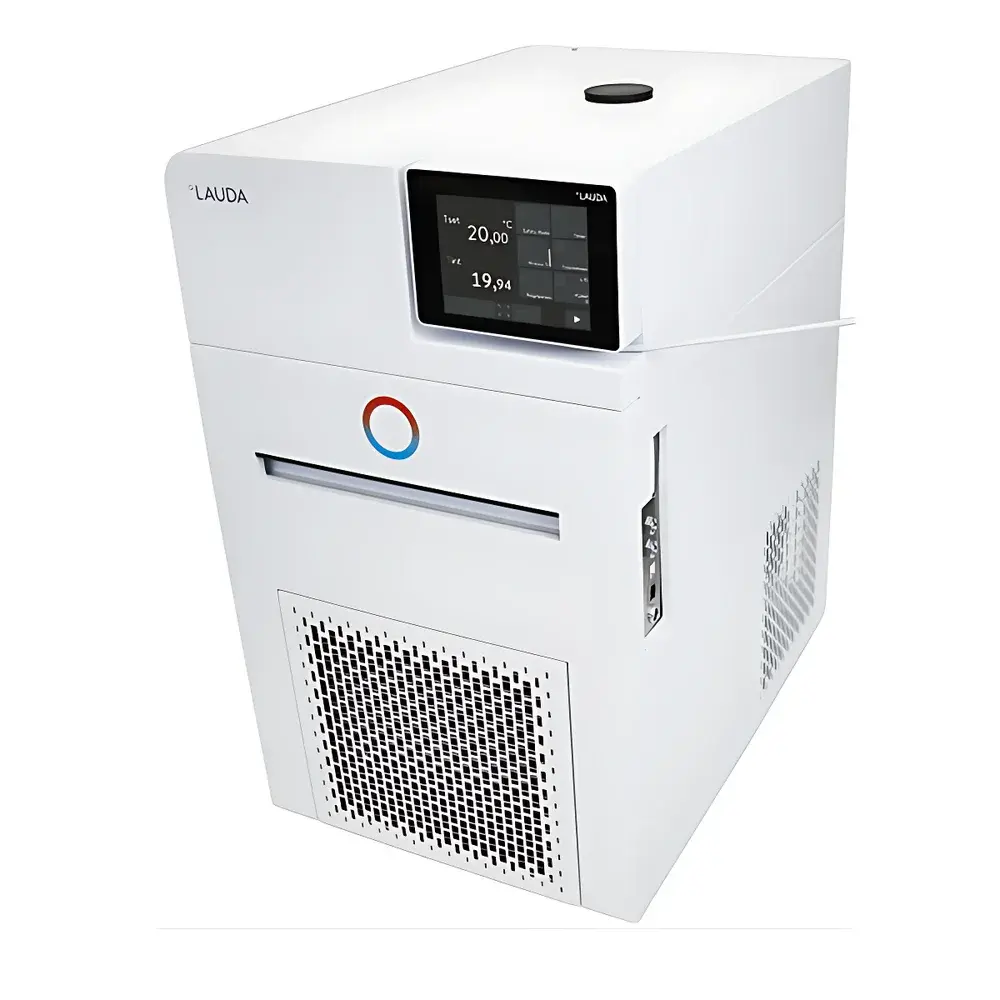
LAUDA PRO RP 290 EC External Circulation Thermostat for Reactor Temperature Control (–90 °C to +200 °C)
| Brand | LAUDA |
|---|---|
| Origin | Germany |
| Model | RP 290 EC |
| Cooling Method | Hybrid (Air- and Water-Cooled) |
| Temperature Range | –90 °C to +200 °C |
| Cooling Capacity | 800 W at 20 °C |
| Temperature Stability | ±0.05 °C |
| Circulating Pump Pressure | 0.68 bar |
| Flow Rate | 22 L/min |
| Reservoir Volume | 2.4–4.4 L |
| Heating Power | 2.5 kW |
| Max. Power Consumption | 3.7 kW |
| Refrigerants | R-452A (0.300 kg, GWP 2140) & R-170 (0.070 kg, GWP 3) |
| Compliance | DIN 12876, EU F-Gas Regulation (EU) No. 517/2014 |
| Interface Options | USB, Ethernet, RS-232/485, Profibus, EtherCAT, Analog I/O |
| Pump Type | LAUDA Varioflex (8-stage adjustable, pressure/suction capable) |
| Display | 5.7″ multi-touch color LCD |
| Programmability | 100 programs × 50 segments |
| User Management | Up to 20 users |
| Safety | Adjustable overtemperature protection with acoustic alarm |
| Dimensions (W×D×H) | 390 × 600 × 685 mm |
| Weight | 80 kg |
Overview
The LAUDA PRO RP 290 EC is a high-performance external circulation thermostat engineered for precise, dynamic temperature control of laboratory reactors, jacketed vessels, and other external process systems requiring operation across an exceptionally wide thermal range—from cryogenic –90 °C to high-temperature +200 °C. Based on LAUDA’s proven dual-refrigerant cascade architecture, the unit integrates R-452A (primary stage) and R-170 (low-temperature secondary stage) refrigerants to achieve stable sub-zero performance without liquid nitrogen dependency. Its hybrid cooling system—switchable between air-cooled and water-cooled modes—ensures adaptability to diverse facility infrastructures while maintaining compliance with EU F-Gas Regulation (EU) No. 517/2014. The compact tower design, minimal internal fluid volume (2.4–4.4 L), and high-flow Varioflex pump enable rapid thermal response times (<3 min from –40 °C to +100 °C in typical reactor loops), making it particularly suited for exothermic reaction monitoring, polymerization kinetics, and catalyst screening where tight thermal ramping and hold accuracy are critical.
Key Features
- Full electronic PID controller with dual-loop capability—supports both internal bath regulation and external process (reactor jacket) feedback via optional PT100 sensor input
- 5.7″ multi-touch color display with detachable configuration—enables remote operation up to 3 m via integrated cable or wireless adapter (optional)
- Advanced programmability: 100 user-defined temperature profiles, each supporting up to 50 time-temperature segments with ramp rate control (0.01–50 °C/min)
- Varioflex dual-mode pump: 8-stage adjustable pressure/suction delivery (max. 0.68 bar pressure, 22 L/min flow at 1 bar backpressure)
- SmartCool digital compressor management system—dynamically modulates refrigeration output based on real-time load demand to minimize energy consumption and thermal overshoot
- PowerAdapt technology—intelligently balances heating and cooling power draw to avoid exceeding circuit-rated current (16 A @ 230 V / 50 Hz)
- Integrated self-diagnostic suite with guided troubleshooting wizard and system health logging
- Stainless steel insulated reservoir with overflow channel, drain valve, and level sensor—compatible with water, water/glycol, silicone oil, and low-viscosity heat transfer fluids
- Comprehensive connectivity: Standard USB 2.0 and Ethernet (TCP/IP, Modbus TCP); field-upgradable with RS-232/485, Profibus DP, EtherCAT, or analog I/O modules
- Multi-user access control with role-based permissions (administrator, operator, technician), audit trail logging, and password-protected parameter locking
Sample Compatibility & Compliance
The RP 290 EC is designed for closed-loop circulation with externally mounted equipment—including glass or stainless steel jacketed reactors (up to 50 L volume), calorimeters, spectroscopic cells, and semiconductor test fixtures. Its fluid path is chemically inert (316L stainless steel fittings, EPDM/FKM seals) and rated for continuous use with aqueous glycol mixtures (up to 50 % v/v), synthetic heat transfer oils (e.g., Syltherm XLT, Marlotherm SH), and low-GWP silicone-based media. All electrical and thermal safety systems conform to DIN 12876 Class III (high-risk applications), EN 61010-1, and IEC 61508 SIL 2 functional safety requirements. For regulated environments, firmware supports 21 CFR Part 11-compliant electronic signatures, ALCOA+ data integrity principles, and GLP/GMP audit-ready event logs—including temperature deviations, pump status changes, refrigerant pressure anomalies, and user login/logout records.
Software & Data Management
LAUDA’s proprietary WinThermost software (Windows-based, included) provides full remote supervision, real-time graphing, and automated report generation (PDF/CSV). It enables synchronized multi-device control (up to 16 units per network), scheduled calibration verification runs, and export of timestamped thermodynamic datasets compliant with ISO/IEC 17025 documentation standards. All USB/Ethernet transfers are encrypted (AES-256), and firmware updates require signed digital certificates. Audit trails capture operator ID, timestamp, parameter modification, and pre/post-change values—retained for ≥12 months unless manually archived. Optional OPC UA server integration allows seamless connection to LIMS, MES, or SCADA platforms for centralized lab infrastructure monitoring.
Applications
- Exothermic/endothermic reaction control in pharmaceutical synthesis (e.g., Grignard, hydrogenation, nitration)
- Temperature-programmed polymerization studies under inert atmosphere (N₂/Ar purged reactors)
- Calibration of differential scanning calorimeters (DSC) and thermogravimetric analyzers (TGA)
- Material testing of composites and adhesives across thermal cycling profiles (–60 °C ↔ +180 °C)
- Preconditioning of electronic components prior to environmental stress screening (ESS)
- Controlled crystallization of APIs with narrow metastable zone width
- High-precision viscosity measurements requiring thermostated capillary viscometers or rotational rheometers
FAQ
What external fluids are compatible with the RP 290 EC?
Water, 10–50 % aqueous ethylene or propylene glycol solutions, silicone oils (e.g., DC200 series), and synthetic heat transfer fluids meeting ASTM D6792 specifications are approved. Halogenated solvents, strong acids/bases, and high-vapor-pressure hydrocarbons are prohibited.
Can the unit operate unattended for extended periods?
Yes—equipped with redundant temperature limiters, refrigerant pressure cut-offs, dry-run detection, and automatic fault escalation (email/SMS via optional gateway), it meets DIN 12876-3 requirements for unsupervised operation up to 72 h under validated protocols.
Is validation support available for IQ/OQ/PQ documentation?
LAUDA provides factory-issued DQ/IQ templates, certified calibration certificates traceable to DKD/DAkkS standards, and on-site OQ execution services—including temperature uniformity mapping, pump flow verification, and alarm response testing per ISO 17025 Annex A.
How does the hybrid cooling mode affect installation requirements?
In air-cooled mode, minimum 500 mm rear clearance and ambient ≤35 °C are required. In water-cooled mode, supply water must be 10–25 °C at 2–4 bar, with flow ≥1.2 L/min and filtration ≤50 µm. Both configurations maintain full cooling capacity across the entire operating range.
What is the expected service interval for preventive maintenance?
Compressor oil and filter replacement every 12 months or 3,000 operating hours; refrigerant leak check and system vacuum integrity verification annually; full calibration of all sensors recommended every 6 months in GxP environments.



