
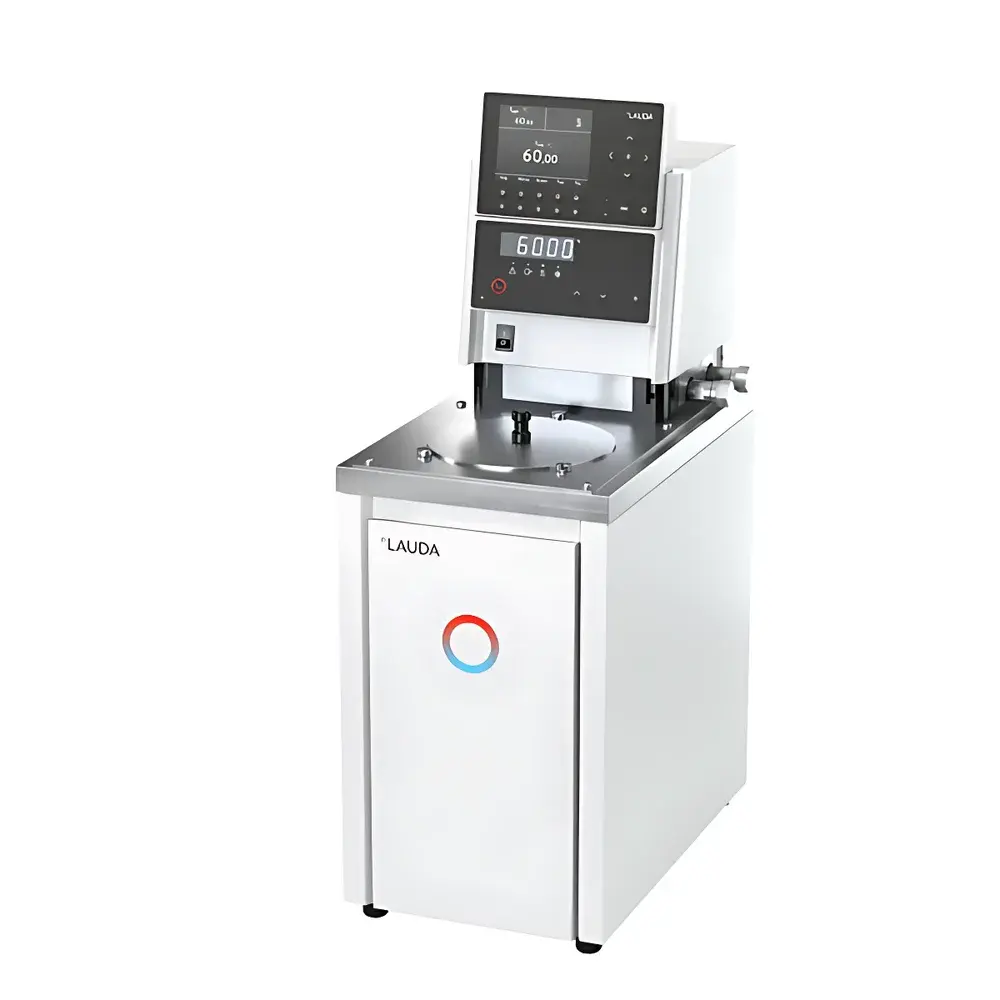
LAUDA Proline PJL 12 C Temperature Calibration Bath (30–200 °C)
| Brand | LAUDA |
|---|---|
| Origin | Germany |
| Model | PJL 12 C |
| Bath Volume | 13.5 L |
| Temperature Range | 30–200 °C (extended to −40 °C with external chiller) |
| Temperature Stability | ±0.01 °C |
| Circulation | Internal & External |
| Pump Type | LAUDA Varioflex (8-stage pressure-adjustable) |
| Max Flow Rate | 25 L/min |
| Max Pressure | 0.8 bar |
| Heater Power | 3.6 kW |
| Interface | RS232/RS485 (standard), USB (standard), optional Ethernet/Profibus/analog modules |
| Programming Capacity | 150 temperature/time segments across 5 programs |
| Compliance | Designed for ISO/IEC 17025-compliant calibration labs, supports GLP/GMP audit trails via optional software |
Overview
The LAUDA Proline PJL 12 C is a high-precision, microprocessor-controlled temperature calibration bath engineered specifically for metrological traceability in accredited laboratories. Operating on the principle of forced convection within a thermally stabilized liquid medium (water, silicone oil, or low-viscosity heat-transfer fluids), it delivers exceptional spatial uniformity and temporal stability—critical prerequisites for primary and secondary temperature sensor calibration per ISO 17025, ASTM E74, and EURAMET cg-18 guidelines. Its cylindrical stainless-steel bath (Ø120 × H320 mm) features a vertically adjustable working chamber, enabling precise alignment of the immersion depth with the reference thermometer’s sensing zone—eliminating stem conduction errors and ensuring compliance with ITS-90 immersion depth requirements. The dual-chamber overflow design maintains constant liquid level during thermal expansion or evaporation, directly supporting repeatable immersion geometry across extended calibration cycles.
Key Features
- Advanced PID-based full-electronic temperature controller with adaptive PowerAdapt technology—dynamically optimizes heating power based on line voltage fluctuations and thermal load, ensuring consistent ramp rates and setpoint recovery.
- Varioflex circulation pump with eight discrete pressure settings (0.1–0.8 bar), enabling optimized flow profiles for low-viscosity water baths or high-viscosity silicone oils without cavitation or turbulence-induced temperature gradients.
- Detachable backlit graphical LCD interface with dual-display mode: high-resolution main screen + dedicated green LED temperature readout for rapid visual verification during calibration procedures.
- Integrated self-diagnostic assistant for real-time system health monitoring—including heater continuity, sensor integrity, pump status, and coolant flow validation—reducing unplanned downtime and supporting preventive maintenance logs.
- Tmax overtemperature protection with user-configurable threshold and audible alarm, certified for use with both flammable (e.g., ethanol-based baths) and non-flammable heat-transfer media under IEC 61010-1 safety standards.
- Modular communication architecture: standard RS232/RS485 and USB ports; optional field-upgradable interfaces including Profibus DP, analog 4–20 mA output, dry-contact relay module, and Ethernet-to-USB gateway for LabVIEW or SCADA integration.
- Programmable thermal profile generator supporting up to five independent sequences (150 total time/temperature steps), with timer-triggered start, standby entry, and automatic shutdown—ideal for unattended overnight calibration runs.
Sample Compatibility & Compliance
The PJL 12 C accommodates a broad range of temperature sensors—including glass liquid-in-glass thermometers (ASTM E1, DIN 12770), PRTs (Pt100, Pt1000), thermistors, RTDs, and digital probes—with immersion depths adjustable from 150 mm to 300 mm. Its stainless-steel bath (electropolished interior, insulated walls, integrated drain valve, and ergonomic handles) resists corrosion from aqueous and organic media while meeting EN 61000-6-3 EMC emission limits. The unit is CE-marked and designed to support ISO/IEC 17025 accreditation requirements: all temperature stability data (±0.01 °C at 100 °C, measured per ISO 5725 repeatability protocols), gradient maps (<0.02 °C vertical/horizontal), and system uncertainty budgets are documented in the factory calibration certificate. Optional traceable NIST-traceable calibration reports and IQ/OQ documentation packages are available upon request.
Software & Data Management
The bath operates natively via its embedded firmware but integrates seamlessly with LAUDA’s optional WinTherm software (Windows-based) for automated calibration workflows. WinTherm enables bidirectional communication for real-time logging of bath temperature, setpoint deviation, pump status, and alarm history—exportable as CSV or PDF with configurable metadata (operator ID, instrument SN, calibration standard used). All data entries include electronic signatures, time stamps, and immutable audit trails compliant with FDA 21 CFR Part 11 when deployed with validated user access controls and electronic record retention policies. Remote operation is supported via USB tethering or RS485 daisy-chaining across multi-bath setups, allowing centralized control of calibration stations in metrology labs.
Applications
- Primary calibration of reference thermometers against national standards (e.g., NIST SRMs) in metrology institutes.
- Secondary calibration of industrial process sensors (thermocouples, RTDs) in QA/QC labs prior to field deployment.
- Verification of temperature uniformity in environmental chambers, autoclaves, and stability ovens per ISO 14644-3 and ICH Q5C.
- Thermal validation of pharmaceutical manufacturing equipment (e.g., lyophilizers, jacketed reactors) under GMP Annex 15.
- Material testing support for coefficient-of-thermal-expansion (CTE) measurements requiring stable isothermal holds over 24+ hours.
FAQ
What is the minimum and maximum recommended bath fluid volume?
The operating volume range is 8.5–13.5 L. Minimum fill ensures adequate immersion of the calibration probe and proper pump priming; exceeding 13.5 L risks overflow during thermal expansion.
Can this bath be used with silicone oil at 200 °C without degradation?
Yes—when operated within its specified 30–200 °C range using LAUDA-recommended HT-300 synthetic heat-transfer fluid, thermal oxidative stability exceeds 1,000 hours at 200 °C per ASTM D92 and D3241.
Is external cooling required to reach −40 °C?
Yes—the PJL 12 C is a heating-only unit; achieving sub-ambient temperatures requires connection to an external chiller (e.g., LAUDA Variocool) via the integrated cooling coil port.
Does the unit support 21 CFR Part 11 compliance out-of-the-box?
The hardware supports audit-trail-capable operation; full Part 11 compliance requires WinTherm software with configured electronic signatures, role-based access, and secure archive storage—validated separately per site-specific SOPs.
How is temperature uniformity verified across the bath volume?
Factory verification uses a 3×3 grid of calibrated PRTs at three vertical planes (top/mid/bottom); results are included in the Certificate of Conformance, showing max gradient ≤0.02 °C under steady-state conditions.



