
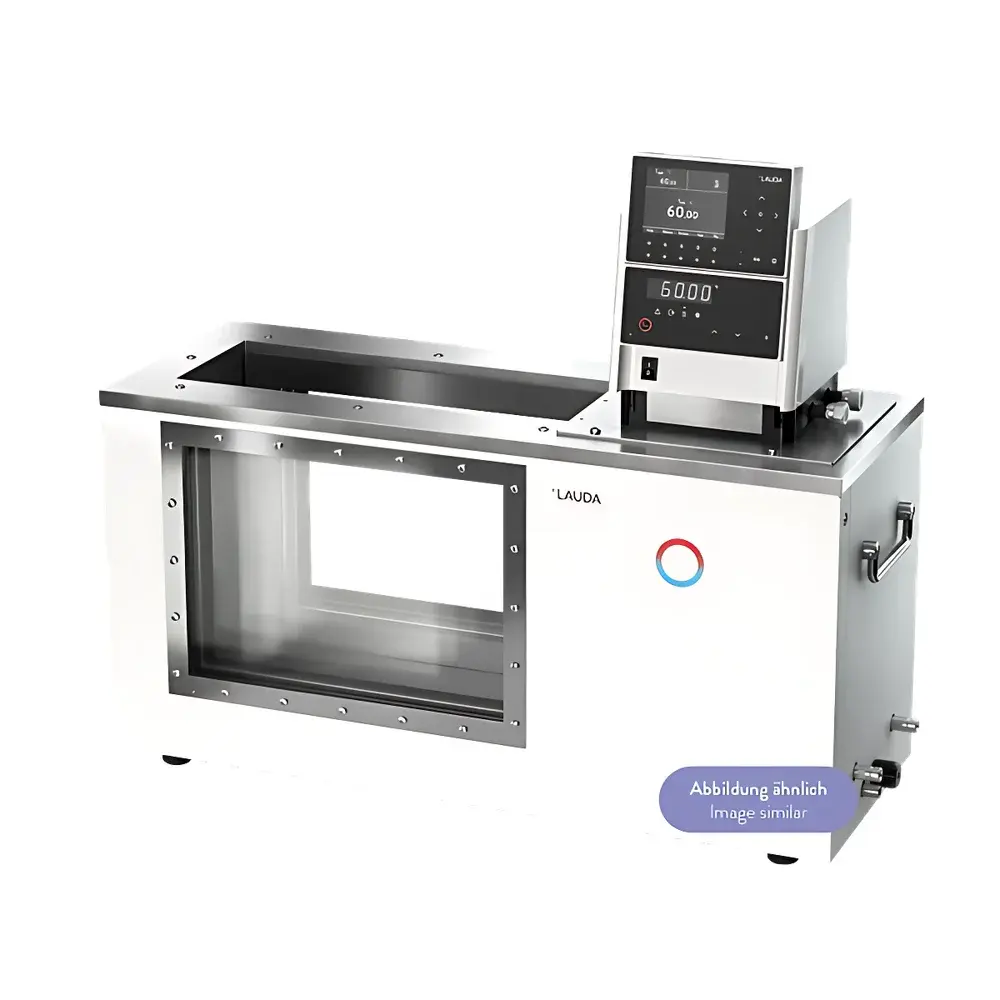
LAUDA Proline PV 15 C Transparent-Window Circulating Bath
| Brand | LAUDA |
|---|---|
| Origin | Germany |
| Model | PV 15 C |
| Bath Volume | 15 L |
| Temperature Range | 30–230 °C (with external cooling: 20–230 °C) |
| Temperature Stability | ±0.01 K |
| Circulation | Internal & External |
| Pump | LAUDA Varioflex, 8-step adjustable pressure, max. 0.8 bar / 25 L/min |
| Controller Options | Master (fixed-parameter) & Command (detachable, LCD, programmable) |
| Interfaces | Standard RS-232/485 |
| Programming Capacity | 150 temp/time segments across 5 programs |
| Power Supply | 230 V, 50/60 Hz, 3.6 kW max heating power |
| Dimensions (bath) | 230 × 135 × 320 mm |
| Overall Dimensions | 506 × 282 × 646 mm |
| Weight | 31 kg |
Overview
The LAUDA Proline PV 15 C Transparent-Window Circulating Bath is a high-precision, microprocessor-controlled temperature regulation system engineered for demanding laboratory applications requiring exceptional thermal stability and optical accessibility. Designed and manufactured in Germany, it operates on the principle of forced convection via an integrated LAUDA Varioflex pressure pump, delivering consistent fluid circulation to maintain uniform temperature distribution across the bath volume. Its core function is to provide stable, programmable thermal environments for external instrumentation—particularly viscometers such as the LAUDA PVS and iVisc series—where precise temperature control directly governs measurement accuracy per ISO 3104, ASTM D445, and ASTM D7042. The bath’s operational range spans 30 °C to 230 °C (extendable down to –40 °C or –60 °C when coupled with an external chiller), making it suitable for both high-temperature oil-based viscosity measurements and low-temperature solvent studies. The transparent double-walled bath chamber—featuring five-layer insulated glass—ensures minimal thermal drift (±0.01 K) while enabling real-time visual monitoring of sample behavior without compromising thermal integrity.
Key Features
- Advanced PID-based full-electronic temperature control with dual-loop capability for internal bath regulation and external device synchronization
- Detachable Command controller with backlit graphical LCD, intuitive soft-key navigation, and full programmability—including 150 temperature/time segments across five independent programs
- Master controller option for fixed-parameter operation in routine QA/QC workflows
- Varioflex pump with eight adjustable pressure levels (0.1–0.8 bar) and flow rates up to 25 L/min, supporting both internal recirculation and external loop integration
- Integrated cooling coil standard—compatible with LAUDA refrigerated circulators (e.g., RP series) or third-party chillers for sub-ambient operation
- SelfCheck diagnostic system for automated hardware verification and fault logging
- PowerAdapt technology dynamically adjusts heating output to prevent circuit overload while maintaining optimal ramp performance
- Dual safety architecture: adjustable overtemperature protection with audible alarm + under-voltage detection, certified for use with flammable and non-flammable media
- Ergonomic stainless-steel bath tank (15 L nominal capacity) with insulated walls, ergonomic handles, drain valve, and side/rear pump ports with integrated bypass
- Standard RS-232/485 interface; expandable with up to two additional modules (Profibus, analog I/O, Ethernet/USB)
Sample Compatibility & Compliance
The PV 15 C accommodates a broad range of heat-transfer fluids—including water, silicone oils, and glycol/water mixtures—within its specified operating envelope (0–230 °C ambient environment, 5–40 °C room temperature). Its sealed, corrosion-resistant stainless-steel bath and chemically inert wetted materials ensure long-term compatibility with aggressive solvents and high-viscosity media. The unit complies with IEC 61000-6-3 (EMC emission standards), IEC 61000-6-2 (immunity), and EN 61010-1 (safety requirements for electrical equipment for measurement, control, and laboratory use). When operated in GLP- or GMP-regulated environments, its programmable controllers support audit-trail-capable operation when paired with LAUDA’s optional software suite—fully aligned with FDA 21 CFR Part 11 requirements for electronic records and signatures.
Software & Data Management
While the PV 15 C operates autonomously via its onboard controllers, it supports bidirectional communication through RS-232/485 for integration into centralized lab management systems. LAUDA’s optional PC software enables remote parameter configuration, real-time temperature logging, program upload/download, and event-triggered data export (CSV/Excel). All controller actions—including setpoint changes, program starts/stops, and alarm events—are timestamped and stored in non-volatile memory. Optional Ethernet or USB interface modules facilitate direct connection to LIMS platforms and enable secure, role-based access control—critical for regulated pharmaceutical, petrochemical, and polymer R&D laboratories.
Applications
- Primary calibration and operation of capillary, rotational, and falling-ball viscometers (e.g., LAUDA PVS, iVisc, Anton Paar Lovis, Brookfield CAP2000+)
- Thermal conditioning of samples prior to rheological, DSC, or TGA analysis
- Temperature-controlled reaction baths for kinetic studies in organic synthesis and catalysis
- Stabilization of optical cells in UV-Vis, FTIR, or fluorescence spectrometry setups
- Material testing of thermoplastics, elastomers, and adhesives under controlled thermal load
- Calibration of temperature probes, RTDs, and thermocouples per ISO/IEC 17025-accredited procedures
FAQ
Can the PV 15 C operate below ambient temperature?
Yes—when connected to an external refrigerated circulator via the standard cooling coil, it achieves stable operation from –40 °C to 230 °C.
Is the transparent window suitable for quantitative optical measurements?
The five-layer insulated glass minimizes thermal distortion and provides optical clarity for visual inspection; however, for photometric applications requiring spectral transmission validation, users should verify wavelength-dependent transmittance with their specific fluid medium.
Does the unit support 21 CFR Part 11 compliance?
Yes—when equipped with LAUDA’s validated software package and appropriate interface modules, it meets electronic record and signature requirements for regulated environments.
What maintenance is required for long-term reliability?
Routine checks include verifying coolant level in external chillers, inspecting pump seals annually, cleaning the bath interior after fluid changes, and validating temperature sensor accuracy against a NIST-traceable reference every six months.
Can multiple external devices be connected simultaneously?
Yes—the dual pump ports (side and rear) and configurable flow split allow parallel connection to up to two external instruments, provided total flow demand remains within the pump’s 25 L/min capacity at the selected pressure setting.



