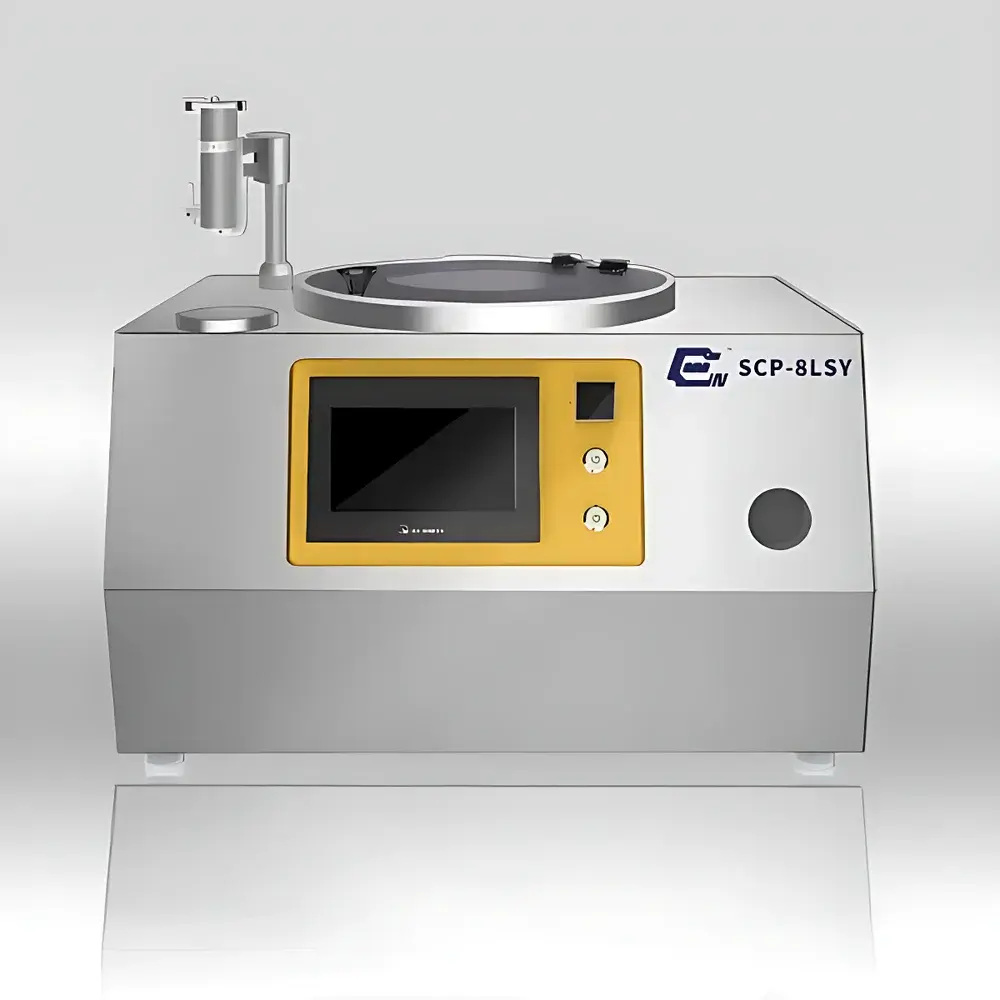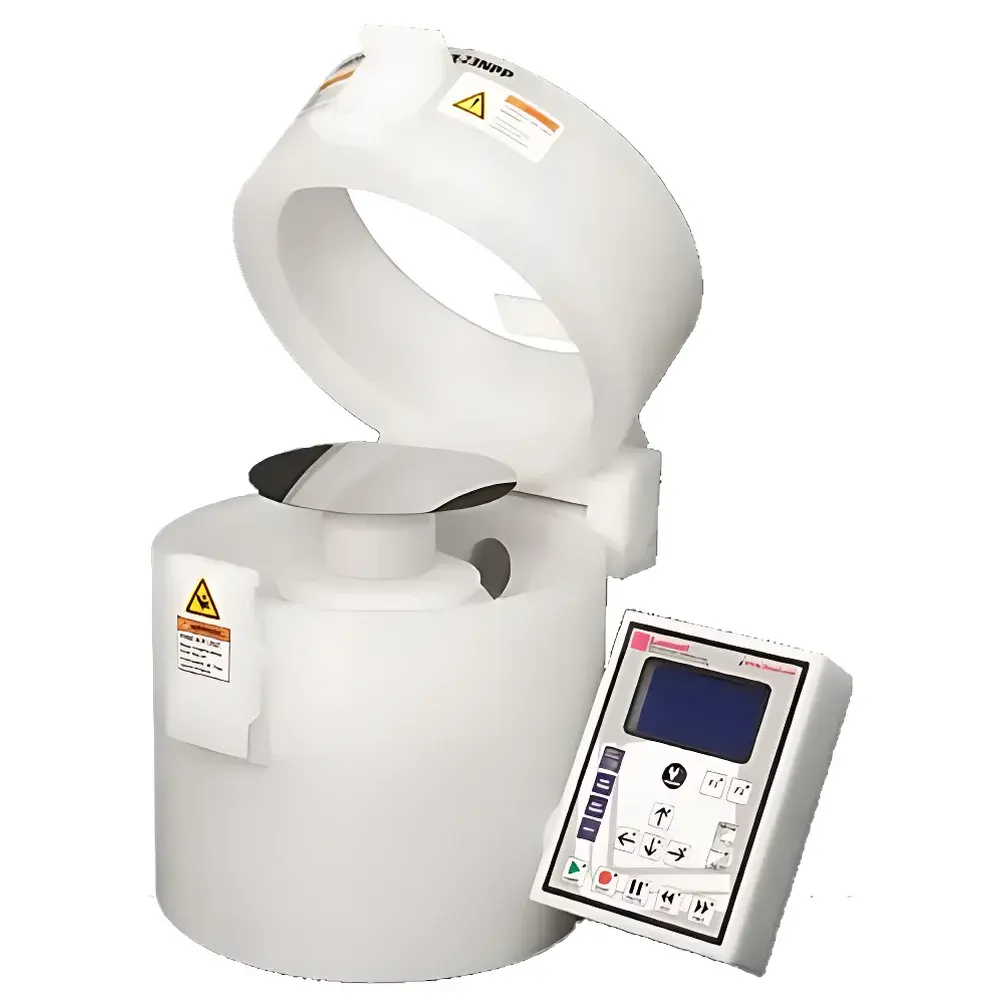
Laurell WS-650Mz-23N Spin Coater for Perovskite Solar Cell Fabrication
| Brand | Laurell |
|---|---|
| Origin | USA |
| Model | WS-650Mz-23N |
| Maximum Speed | 12,000 rpm |
| Acceleration | 0–12,000 rpm/sec |
| Speed Accuracy | ≤ ±1 rpm (NIST-traceable) |
| Speed Stability | < ±1% |
| Time Resolution | 0.1 sec (1–5999.9 sec/step) |
| Chuck Compatibility | Ø10–150 mm wafers or 125×125 mm square substrates |
| Chamber Diameter | 9.5 in (241 mm) |
| Controller | PLC-based with SPIN3000 software integration |
| Construction Material | NPP (Natural Polypropylene) |
| Programmability | 20 stored recipes, up to 51 steps per recipe |
| Vacuum System | Oil-free pump, 220–240 VAC, 50/60 Hz |
| Leveling | Included NIST-calibrated digital level |
Overview
The Laurell WS-650Mz-23N Spin Coater is a precision-engineered rotational deposition system designed specifically for reproducible thin-film fabrication in emerging photovoltaic research—particularly perovskite solar cells (PSCs), organic photovoltaics (OPV), OLEDs, and 2D material processing. Operating on the principle of centrifugal force-driven solvent evaporation, the instrument enables controlled, uniform film formation through programmable acceleration profiles, multi-step rotational sequences, and real-time process logging. Since its introduction in the mid-1980s, Laurell’s spin coaters have been deployed in over one million laboratory procedures worldwide—including foundational PSC development at EPFL’s Laboratory of Photonics and Interfaces under Prof. Michael Grätzel. This model represents the latest evolution of Laurell’s NIST-traceable platform, integrating metrology-grade speed control, chemical-resistant NPP construction, and deterministic process repeatability required for GLP-compliant R&D workflows.
Key Features
- Ultra-stable rotational control: Achieves speed stability < ±1% across the full 0–12,000 rpm range, with resolution ≤1 rpm—certified traceable to NIST standards and requiring no field recalibration.
- High-acceleration dynamics: Programmable acceleration up to 12,000 rpm/sec enables precise control over initial fluid spreading and subsequent solvent removal kinetics—critical for defect minimization in perovskite precursor films.
- Multi-step PLC-based sequencing: Supports up to 20 independent recipes, each containing up to 51 discrete speed/time steps; ideal for complex bilayer or gradient-thickness protocols used in tandem PSC architectures.
- SPIN3000 software integration: Provides real-time curve visualization of speed vs. time profiles, offline parameter optimization, and automated data export compliant with ISO/IEC 17025 documentation requirements.
- NPP chamber construction: Natural polypropylene housing delivers exceptional resistance to halogenated solvents (e.g., DMF, DMSO, chlorobenzene), acidic precursors (e.g., HI, HBr), and metal-halide etchants—ensuring long-term mechanical integrity and contamination-free operation.
- Digital leveling & vacuum chuck: Integrated NIST-calibrated inclinometer ensures sub-0.1° substrate planarity; vacuum hold-down supports rigid and flexible substrates (glass, ITO/PET, Ni foil) from Ø10 mm to 150 mm or 125 × 125 mm squares.
Sample Compatibility & Compliance
The WS-650Mz-23N accommodates substrates ranging from micro-scale test coupons to full 6-inch wafers, including brittle perovskite-coated glass, flexible polymer electrodes, and conductive metal foils. Its chamber geometry and vacuum distribution are optimized for low-waste, high-yield coating of temperature-sensitive layers—such as MAPbI₃, FAPbI₃, or mixed-cation perovskites—without thermal degradation or edge bead formation. The system meets mechanical safety requirements per ANSI/UL 61010-1 and electromagnetic compatibility per FCC Part 15 Class A. While not a regulated medical device, its data logging architecture—including timestamped parameter records, operator ID tagging, and immutable audit trails—supports alignment with FDA 21 CFR Part 11 principles for electronic records in academic and industrial R&D environments.
Software & Data Management
SPIN3000 is a Windows-based control and analysis suite enabling full experimental traceability. It logs all operational parameters—including actual vs. setpoint rpm, elapsed time per step, vacuum pressure, and ambient temperature—with millisecond-level temporal resolution. Users may import/export SOPs in CSV or XML formats, generate PDF reports with embedded speed-time curves, and perform comparative statistical analysis across batches. All stored recipes include metadata fields for project ID, material lot number, and environmental conditions—facilitating cross-laboratory reproducibility studies aligned with IEEE 1620.1-2022 guidelines for thin-film process documentation.
Applications
- Perovskite solar cell fabrication: Uniform deposition of precursor inks (e.g., PbI₂ + MAI in GBL/DMSO) with tunable crystallinity via ramped spin profiles.
- Organic photovoltaic active layers: Controlled phase separation in bulk heterojunction blends (e.g., PTB7:PC₇₁BM) through solvent annealing-integrated spin protocols.
- OLED emissive layer patterning: Sub-100 nm thickness control for small-molecule or polymer emitters (e.g., TPD, PVK, Ir(ppy)₃).
- 2D material transfer & encapsulation: Spin-casting of graphene oxide, MoS₂ dispersions, or ALD-compatible barrier layers (e.g., Al₂O₃ precursors).
- Substrate functionalization: Hydrophobic/hydrophilic surface modification via silane or PFPE spin-on coatings prior to vacuum deposition.
FAQ
Is the WS-650Mz-23N compatible with corrosive perovskite precursor solvents such as DMF or DMSO?
Yes—the entire process chamber, chuck assembly, and fluid containment zones are constructed from NPP (natural polypropylene), which exhibits outstanding resistance to polar aprotic solvents, halogenated hydrocarbons, and acidic metal-halide solutions.
Does the system support automated process validation for ISO/IEC 17025 accreditation?
While the instrument itself is not accredited, its NIST-traceable speed calibration, deterministic PLC control, and SPIN3000’s full audit trail functionality enable laboratories to meet Clause 7.7 (Equipment) and Clause 7.8 (Technical Records) requirements when implemented within a validated quality management system.
Can the spin coater be integrated into a glovebox environment?
Yes—its oil-free vacuum pump, low EMI emissions, and compact footprint (W × D × H: 45 × 48 × 35 cm) allow seamless integration into nitrogen- or argon-purged enclosures with standard feedthrough ports for power and USB communication.
What is the recommended maintenance interval for long-term reliability?
Under typical academic usage (≤10 cycles/day), no scheduled mechanical maintenance is required beyond quarterly verification of chuck flatness using the included digital level and annual inspection of vacuum line integrity.
How does the system ensure thickness reproducibility across different operators?
Through enforced SOP execution via password-protected recipe loading, real-time deviation alerts during run-time, and automatic archiving of all executed parameters—including ambient humidity and substrate temperature if externally logged—enabling root-cause analysis of inter-operator variability.