
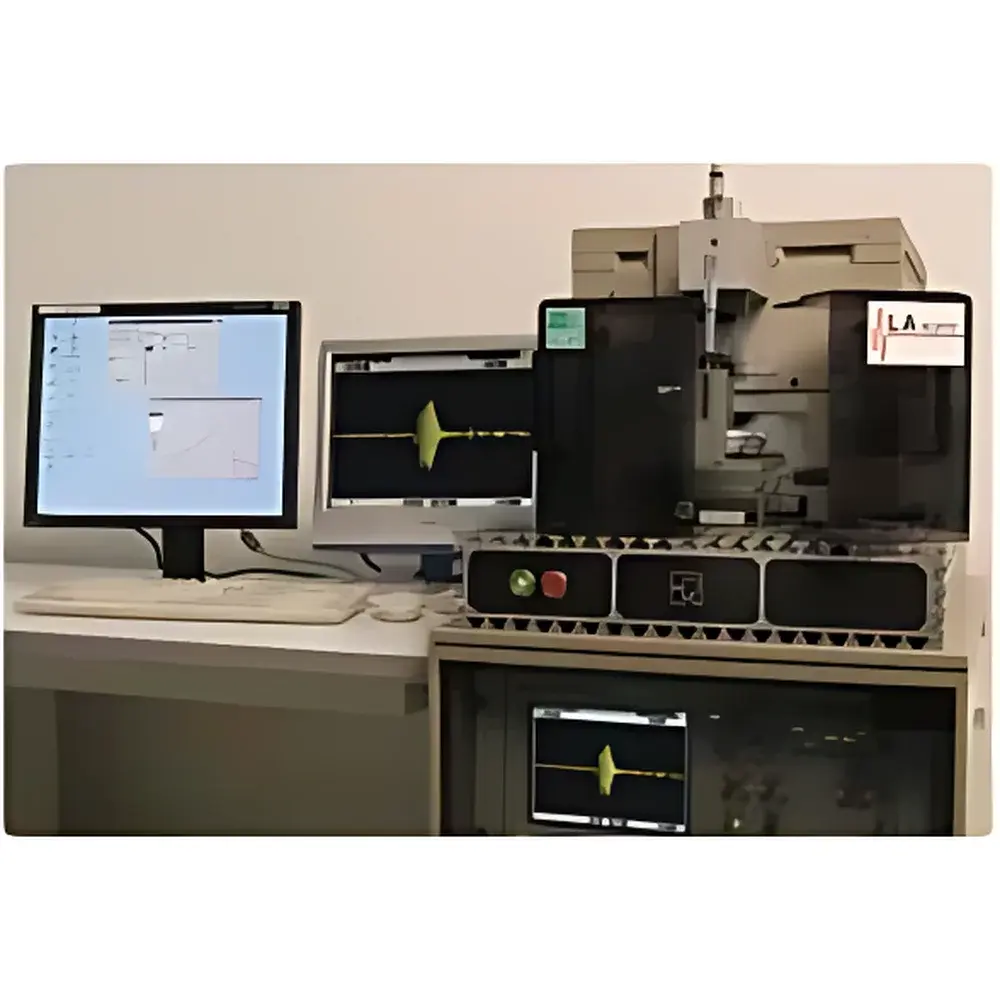
LAwave® Non-destructive Young’s Modulus Measurement System
| Brand | LAwave |
|---|---|
| Origin | Germany |
| Model | LAwave |
| Type | Laser-based Surface Acoustic Wave (SAW) Dispersion Analyzer |
| Application | Thin-film elastic property characterization |
| Compliance | Designed for ISO/IEC 17025-aligned laboratories, compatible with GLP/GMP data integrity workflows |
Overview
The LAwave® Non-destructive Young’s Modulus Measurement System is a turnkey laser ultrasonic instrument engineered for contactless, quantitative determination of thin-film mechanical properties—primarily Young’s modulus, mass density, and thickness—via surface acoustic wave (SAW) dispersion analysis. Operating on the physical principle of picosecond-scale laser pulse excitation and interferometric detection, the system generates broadband surface acoustic waves (typically 10–1000 MHz) on the sample surface without mechanical coupling or vacuum requirements. These SAWs propagate exclusively within the near-surface region (<1 µm to several µm depth), with energy decay governed by the Rayleigh wave decay length—ensuring true non-destructive interrogation of delicate, functional, or coated surfaces. The measured phase velocity as a function of frequency forms a dispersion curve, which is intrinsically sensitive to the elastic stiffness contrast between film and substrate, interfacial adhesion quality, and microstructural homogeneity. Unlike nanoindentation or resonant methods, LAwave® does not require reference standards, calibration layers, or destructive cross-sectioning—making it suitable for in-line process monitoring, R&D screening, and failure analysis of advanced coatings.
Key Features
- Laser-based non-contact operation: Eliminates probe wear, loading artifacts, and surface contamination risks
- Sub-nanometer displacement resolution enabled by heterodyne interferometry
- Measurement area as small as 5 × 5 mm—compatible with wafer-level mapping and localized defect assessment
- Full dispersion curve acquisition in <60 seconds per measurement point
- Robust performance on surfaces with RMS roughness up to 500 nm—no polishing or planarization required
- Simultaneous extraction of Young’s modulus, film thickness, and effective density via inverse modeling against multi-layer elastic wave theory
- Modular optical design optimized for integration into cleanroom environments or glovebox systems
Sample Compatibility & Compliance
The LAwave® system accommodates a broad spectrum of material classes—including amorphous polymers (e.g., PMMA, PI), metallic alloys (Al, Ti, Ni-based), ceramic oxides (Al₂O₃, SiO₂), hard carbon coatings (DLC, ta-C), and emerging 2D materials (graphene oxide films, MXenes). It supports films ranging from ~2 nm (monolayer-sensitive regime) to >200 µm (bulk-like substrates with graded interfaces). No electrical conductivity, transparency, or magnetic susceptibility is required. All measurements adhere to fundamental acousto-elastic theory validated against ASTM E2587 (Standard Practice for Ultrasonic Testing of Metals) and ISO 20483-1 (Non-destructive testing — Ultrasonic testing — Part 1: General principles). Raw interferometric data and dispersion fits are timestamped and stored with full audit trails, supporting FDA 21 CFR Part 11 compliance when deployed with validated LIMS or ELN platforms.
Software & Data Management
The LAwave® Control Suite provides a deterministic, scriptable environment built on Qt/C++ with Python API access. Core functions include real-time dispersion curve visualization, multi-parameter Levenberg–Marquardt fitting using custom anisotropic or isotropic layered models, batch processing across wafer maps, and export of uncertainty-weighted parameter sets (k = 2 coverage). All raw time-domain interferograms and processed dispersion datasets are saved in HDF5 format with embedded metadata (laser fluence, spot size, ambient temperature, operator ID). Software versioning, user role management (admin/operator/auditor), and electronic signature capability ensure alignment with GLP and GMP documentation requirements. Integration with third-party statistical process control (SPC) tools is supported via OPC UA and RESTful JSON endpoints.
Applications
- Quantitative evaluation of DLC, TiN, and CrN PVD/CVD coatings on automotive and aerospace components
- In-process monitoring of atomic layer deposition (ALD) and plasma-enhanced CVD film stiffening during thermal cycling
- Correlation of Young’s modulus gradients with ion implantation dose in semiconductor gate stacks
- Assessment of porosity evolution in thermal barrier coatings (TBCs) under thermal aging
- Validation of mechanical integrity in flexible electronics—PET/PEN substrates with printed Ag nanowire electrodes
- Research on stress relaxation kinetics in biodegradable polymer films (PLA, PCL) exposed to humidity gradients
FAQ
Does LAwave® require vacuum or controlled atmosphere for operation?
No. Measurements are performed in ambient air at standard temperature and pressure. Optional environmental chambers (−40 °C to +150 °C) are available for thermo-mechanical studies.
Can LAwave® distinguish between compressive and tensile intrinsic stress?
Not directly. While SAW velocity is influenced by biaxial stress, LAwave®’s primary output is elastic modulus. Stress quantification requires complementary techniques such as wafer curvature or XRD.
What is the minimum lateral feature size resolvable in mapping mode?
With optional high-NA optics, spatial resolution reaches 10 µm; standard configuration resolves ≥50 µm features across 100 × 100 mm sample areas.
Is training and application support included with purchase?
Yes. LAwave® delivery includes on-site installation, two-day operator certification, and one year of remote technical support with priority response for method development assistance.



