
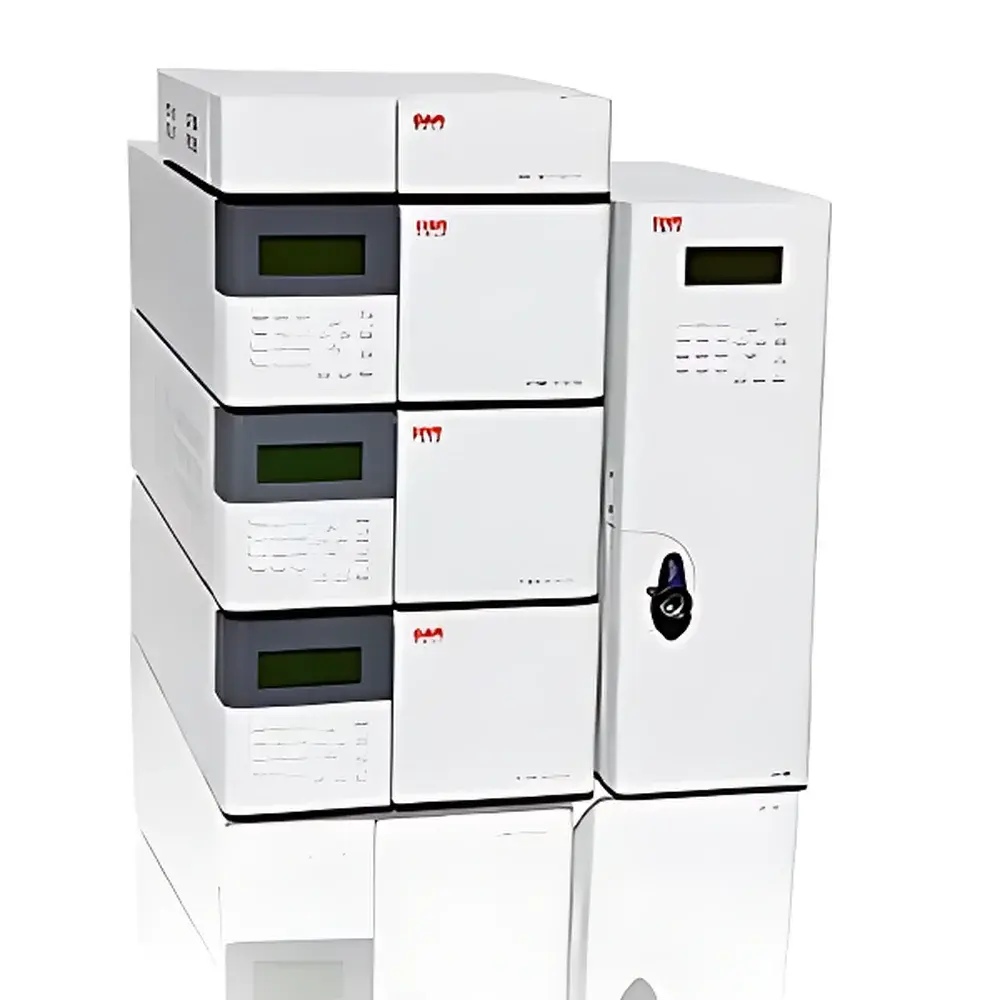
LC-5520 High-Performance Liquid Chromatograph (HPLC) by East & West Analytical Instruments
| Brand | East & West Analytical Instruments |
|---|---|
| Origin | Beijing, China |
| Manufacturer Type | Direct Manufacturer |
| Instrument Type | Conventional HPLC System |
| Flow Rate Range | 0–50 mL/min |
| Maximum Operating Pressure | 42 MPa |
| Flow Accuracy | ≤0.5% RSD |
| Sample Injection Volume | 0.1–100 µL |
| Injection Capacity | 120 positions (1.8 mL vials) |
| Column Oven Temperature Range | 5–80 °C |
| UV-Vis Wavelength Range | 190–700 nm |
| Pressure Pulsation (without damper) | <0.4% |
| Pressure Pulsation (with damper) | <0.015% |
| Detection Principle | UV-Vis absorbance with differential refractive index suppression and 40-mm optical path length flow cell |
Overview
The LC-5520 High-Performance Liquid Chromatograph is a modular, dual-pump gradient HPLC system engineered for precision, stability, and broad method adaptability in routine analytical laboratories. Built upon the proven mechanical architecture of its predecessor LC-5510, the LC-5520 integrates an upgraded dual-servo-driven reciprocating pump system that minimizes pressure transients during head-switching cycles—achieving intrinsic pulsation <0.4% without external damping and <0.015% when equipped with an optional pulse damper. This hydraulic refinement supports high-fidelity gradient delivery across diverse column formats, from capillary and analytical-scale (2.1–4.6 mm ID) to semi-preparative (10 mm ID), with a maximum flow rate of 50 mL/min and sustained pressure capability up to 42 MPa (6090 psi). The system employs UV-Vis absorbance detection based on a low-noise, broadband photodiode array (190–700 nm) enhanced by proprietary differential refractive index suppression technology and a 40-mm pathlength flow cell—enabling improved baseline stability and lower detection limits for low-absorbing analytes under isocratic or gradient elution.
Key Features
- Dual high-pressure gradient pump with servo-controlled dual-piston architecture and real-time pressure feedback for enhanced gradient accuracy and reproducibility
- Column oven utilizing Peltier thermoelectric elements for precise temperature control between 5 °C and 80 °C (±0.2 °C stability), supporting method robustness and retention time reproducibility
- Autosampler with 120-position capacity (1.8 mL vials), programmable injection volumes from 0.1 µL to 100 µL, and needle-wash functionality to minimize carryover
- UV-Vis detector featuring a high-stability deuterium/tungsten lamp source, holographic grating monochromator, and thermally stabilized flow cell with 40-mm optical path length
- Integrated refractive index suppression algorithm to reduce baseline drift induced by solvent composition changes during gradient elution
- Fully configurable system architecture compatible with standard 1/16″ stainless steel and PEEK tubing, industry-standard fittings, and third-party columns (3.5–5 µm particle size)
Sample Compatibility & Compliance
The LC-5520 accommodates a wide range of sample matrices—including pharmaceutical actives, environmental extracts, food additives, natural product isolates, and polymer oligomers—when paired with appropriate sample preparation (e.g., filtration, dilution, solid-phase extraction). It complies with fundamental hardware requirements outlined in ISO 17025:2017 for testing laboratories and supports method validation per ICH Q2(R2) guidelines. Data acquisition and audit trail functions are configurable to meet basic GLP documentation needs; optional software modules provide 21 CFR Part 11-compliant electronic signatures, user access controls, and immutable audit logs for regulated environments.
Software & Data Management
Controlled via the proprietary ChromSight™ workstation software (Windows-based), the LC-5520 supports method development, sequence scheduling, real-time chromatogram visualization, peak integration using tangent skim or valley-to-valley algorithms, and customizable report templates. Raw data files adhere to AIA/ANDI format standards for cross-platform compatibility with third-party processing tools (e.g., OpenLab CDS, Chromeleon, Empower). All instrument parameters—including flow rate, gradient profile, oven temperature, and wavelength—are stored with timestamps and operator IDs. System suitability tests (SST) can be automated and evaluated against user-defined criteria (e.g., resolution ≥2.0, tailing factor ≤2.0, %RSD ≤1.0 for replicate injections).
Applications
- Pharmaceutical quality control: assay quantitation of APIs and impurities per USP/EP monographs
- Environmental analysis: determination of PAHs, pesticides, and phenolic compounds in water and soil extracts
- Food safety testing: detection of mycotoxins (e.g., aflatoxin B1), preservatives (e.g., benzoic acid), and artificial colors
- Academic research: separation and characterization of peptides, flavonoids, and synthetic intermediates
- Chemical manufacturing: batch release testing of solvents, catalysts, and monomer purity
- Method transfer: seamless migration from legacy HPLC platforms due to standardized hardware interfaces and ASCII-based method export
FAQ
What column dimensions and particle sizes are supported?
The LC-5520 is optimized for columns with internal diameters from 2.1 mm to 10 mm and particle sizes ranging from 3.5 µm to 10 µm. Standard stainless steel guard cartridges (e.g., 2.1 × 10 mm) are recommended for extended column life.
Is the system compatible with mass spectrometry detection?
Yes—the UV-Vis detector module can be bypassed, and the system’s low-dead-volume flow path (≤12 µL from pump outlet to column inlet) supports direct coupling to electrospray ionization (ESI) or atmospheric pressure chemical ionization (APCI) sources with appropriate interface hardware.
Does the autosampler support needle-in-vial or needle-through-cap piercing?
It operates in needle-in-vial mode with positive-pressure septum penetration for 1.8 mL screw-thread vials; optional crimp-cap piercing kits are available upon request.
Can the column oven cool below ambient temperature?
No—the Peltier-based oven provides heating and passive cooling only; minimum setpoint is 5 °C above ambient or 5 °C absolute, whichever is higher.
What is the typical maintenance interval for the dual-pump system?
With proper mobile phase filtration (≤0.22 µm) and regular seal flushing, piston seals and check valves require replacement every 6–12 months under continuous operation at ≤30 MPa.





