
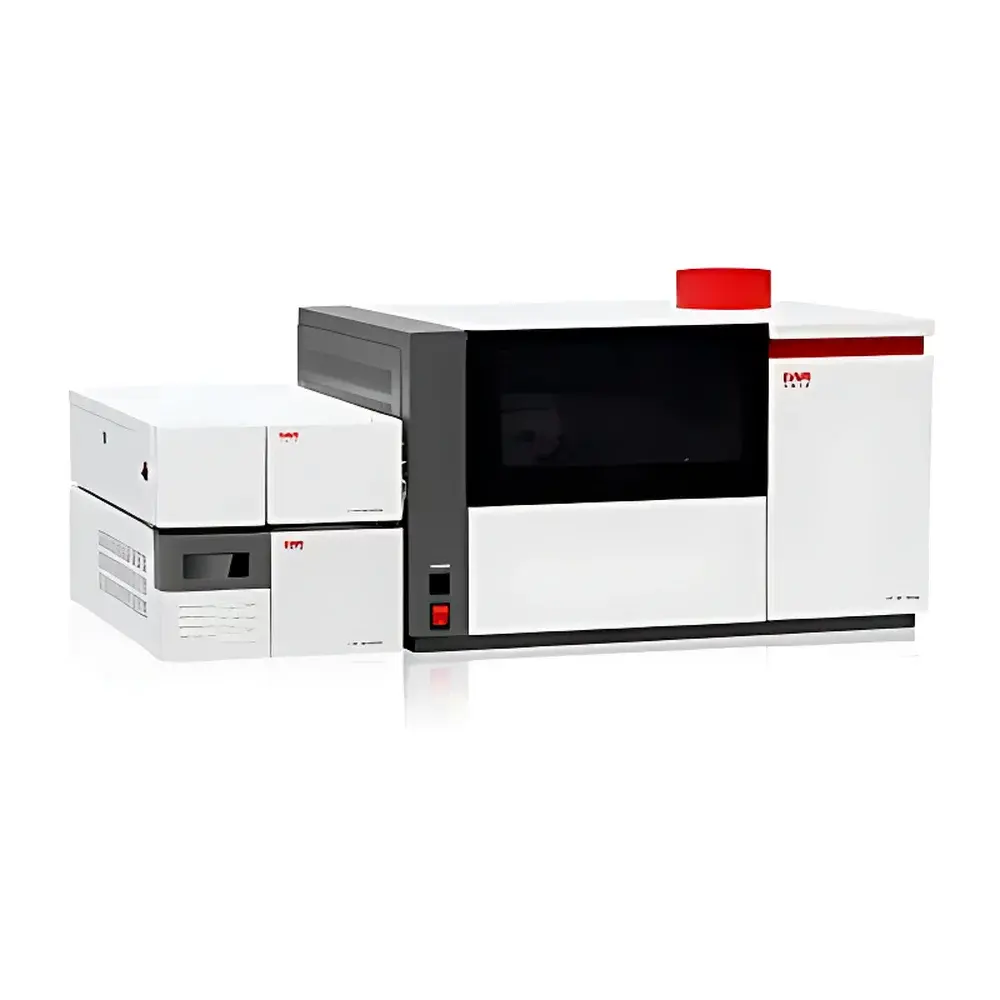
LC-AF7590 Liquid Chromatography–Atomic Fluorescence Spectrometer
| Brand | East & West Analytical Instruments |
|---|---|
| Origin | Beijing, China |
| Manufacturer Type | Direct Manufacturer |
| Instrument Type | LC-AFS Hyphenated System |
| Sample Introduction | Peristaltic Pump |
| Detectable Elements | As, Hg, Se, Sb |
| Relative Standard Deviation (RSD) | <3% |
| Linear Dynamic Range | >3 orders of magnitude |
| Detection Limit | sub-ng L⁻¹ level |
| LC Pump | Dual-piston reciprocating pump with PEEK fluidic path, 0–35 MPa (0–5000 psi) pressure range, flow rate programmable, pH 0–14 chemical compatibility |
| Post-column UV Digestion | Integrated, leak-proof, low-ozone emission |
| Flow Path Design | Minimized post-column volume for reduced band broadening |
| Software | Dedicated LC-AFS control and data acquisition software with Ethernet interface, gradient elution support, real-time chromatogram/fluorescence signal synchronization |
| Compliance | Designed to support GLP/GMP-aligned workflows |
Overview
The LC-AF7590 is a fully integrated liquid chromatography–atomic fluorescence spectrometry (LC-AFS) hyphenated system engineered for elemental speciation analysis of hydride-forming elements—including arsenic (As), mercury (Hg), selenium (Se), and antimony (Sb)—in complex matrices. Unlike conventional total-element quantification, this instrument couples high-resolution reversed-phase or ion-exchange liquid chromatography with highly sensitive atomic fluorescence detection following on-line UV photo-oxidation. The system operates on the principle of post-column hydride generation coupled with atomic fluorescence detection: after chromatographic separation, analyte species are oxidized in a dedicated UV digestion unit, reduced to volatile hydride forms (e.g., AsH₃, H₂Se), atomized in a quartz cell, and excited by a high-intensity hollow cathode lamp. The resulting element-specific fluorescence signal is measured with photomultiplier tube detection, delivering exceptional selectivity and sensitivity at sub-ng L⁻¹ levels.
Key Features
- Modular architecture: The AFS detector and LC module operate independently—enabling standalone use for routine total-element analysis or full hyphenated operation for speciation.
- Integrated UV post-column digestion: Patented quartz-based UV reactor with optimized residence time and ozone suppression ensures complete organic matrix mineralization without UV leakage or operator exposure risk.
- Low-volume, chemically inert flow path: Entire fluidic pathway constructed from PEEK and fluoropolymer components—resistant to pH 0–14, strong acids/bases, and organic solvents; column dead volume minimized to <15 µL to preserve chromatographic resolution.
- Dual-piston reciprocating LC pump: Microprocessor-controlled, constant-stroke displacement design with automatic dual-plunger washing; pressure limit adjustable in 1 MPa increments (0–35 MPa); pulsation <0.1% RSD at 1.0 mL min⁻¹.
- Intelligent flow management: Dedicated waste diversion valve routes column wash solvents directly to waste bottle—bypassing gas–liquid separator—to prevent cross-contamination and extend membrane life.
- Ethernet-enabled instrumentation: Real-time bidirectional communication between LC controller, AFS detector, and workstation eliminates USB latency; supports remote diagnostics and firmware updates.
Sample Compatibility & Compliance
The LC-AF7590 is validated for aqueous extracts from foodstuffs (e.g., rice, seafood), environmental samples (soil leachates, wastewater), geological digests (sediment, ore), clinical biofluids (urine, serum), and agricultural products. Its design conforms to key performance expectations outlined in ISO 17025:2017 for testing laboratories and supports method development aligned with EPA Method 1638 (for organoarsenicals) and GB/T 22980–2008 (Chinese national standard for As speciation in milk). Data handling architecture includes timestamped audit trails, role-based user access, and electronic signature capability—preparing laboratories for FDA 21 CFR Part 11 compliance and internal GLP/GMP audits.
Software & Data Management
The proprietary LC-AFS Control Suite provides unified control of gradient programming, valve sequencing, lamp warm-up, signal integration, and calibration curve fitting—all within a single GUI. Chromatograms and fluorescence intensity traces are acquired synchronously at 10 Hz sampling rate; peak identification uses retention time matching with optional spectral deconvolution for co-eluting species. Raw data files (.afsd) are stored in vendor-neutral HDF5 format with embedded metadata (instrument parameters, method ID, analyst ID, calibration history). Batch processing supports automated report generation in PDF/CSV formats compliant with LIMS import protocols.
Applications
- Food safety: Quantification of inorganic arsenic vs. dimethylarsinic acid (DMA) and monomethylarsonic acid (MMA) in rice flour and infant cereals.
- Environmental monitoring: Speciation of methylmercury and inorganic Hg in fish tissue and river sediment pore water.
- Clinical toxicology: Differentiation of selenomethionine, selenocysteine, and inorganic Se in human urine following dietary supplementation studies.
- Geochemical research: Antimony species profiling (Sb(III)/Sb(V)) in mine drainage to assess redox-driven mobility.
- Method validation: Used as reference platform in interlaboratory comparison studies under CCQM (Consultative Committee for Amount of Substance) frameworks.
FAQ
What hydride-forming elements can be speciated using the LC-AF7590?
As, Hg, Se, and Sb—provided they are separable on compatible LC columns (e.g., anion-exchange for As species; reversed-phase C18 with ion-pairing for Hg complexes).
Is UV digestion mandatory for all sample types?
Yes—organic-bound species require on-line photo-oxidation prior to hydride generation; the system disables AFS detection if UV lamp status is not verified.
Can the LC module be used with other detectors (e.g., ICP-MS)?
The flow path is designed for AFS coupling; while mechanical interfaces may allow adaptation, no vendor-supported configurations exist for third-party detectors.
What is the typical analysis time for a full As speciation run?
12–18 minutes under optimized gradient conditions (e.g., 25 mM ammonium nitrate/methanol), including column re-equilibration.
Does the system support unattended overnight operation?
Yes—when equipped with the optional autosampler (21-position vial tray), method sequences with auto-shutdown and leak detection remain active for up to 72 hours.
Related Products





