
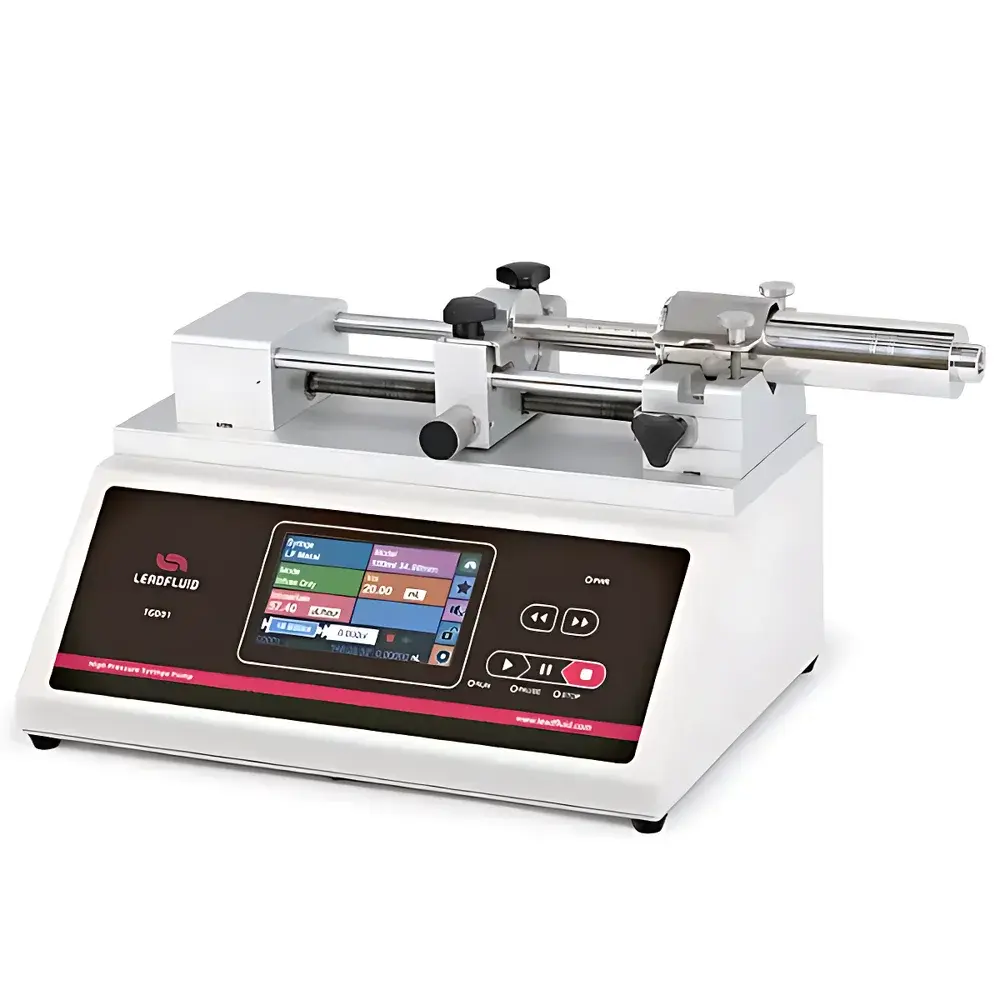
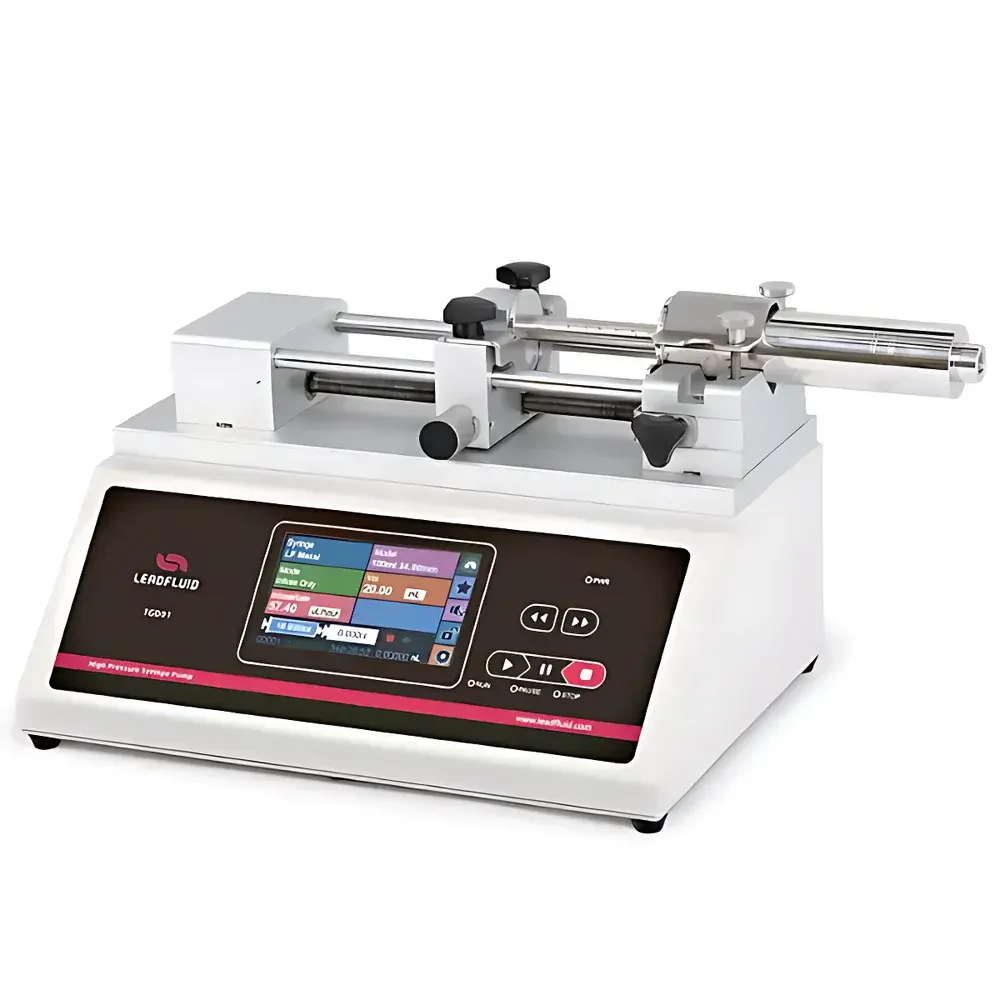
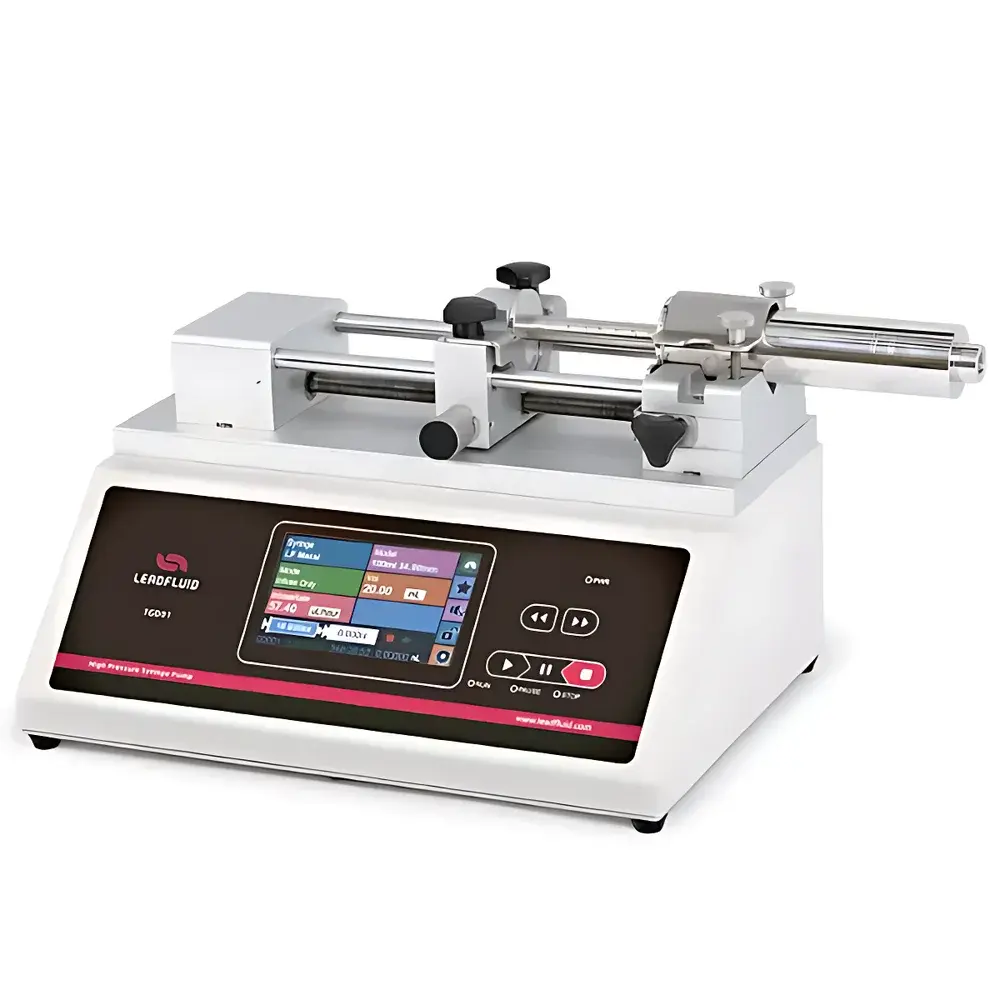
LeadFluid TGD01 Single-Channel Precision Syringe Pump
| Brand | LeadFluid |
|---|---|
| Model | TGD01 |
| Type | Microfluidic Syringe Pump |
| Flow Rate Range | 0.001 µL/min to 215 mL/min |
| Accuracy | ≤ ±0.35% (when stroke > 30% of max) |
| Repeatability | ≤ 0.1% |
| Maximum Linear Force | 91 kg |
| Stroke | 140 mm |
| Stroke Resolution | 0.156 µm/µstep |
| Push Speed | 1 µm/min to 190 mm/min |
| Injector Capacity | 0.5 µL to 140 mL |
| Display | 4.3" color LCD with real-time animation |
| Control Interface | Touchscreen + dedicated function keys |
| Communication | RS485, Modbus RTU protocol |
| Power Supply | AC 100–240 V, 50/60 Hz |
| Operating Environment | 5–40 °C, RH < 80% |
| Enclosure Rating | IP31 |
| Weight | 6.6 kg |
| Dimensions | 305 × 222 × 190 mm |
Overview
The LeadFluid TGD01 is a single-channel, high-force precision syringe pump engineered for demanding microfluidic applications requiring exceptional volumetric accuracy, long-term stability, and robust mechanical performance. It operates on a linear stepper motor-driven pusher mechanism, delivering controlled, pulseless fluid displacement via direct plunger actuation—eliminating peristaltic compression artifacts and enabling true laminar flow delivery across wide viscosity and pressure ranges. Unlike conventional peristaltic or gear-driven pumps, the TGD01 employs closed-loop position feedback and high-resolution microstepping (0.156 µm/µstep) to ensure sub-nanoliter dosing fidelity and minimal flow pulsation. Its architecture supports both low-flow nanoliter-per-minute infusions (e.g., 3.06 pL/min using a 0.5 µL syringe) and high-volume transfers up to 215 mL/min (with a 140 mL syringe), making it suitable for applications spanning analytical sample introduction, chemical synthesis, electrophysiology perfusion, and high-pressure reactor charging.
Key Features
- High-force linear actuation: 91 kg maximum push force at 100% setting—enabling reliable delivery of viscous fluids (e.g., polymer melts, slurries, pastes) and operation into elevated backpressures (up to ~20 MPa with compatible stainless-steel syringes).
- True microfluidic resolution: Flow range extends down to 0.001 µL/min with calibrated accuracy ≤ ±0.35% (for strokes exceeding 30% of full travel), supported by real-time flow calibration routines.
- Intuitive human-machine interface: 4.3-inch color TFT LCD displays dynamic parameters—including delivered volume, remaining volume, flow rate, direction, syringe ID, and animated plunger motion—without external software dependency.
- Flexible control architecture: Standalone programmability via touchscreen and dedicated hardware keys; optional RS485 Modbus RTU integration for centralized lab automation (e.g., synchronization with chromatography systems or reactor controllers).
- Robust mechanical design: Metal chassis with anti-corrosion coating; IP31-rated enclosure ensures resilience against incidental splashes and particulate ingress in standard laboratory environments.
- Power-loss resilience: Built-in non-volatile memory retains all operational parameters—including syringe geometry, flow profile, and mode settings—after unexpected power interruption.
Sample Compatibility & Compliance
The TGD01 accommodates syringes from major global manufacturers (e.g., Hamilton, BD, SGE, Ito) across volumes from 0.5 µL to 140 mL, with automatic recognition of standard barrel diameters or manual entry of custom inner diameters (ID). Stainless-steel syringes are fully supported for aggressive solvents (e.g., concentrated acids, halogenated organics) and high-temperature applications. The pump complies with IEC 61010-1:2010 for electrical safety in laboratory equipment and meets EMC requirements per EN 61326-1:2013. While not certified for medical use, its repeatability (≤0.1%) and traceable calibration support GLP-compliant workflows when paired with documented SOPs and periodic verification using gravimetric or spectrophotometric methods.
Software & Data Management
No host PC is required for basic or advanced operation: multi-segment protocols (including ramped, stepped, and cyclic profiles) are configured directly on-device. For integrated lab environments, the RS485 interface enables bidirectional communication under Modbus RTU—allowing remote start/stop, status polling (e.g., “running”, “paused”, “completed”), and real-time parameter readback (current volume, speed, direction). Audit trails are maintained locally for critical events (e.g., power loss, emergency stop), though full 21 CFR Part 11 compliance requires third-party electronic lab notebook (ELN) integration or middleware validation.
Applications
- High-pressure liquid loading into autoclaves, supercritical fluid systems, or microreactors.
- Precise reagent addition in automated synthesis platforms where stoichiometric accuracy below 1% CV is mandatory.
- Controlled perfusion in neurophysiology and organ-on-chip models requiring stable sub-µL/min flow over hours.
- Calibration standard delivery for mass spectrometry, ICP-MS, and HPLC autosamplers.
- Delivery of corrosive or abrasive suspensions (e.g., catalyst slurries, nanoparticle dispersions) using chemically resistant syringes and PTFE-coated push rods.
FAQ
What syringe sizes and materials are officially supported?
The TGD01 includes a built-in database for syringes from Hamilton, BD, SGE, and Ito, covering glass, polypropylene, and stainless-steel variants from 0.5 µL to 140 mL. Custom syringes may be added manually by entering internal diameter (ID) in millimeters.
Does the pump support bidirectional flow control with independent speed settings for inject and withdraw phases?
Yes—four distinct modes are available: Inject Only, Withdraw Only, Inject→Withdraw, and Withdraw→Inject, each configurable with independent flow rates, volumes, and acceleration profiles.
Is flow calibration traceable to national standards?
The onboard calibration routine adjusts for syringe geometry and mechanical backlash but does not provide NIST-traceable certification. Users must perform gravimetric verification per ASTM D3427 or ISO 8503-2 using certified balances and temperature-controlled conditions.
Can multiple TGD01 units be synchronized via Modbus?
Yes—RS485 daisy-chaining allows up to 32 devices on a single bus with unique slave IDs; coordinated start/stop and interlocked sequencing are achievable through master controller logic.
What maintenance intervals are recommended for sustained accuracy?
LeadFluid recommends quarterly visual inspection of the push rod and rail, biannual lubrication of the linear guide (using specified synthetic grease), and annual verification of stroke linearity and force output using a calibrated load cell.



