
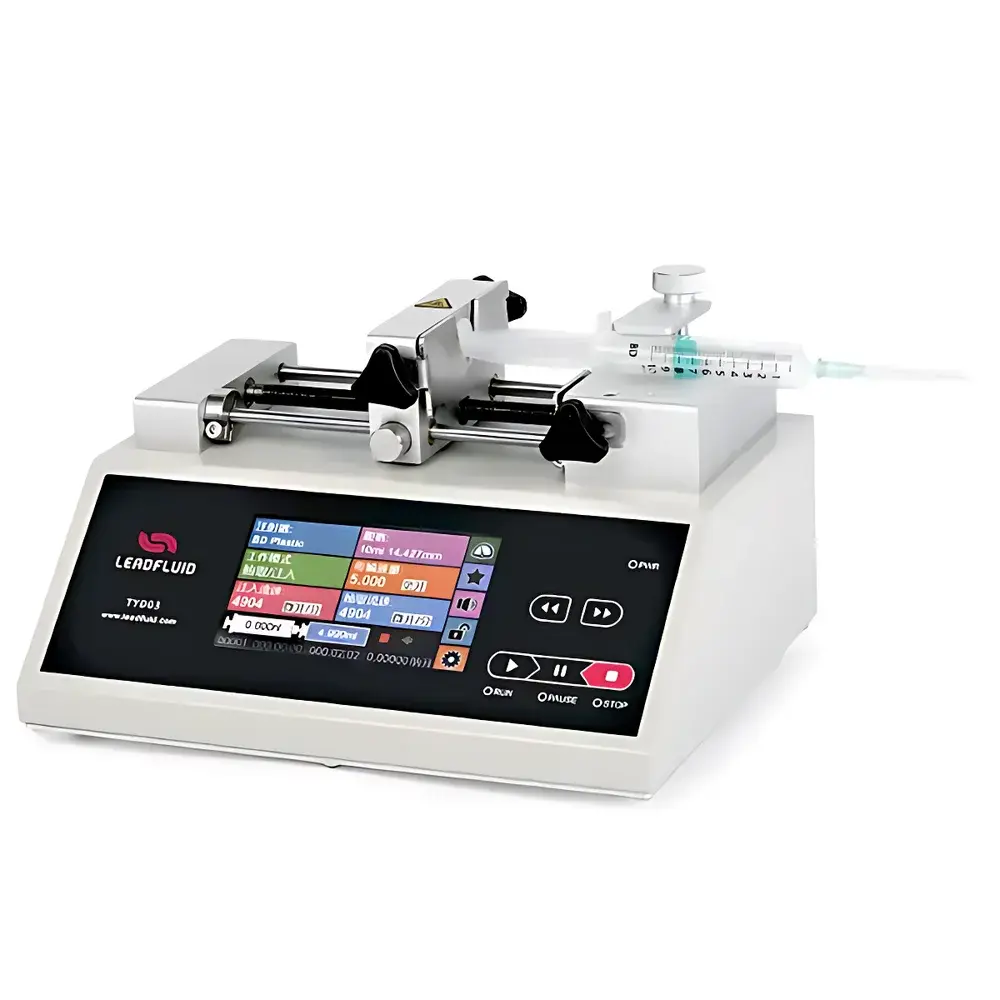
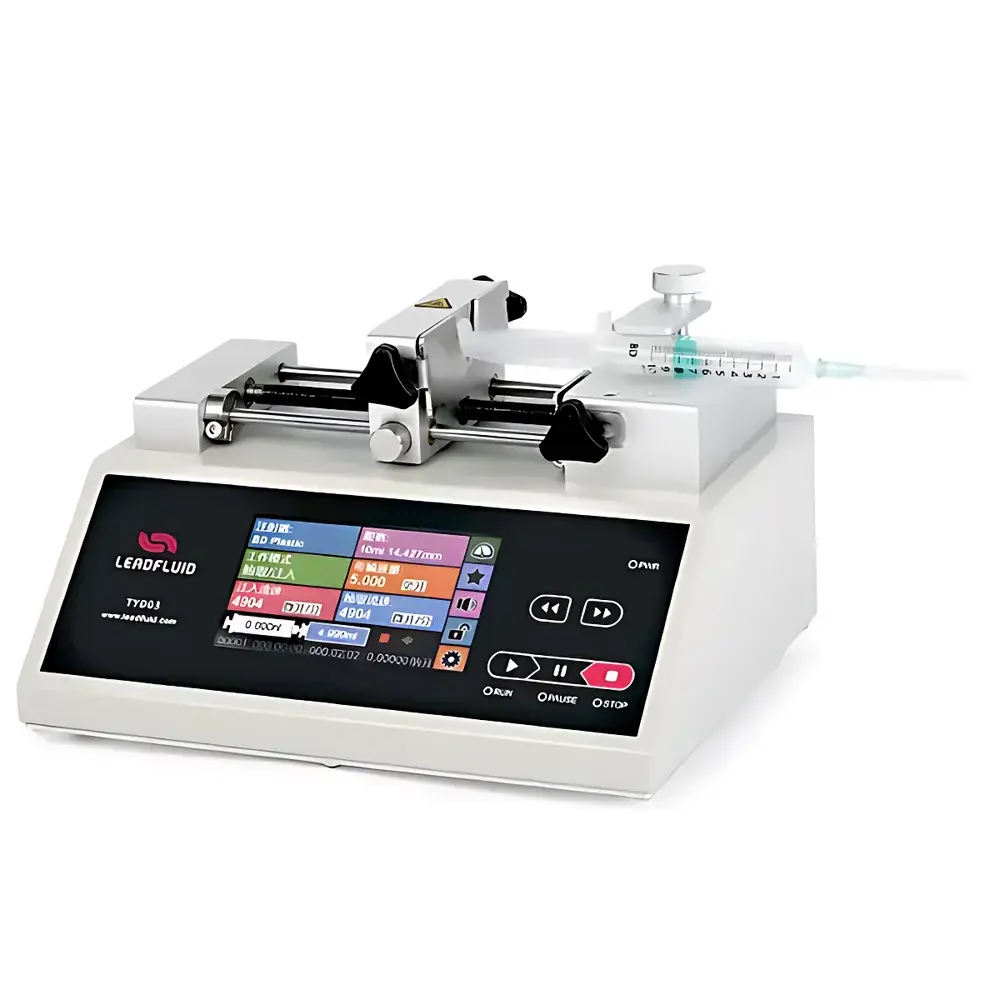
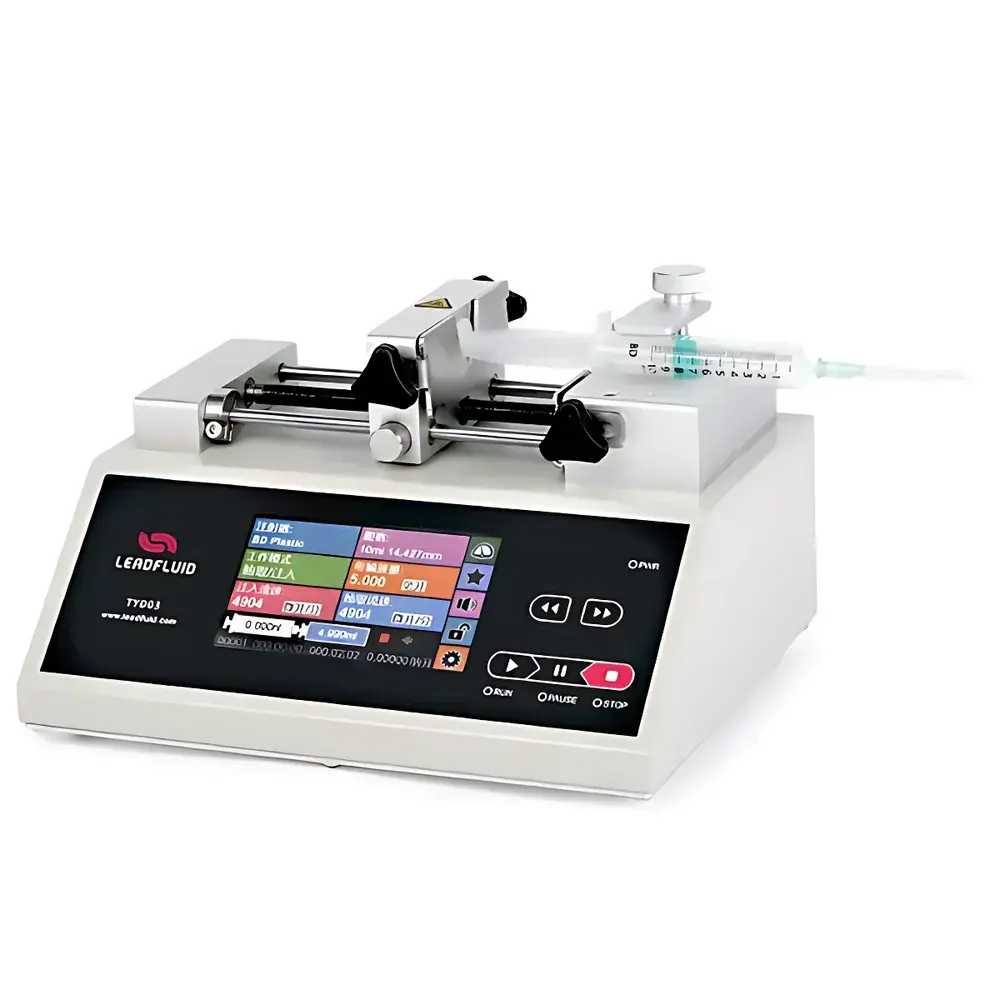
LeadFluid TYD03-01 Benchtop Syringe Pump
| Brand | LeadFluid |
|---|---|
| Origin | Hebei, China |
| Model | TYD03-01 |
| Instrument Type | Micro-syringe Pump |
| Flow Rate | 0.037 nL/min to 16.663 mL/min |
| Accuracy | < ±0.35% |
| Repeatability | < ±0.35% |
| Stroke | 110 mm |
| Linear Force Range | 1–100% adjustable (≥16 kgf rated) |
| Syringe Capacity | 10 µL to 60 mL |
| Line Speed | 0.2 µm/min to 30 mm/min |
| Resolution | 0.03125 µm/µstep |
| Communication | RS485, Modbus RTU protocol |
| Power Input | AC 100–240 V, 50/60 Hz |
| Dimensions | 245 × 195 × 140 mm |
| Weight | 3.2 kg |
| Operating Environment | 5–40 °C, RH < 80% |
Overview
The LeadFluid TYD03-01 Benchtop Syringe Pump is an engineered solution for precise, repeatable, and programmable fluid delivery in analytical, pharmaceutical, microfluidic, and life science laboratories. Based on high-resolution stepper motor actuation coupled with a precision-ground lead screw and aerospace-grade angular contact bearings, the pump delivers volumetric control via displacement-driven syringe actuation—eliminating dependency on fluid properties such as viscosity or compressibility. Its closed-loop mechanical architecture ensures consistent linear displacement per step, enabling trace-level dosing down to sub-nanoliter increments. Designed for integration into regulated environments, the TYD03-01 supports deterministic flow profiles across wide dynamic ranges—critical for applications including HPLC sample injection, electrophysiology perfusion, organ-on-chip media exchange, and controlled reagent addition in automated synthesis platforms.
Key Features
- High-resolution motion control: 0.03125 µm per microstep resolution, supporting ultra-low flow rates from 0.037 nL/min with stable laminar delivery.
- Dual-mode operation: Independent selection of injection-only, withdrawal-only, bidirectional sequence (inject-then-withdraw or withdraw-then-inject), and continuous cyclic mode—each fully programmable via touchscreen interface.
- Robust mechanical design: Precision-machined aluminum housing with full-metal enclosure; lead screw supported by preloaded angular contact ball bearings (not bronze bushings), ensuring >50,000-hour service life and minimal axial play under load.
- Intelligent syringe handling: Built-in database of standard syringes (from major manufacturers including Hamilton, BD, SGE, and Ito); manual entry of inner diameter enables accurate volume-to-displacement conversion for custom or non-standard glass/plastic syringes (10 µL–60 mL range).
- EMI-hardened electronics: Certified for stable operation in high-voltage electrostatic fields (e.g., near electrospray ionization sources or plasma reactors), with reinforced grounding and shielded signal paths.
- Industrial-grade communication: RS485 interface compliant with Modbus RTU protocol (function codes 03/06/16), enabling seamless integration with PLCs, SCADA systems, LabVIEW, Python-based controllers, or centralized LIMS infrastructure.
Sample Compatibility & Compliance
The TYD03-01 accommodates single-syringe configurations using standard Luer-lock or fixed-needle glass/plastic syringes. It is compatible with aqueous buffers, organic solvents, viscous polymer solutions (up to ~5000 mPa·s at 25 °C), and low-surface-tension fluids—provided appropriate syringe material (e.g., glass for acetonitrile, PTFE-coated plunger for aggressive solvents) is selected. While not certified for ISO 13485 or FDA 21 CFR Part 11 out-of-the-box, its deterministic control architecture, parameter lockout, audit-trail-ready configuration memory (with power-loss retention), and Modbus logging capability support implementation within GLP/GMP workflows when deployed with validated SOPs and electronic record protocols. No internal wetted parts beyond syringe barrel and plunger seal—user maintains full control over material compatibility and cleaning validation.
Software & Data Management
Operation is managed locally via a 4.3-inch capacitive color TFT touchscreen with intuitive icon-driven navigation and real-time animated status visualization (direction, remaining volume, elapsed time, flow rate, syringe ID). All parameters—including volume, speed, acceleration, direction, and pause/resume points—are configurable and stored in non-volatile memory. The RS485 port permits remote command execution (start/stop/pause/direction change), real-time status polling (current position, direction flag, error code), and synchronized multi-pump coordination in master-slave topologies. Third-party software integration is supported through open Modbus register mapping documentation, enabling traceable data capture in compliance-ready lab informatics systems. Optional PC software (LeadFluid PumpControl Suite) provides waveform editing, batch protocol sequencing, and CSV export with timestamped event logs.
Applications
- Microscale chromatography: Precise gradient elution and autosampler loop filling in nanoLC and capillary LC systems.
- Neuroscience research: Stable, pulseless perfusion of brain slices or cultured neurons during patch-clamp experiments.
- Materials science: Controlled deposition of nanomaterial inks in inkjet-assisted fabrication or layer-by-layer assembly.
- Pharmaceutical development: Accurate formulation dosing in dissolution testing, IVIVC studies, and excipient screening assays.
- Environmental analysis: Automated calibration standard delivery in IC and ICP-MS sample introduction modules.
- Academic teaching labs: Demonstrating fluid mechanics principles, Poiseuille flow modeling, and digital control theory fundamentals.
FAQ
What syringe sizes are supported?
The TYD03-01 accepts syringes ranging from 10 µL to 60 mL. Inner diameter can be manually entered for custom syringes, or selected from a built-in library covering Hamilton, BD, SGE, Ito, and other common brands.
Does the pump support bidirectional flow control?
Yes—it offers five operational modes: inject only, withdraw only, inject-then-withdraw, withdraw-then-inject, and continuous oscillation—all programmable with independent speed and volume settings per phase.
Is the flow accuracy verified across the entire range?
Accuracy specification (<±0.35%) applies when stroke exceeds 30% of maximum (i.e., ≥33 mm), per ISO 8536-4 methodology. For ultra-low flows (<100 nL/min), gravimetric verification using calibrated analytical balances is recommended for critical applications.
Can the pump be integrated into a larger automation system?
Yes—via RS485 Modbus RTU, it supports industrial PLCs, LabVIEW, Python (pyModbus), and custom C/C++ controllers. Register-level documentation is provided for deterministic command-response timing and error-state monitoring.
What safety features prevent syringe damage during occlusion?
The pump includes real-time torque monitoring and automatic stall detection. Upon detecting abnormal resistance (e.g., clogged needle or blocked line), it halts motion and triggers visual/audible alerts while preserving positional integrity for recovery.
Related Products



