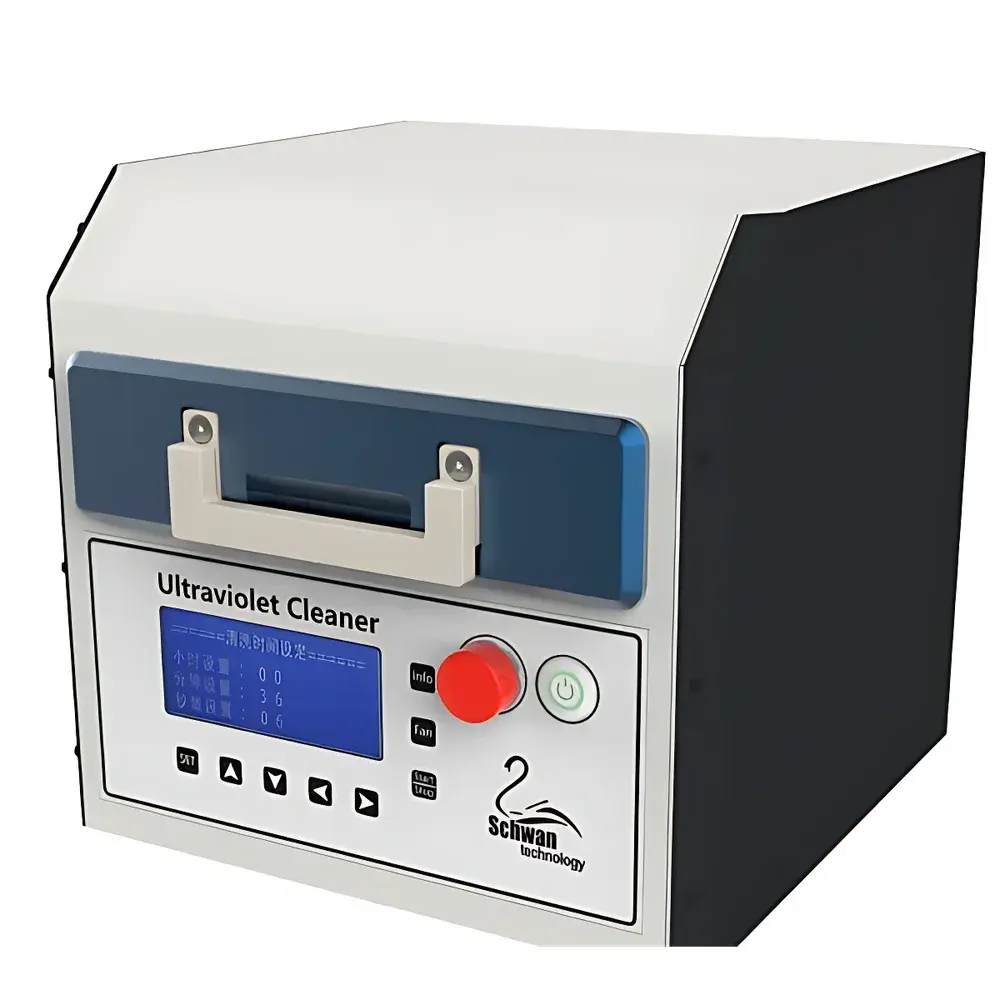
LEBO UC100-SE UV-Ozone Cleaner
| Brand | LEBO Science |
|---|---|
| Origin | Jiangyin, Jiangsu, China |
| Model | UC100-SE |
| Rated Voltage | AC 220 V, 50 Hz |
| Lamp Power | 275–300 W |
| Lamp Lifetime | ≥8,000 h |
| Emission Wavelengths | 184/185 nm + 254 nm |
| Maximum Substrate Size | ≤8-inch (200 mm) |
| Dimensions (W×D×H) | 330 × 400–420 × 315 mm |
| Weight | 15–16 kg |
Overview
The LEBO UC100-SE UV-Ozone Cleaner is a compact, benchtop dry cleaning system engineered for precision surface preparation in semiconductor fabrication, flat-panel display manufacturing, and advanced materials research. It operates on the well-established principle of vacuum-ultraviolet (VUV) photolysis combined with in situ ozone generation. Dual-wavelength low-pressure mercury lamps emit photons at 184/185 nm and 254 nm—energetically sufficient to directly cleave C–C, C–H, C–O, and C–N covalent bonds in organic contaminants (e.g., photoresist residues, hydrocarbon films, lubricants, and adventitious carbon). Concurrently, 184/185 nm radiation dissociates ambient O₂ to generate atomic oxygen (O), which rapidly combines with molecular oxygen to form ozone (O₃). This synergistic photochemical–oxidative process mineralizes organic layers into volatile byproducts (CO₂, H₂O, and low-molecular-weight oxides), leaving atomically clean, hydrophilic surfaces without solvents, plasma damage, or particulate redeposition.
Key Features
- Dual-band VUV lamp source: U-shaped or G-shaped low-pressure mercury lamps delivering stable, calibrated output at 184/185 nm (for O₂ dissociation and direct bond scission) and 254 nm (for ozone photolysis and secondary radical generation).
- Integrated embedded control system: Microprocessor-based controller with backlit dot-matrix LCD display and intuitive numeric keypad interface; supports programmable cleaning cycles (time range: 1–999 min), real-time lamp status monitoring, and fault diagnostics.
- Adjustable sample height mechanism: Precision X-type vertical positioning assembly enabling continuous, backlash-free height adjustment between lamp and substrate—critical for uniform irradiance distribution across 8-inch wafers or glass substrates.
- Five-stage variable-speed airflow management: Independently controllable intake and exhaust fans with five discrete speed settings optimize chamber gas exchange rate, ensuring consistent O₃ concentration, thermal stability, and removal of volatile reaction products.
- Ergonomic benchtop architecture: Compact footprint (≤0.14 m²), front-access loading, and low center-of-gravity design facilitate integration into Class 100–1000 cleanroom environments and routine lab workflows without requiring external exhaust ducting.
- Operational safety safeguards: Automatic interlock disables UV emission when chamber door is opened; touch-protection logic prevents unintended parameter changes during active cycles.
Sample Compatibility & Compliance
The UC100-SE accommodates rigid planar substrates up to 200 mm (8-inch) in diameter—including silicon wafers, fused silica, quartz, sapphire, ITO-coated glass, and polymer films (e.g., PET, PI). It is compatible with standard SEM/TEM sample stubs, AFM cantilever holders, and optical components. The cleaning process conforms to widely referenced industry protocols: ASTM F2163 (Standard Practice for Cleaning Silicon Wafers Using UV/Ozone), ISO 14644-1 (cleanroom air cleanliness classification), and SEMI S2/S8 (safety and ergonomics guidelines for semiconductor equipment). While not certified for GMP production use, its repeatable process parameters support GLP-compliant documentation when paired with external logging tools.
Software & Data Management
The UC100-SE operates as a standalone instrument with no proprietary PC software dependency. All operational data—including elapsed time, lamp-on hours, cycle count, and error codes—are stored in non-volatile memory and accessible via the front-panel interface. For traceability in regulated environments, users may integrate optional RS-232 or USB-to-serial adapters to log timestamps, cycle parameters, and lamp status to external systems. Though native support for FDA 21 CFR Part 11 electronic records is not implemented, audit trails can be reconstructed from exported logs when combined with validated third-party data acquisition platforms.
Applications
- Semiconductor processing: Pre-deposition cleaning of Si, GaAs, and SiC wafers prior to ALD, PVD, or lithography; removal of residual HMDS, BCB, or spin-on carbon films; surface activation before metal evaporation (Al, Cr, Ti) to suppress void formation and improve adhesion.
- Display technology: Photo-cleaning of TFT-LCD and OLED backplanes pre-coating with PI alignment layers, color filters, or ITO; enhancement of surface energy (≥72 mN/m) for uniform inkjet-printed emissive layer deposition.
- Scanning probe microscopy: In-situ cleaning of AFM tips, STM electrodes, and calibration gratings to eliminate hydrocarbon contamination that degrades resolution and causes tip convolution artifacts.
- Optics & photonics: Preparation of laser cavity mirrors, AR/HR coatings, and nonlinear crystals where sub-monolayer carbon contamination induces scattering loss or laser-induced damage.
- Research & development: Surface functionalization of graphene, MoS₂, and perovskite thin films; controlled oxidation of metal surfaces for catalytic studies; conditioning of microfluidic PDMS devices prior to plasma bonding.
FAQ
What is the typical cleaning time required for a 6-inch silicon wafer?
Cleaning duration depends on contaminant type and thickness; for monolayer hydrocarbons, 5–10 minutes achieves >95% removal (verified by XPS C1s peak reduction); heavily contaminated wafers may require 20–30 minutes.
Can the UC100-SE be used under nitrogen purge?
No—oxygen is essential for ozone generation and oxidative decomposition; operation requires ambient air or controlled humidified air (30–60% RH recommended for optimal O₃ yield).
Is lamp replacement user-serviceable?
Yes—lamps are modular and field-replaceable using standard Torx tools; alignment fixtures ensure repeatable optical coupling without recalibration.
Does the system generate measurable ozone leakage?
When operated in a well-ventilated lab (≥6 air changes/hour), ambient O₃ concentrations remain below 0.05 ppm (OSHA PEL), verified by onboard electrochemical sensor calibration points.
How is process reproducibility ensured across multiple units?
Each UC100-SE undergoes factory irradiance mapping at 185 nm and 254 nm using NIST-traceable radiometers; delivered irradiance uniformity across the 200-mm field is ±12% (1σ), supporting inter-lab method transfer.