
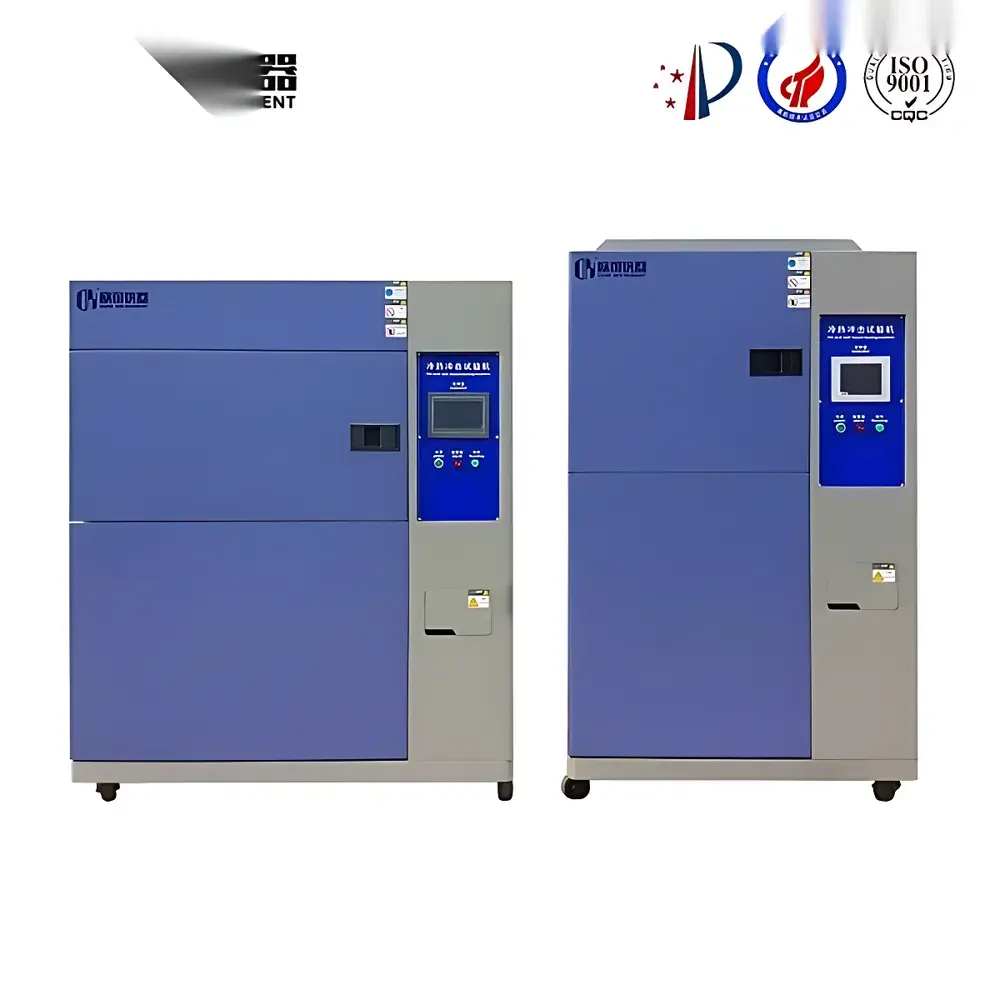
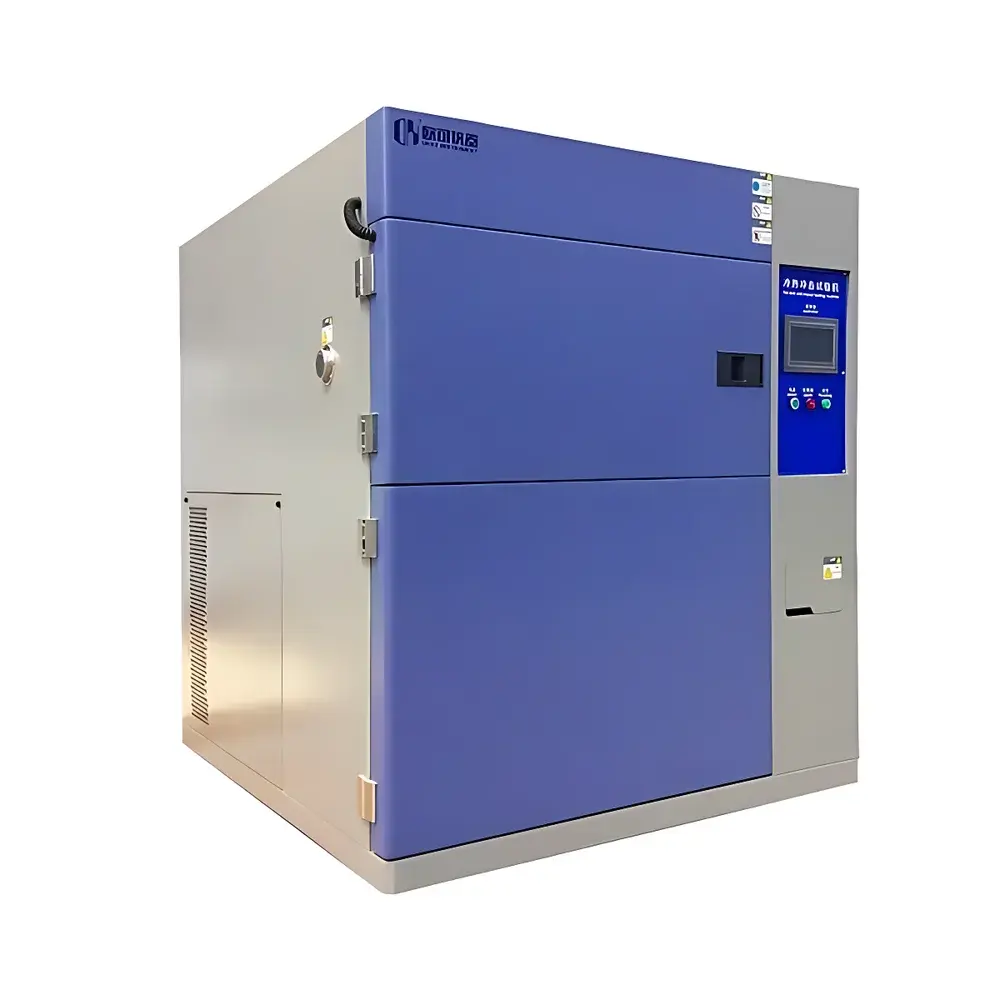
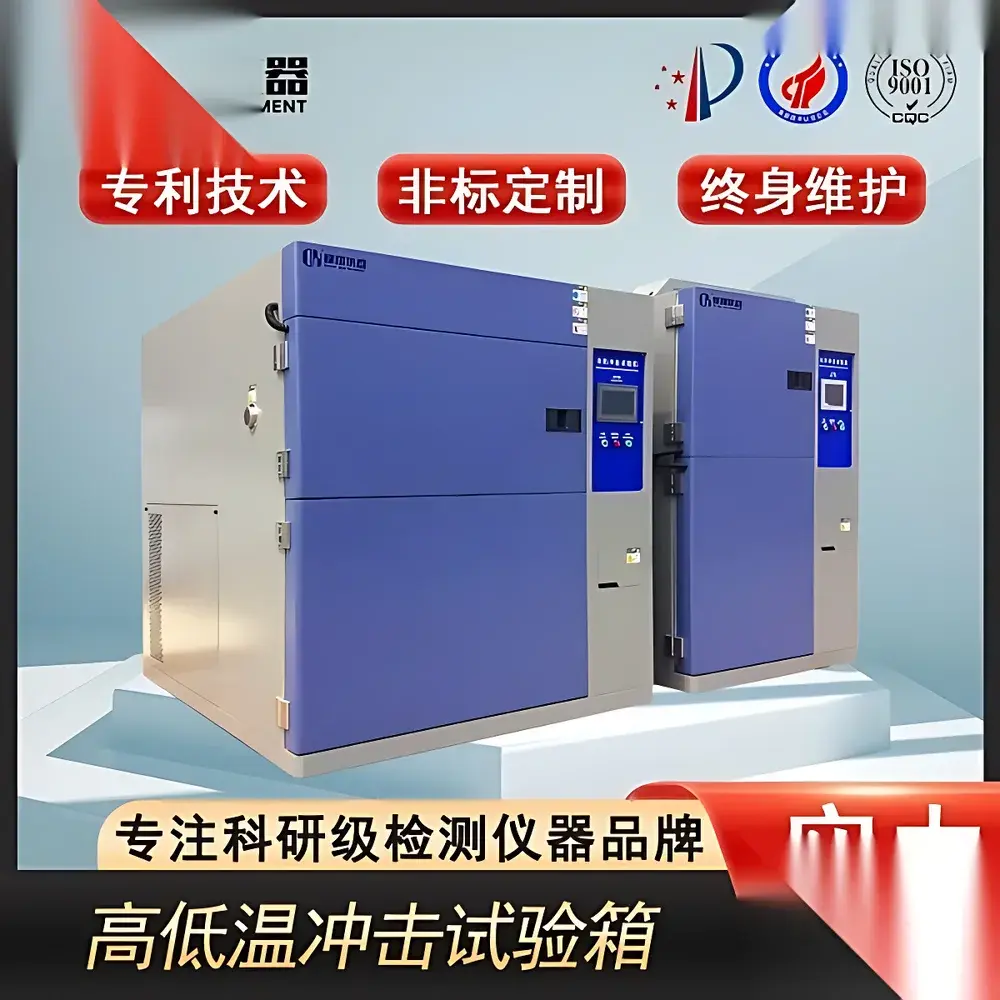
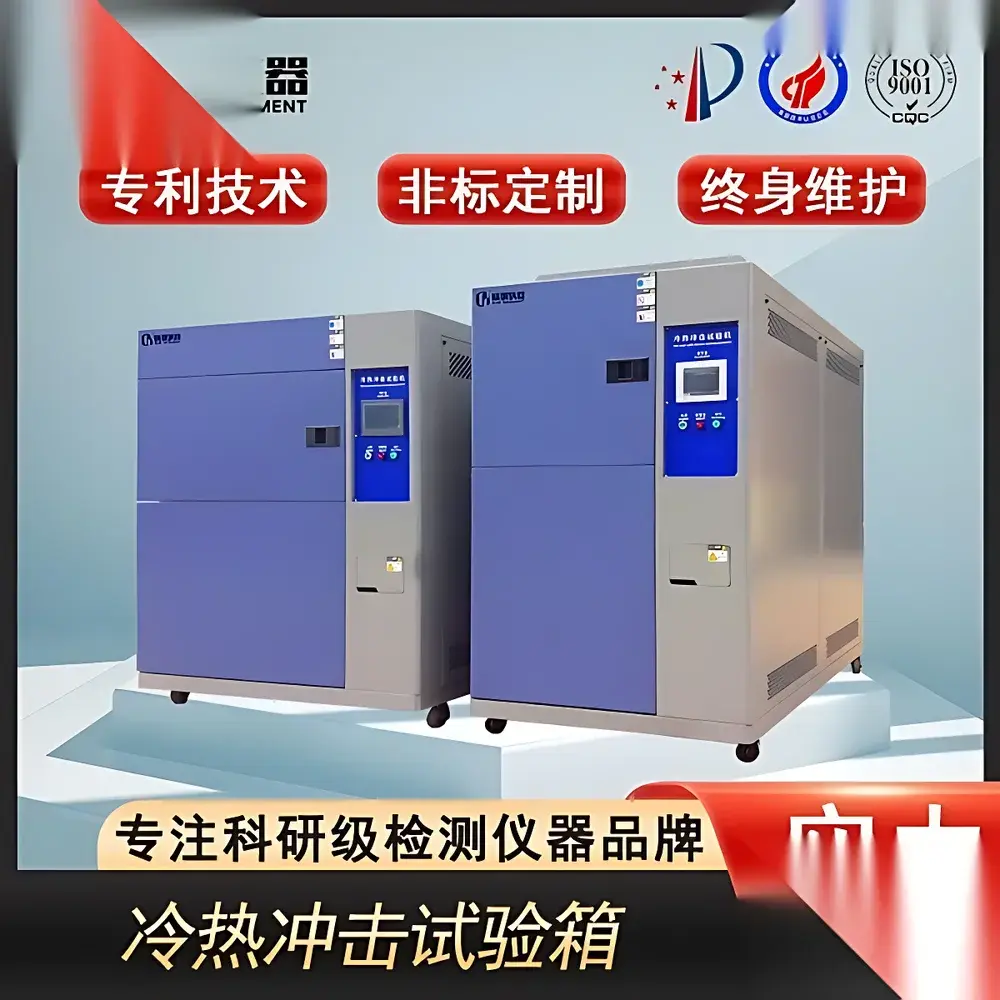
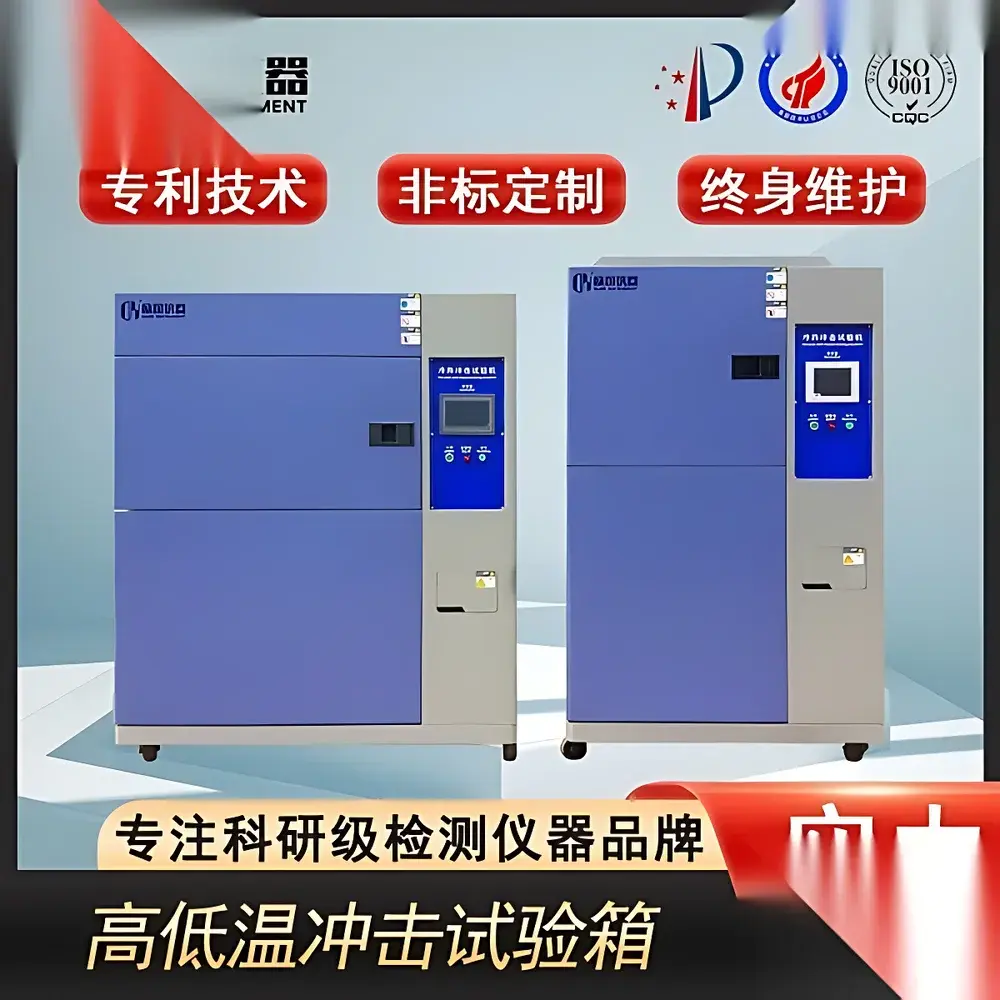
LED Cold Thermal Shock Test Chamber
| Brand | OEM |
|---|---|
| Origin | Imported |
| Manufacturer Type | Authorized Distributor |
| Price | USD 11,200 (FOB) |
| Temperature Range | −70°C to +180°C |
| Thermal Transition Time (5 min) | ≤15 s (air-to-air) |
| Recovery Time (after door opening) | ≤3 min |
| Control System | TEMI880 color touchscreen PLC controller (English/Chinese switchable) or TEMI300 membrane-key programmable controller (English only) |
| Refrigeration | Twin-stage or cascade refrigeration system with original French Tecumseh/Tecumseh-derived hermetic compressor |
| Heating | Nickel-chromium alloy wire heater |
| Humidification | Surface evaporation type |
| Air Circulation | Wide-band forced convection via centrifugal blower (top discharge / bottom intake) |
| Insulation | Polyurethane rigid foam (≥100 mm) + ultra-fine glass fiber |
| Inner Chamber Material | SUS304 stainless steel |
| Outer Chamber Material | Cold-rolled steel with electrostatic powder coating or optional SUS304 brushed finish |
| Door Seal | Dual-layer high-temp/low-temp resistant silicone rubber gasket |
| Standard Ports | One Ø50 mm test port (left side), dual-pane tempered observation window, two adjustable sample racks, fluorescent interior lighting, four swivel casters, integrated humidifier tank, RS485/RS232 communication interface |
Overview
The LED Cold Thermal Shock Test Chamber is an engineered environmental stress screening (ESS) system designed for rapid, repeatable thermal cycling between extreme low and high temperature zones. It operates on the air-to-air thermal shock principle—utilizing independent hot and cold reservoirs with high-speed pneumatic or mechanical transfer mechanisms—to subject electronic components, LED modules, PCB assemblies, automotive lighting systems, and optoelectronic packaging to accelerated aging under controlled, non-gradual temperature transitions. Unlike conventional temperature-humidity chambers, this unit delivers sub-15-second transition times between −70°C and +180°C, enabling compliance with MIL-STD-810H Method 503.5, JEDEC JESD22-A104F, IEC 60068-2-14, and AEC-Q200 stress protocols. Its architecture prioritizes thermal inertia minimization, spatial uniformity (<±0.5°C at steady state), and long-term operational stability in continuous duty cycles typical of reliability labs and Tier-1 supplier QA departments.
Key Features
- High-fidelity dual-zone thermal shock architecture with independently controlled hot (+180°C) and cold (−70°C) chambers and automated specimen transfer mechanism
- TEMI880 full-color 7-inch TFT touchscreen controller with dual-language UI (English/Chinese), real-time trend logging, and multi-segment programmable profiles (up to 999 steps)
- Cascade or two-stage refrigeration circuit using original Tecumseh hermetic compressors, ensuring stable sub-zero performance and extended mean time between failures (MTBF > 12,000 hrs)
- Broadband forced-air circulation system with backward-curved centrifugal blower and optimized duct geometry—achieving ≤±1.0°C temperature uniformity across 600 L working volume per IEC 60068-3-5
- Robust chamber construction: inner liner of mirror-finished SUS304 stainless steel; outer shell in electrostatically coated cold-rolled steel or optional brushed SUS304; 100 mm polyurethane insulation with vapor barrier
- Integrated safety interlocks including compressor overheat/overcurrent/overpressure protection, dry-run prevention for humidifier, water-level monitoring, and door-open thermal cutoff
Sample Compatibility & Compliance
The chamber accommodates standard LED packages (SMD 2835, 3030, 5050), COB arrays, driver ICs, heat-sink bonded substrates, and encapsulated optical lenses up to 450 mm × 450 mm × 400 mm (W×D×H). Its internal configuration supports static mounting via height-adjustable stainless steel racks and dynamic testing via optional rotary sample holders. All materials in contact with test specimens comply with RoHS Directive 2011/65/EU and are non-outgassing per ASTM E595. The system meets electromagnetic compatibility requirements per EN 61326-1 and is certified to IEC 61000-4 series immunity standards. Full traceability documentation—including factory calibration certificates for temperature sensors (PT100 Class A) and pressure transducers—is provided upon delivery.
Software & Data Management
The included PC-based control software (Windows 10/11 compatible) enables remote operation, profile synchronization, real-time data streaming (temperature, humidity, cycle count, alarm status), and automated report generation in PDF/CSV formats. Audit trails record all user actions, parameter changes, and system events with timestamped entries—supporting GLP/GMP-aligned validation per FDA 21 CFR Part 11 when configured with electronic signature modules. Data export conforms to ASTM E2913-20 metadata standards, facilitating integration into LIMS platforms such as LabWare or Thermo Fisher SampleManager. Firmware updates are delivered via secure HTTPS channel with SHA-256 integrity verification.
Applications
- Qualification testing of LED luminaires under cyclic thermal stress per LM-80 and TM-21 extrapolation models
- Failure mode analysis of solder joint integrity in automotive headlamp ECUs exposed to −40°C/+125°C shocks
- Validation of conformal coating adhesion and delamination resistance on flexible PCBs
- Accelerated life testing of phosphor-converted white LEDs subjected to 1,000+ shock cycles
- Thermal fatigue assessment of ceramic substrate bonding in high-power UV-C LED packages
- Pre-screening of encapsulant materials (silicones, epoxies) for coefficient of thermal expansion (CTE) mismatch
FAQ
What is the minimum dwell time per zone required for valid thermal shock testing?
Per JEDEC JESD22-A104F, minimum dwell time is 10 minutes per temperature extreme—configurable within the TEMI880 controller.
Can the chamber operate without humidification during thermal shock cycles?
Yes. Humidification is fully decoupled from thermal cycling; the system defaults to dry-shock mode unless explicitly enabled in the test profile.
Is NIST-traceable calibration included with purchase?
A full factory calibration certificate (traceable to NIST via DAkkS-accredited lab) is supplied; on-site IQ/OQ/PQ validation support is available under separate service agreement.
What maintenance intervals are recommended for the refrigeration system?
Compressor oil analysis and filter-drier replacement every 4,000 operating hours; annual inspection of refrigerant charge and heat exchanger cleanliness per ISO 8573-1.
Does the chamber meet CE marking requirements for EU deployment?
Yes. Certified to EN 61000-6-2 (immunity), EN 61000-6-4 (emissions), EN 61010-1 (safety), and carries CE mark with Declaration of Conformity.



