
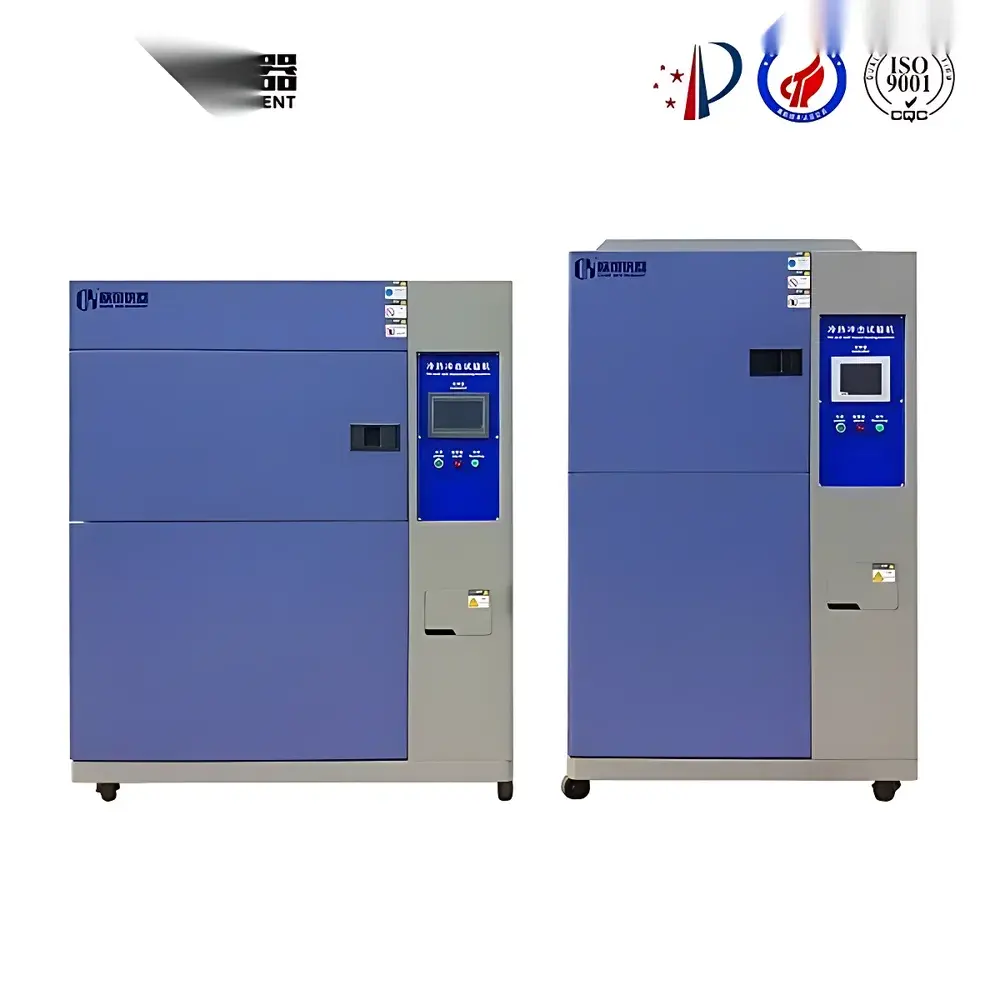
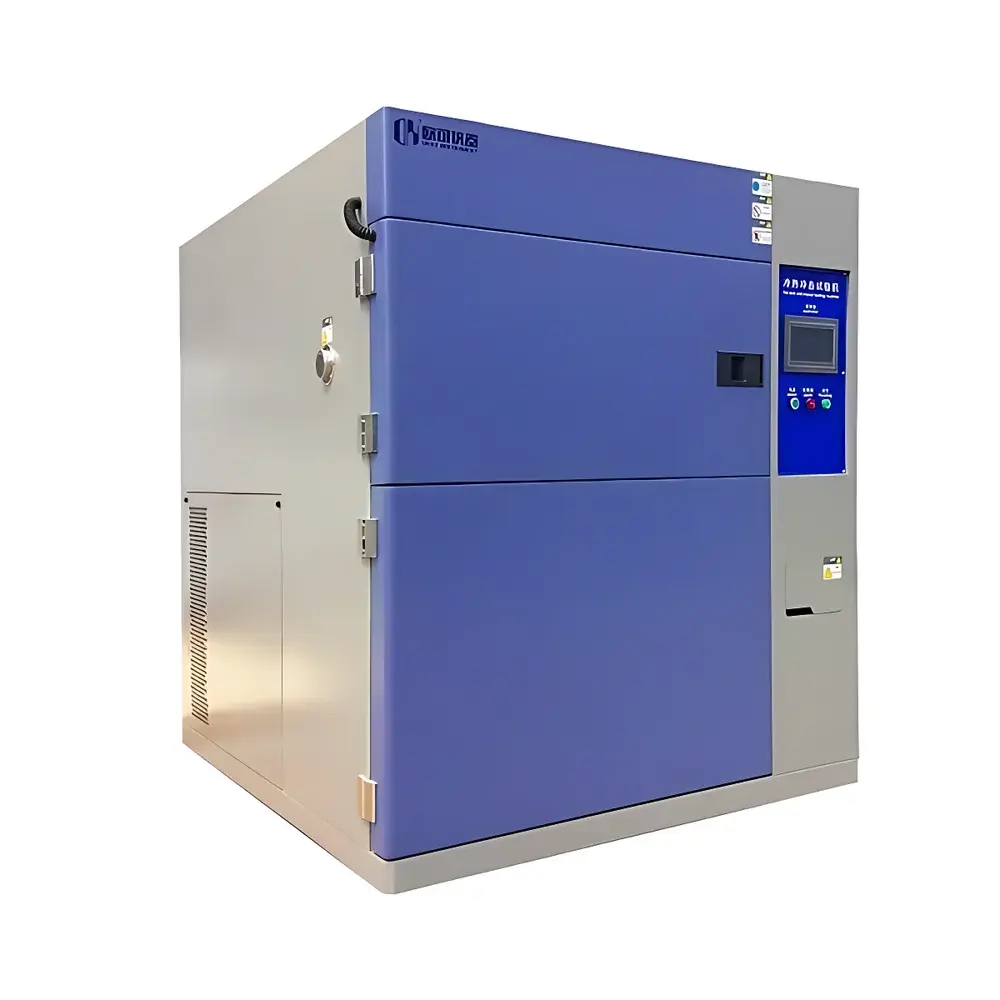
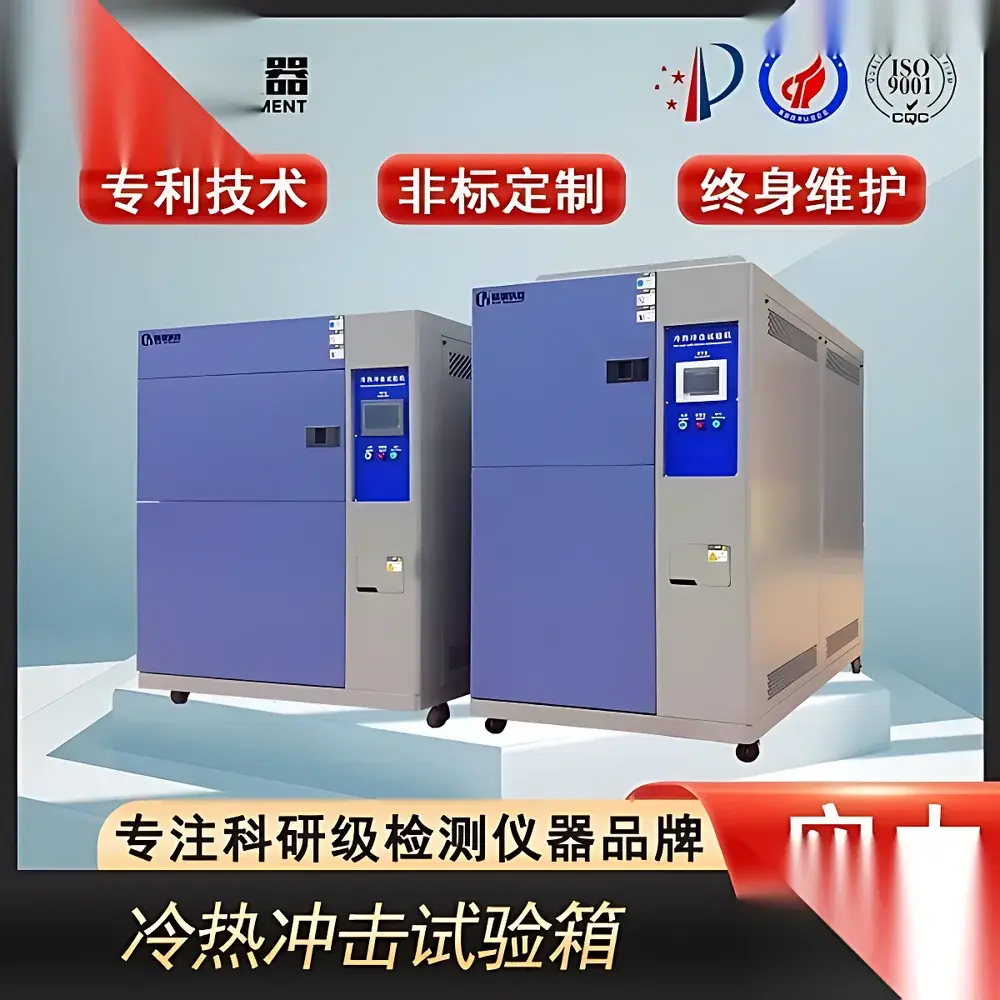
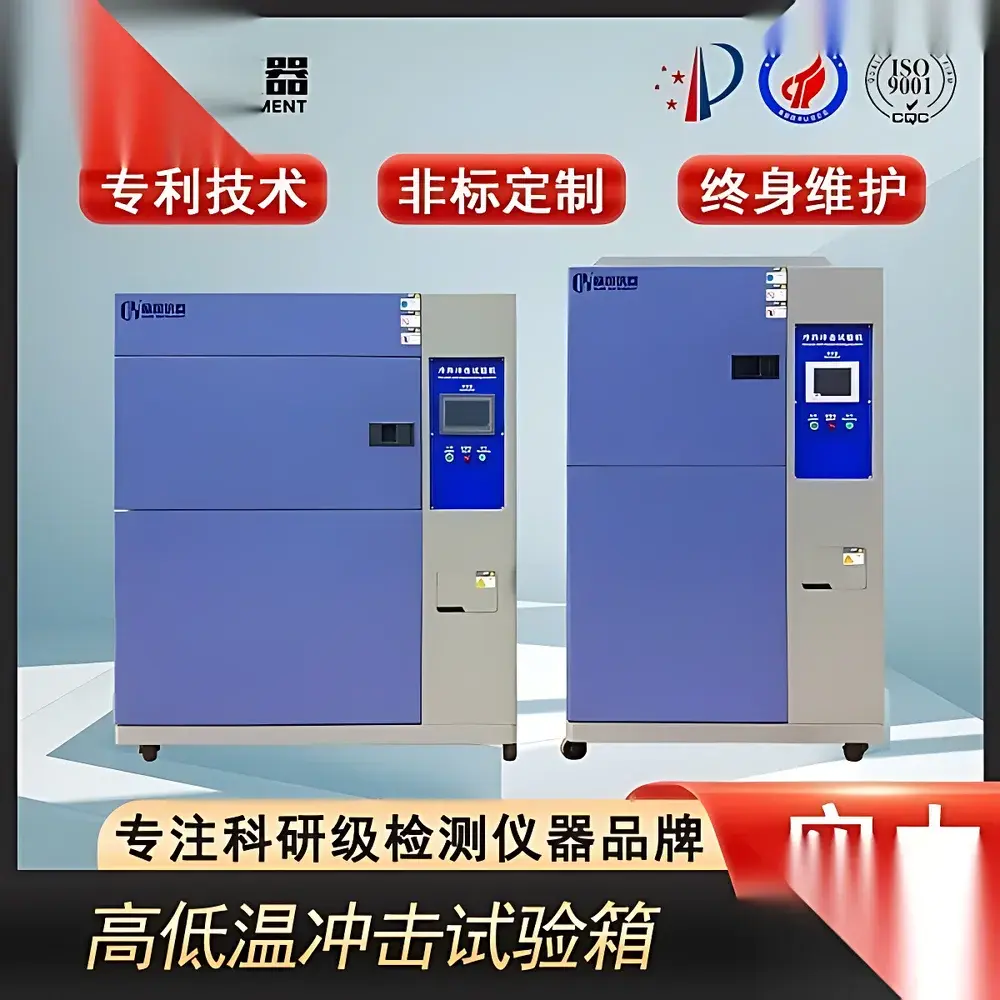
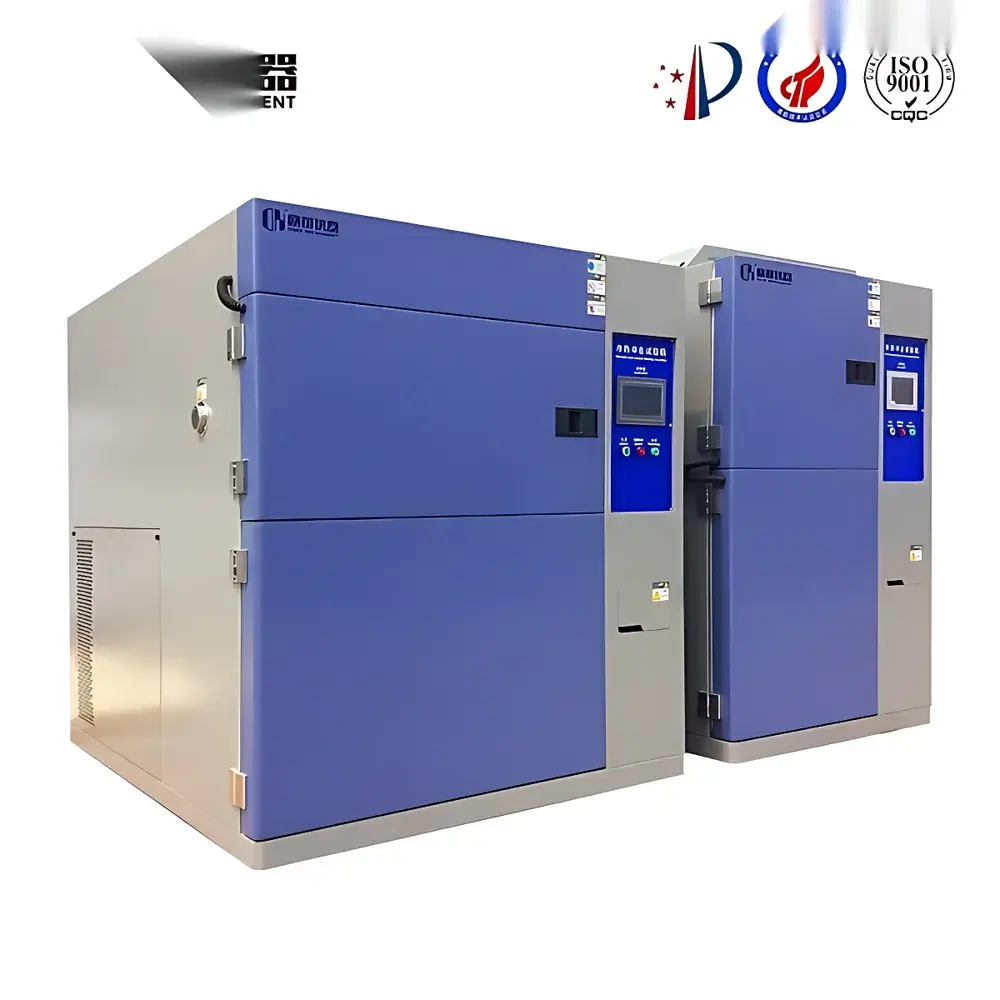
LED Thermal Shock Test Chamber
| Key | Brand: Other Brands |
|---|---|
| Origin | Imported |
| Manufacturer Type | General Distributor |
| Price | USD 12,500 (FOB) |
| Internal Dimensions (W×H×D) | 40×35×30 cm to 70×60×60 cm |
| Temperature Range (Hot Zone) | RT to +200 °C |
| Temperature Range (Cold Zone) | RT to −70 °C |
| Test Zone Range | +60 °C to +150 °C (hot shock) |
| Switching Mechanism | Pneumatic air-door, static sample placement |
| Recovery Time | <5 min |
| Temperature Uniformity | ±2.0 °C |
| Control Accuracy | ±0.5 °C |
| Refrigeration | Dual-stage cascade system with semi-hermetic compressors (R404A/R23) |
| Insulation | High-density fire-retardant PU foam |
| Interior Material | SUS#304 mirror-finish stainless steel |
| Exterior Material | SUS#304 stainless steel or powder-coated steel |
| Power Supply | AC 380 V ±5%, 50 Hz ±0.5 Hz, 3-phase 5-wire |
Overview
The LED Thermal Shock Test Chamber is a precision-engineered environmental test system designed for accelerated evaluation of material integrity under extreme, rapid temperature transitions. It operates on the principle of thermal shock testing—subjecting specimens to abrupt, repetitive shifts between high- and low-temperature environments to simulate real-world operational stresses encountered during transport, storage, or field deployment. Unlike standard thermal cycling chambers, this unit employs a three-zone architecture (hot soak chamber, cold soak chamber, and test chamber), enabling true static-sample testing with pneumatic air-door switching—eliminating mechanical motion artifacts and ensuring consistent thermal loading across the entire specimen surface. The chamber is optimized for reliability-critical sectors including LED packaging, automotive electronics, aerospace components, and high-density PCB assemblies, where microstructural defects induced by coefficient-of-thermal-expansion (CTE) mismatch must be identified prior to qualification.
Key Features
- Three-chamber static-test configuration: eliminates basket movement, preserving specimen orientation and minimizing vibration-induced measurement noise
- Dual-stage cascade refrigeration system using semi-hermetic compressors (imported German design) and environmentally compliant refrigerants (R404A/R23), delivering stable operation down to −70 °C in the cold zone and up to +200 °C in the hot zone
- High-efficiency evaporative condenser coupling ensures precise inter-stage energy transfer and enables rapid thermal recovery (<5 minutes per transition cycle)
- Advanced PID-based digital temperature controller with ±0.5 °C setpoint accuracy and ±2.0 °C uniformity across the test volume
- Fire-retardant, high-density polyurethane insulation (imported grade) minimizes thermal leakage and supports long-term stability under repeated thermal stress
- Corrosion-resistant SUS#304 mirror-finish stainless steel interior and optional exterior cladding ensure compatibility with cleanroom and ISO Class 5–8 environments
- Standardized 50 mm diameter cable/port access with silicone gasket seal, supporting in-situ electrical monitoring during thermal transients
Sample Compatibility & Compliance
This chamber accommodates a broad range of non-hazardous solid specimens—including LED modules, IC packages, solder joints, conformal-coated assemblies, and polymer-encapsulated sensors—within configurable internal volumes (49 L to 225 L). Its static-test architecture ensures no mechanical perturbation during thermal transitions, making it suitable for fragile or metrology-sensitive samples. The system fully complies with internationally recognized thermal shock and temperature change standards, including: IEC 60068-2-14 (Test N: Change of Temperature), MIL-STD-810G Method 503.5, GJB 150.5A-2009 (Temperature Shock), GB/T 2423.22–2012 (Temperature Change), and SJ/T 10186–1991 / SJ/T 10187–1991 (two- and one-box variants). It supports audit-ready documentation for GLP and GMP-regulated validation protocols, including traceable calibration records and deviation logs aligned with ISO/IEC 17025 requirements.
Software & Data Management
The integrated controller features Ethernet-enabled data logging with timestamped temperature profiles for both hot and cold zones, plus real-time monitoring of test chamber conditions. Export formats include CSV and PDF reports compatible with LabArchives, JMP, and Minitab for statistical process control (SPC) analysis. Optional software add-ons support FDA 21 CFR Part 11 compliance—including electronic signatures, role-based access control, and immutable audit trails for all parameter changes and cycle executions. All firmware updates are delivered via secure HTTPS, and historical run data is retained for ≥12 months without external storage dependency.
Applications
- Qualification testing of LED phosphor adhesion and die-attach integrity under repeated thermal excursions
- Evaluation of solder joint fatigue resistance in automotive ADAS modules subjected to −40 °C to +125 °C cycling
- Validation of encapsulant delamination thresholds in high-power semiconductor packages
- Reliability screening of MEMS sensor housings exposed to rapid ambient temperature fluctuations
- Process development support for reflow profile optimization and underfill cure validation
- Failure mode identification in multi-material assemblies where CTE mismatch drives interfacial cracking
FAQ
What distinguishes a three-chamber thermal shock chamber from a two-chamber (basket-type) system?
The three-chamber design maintains specimen immobility throughout testing—critical for optical alignment stability, weight-sensitive components, and avoiding false failures caused by mechanical shock. Two-chamber systems rely on moving baskets, introducing inertial forces and positional variability.
Is external cooling water infrastructure required?
Yes. The dual-stage cascade refrigeration system requires a dedicated closed-loop cooling tower (10 m³/h capacity) installed outdoors. This ensures consistent condensing performance at ambient temperatures up to 40 °C.
Can the chamber be validated per IQ/OQ/PQ protocols?
Yes. Factory-installed NIST-traceable PT100 sensors, documented uncertainty budgets, and preconfigured validation templates (per ASTM E2297 and ISO 17025) are provided as part of the commissioning package.
What safety certifications does the unit carry?
CE marking (EMC Directive 2014/30/EU and Low Voltage Directive 2014/35/EU), RoHS 2011/65/EU compliance, and UL-listed power distribution components (per UL 61010-1).
Are custom internal configurations available?
Yes. Custom shelf layouts, additional porting, nitrogen purge integration, and humidity-controlled variants (with desiccant drying loop) can be engineered upon request—subject to structural and thermal load analysis.



