
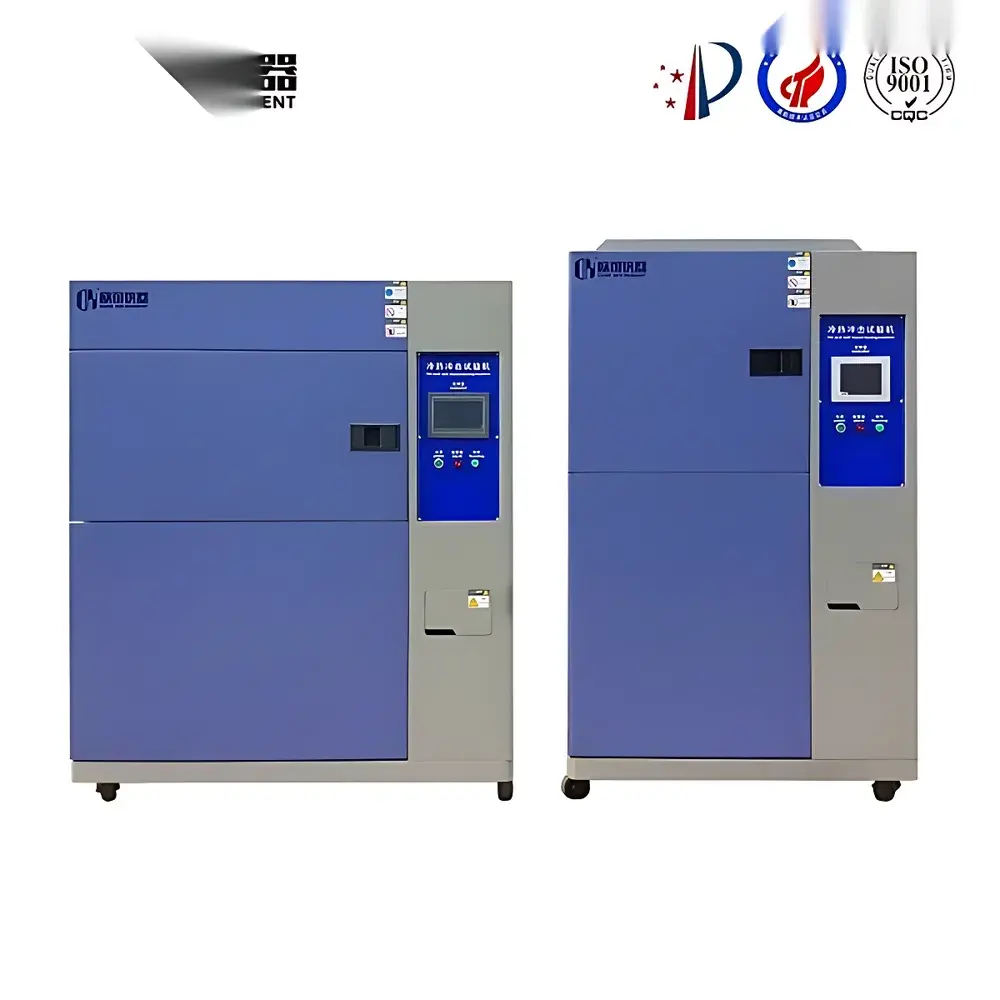
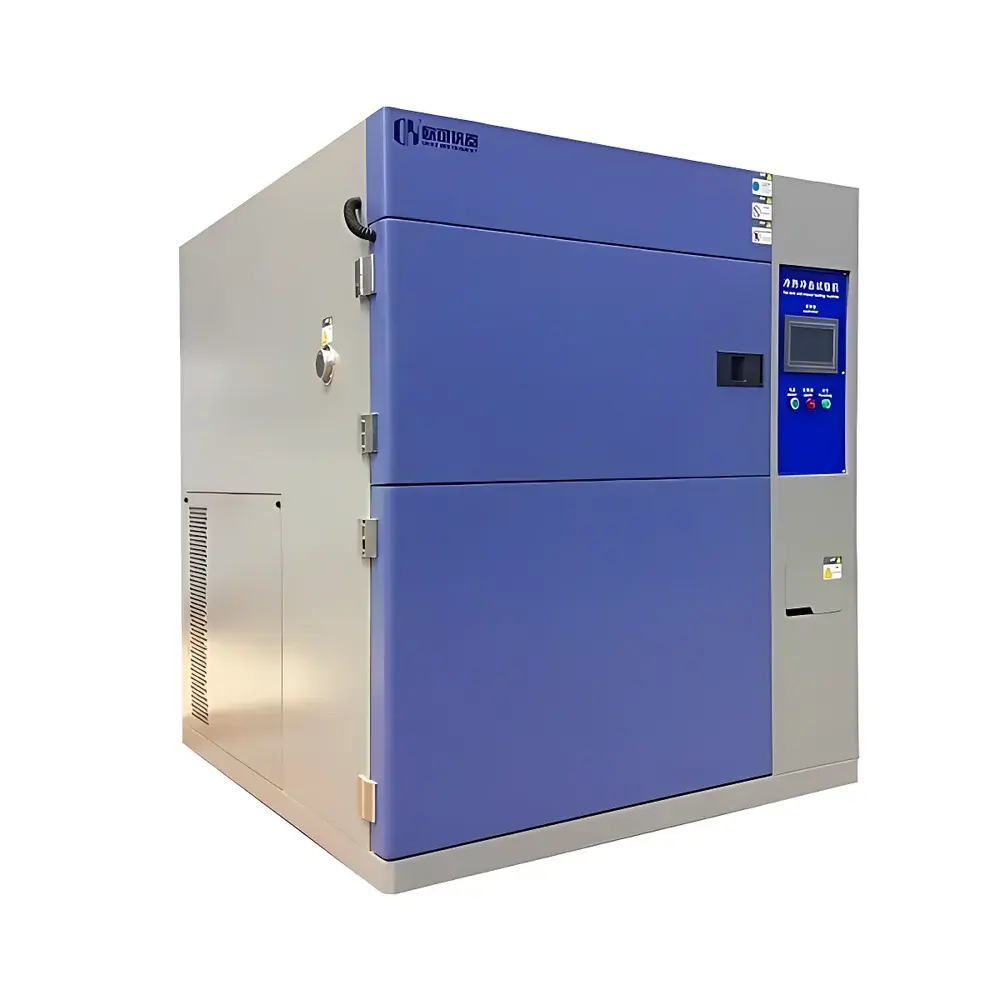
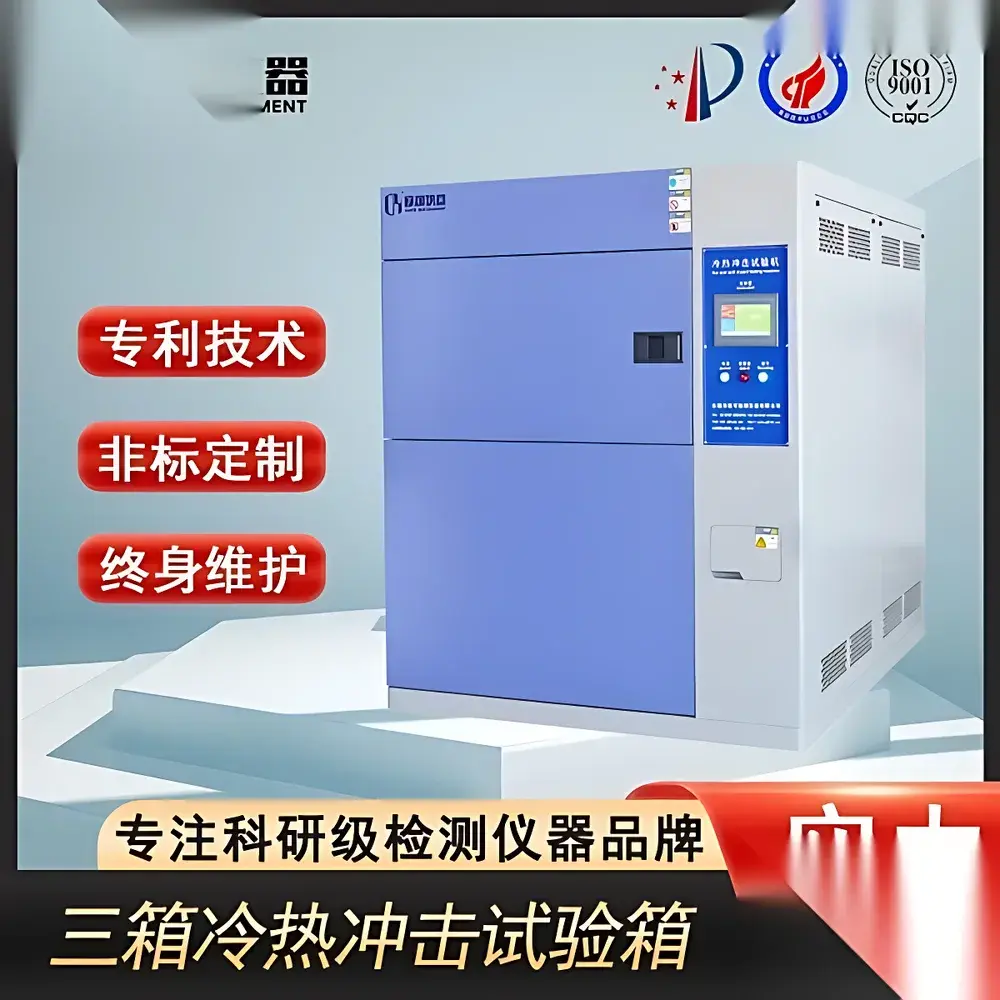
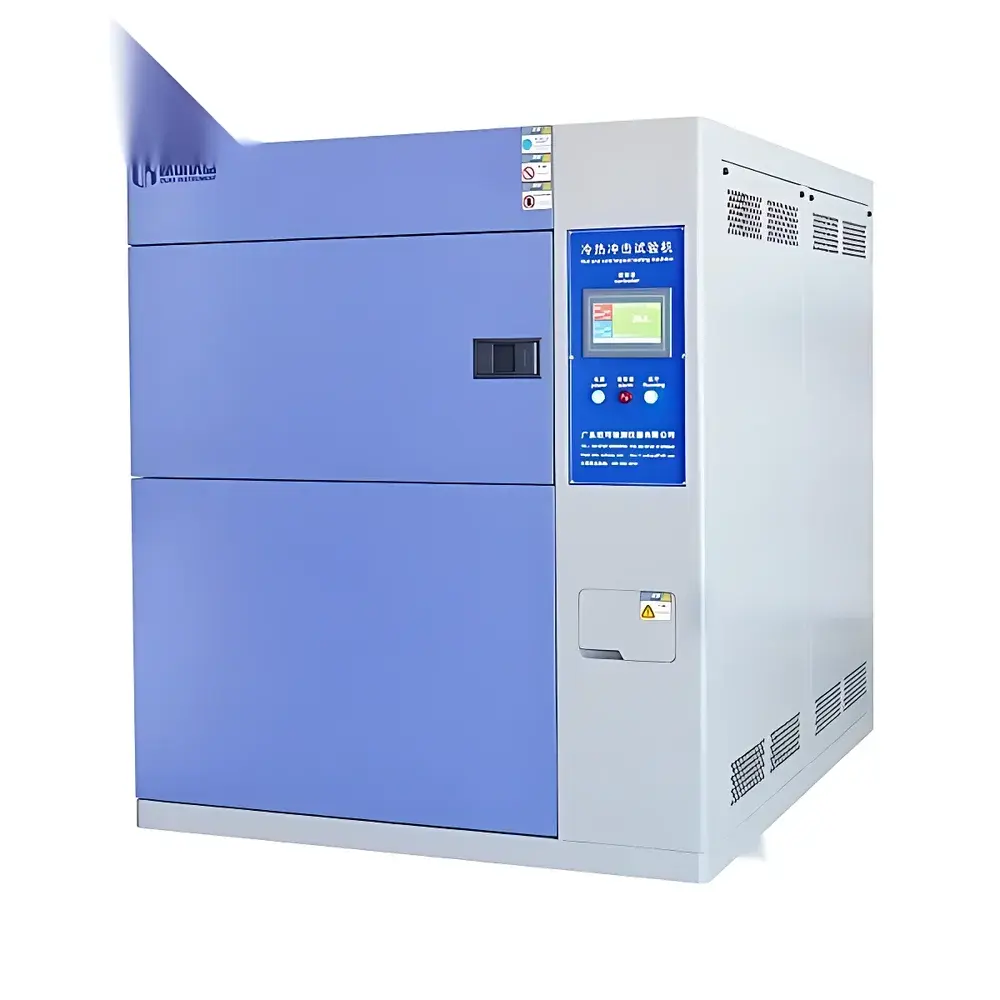
LED Thermal Shock Test Chamber
| Brand | OEM |
|---|---|
| Origin | Imported |
| Manufacturer Type | Authorized Distributor |
| Price | USD 12,500 (FOB) |
| Internal Dimensions (W×H×D) | 40×35×30 cm to 70×60×60 cm |
| Temperature Range | High Zone: RT to +200°C |
| Low Zone | RT to −70°C |
| Test Zone | +60°C to +150°C (hot shock), 0°C to −65°C (cold shock) |
| Transfer Mechanism | Pneumatic air-door switching (stationary test specimen) |
| Recovery Time | <5 min |
| Temperature Uniformity | ±2.0°C |
| Control Accuracy | ±0.5°C |
| Refrigeration | Dual-stage cascade system with semi-hermetic German compressors |
| Refrigerant | R404A/R23 |
| Insulation | High-density fire-retardant PU foam |
| Interior Material | Mirror-finish SUS304 stainless steel |
| Exterior | SUS304 or powder-coated steel |
| Power Supply | AC 380 V ±5%, 50 Hz ±0.5 Hz, 3-phase 5-wire |
Overview
The LED Thermal Shock Test Chamber is a precision-engineered environmental stress screening (ESS) system designed for accelerated reliability validation of electronic components, automotive modules, aerospace assemblies, and advanced polymeric materials. It operates on the principle of rapid thermal transients—subjecting test specimens to abrupt, high-magnitude temperature transitions between extreme hot and cold reservoirs—thereby inducing thermomechanical stress sufficient to reveal latent defects such as interfacial delamination, solder joint fatigue, coating cracking, or coefficient-of-thermal-expansion (CTE) mismatch failure. Unlike conventional temperature cycling chambers, this unit employs a three-compartment architecture (hot soak chamber, cold soak chamber, and test chamber), enabling true static-sample testing with pneumatic door actuation—eliminating mechanical motion artifacts and ensuring repeatable, ISO/IEC 17025-compliant thermal profiles. Its design conforms to the fundamental physics of transient heat transfer in solids, leveraging controlled convective exchange and minimized thermal mass inertia to achieve sub-5-minute recovery times and stable dwell conditions per MIL-STD-810H Method 503.5 and IEC 60068-2-14.
Key Features
- Three-zone cascade architecture: independent hot chamber (RT to +200°C), cold chamber (RT to −70°C), and insulated test chamber—ensuring zero cross-contamination and precise thermal zoning.
- Pneumatically actuated high-speed air doors (cycle time <1.5 s) enable rapid chamber isolation and thermal transfer without moving the DUT—critical for optical alignment-sensitive LED packages and MEMS devices.
- Dual-stage refrigeration system using semi-hermetic German compressors and environmentally compliant R404A/R23 refrigerant blend—optimized for sustained operation at −65°C cold soak and efficient energy modulation across load variations.
- High-fidelity temperature control via PID + fuzzy logic algorithm with real-time adaptive compensation; achieves ±0.5°C setpoint accuracy and ±2.0°C uniformity across full working volume.
- Mirror-finish SUS304 stainless steel interior with seamless welds and electropolished surfaces—resistant to condensation-induced corrosion and compatible with cleanroom-grade validation protocols.
- Modular insulation using imported fire-retardant polyurethane foam (λ ≤ 0.022 W/m·K) ensures low thermal leakage and stable ambient decoupling—even under continuous 24/7 thermal shock duty cycles.
Sample Compatibility & Compliance
The chamber accommodates rigid and semi-rigid samples up to 70 × 60 × 60 cm (OK-HH-225 model), including PCBAs with surface-mounted LEDs, automotive ECUs, sensor housings, encapsulated optoelectronic modules, and composite structural coupons. Standardized mounting fixtures and two-tier SUS304 shelf supports ensure consistent airflow distribution and minimize thermal shadowing. The system fully satisfies the procedural and performance requirements of multiple international standards: GB/T 2423.1–2022 (cold), GB/T 2423.2–2022 (dry heat), GB/T 2423.22–2012 (temperature change), GJB 150.3A–2009 (military thermal shock), IEC 60068-2-14 (change of temperature), and EIA-364-32 (connector thermal shock). All operational parameters—including ramp rates, dwell durations, and transition times—are programmable and auditable, supporting GLP/GMP documentation workflows and FDA 21 CFR Part 11-compliant electronic records when integrated with optional validation software.
Software & Data Management
Equipped with an embedded industrial touchscreen HMI (10.1″ TFT, IP65-rated), the chamber provides intuitive profile programming, real-time multi-channel temperature monitoring (up to 8 external thermocouple inputs), and automatic data logging at user-defined intervals (100 ms to 60 s resolution). Export formats include CSV and PDF reports compliant with ISO/IEC 17025 clause 7.8. Optional Ethernet/WiFi connectivity enables remote supervision via web-based SCADA interface and integration into enterprise MES/QMS platforms (e.g., TrackWise, MasterControl). Audit trail functionality records all operator actions, parameter changes, and alarm events with timestamped digital signatures—meeting traceability requirements for ISO 9001:2015 Clause 8.5.2 and IATF 16949 Section 8.5.1.2.
Applications
- Qualification testing of high-brightness LED packages under JEDEC JESD22-A106 (thermal shock) and JESD22-A104 (temperature cycling).
- Reliability screening of automotive ADAS sensors subjected to SAE J2223 and ISO 16750-4 environmental stress profiles.
- Failure analysis of solder interconnects in fine-pitch BGAs using accelerated thermal shock to induce intermetallic growth or void coalescence.
- Material compatibility assessment of conformal coatings, potting compounds, and underfill epoxies exposed to repeated CTE mismatch stress.
- Process validation of vacuum reflow and vapor phase soldering equipment by simulating post-process thermal gradients.
- Pre-conditioning of calibration standards prior to dimensional metrology in temperature-controlled coordinate measuring machines (CMMs).
FAQ
What is the difference between two-box and three-box thermal shock configurations?
A two-box system uses a single test chamber that physically moves between hot and cold zones via a motorized basket—introducing mechanical vibration and longer transition times. The three-box design maintains a stationary test specimen while pneumatically routing airflow between isolated hot/cold reservoirs—yielding superior repeatability, faster recovery, and no motion-induced artifacts.
Does the chamber support automated test sequencing per MIL-STD-810H?
Yes. Predefined MIL-STD-810H Method 503.5 profiles—including ramp rate, dwell time, cycle count, and failure criteria thresholds—are built into the firmware and可 exported as validated test scripts.
Is external cooling water required for operation?
Yes. The dual-stage cascade refrigeration system requires a dedicated closed-loop cooling tower delivering 10 m³/h of water at ≤32°C inlet temperature—typically installed outdoors per ASHRAE Guideline 15.
Can the chamber be qualified for IQ/OQ/PQ under GxP environments?
Absolutely. Full qualification documentation packages—including URS, FDS, SAT, and 3Q protocols—are available upon request, aligned with ASTM E2500 and Annex 15 of the EU GMP Guide.
What safety certifications does the unit carry?
CE marking per Machinery Directive 2006/42/EC and Low Voltage Directive 2014/35/EU; RoHS 2011/65/EU compliant; UL/cUL listing optional upon configuration review.



