
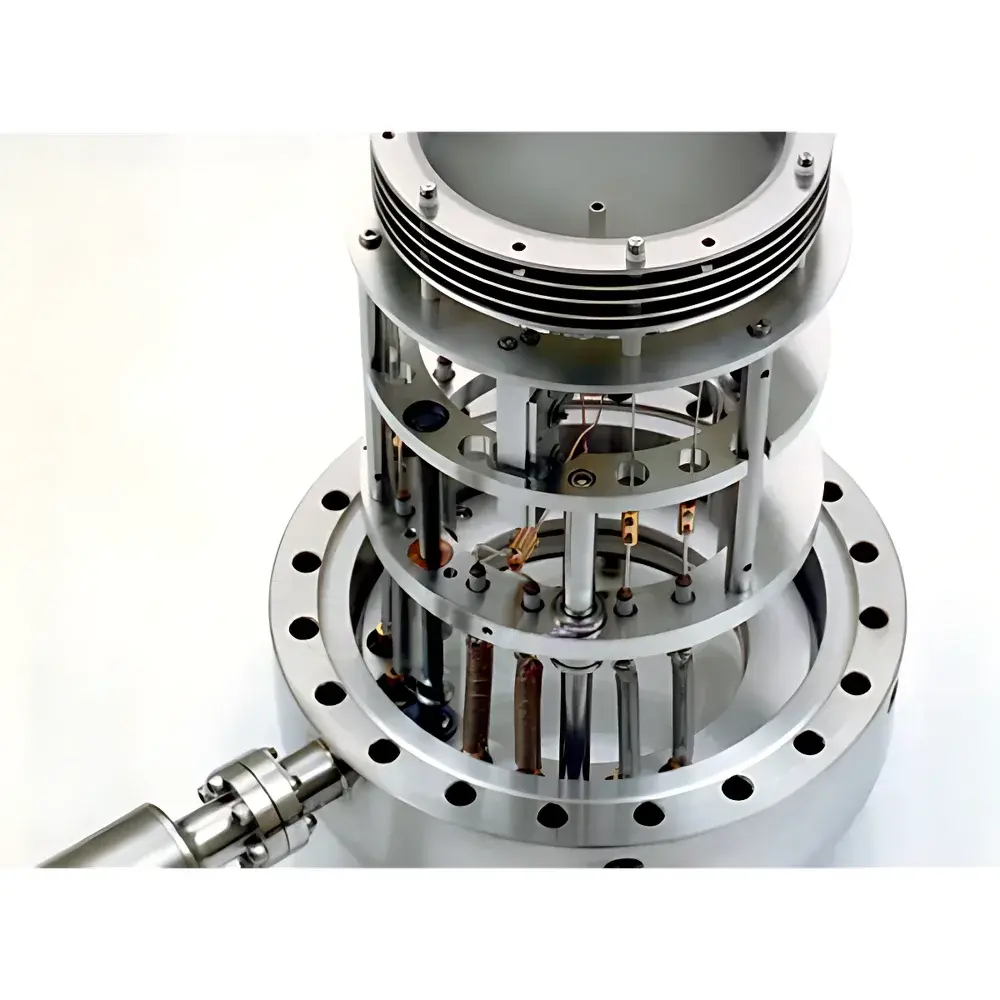
LEED Low-Energy Electron Diffraction System RVL2000 by LK (USA)
| Brand | Angstrom (USA) |
|---|---|
| Origin | USA |
| Manufacturer Type | Authorized Distributor |
| Origin Category | Imported |
| Model | RVL2000 |
| Pricing | Upon Request |
Overview
The RVL2000 LEED (Low-Energy Electron Diffraction) System, engineered and distributed by LK (USA) since 1998, is a high-precision surface science instrument designed for atomic-scale structural characterization of crystalline surfaces under ultra-high vacuum (UHV) conditions. Operating on the principle of elastic scattering of low-energy electrons (typically 20–200 eV), the system generates diffraction patterns that directly reflect the two-dimensional periodicity and symmetry of surface atomic lattices. Unlike bulk-sensitive techniques, LEED provides exclusive sensitivity to the topmost 1–3 atomic layers, making it indispensable for studies of surface reconstruction, adsorbate ordering, epitaxial growth, and interface formation in catalysis, semiconductor processing, and thin-film materials research. The RVL2000 integrates a compact, all-metal UHV-compatible electron optical column with rigorously minimized outgassing pathways—eliminating polymer-coated wiring, glass-fiber insulation, or epoxy-based assemblies to ensure long-term vacuum integrity below 1×10⁻¹⁰ mbar.
Key Features
- UHV-optimized electron optics: Fully metallic construction with no polymer or glass-fiber insulation; compliant with standard UHV bake-out protocols (up to 150 °C).
- Precision 4-grid tungsten electron gun: 1.59 cm (0.625″) diameter, enabling stable beam emission with 103° angular acceptance and <0.5% energy resolution at nominal operating voltages.
- Modular optical design: Retractable optics configuration with standard 2-inch and optional 4-inch retraction stroke, facilitating alignment flexibility and integration with adjacent surface analysis tools.
- Dual-mode detection capability: Compatible with both Faraday cup and microchannel plate (MCP) detectors—supporting pA- and nA-level current measurement via integrated lock-in amplifier for enhanced signal-to-noise ratio in weak-diffraction regimes.
- Integrated flange architecture: Features built-in viewport, electrical feedthroughs (16-pin CF-compatible), and standardized ConFlat (CF) mounting interfaces (6″ and 8″ OD variants available).
- Co-analysis readiness: Optimized mechanical and electrical layout for seamless coupling with Auger Electron Spectroscopy (AES) systems, including shared differential pumping stages and synchronized raster scanning.
Sample Compatibility & Compliance
The RVL2000 accommodates planar, conductive, or semi-conductive samples up to 25 mm in diameter mounted on standard sample holders compatible with common UHV manipulators (e.g., Omicron, SPECS, Unisoku). Sample heating (up to 1200 K) and cooling (down to 80 K) options are available via resistive or liquid-nitrogen cryo-stages. All components meet ASTM E1577–22 (Standard Practice for Specifying and Reporting Surface Analysis Data) and ISO 18115–2:2016 (Surface Chemical Analysis — Vocabulary — Part 2: Terms Used in Auger Electron Spectroscopy and X-ray Photoelectron Spectroscopy). The system’s electrical grounding, shielding, and feedthrough design comply with IEC 61000-6-3 (EMC Emission Standards) and supports GLP/GMP-aligned documentation workflows when paired with validated data acquisition software.
Software & Data Management
Control and acquisition are managed through a Windows-based native application supporting real-time diffraction pattern capture, azimuthal rotation mapping, and I-V curve generation (intensity vs. incident electron energy). Software includes automated calibration routines for beam alignment and stigmatic focusing, along with export modules for ASCII, TIFF, and HDF5 formats. Audit-trail functionality logs operator actions, parameter changes, and system status per FDA 21 CFR Part 11 requirements when configured with electronic signature modules. Raw data files retain full metadata—including vacuum pressure history, filament temperature, lens voltages, and detector gain settings—ensuring traceability for peer-reviewed publication or regulatory submission.
Applications
- Quantitative determination of surface superstructures and domain boundaries on single-crystal metal and oxide substrates.
- In-situ monitoring of surface phase transitions during thermal annealing or reactive gas exposure (e.g., CO oxidation on Pt(111)).
- Validation of molecular beam epitaxy (MBE) growth modes via real-time spot intensity evolution.
- Adsorbate-induced reconstruction analysis (e.g., Si(111)-(7×7), Ge(105)-(16×16)).
- Interfacial lattice matching assessment in van der Waals heterostructures and 2D material stacks.
- Complementary use with XPS and AES for combined chemical state and structural symmetry assignment.
FAQ
Is the RVL2000 compatible with existing UHV chambers from other manufacturers?
Yes—the system uses industry-standard CF flanges (6″ and 8″ OD), fully documented electrical pinouts, and mechanically decoupled optical mounts to enable retrofit integration into chambers from SPECS, Omicron, Scienta Omicron, and Focus GmbH.
What vacuum level is required for optimal LEED performance?
A base pressure ≤5×10⁻¹¹ mbar is recommended prior to data acquisition; stable operation is maintained down to 1×10⁻¹⁰ mbar with appropriate beam current adjustment.
Can the RVL2000 be operated remotely for unattended experiments?
Yes—Ethernet-enabled controller firmware supports TCP/IP communication, allowing full command-line and script-driven operation via Python or LabVIEW APIs.
Does the system include alignment aids for novice users?
It features an integrated alignment assistant module with step-by-step visual guidance, real-time beam profile feedback, and auto-focus routines based on diffraction ring sharpness metrics.
Are service and calibration support available outside North America?
LK maintains authorized service partners in Germany, Japan, South Korea, and Singapore, offering on-site calibration, UHV leak-checking, and electron-optical alignment certification per ISO/IEC 17025 standards.







