
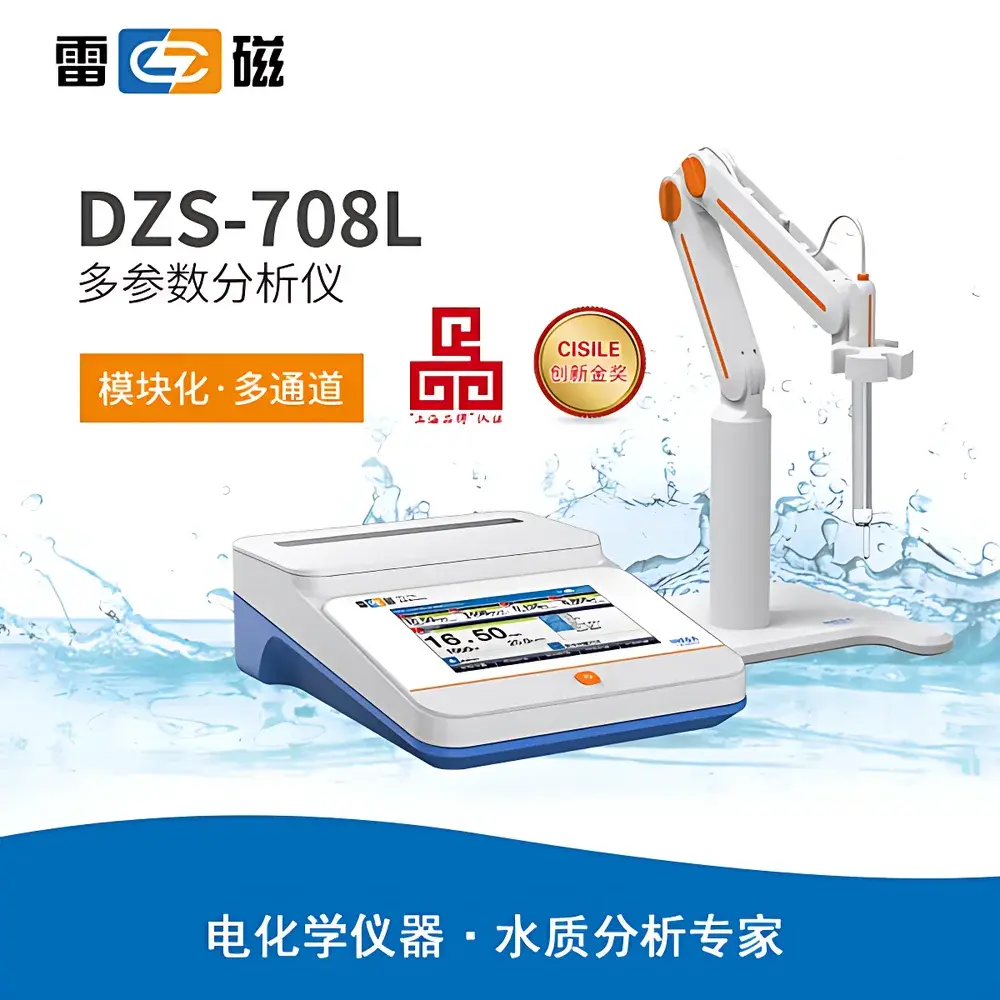
Lei-Mag DZS-708L Multi-Parameter Water Quality Analyzer
| Brand | Lei-Mag |
|---|---|
| Origin | Shanghai, China |
| Manufacturer Type | Direct Manufacturer |
| Instrument Type | Laboratory Water Quality Analyzer |
| Model | DZS-708L |
| Measurement Parameters | pH, ORP, mV, pX, Ion Concentration, Conductivity, Resistivity, TDS, Salinity, Ash Content, Dissolved Oxygen (DO) Concentration, DO Saturation, Temperature |
| Display | 7-inch HD color capacitive touchscreen |
| IP Rating | IP54 |
| Channels | 4 independent measurement channels |
| Supported Modules | pH Module, pX Module, EC-T (2-electrode conductivity), EC-F (4-electrode conductivity), DO-F (fluorescence-based DO), DO-P (polarographic DO) |
| Compliance | GLP, GMP-ready audit trail, ASTM D1125, ISO 7888, ISO 5814, USP <643>, EN 27888 |
| Data Storage | 1000 measurement records per parameter, 100 calibration sets, 1000 verification logs |
| Interfaces | RS-232, USB-A, USB-B (PC connection), optional barcode scanner support |
| Operating Environment | 0–40 °C, ≤85% RH |
Overview
The Lei-Mag DZS-708L Multi-Parameter Water Quality Analyzer is a modular, laboratory-grade benchtop instrument engineered for high-precision, multi-analyte assessment of aqueous samples in environmental monitoring, municipal water treatment, pharmaceutical process water validation, and academic research laboratories. Built upon a dual-sensor architecture with automatic module recognition, it implements standardized electrochemical measurement principles—including potentiometric ion-selective electrode (ISE) detection for pH/pX/ion concentration, two-electrode AC conductivity (ASTM D1125 compliant), and optical fluorescence quenching for dissolved oxygen (ISO 5814)—ensuring metrological traceability and inter-laboratory comparability. Its 7-inch capacitive touchscreen interface supports bilingual operation (English/Chinese), configurable temperature units (°C/°F), and real-time visualization of dynamic sensor diagnostics. Designed to meet the operational rigor of regulated environments, the DZS-708L incorporates hardware-level safeguards including power-fail recovery, factory reset protection, and embedded firmware upgradability—enabling long-term adaptability without hardware replacement.
Key Features
- Modular 4-channel platform supporting simultaneous or sequential analysis across six interchangeable sensor modules: pH, pX (ion-selective), EC-T (2-electrode conductivity), EC-F (4-electrode conductivity), DO-F (fluorescence-based DO), and DO-P (polarographic DO)
- Automatic module identification and plug-and-play configuration—no manual setup required upon insertion
- GLP-compliant data integrity architecture: full electronic audit trail, user-level access control (3-tier permissions), password-protected method editing, and timestamped calibration/verification logs
- Advanced endpoint determination algorithms: auto-read, timed-read, interval-read, and manual-trigger modes with configurable stability criteria
- Comprehensive calibration management: support for 1–6-point pH/pX calibrations; 1–5-point conductivity calibrations; zero/full-scale DO calibration with atmospheric pressure and salinity compensation
- Embedded buffer standard recognition: automatic identification of GB, NIST, DIN, JIS, ASTM, and MERK pH and conductivity reference solutions
- Rugged industrial design: IP54-rated enclosure, 2.0 kg compact footprint (240 × 310 × 98 mm), wide operating range (0–40 °C, ≤85% RH)
Sample Compatibility & Compliance
The DZS-708L is validated for use with natural waters (surface, groundwater, seawater), wastewater effluents, drinking water, purified water (PW), water-for-injection (WFI), and process rinse solutions. Its measurement methodologies align with internationally recognized standards: pH and ORP measurements conform to ISO 10523 and ASTM D1293; conductivity analysis meets ISO 7888 and ASTM D1125 specifications; fluorescence-based DO quantification complies with ISO 5814 and EN 27888; and TDS/salinity calculations follow USP guidelines. All stored data—including raw sensor outputs, calibration coefficients, verification results, and operator actions—are time-stamped, digitally signed, and retained with immutable metadata to satisfy FDA 21 CFR Part 11 requirements for electronic records and signatures when deployed with validated software configurations.
Software & Data Management
Data handling is structured around regulatory readiness and workflow efficiency. The instrument stores up to 1000 measurement records per parameter type, 100 calibration datasets, and 1000 verification logs—including pH buffer checks, conductivity standard verifications, and DO zero/full-scale validations. Export options include CSV (for spreadsheet analysis), PDF (for report generation), and direct printing via RS-232-compatible thermal or dot-matrix printers. USB-A port enables method import/export using Lei-Mag’s proprietary PC communication software, while USB-B facilitates secure data transfer to Windows-based workstations. All exported files retain full metadata: sample ID, operator ID, module serial number, calibration history, ambient conditions, and measurement timestamps. GMP-oriented features include role-based login, editable audit trail filters, and exportable operator activity logs for internal quality audits.
Applications
The DZS-708L serves critical roles across multiple sectors: environmental labs performing EPA Method 150.1 (conductivity), 365.1 (phosphate via ISE), and 365.4 (nitrate); municipal water utilities verifying compliance with WHO and EU Drinking Water Directive parameters; pharmaceutical QC labs monitoring PW/WFI per USP and ; and university research groups conducting kinetic studies on redox-active species or salinity-dependent microbial respiration. Its fluorescence-based DO module eliminates membrane fouling and oxygen consumption artifacts common in Clark-type sensors—making it ideal for low-flow, high-accuracy biological oxygen demand (BOD) pre-screening and bioreactor monitoring. The pX module supports quantitative analysis of Ag⁺, F⁻, NO₃⁻, Ca²⁺, and other priority ions using Gran plot, standard addition, and direct concentration methods—fully traceable to certified reference materials.
FAQ
Does the DZS-708L support FDA 21 CFR Part 11 compliance?
Yes—when used with validated PC software and configured with enabled audit trail, electronic signatures, and role-based access controls, the system meets core Part 11 requirements for electronic records and signatures.
Can I use third-party electrodes or sensors with this analyzer?
Only modules and electrodes certified by Lei-Mag are supported for calibration recognition, automatic parameter assignment, and GLP-compliant data logging. Non-certified accessories may function but will not trigger auto-ID or store calibration metadata.
What is the difference between EC-T and EC-F conductivity modules?
EC-T employs a two-electrode cell optimized for low-to-mid conductivity ranges (0.000 µS/cm to 20 mS/cm) with linear temperature compensation; EC-F uses a four-electrode cell for high-accuracy, high-range measurements (up to 3000 mS/cm), minimizing polarization errors in saline or contaminated samples.
How does the DO-F module achieve improved stability over polarographic sensors?
The fluorescence-based DO-F module measures oxygen-dependent quenching of a ruthenium complex immobilized on an optode film—eliminating cathodic current drift, electrolyte depletion, and membrane clogging associated with DO-P systems.
Is method validation documentation available for regulatory submissions?
Lei-Mag provides IQ/OQ protocols, metrological traceability statements, and test reports aligned with ISO/IEC 17025. Full validation packages require site-specific PQ execution under client-defined SOPs.
Related Products







