
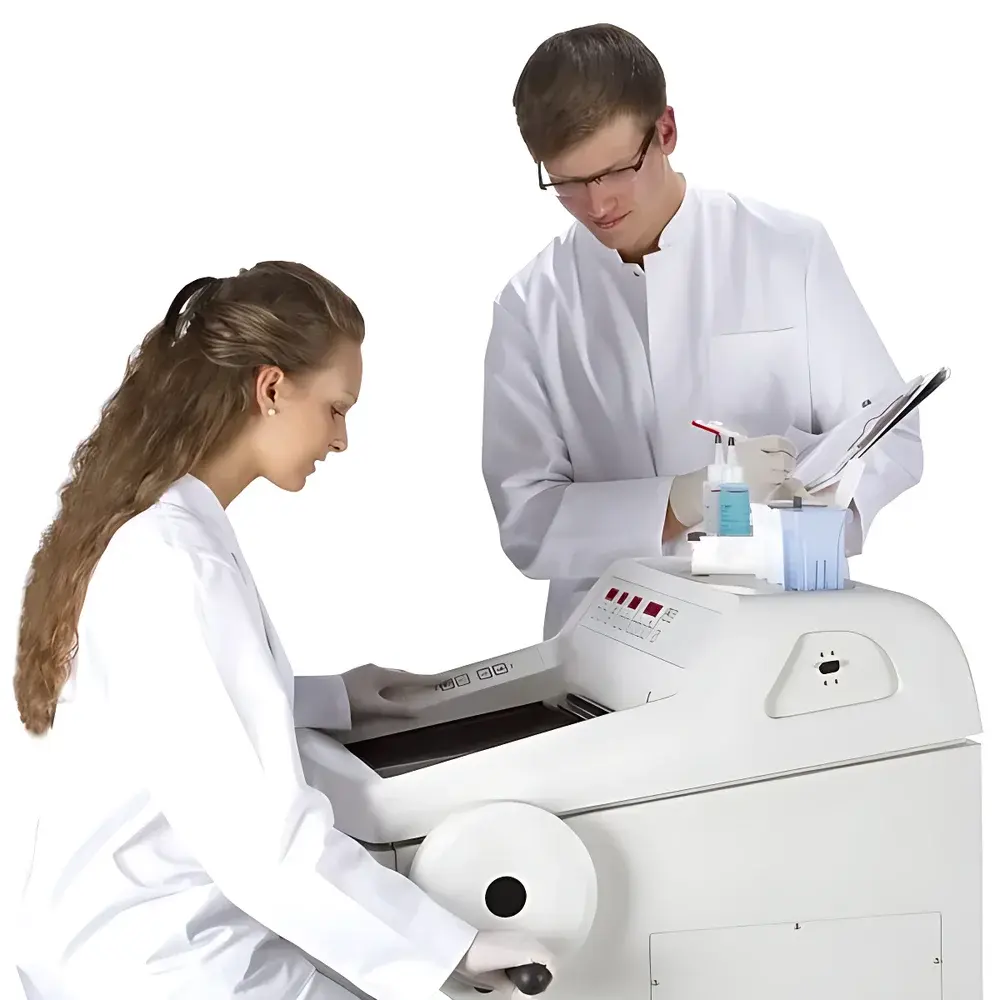
Leica CM1520 Cryostat Microtome
| Brand | Leica Biosystems |
|---|---|
| Origin | Germany |
| Model | CM1520 |
| Maximum Sample Size | 55 mm × 55 mm or 50 mm × 80 mm |
| Section Thickness Range | 2 µm to 60 µm |
| Sectioning Increment | 25 µm + 3 µm step adjustment |
Overview
The Leica CM1520 Cryostat Microtome is a precision-engineered, actively cooled cryostat designed for high-fidelity frozen sectioning in clinical histopathology and translational research laboratories. Operating on the principle of cryo-microtomy—where tissue specimens are rapidly frozen to sub-zero temperatures (typically −20 °C to −30 °C) to maintain structural integrity and minimize ice crystal artifact—the CM1520 enables real-time, intraoperative diagnostic support, including Mohs micrographic surgery, rapid tumor margin assessment, and neurosurgical specimen evaluation. Its thermally optimized chamber architecture, combined with a high-capacity refrigeration system and low-thermal-mass specimen stage, ensures consistent thermal stability across extended operation cycles. Unlike passive cooling systems, the CM1520 integrates active Peltier-based cooling for rapid temperature equilibration (<5 minutes from ambient to −25 °C), reducing pre-sectioning delay and improving workflow continuity in time-critical diagnostic settings.
Key Features
- Active dual-zone cooling system: Independent temperature control of specimen stage (−5 °C to −35 °C) and cryochamber (−15 °C to −40 °C), ensuring optimal thermal gradient for brittle or lipid-rich tissues.
- Precision motorized sectioning drive: Stepper-motor-controlled advance mechanism with fine-tuned increment resolution (25 µm base setting + 3 µm micro-adjustment), enabling reproducible thickness selection across the full 2–60 µm range.
- Ergonomic specimen orientation: Integrated 8° angular tilt function allows rapid repositioning of tissue blocks without manual re-mounting—critical for achieving optimal plane-of-section in irregular or layered specimens.
- Sealed, low-maintenance mechanical design: Fully enclosed knife carrier and drive train minimize dust ingress and lubricant migration, extending service intervals and sustaining long-term cutting accuracy per ISO 13485-aligned quality protocols.
- Intuitive human-machine interface: Single-layer tactile control panel with dedicated physical dials for section thickness, chamber temperature, and anti-roll plate position—eliminating nested menu navigation and reducing operator training time.
- Modular workspace configuration: Includes adjustable accessory tray, removable instrument shelf, and forward-positioned specimen loading platform to support ISO/IEC 17025-compliant lab ergonomics and spatial standardization.
Sample Compatibility & Compliance
The CM1520 accommodates standard OCT-embedded tissue cassettes up to 55 mm × 55 mm or elongated formats up to 50 mm × 80 mm, compatible with Leica’s full line of cryo-knives (disposable steel, tungsten carbide, and reusable stainless-steel variants). It supports routine processing of soft tissues (e.g., brain, breast, skin), fatty specimens (e.g., adipose-rich tumors), and calcified samples when paired with appropriate blade geometry and cryo-temperature optimization. The system complies with IEC 61010-1:2010 for laboratory equipment safety and meets electromagnetic compatibility requirements per EN 61326-1. While not FDA 510(k)-cleared as a standalone diagnostic device, it is routinely deployed in CLIA-certified and CAP-accredited laboratories under documented SOPs aligned with College of American Pathologists (CAP) ANP.43200 and ISO 15189:2022 clause 5.3.2 for pre-analytical instrumentation validation.
Software & Data Management
The CM1520 operates as a standalone hardware platform without embedded software or network connectivity—intentionally designed to eliminate cybersecurity vulnerabilities and ensure deterministic mechanical performance. All operational parameters (section thickness, chamber temperature, knife angle) are recorded manually or via external LIMS-integrated logbooks per GLP/GMP Annex 11 principles. Optional Leica Biosystems documentation kits provide traceable calibration certificates, preventive maintenance logs, and temperature mapping reports compliant with USP <1058> Analytical Instrument Qualification frameworks. Audit trails for critical adjustments are maintained through paper-based or validated electronic lab notebook (ELN) entries, satisfying 21 CFR Part 11 requirements when implemented within a controlled digital infrastructure.
Applications
- Intraoperative frozen section analysis during Mohs surgery and wide local excision procedures.
- Rapid neuropathological assessment of biopsy cores and resection margins in neuro-oncology.
- Preparation of frozen sections for immunofluorescence, enzyme histochemistry, and lipid-soluble stain protocols requiring preserved antigenicity.
- Quality control of biobanked tissues prior to nucleic acid or protein extraction.
- Training platform for histotechnologist certification programs accredited by the National Society for Histotechnology (NSH) and ASCP.
FAQ
What is the minimum achievable section thickness on the CM1520, and how is consistency ensured?
The CM1520 achieves a minimum section thickness of 2 µm using calibrated stepper-motor advancement and rigid knife alignment—verified during factory acceptance testing per ASTM E2925-20 standards for microtome performance characterization.
Does the CM1520 support automated staining integration?
No; it is a dedicated cryosectioning instrument. Staining must be performed post-sectioning on separate platforms (e.g., Leica ST5010 or Bond RX systems) in accordance with CAP ANP.43450 pre-stain handling guidelines.
Is remote monitoring or IoT connectivity available?
No—this model intentionally omits network interfaces to preserve operational reliability, thermal stability, and regulatory compliance in diagnostic environments governed by HIPAA and GDPR data-handling mandates.
How often does the refrigeration system require servicing?
Under typical clinical use (≤8 hours/day), the sealed Peltier modules require no scheduled maintenance beyond annual temperature uniformity verification and chamber seal inspection per Leica Service Bulletin SB-CM1520-Rev.4.
Can the CM1520 be validated for GMP environments?
Yes—when operated within a documented IQ/OQ/PQ protocol referencing ISO 13485:2016 Annex C and EU Annex 15, the CM1520 supports qualification for pharmaceutical histopathology workflows involving non-clinical toxicology studies.



