
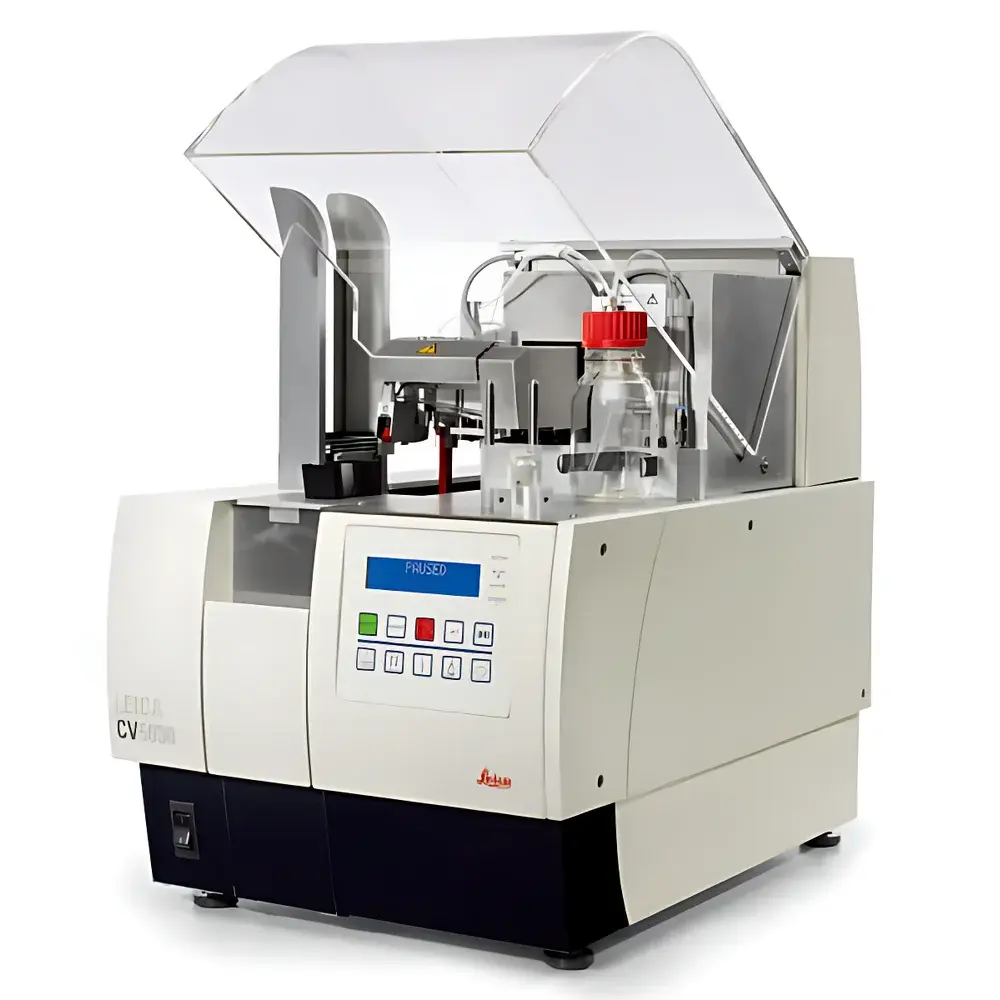
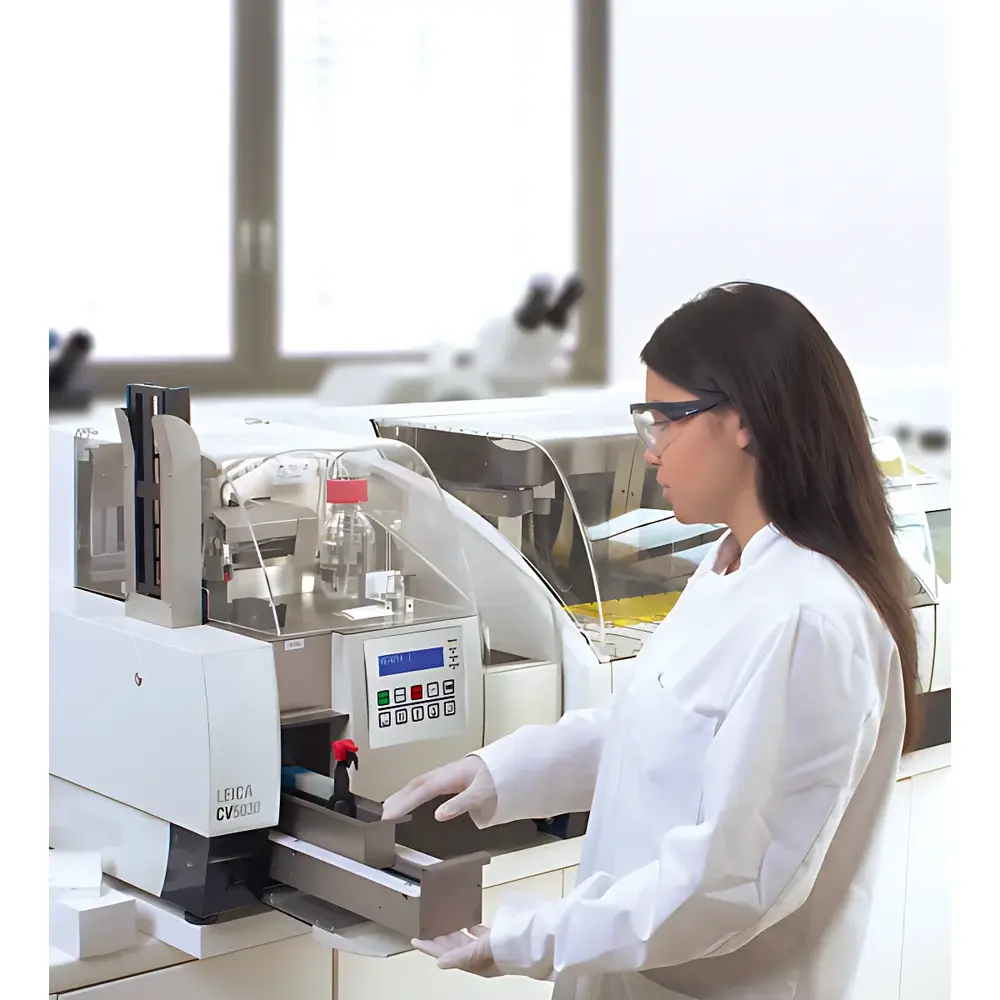
Leica CV5030 Fully Automated Coverslipper
| Brand | Leica Biosystems |
|---|---|
| Origin | Germany |
| Model | CV 5030 |
| Throughput | 400 slides/hour |
| Slide Compatibility | Standard microscope slides and variable coverslip sizes |
| Mounting Media Support | Xylene-based and xylene-free media |
| Operation Modes | Wet-mount and dry-mount |
| Integrated Fume Extraction | Activated carbon filtration system |
| System Integration | Compatible with Leica ST5010/ST5020 stainers |
| Compliance | Designed for GLP/GMP-aligned pathology laboratories |
| Footprint | Open-architecture design for flexible lab integration |
Overview
The Leica CV5030 Fully Automated Coverslipper is an engineered solution for high-throughput, reproducible glass coverslipping in diagnostic and research pathology laboratories. Operating on a precision robotic dispensing and placement principle, the CV5030 applies mounting medium uniformly onto histological or cytological tissue sections and precisely positions coverslips using vacuum-assisted alignment and controlled descent mechanics. This ensures optical clarity, minimal bubble formation, and consistent refractive index matching—critical parameters for long-term archival stability and digital pathology imaging. Designed and manufactured in Germany by Leica Biosystems, the instrument meets stringent requirements for workflow continuity, operator safety, and regulatory traceability in clinical diagnostics environments.
Key Features
- Precision robotic coverslip placement with sub-millimeter positional repeatability and programmable pressure control to prevent tissue compression or coverslip fracture.
- Modular mounting medium delivery system supporting both xylene-based (e.g., DPX, Permount) and xylene-free alternatives (e.g., EcoMount, Histoclad), accommodating evolving laboratory safety protocols and environmental compliance mandates.
- Dual-mode operation: configurable wet-mount (medium dispensed immediately prior to coverslip application) and dry-mount (pre-applied medium cured before processing) workflows, enabling optimization for immunohistochemistry, fluorescence, or routine H&E applications.
- Integrated fume extraction module featuring replaceable activated carbon filters certified to ISO 10121-1 for adsorption of aromatic hydrocarbons—including xylene, xylene substitutes (e.g., Bio-Clear), and solvent vapors—reducing ambient airborne concentrations below OSHA PEL and ACGIH TLV thresholds.
- Open-architecture mechanical design compatible with third-party slide racks (including Sakura, Thermo Fisher, and Sakura-compatible carriers), eliminating vendor lock-in and simplifying transition from legacy staining platforms.
- Automated calibration routines and real-time sensor feedback (viscosity monitoring, fluid level detection, vacuum integrity checks) ensure process consistency across shifts and operators.
Sample Compatibility & Compliance
The CV5030 accepts standard 1″ × 3″ (25 × 75 mm) microscope slides and accommodates coverslips ranging from 22 × 22 mm to 24 × 60 mm. It supports both paraffin-embedded tissue sections (3–5 µm thickness) and liquid-based cytology preparations (e.g., ThinPrep, SurePath). All operational parameters—including dispensing volume (adjustable from 25–80 µL), dwell time, and descent velocity—are programmable per protocol and stored with user-defined metadata. The system complies with ISO 13485:2016 quality management requirements for IVD devices and incorporates audit-trail functionality aligned with FDA 21 CFR Part 11 for electronic records and signatures—supporting GLP and CAP-accredited laboratory workflows.
Software & Data Management
Controlled via Leica’s proprietary Coverslipper Control Software (v3.2+), the CV5030 provides intuitive touchscreen interface with role-based access control (administrator, technician, supervisor). Protocols are managed as version-controlled templates with embedded QC checkpoints (e.g., slide presence verification, medium viscosity validation). Raw process logs—including timestamped event sequences, sensor readings, and error codes—are exportable in CSV or XML format for LIMS integration. Optional connectivity to Leica Pathology Workflow Suite enables bidirectional communication with ST5010/ST5020 stainers, synchronizing slide batch IDs, staining protocols, and coverslipping parameters to eliminate manual transcription errors.
Applications
- Routine histopathology: High-volume processing of surgical specimens in academic medical centers and reference labs.
- Molecular pathology: Coverslipping of FISH and CISH slides requiring precise medium thickness to maintain probe signal integrity.
- Immunofluorescence: Dry-mount mode compatibility minimizes antibody elution during medium application.
- Telepathology preparation: Optimized optical flatness and bubble-free mounting support whole-slide imaging at 40× and 60× magnification without refocusing artifacts.
- Biobanking: Long-term archival stability validated per ISO 15189 Annex B for specimen integrity over 10+ year storage periods.
FAQ
Can the CV5030 be integrated into an existing Leica ST5020 staining line?
Yes—the CV5030 features native RS-485 and Ethernet/IP interfaces for seamless handshake with ST5010 and ST5020 stainers, enabling fully unattended end-to-end staining and coverslipping without manual slide transfer.
Does the system support LIMS connectivity?
It exports structured process logs compatible with HL7 ADT and ASTM E1384 interfaces; direct LIMS integration requires optional middleware licensed through Leica Biosystems Professional Services.
What maintenance intervals are recommended for the fume extraction system?
Activated carbon filters require replacement every 6 months under continuous operation or after processing 10,000 slides—whichever occurs first—as validated per ISO 10121-2 performance testing protocols.
Is remote diagnostics supported?
Yes—when connected to a secure institutional network, the instrument supports encrypted remote session access by Leica Field Application Specialists for troubleshooting and firmware updates.
How is user training delivered?
Leica offers on-site installation qualification (IQ), operational qualification (OQ), and comprehensive operator certification programs accredited by the European Society of Pathology (ESP) Continuing Education framework.




