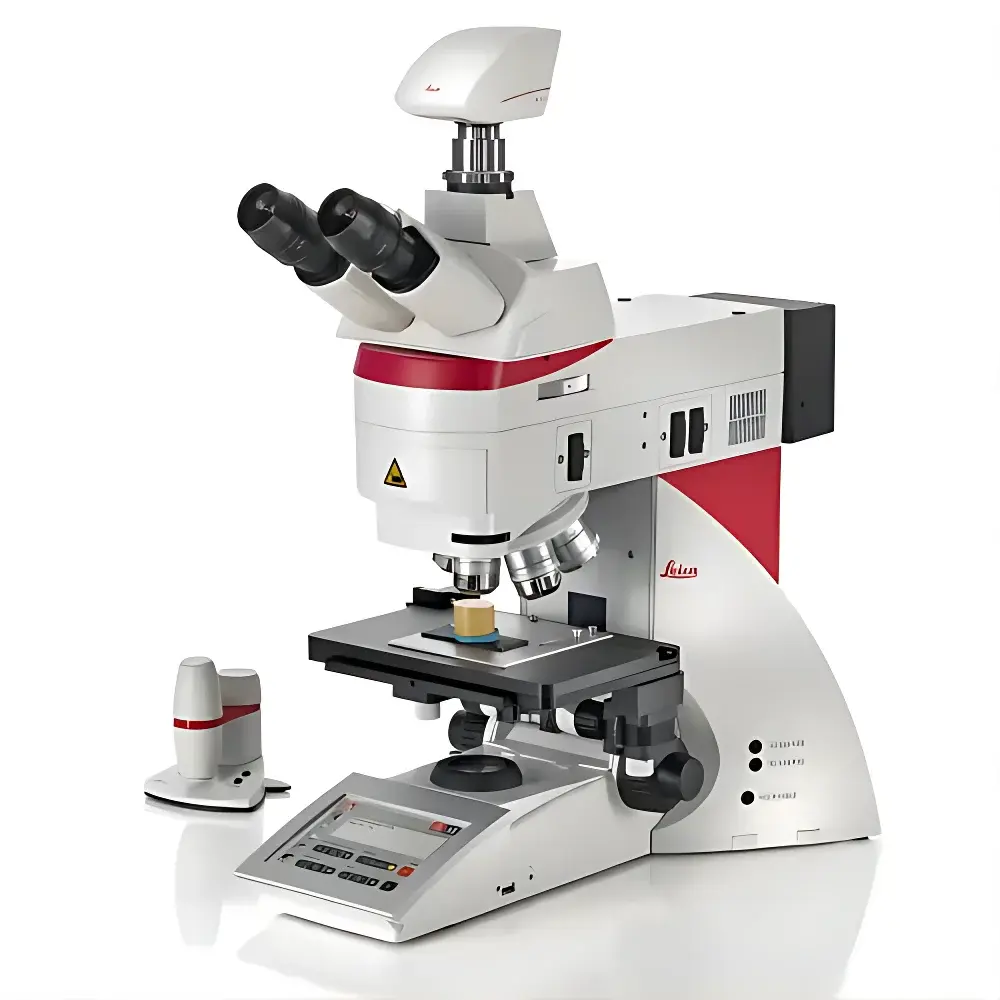
Leica DM4 M Upright Semi-Automatic Metallurgical Microscope
| Brand | Leica |
|---|---|
| Origin | Germany |
| Model | DM4 M |
| Type | Upright Metallurgical Microscope |
| Measurement Principle | Reflected Light Optical Microscopy (Not White Light Interferometry) |
| Automation Level | Semi-Automatic (Motorized Objective Turret, Motorized XY Stage, Adjustable LED Illumination) |
| Application Domain | Metallographic Structure Observation, Grain Size Analysis, Phase Identification, Failure Analysis, QC/QA in Metals & Alloys |
| Compliance | Designed for ISO 9001, ASTM E3, ASTM E112, ASTM E1245, ISO 643, ISO 10770-1, and GLP-compliant documentation workflows |
Overview
The Leica DM4 M is an upright semi-automatic metallurgical microscope engineered for routine metallographic structure observation in industrial quality control, research laboratories, and academic teaching environments. Unlike profilometers or white light interferometers — which measure surface topography quantitatively — the DM4 M operates on the principle of reflected-light optical microscopy. It utilizes Köhler illumination with high-color-rendering LED lighting and precision-corrected infinity-corrected optics to deliver high-contrast, low-aberration images of opaque, polished, and etched metallic specimens. Its upright configuration places the objective lens above the sample, enabling direct observation of bulk, sectioned, mounted, and metallographically prepared specimens without inversion or complex sample mounting constraints. This architecture aligns with standardized metallographic practice defined in ASTM E3 and ISO 643, ensuring compatibility with conventional specimen preparation workflows including cutting, hot mounting, grinding, polishing, and chemical/electrolytic etching.
Key Features
- Semi-Automatic Operation: Motorized objective turret enables precise, repeatable switching between up to 6 objectives (e.g., 5×, 10×, 20×, 50×, 100×, 150× oil); position memory ensures consistent magnification recall across sessions.
- Motorized XY Stage: High-resolution, backlash-free mechanical stage with 76 × 52 mm travel range; programmable coordinate referencing supports multi-location imaging and stitching for large-area microstructural mapping.
- Intelligent LED Illumination: Constant-luminance, temperature-stable 3W white LED with continuous intensity control (0–100%) and integrated neutral density filters; optimized for both brightfield and polarized light observation.
- Ergonomic Design: Inclined binocular tube (30° tilt), adjustable interpupillary distance (55–75 mm), and diopter compensation (±5 dpt) per eyepiece reduce operator fatigue during extended inspection sessions.
- Modular Imaging Integration: C-mount interface compatible with Leica DMC series digital cameras; supports live preview, time-lapse capture, and calibrated pixel-to-micron scaling via Leica Application Suite (LAS X) software.
- Robust Mechanical Architecture: Cast-aluminum base and rigid optical path minimize vibration sensitivity; all optical components are anti-fungal coated and sealed against dust ingress per IP20 classification.
Sample Compatibility & Compliance
The DM4 M accommodates standard metallographic specimens up to 50 mm in diameter and 40 mm in height, including hot-embedded resin blocks, vacuum-impregnated porous samples, and coated cross-sections. Its optical design complies with ISO 10770-1 for resolution verification using certified test targets and supports traceable calibration per ISO/IEC 17025 requirements when paired with NIST-traceable stage micrometers and graticules. The system meets essential requirements for GLP and GMP environments: LAS X software provides audit trails, user access levels, electronic signatures, and 21 CFR Part 11–compliant data integrity features when configured with secure network authentication and encrypted database storage.
Software & Data Management
Leica Application Suite (LAS X) serves as the native platform for image acquisition, annotation, measurement (line, area, particle count, grain size per ASTM E112), and report generation. All measurements are stored with metadata including objective magnification, illumination settings, stage coordinates, timestamp, and operator ID. Export formats include TIFF (uncompressed), JPEG2000 (lossless compression), and CSV for statistical post-processing. LAS X supports DICOM export for integration into enterprise LIMS or PACS systems. Optional modules enable automated grain boundary detection, phase fraction analysis via color thresholding, and comparative overlay of serial sections from heat-treated batches.
Applications
- Steel Microstructure Evaluation: Quantitative assessment of ferrite/pearlite ratios, martensite morphology, carbide distribution, and decarburization depth in annealed, quenched, and tempered steels per ISO 643 and ASTM E1245.
- Non-Ferrous Alloy Characterization: Identification of eutectic phases in Al-Si alloys, intermetallic precipitates in Mg-based castings, and recrystallization behavior in cold-worked Cu alloys.
- Failure Analysis: Fractography of ductile/brittle fracture surfaces, crack propagation path tracing, inclusion rating (ASTM E45), and weld zone microstructural zoning.
- Coating & Surface Treatment Inspection: Thickness estimation of thermal spray coatings, porosity analysis of PVD/CVD layers, and diffusion zone characterization in carburized or nitrided components.
- Education & Training: Standardized demonstration of ASTM E3 specimen preparation protocols and hands-on instruction in quantitative metallography fundamentals.
FAQ
Is the Leica DM4 M a profilometer or interferometric surface metrology system?
No. The DM4 M is a reflected-light metallurgical microscope. It does not perform surface topography measurement. For white light interferometry or contact profilometry, consider Leica’s DCM8 or Sensofar PLu ne systems.
Can the DM4 M be used for polarized light or differential interference contrast (DIC)?
Yes — optional polarization kits and DIC sliders are available and fully integrated into the optical train with alignment-preserving slider mechanisms.
Does the system support automated grain size analysis according to ASTM E112?
Yes, LAS X includes certified grain size analysis modules compliant with ASTM E112 Annex A1 (intercept method) and ISO 643, with customizable sensitivity thresholds and manual correction tools.
What maintenance is required for long-term optical stability?
Annual verification of Köhler illumination alignment and stage calibration is recommended; objective cleaning with lens-grade solvent and air-dusting of optical paths every 3 months maintains optimal throughput and contrast.
Is remote operation supported for lab-wide deployment?
Yes — LAS X Core Server enables centralized image management, role-based access control, and browser-based review of acquired datasets across institutional intranets.