
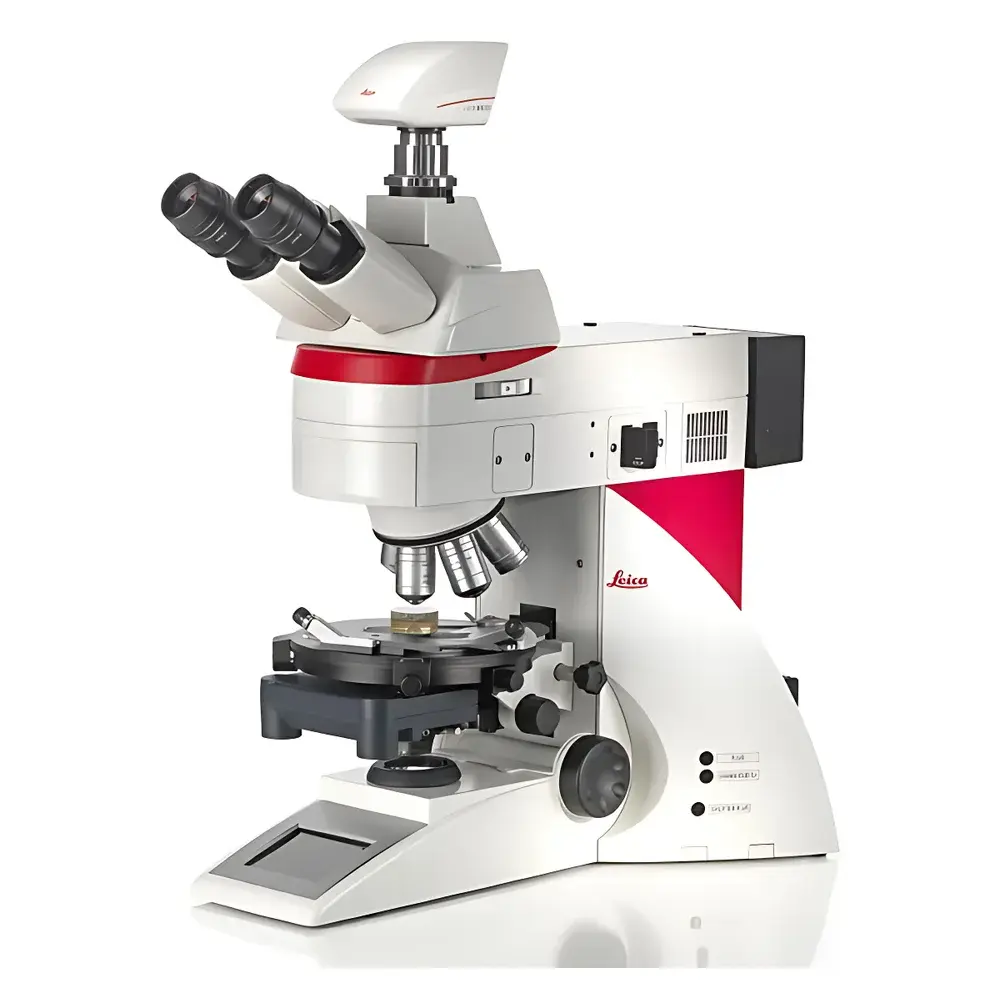
Leica DM4 P Polarizing Microscope
| Brand | Leica |
|---|---|
| Origin | Germany |
| Model | DM4 P |
| Illumination | LED (transmitted and/or incident) |
| Objective Turret | 6-position encoded |
| Field of View | 25 mm |
| Rotating Stage | 360° with optional 45° click stops |
| Polarization Components | Stress-free optics, polarizer/analyzer, Bertrand lens for conoscopic observation, fixed and variable compensators per DIN 58879 |
| Compliance | Designed for ISO/IEC 17025-compliant laboratories, supports GLP/GMP documentation workflows via encoded parameter tracking |
Overview
The Leica DM4 P is a high-precision, research-grade polarizing microscope engineered for quantitative birefringence analysis and anisotropic material characterization. Based on the fundamental principles of polarized light microscopy—where linearly polarized illumination interacts with optically anisotropic specimens to generate interference patterns—the DM4 P delivers reproducible contrast and phase-sensitive imaging across geological, pharmaceutical, polymer, and materials science applications. Its optical path is fully stress-free, eliminating intrinsic birefringence from lenses and prisms, ensuring that all observed retardation originates solely from the specimen. The system integrates transmitted and incident illumination pathways, enabling dual-mode operation critical for heterogeneous samples such as polished ore sections (reflected light) and mineral thin sections or polymer films (transmitted light). Designed and manufactured in Wetzlar, Germany, the DM4 P conforms to stringent optical engineering standards and supports traceable, auditable workflows required in regulated environments.
Key Features
- 6-position encoded objective turret with automatic parameter recognition—ensures precise magnification calibration and seamless recall of illumination intensity, aperture settings, and contrast configurations per objective
- 25 mm field-of-view eyepieces for rapid macrostructural assessment—ideal for identifying flow textures, deformation bands, crystallization zones, or thermal gradient-induced banding in bulk samples
- Dual-illumination capability: Independently switchable or simultaneously operable LED-based transmitted and incident light paths, each with stable color temperature (5700 K) and intensity control
- 360° precision rotating stage with optional 45° detent positions—enables accurate crystallographic orientation alignment and azimuthal scanning for extinction angle measurement
- Integrated Bertrand lens for conoscopic observation—supports uniaxial and biaxial optic axis determination, sign of elongation, and interference figure analysis
- Comprehensive polarization suite: Linear polarizer and analyzer with fine rotational control, DIN 58879-compliant fixed (e.g., λ-plate, quartz wedge) and variable compensators for quantitative retardation measurement
- Real-time LED status indicator and encoded polarization module recognition—guarantees consistent setup reproducibility across multiple users and sessions
Sample Compatibility & Compliance
The Leica DM4 P accommodates standard 26 mm and 32 mm diameter thin sections, metallurgical mounts, polymer films, pharmaceutical tablets, and fiber specimens without modification. Its modular design allows configuration for both cover-slip-corrected and cover-slip-free objectives (≥10×), accommodating diverse sample thicknesses and mounting media. All optical components are certified stress-free per DIN EN ISO 10110-7, minimizing background birefringence to <1 nm path difference. The system supports compliance with ASTM D4123 (birefringence of plastics), ISO 10477 (optical mineralogy), and USP <1229> (microscopic evaluation of pharmaceutical excipients). Encoded hardware events—including turret position, polarizer angle, and compensator insertion—are logged with timestamps, facilitating audit-ready records aligned with FDA 21 CFR Part 11 and ISO/IEC 17025 requirements.
Software & Data Management
When paired with Leica Application Suite X (LAS X) software, the DM4 P enables full parameter synchronization: objective magnification, polarizer/analyzer angles, compensator type, and illumination mode are automatically embedded into image metadata. LAS X supports GLP-compliant annotation, region-of-interest (ROI) based retardation profiling, and batch export of calibrated interferograms. All hardware-triggered events are recorded in a tamper-evident log file, including user ID, timestamp, and configuration state—essential for multi-user labs and quality control environments subject to internal or external audits. Export formats include TIFF (with EXIF tags), CSV (for retardation vs. rotation angle), and PDF reports compliant with laboratory information management systems (LIMS).
Applications
- Geological petrography: Identification of mineral assemblages, determination of optic sign and axial angle in unknown crystals, and strain analysis in deformed rocks
- Pharmaceutical solid-state characterization: Detection of polymorphic forms, hydrate/anhydrate differentiation, and crystallinity assessment in active pharmaceutical ingredients (APIs)
- Materials science: Evaluation of residual stress in injection-molded thermoplastics, liquid crystal domain orientation, and fiber birefringence in composites
- Forensic fiber analysis: Discrimination of synthetic fibers by retardation magnitude, dispersion staining, and interference color mapping
- Metallurgy: Observation of grain boundary birefringence in etched alloys and phase transformation kinetics under controlled thermal stages
FAQ
Does the DM4 P support both transmitted and reflected light polarization simultaneously?
Yes—the optical design permits concurrent use of transmitted and incident LED illumination, with dedicated beam splitters and aperture routing to maintain polarization integrity in both paths.
Is the rotating stage motorized or manually operated?
The standard stage is manually rotated with precision vernier scale and optional 45° mechanical detents; motorized rotation is available via optional Leica STP stage controller with programmable angular increments.
Can the encoded turret store custom illumination presets for each objective?
Yes—LAS X software links specific illumination intensity, condenser aperture, and contrast settings to each objective position, recalled automatically upon turret rotation.
What compensators are included by default?
The base configuration includes a fixed first-order red (λ) plate and a quartz wedge compensator; additional options include gypsum, mica, and brine plates per DIN 58879 specifications.
Is the DM4 P compatible with third-party digital cameras?
All Leica DMC and DFC series cameras interface natively; non-Leica C-mount cameras may be used with appropriate adapters but will not support hardware-encoded parameter embedding in image metadata.





