
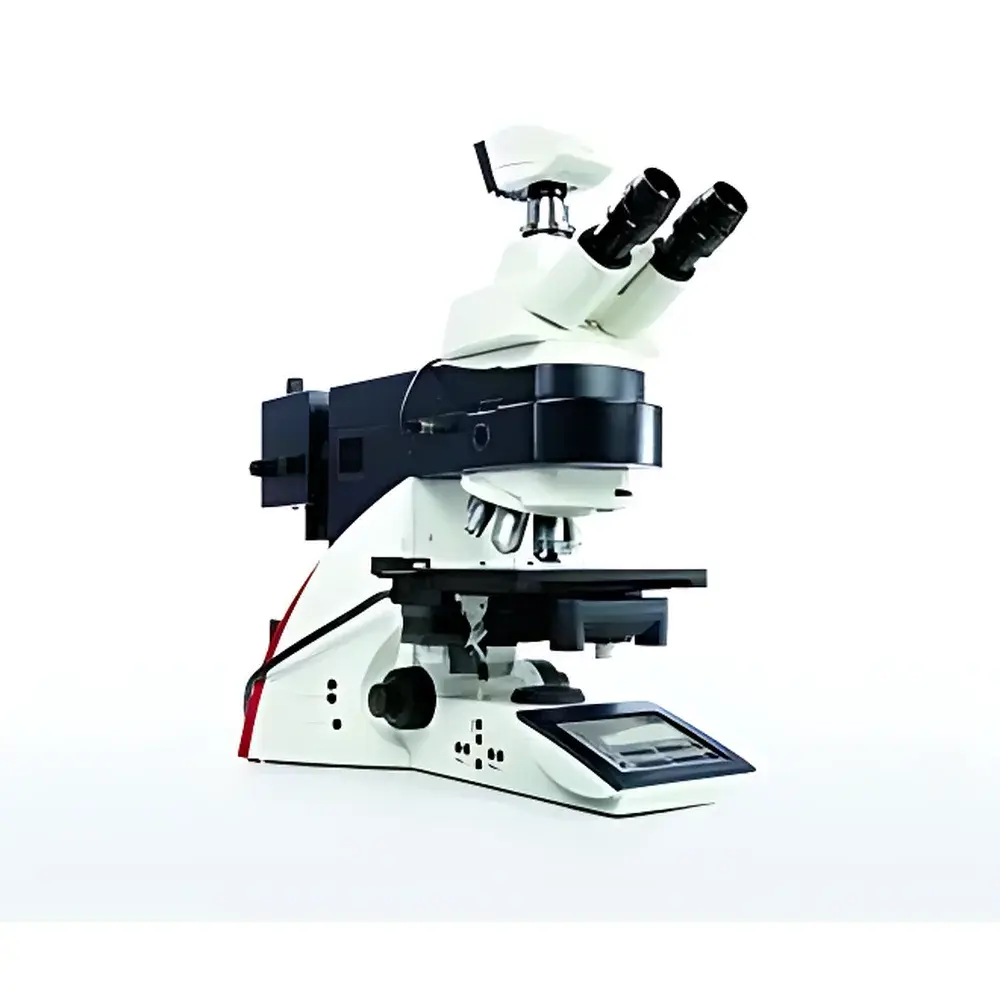
Leica DM6000 B Motorized Upright Microscope
| Brand | Leica |
|---|---|
| Origin | Germany |
| Model | DM6000 B |
| Type | Upright Microscope |
| Optical Configuration | Motorized Z-axis Focus, Encoded 7-Position Objective Turret, Fully Automated DIC, 5× or 8× Fluorescence Filter Changer |
| Illumination | CCIC (Constant Color and Intensity Control) Halogen Light Source |
| Software Integration | LAS / LAS AF |
| Compliance | Designed for GLP/GMP-aligned workflows, supports audit-trail-capable imaging sessions per FDA 21 CFR Part 11 requirements when used with validated LAS AF configurations |
Overview
The Leica DM6000 B is a high-precision motorized upright microscope engineered for demanding life science applications requiring reproducible, quantitative optical imaging across brightfield, differential interference contrast (DIC), and fluorescence modalities. Built upon Leica’s proven modular optical platform, it implements Couette-flow-aligned Köhler illumination geometry and precision-machined mechanical stages to ensure optical stability during extended time-lapse or multi-position acquisitions. Its core measurement principle relies on high-fidelity beam path alignment—enabled by encoded objective turrets and motorized focus—ensuring that magnification, numerical aperture, and contrast method parameters are intrinsically linked to each optical configuration. This architecture eliminates manual re-alignment drift and enables strict adherence to standardized imaging protocols required in regulatory environments such as ISO 13485–certified IVD development or USP microscopy validation.
Key Features
- Motorized Z-axis drive with sub-micron repeatability (±0.1 µm step resolution), enabling automated focus mapping, Z-stack acquisition, and focal plane memory recall across multiple objectives.
- Encoded 7-position objective turret with automatic registration of optical parameters—including magnification, NA, working distance, and correction collar settings—ensuring DIC bias and fluorescence excitation/emission alignment remain consistent per objective.
- World’s first fully automated DIC system: motorized Wollaston prisms, polarizer/analyzer rotation, and bias compensation are synchronized in real time; DIC contrast optimization is stored per objective and recalled instantly upon turret rotation.
- 5× or 8× motorized fluorescence filter changer with spectral calibration traceability; integrated shutter control and intensity modulation synchronized with exposure timing in LAS AF.
- CCIC (Constant Color and Intensity Control) halogen illumination: maintains stable color temperature (±50 K) and luminous flux (±2%) across voltage fluctuations, eliminating manual white-balance recalibration during long-duration experiments.
- SmartTouch touchscreen interface with context-aware GUI: all hardware states—including DIC settings, fluorescence filters, focus position, and illumination intensity—are saved as named protocols and recalled with one tap.
Sample Compatibility & Compliance
The DM6000 B accommodates standard glass slides (1–3 mm thickness), petri dishes (35–100 mm), multi-well plates (6–96-well), and live-cell chambers (e.g., Tokai Hit stage-top incubators). Its mechanical stage supports XYZ motorization (optional) with 130 × 85 mm travel range and 0.1 µm positional resolution. All optical components comply with ISO 8578 (microscope terminology) and DIN EN 61000-6-3 (EMC immunity). When operated with LAS AF v3.3+ under documented SOPs, the system meets data integrity requirements outlined in FDA 21 CFR Part 11 for electronic records and signatures—including user authentication, audit trail logging, and immutable image metadata embedding (EXIF + custom XML).
Software & Data Management
Control and acquisition are managed through Leica Application Suite (LAS) and LAS Advanced Fluorescence (LAS AF), both compliant with Windows 10/11 LTSB editions. LAS AF provides multi-channel time-lapse scheduling, Z-stack deconvolution (via Huygens integration), and region-of-interest (ROI) based intensity quantification with background subtraction algorithms traceable to NIST SRM 2197 reference standards. Raw image data is saved in Leica’s proprietary .lif format (lossless TIFF-based container) with embedded calibration metadata—including objective ID, DIC bias offset, exposure time, and lamp hours—enabling full experimental reproducibility. Export options include OME-TIFF for FAIR-compliant data sharing and direct import into ImageJ/Fiji, Imaris, or MATLAB via documented APIs.
Applications
- Quantitative histopathology: automated DIC-based fiber orientation analysis in collagen-rich tissues (e.g., tendon, cornea) with reproducible contrast normalization across batches.
- Live-cell dynamics: long-term phase-DIC imaging of mitotic progression in adherent mammalian cultures under environmental control, with focus drift correction enabled by Z-axis memory mapping.
- Fluorescence co-localization studies: precise spectral unmixing across 5–8 channels using motorized filter synchronization and intensity-stabilized illumination.
- GMP-compliant QC microscopy: routine inspection of sterile filtration membranes or bioreactor harvest samples per USP and , supported by audit-trail-enabled session logs.
- Academic core facility use: shared-resource deployment with user-profile-based permission tiers, protocol locking, and instrument usage billing integration via optional Leica Lab Manager module.
FAQ
Does the DM6000 B support objective lens auto-recognition without manual calibration?
Yes—the encoded turret communicates lens-specific parameters (focal length, NA, correction collar range) directly to the microscope controller, eliminating manual setup per objective.
Can DIC bias positions be exported or backed up between instruments?
Yes—DIC calibration files (.dicconf) are stored in LAS AF project folders and can be transferred to other DM6000 B systems running identical firmware versions.
Is CCIC compatible with LED illumination upgrades?
No—CCIC is designed exclusively for 12 V/100 W halogen lamps; LED retrofit kits (e.g., Leica LED3000 RL) use separate intensity stabilization circuitry and do not implement CCIC.
What level of software validation support is provided for regulated environments?
Leica offers IQ/OQ documentation packages for LAS AF, including test scripts, acceptance criteria, and traceability matrices aligned with GAMP5; full CSV requires site-specific risk assessment and configuration management.
How is focus drift compensated during extended time-lapse imaging?
Via the motorized Z-axis’s “Auto Focus” function, which uses contrast-based autofocus at user-defined intervals or leverages the optional Leica Adaptive Focus Control (AFC) infrared sensor for continuous thermal-drift correction.




