
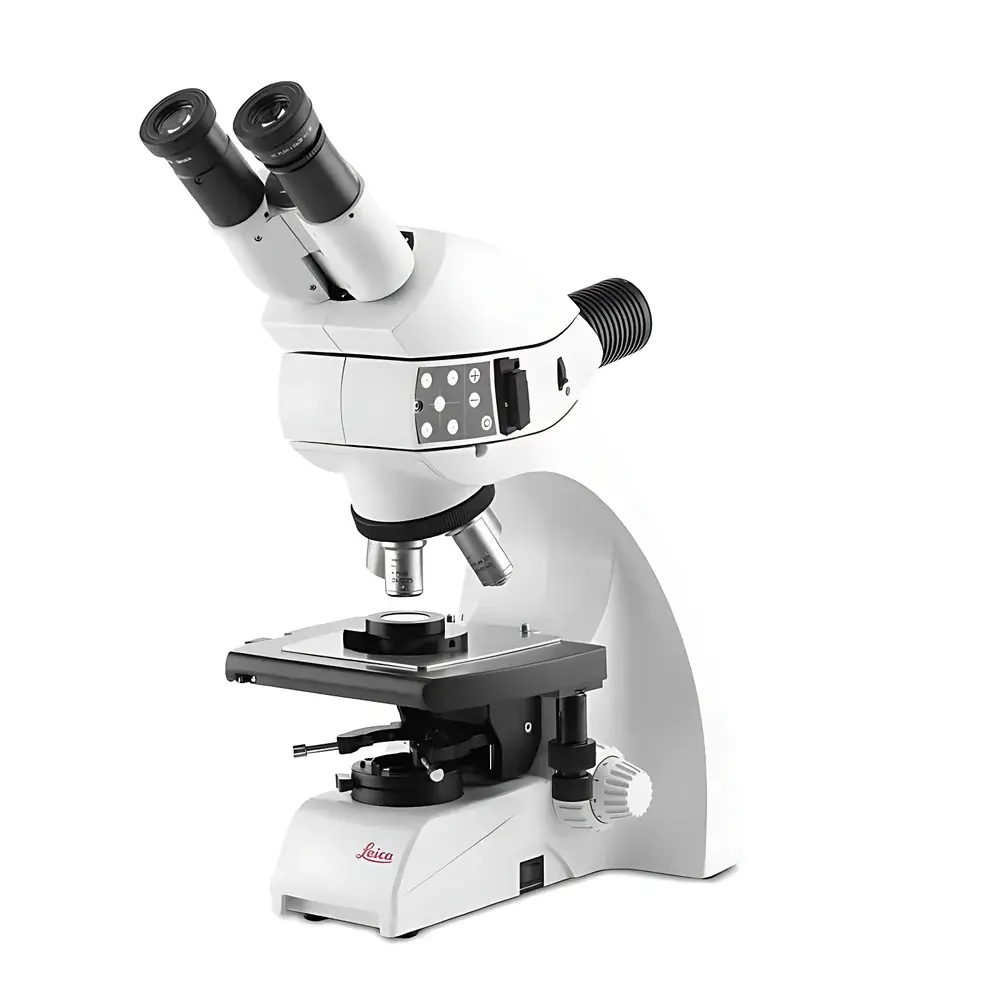
Leica DM750M Upright Microscope
| Brand | Leica |
|---|---|
| Origin | Germany |
| Model | DM750M |
| Instrument Type | Upright Microscope |
| Illumination | White LED (Transmitted & Reflected Light) |
| Magnification Range | 50×–1000× |
| Objective Turret | 4-position or 5-position |
| Condenser | Adjustable Abbe condenser for transmitted light |
| Reflected Light Module | LED-based with field diaphragm and aperture diaphragm |
| Stage | Mechanical XY stage with 25–30 mm specimen clamp compatibility |
| Eyepieces | 10× widefield (20 mm field number), optional ergonomic viewing tubes (four configurations) |
| Digital Imaging | Compatible with Leica ICC50 HD, DMC2900, and other Leica-certified CMOS/CCD cameras |
Overview
The Leica DM750M is a robust, modular upright microscope engineered for routine and advanced optical inspection in materials science laboratories, quality control environments, and industrial R&D settings. Unlike inverted or specialized live-cell systems, the DM750M employs conventional Köhler illumination geometry optimized for high-contrast, artifact-free imaging of opaque, semi-transparent, and polished specimens. Its dual-path optical architecture supports both transmitted-light brightfield (via Abbe condenser) and reflected-light illumination (via integrated LED module), enabling seamless transition between metallurgical, ceramic, polymer, and thin-film sample analysis without reconfiguration. The system’s mechanical stability—achieved through a rigid cast-metal stand, precision-ground optical rails, and vibration-damped base—ensures long-term alignment integrity under continuous operation. Designed for compliance with ISO 9001-aligned laboratory workflows, the DM750M delivers repeatable image acquisition across shifts and operators, making it suitable for documentation in GLP-compliant reporting and internal audit trails.
Key Features
- White LED illumination system (6,500 K CCT) delivering uniform, flicker-free output for both transmitted and reflected light paths; rated for >20,000 hours lifetime with no spectral drift or intensity decay.
- Modular reflected-light illuminator with adjustable field and aperture diaphragms, supporting brightfield, polarized light, and oblique illumination modes via mechanical filter sliders and rotatable analyzer.
- 4-position or 5-position objective turret accommodating Leica PlanApo, HC PL Fluotar, and EC Epiplan objectives (5× to 100×), enabling total magnifications from 50× to 1000× with parfocal and parcentric alignment.
- Universal mechanical stage with 76 × 52 mm travel range, calibrated vernier scales, and interchangeable clamps (25 mm and 30 mm diameter variants) for secure mounting of discs, wafers, cross-sections, and irregularly shaped samples.
- Ergonomic observation tube options: binocular inclined (30°), trinocular (photo port enabled), ergonomic tilting (up to 45°), and high-eyepoint widefield configuration—each compatible with 10×/20 mm FN eyepieces and diopter adjustment.
- Optical path designed for Leica-certified digital imaging: native C-mount interface, real-time HDMI output (1080p), and full integration with Leica Application Suite (LAS X) for annotation, measurement, and multi-channel Z-stack capture.
Sample Compatibility & Compliance
The DM750M accommodates a broad spectrum of solid-state specimens—including metallographic mounts, semiconductor wafers, printed circuit boards, geological thin sections, coated substrates, and composite laminates—without requiring immersion media or vacuum environments. Its large working distance objectives (e.g., 5× and 10× EC Epiplan) permit imaging of samples up to 35 mm in height. The system conforms to IEC 61000-6-3 (EMC emissions) and IEC 61000-6-2 (immunity) standards. While not FDA-cleared (as it is non-diagnostic), its documentation structure supports 21 CFR Part 11 readiness when paired with LAS X software configured for electronic signatures and audit logging. Routine calibration protocols align with ASTM E1558 (metallographic imaging) and ISO 4037-3 (radiation-hardened component inspection support).
Software & Data Management
Leica LAS X Core provides native driver-level control of focus drive (optional motorization), illumination intensity, camera exposure, and stage positioning. Image metadata—including objective ID, magnification, illumination mode, timestamp, and operator ID—is embedded in TIFF and JPEG files per EXIF 2.31 specification. Batch acquisition workflows support automated mosaic stitching (up to 100×100 tile grids), particle counting (ISO 13322-2 compliant thresholding), and grain size analysis (ASTM E112). All raw data is stored in vendor-neutral formats; LAS X export modules generate PDF reports with embedded hyperlinked thumbnails and traceable calibration certificates.
Applications
- Metallurgical failure analysis: phase identification, inclusion rating (ASTM E45), grain boundary delineation, and heat-affected zone characterization.
- Semiconductor QA: wafer defect mapping, bond pad inspection, solder mask registration verification, and delamination detection in stacked die assemblies.
- Advanced materials R&D: carbon fiber weave analysis, thermal barrier coating porosity quantification, and additive manufacturing layer fusion assessment.
- Geological core logging: mineralogical discrimination in polished sections, pore network morphology, and fluid inclusion sizing.
- Academic teaching labs: comparative microstructure studies across alloy families, polymer crystallinity demonstration, and corrosion mechanism visualization.
FAQ
Is the DM750M suitable for fluorescence imaging?
No—the standard DM750M lacks excitation filter cubes, dichroic mirrors, and high-sensitivity emission optics required for epifluorescence. For fluorescence applications, consider the Leica DM6 M or DM2700 M platforms.
Can the mechanical stage be upgraded to motorized XYZ control?
Yes—Leica offers the Motorized Stage Controller (MSC) module with programmable coordinates, homing sensors, and TTL-triggered synchronization with camera acquisition.
Does the system support DIC or differential interference contrast?
Not natively—the DM750M optical train does not include Nomarski prisms or strain-free objectives required for DIC. This capability is available on the DM6000 M and DM2500 M series.
What is the maximum specimen thickness supported under reflected light?
With the 5× EC Epiplan objective (WD = 18.5 mm), specimens up to 35 mm tall can be accommodated using the extended-height stage insert kit (Leica part no. 11506365).
Are calibration certificates included with purchase?
A factory-issued optical alignment certificate (covering focus parfocality, stage linearity, and illumination uniformity) is provided. NIST-traceable calibration services are available through Leica-certified service centers upon request.





